A historical trip from 1991 to Present Day America.
By Google and Gemini
The Wind, the Hammer, and the Mirror: Tracing the 30-Year Transmutation of the Unipolar Moment
In October 2007, retired U.S. Army General and former NATO Supreme Allied Commander Wesley Clark stood before an audience at the Commonwealth Club of California and disclosed one of the most sobering revelations in modern strategic history. Weeks after September 11, 2001, Clark recounted, he visited the Pentagon and was shown a classified memorandum originating from the Office of the Secretary of Defense. The memo outlined an astonishing five-year military campaign: the United States was going to systematically attack and overthrow the governments of seven nations—starting with Iraq, and moving sequentially to Syria, Lebanon, Libya, Somalia, Sudan, and culminating in Iran.
It did not take five years. It took over three decades.
Yet, looking across the wreckage of the modern geopolitical landscape, an inescapable reality emerges: every single one of those seven nations has since been invaded, subjected to airstrikes, shattered by covert proxy wars, crippled by economic embargoes, or pushed to varying degrees of state collapse. Iraq was brought to ruin by invasion and civil bloodletting; Syria was turned into a fractured proxy battlefield culminating in the historic collapse of the Assad regime in December 2024; Libya remains a partitioned wasteland after the 2011 NATO intervention; Lebanon’s financial, political, and physical infrastructure has been systematically degraded; Somalia has endured continuous aerial bombardments and internal conflict; Sudan has collapsed into catastrophic civil war; and Iran remains besieged by economic siege warfare and regional confrontation.
What General Clark brought into public view almost two decades ago was not a spontaneous wartime reaction to 9/11. It was the operational execution of a doctrine formulated decades earlier. This essay traces how a strategy openly written, debated, and refined inside the defense establishment—yet almost entirely obscured from the public consciousness—shaped thirty-five years of the American experience, charting the fateful trajectory from unipolar triumphalism to the very multipolar reality it sought to prevent.
In August 1989, a West German rock band named the Scorpions performed at the Moscow Music Peace Festival. Inspired by the sudden thaw in the Cold War, lead singer Klaus Meine penned a power ballad that would become the global soundtrack for an era:
Down to Gorky Park
Listening to the wind of change…"
When the Berlin Wall fell months later, followed by the formal dissolution of the Soviet Union in 1991, the world breathed a collective sigh of relief. The "Wind of Change" promised a peaceful, integrated global village.
But inside the windowless corridors of the Pentagon, a small group of defense intellectuals heard something else in that wind: the sound of a strategic vacuum. To them, the collapse of the Soviet Union was not an invitation to collect a "peace dividend" or disarm. It was a fleeting, historic unipolar moment—a strategic window of absolute American dominance that had to be aggressively locked into place before another peer competitor could rise to challenge it.
In May 1991, fresh off the overwhelming conventional triumph of Operation Desert Storm, Wesley Clark walked into the Pentagon. He was there to see his old boss, Chairman of the Joint Chiefs of Staff Colin Powell.
As Clark recalled in later retrospectives—including his landmark address archived on the Commonwealth Club Event Page—Powell was already looking toward a dramatically altered future. Powell told Clark that the U.S. military would have to downsize substantially, adapting to a world without a Soviet threat.
Seeking a second perspective, Clark walked up to the third floor to see Paul Wolfowitz, then serving as the Under Secretary of Defense for Policy under Dick Cheney. Clark congratulated him on the liberation of Kuwait, but Wolfowitz was visibly frustrated.
"We should have cleared up Saddam Hussein," Wolfowitz remarked.
Then, he laid bare the foundational thesis of what would become modern neoconservatism. Wolfowitz explained to Clark that the U.S. had learned a profound lesson in the Gulf: the military could now operate in the Middle East with total impunity. The Soviets would not intervene. Wolfowitz explicitly told the one-star general:
The Overton Window of American foreign policy had just violently shifted. The defensive containment strategy of the Cold War was dead. Unilateral, preemptive regime change was born.
Wolfowitz immediately set to work codifying this conversation into official military doctrine. He tasked his top aides—I. Lewis "Scooter" Libby and Zalmay Khalilzad—with drafting the Defense Planning Guidance (DPG) for FY 1994–1999.
This internal document reimagined the role of U.S. Central Command (CENTCOM). Historically, CENTCOM was a tripwire designed to prevent a Soviet tank army from seizing the oil fields of Iran and the Persian Gulf. In the new draft DPG, CENTCOM’s mission shifted from defense against an equal rival to unilateral hegemony. The region's vast oil reserves were deemed a vital U.S. interest that Washington must secure by policing regional revisionist states like Iraq and Iran, completely bypassing international law if necessary.
The draft laid out three radical pillars:
- Preventing Peer Competitors: The supreme goal of U.S. policy must be to prevent any hostile power from dominating any region whose resources would suffice to generate global power.
- Unilateralism: The U.S. should act through ad-hoc coalitions, but must retain the right to act entirely alone.
- Preemption: Destabilizing threats had to be neutralized before they could mature.
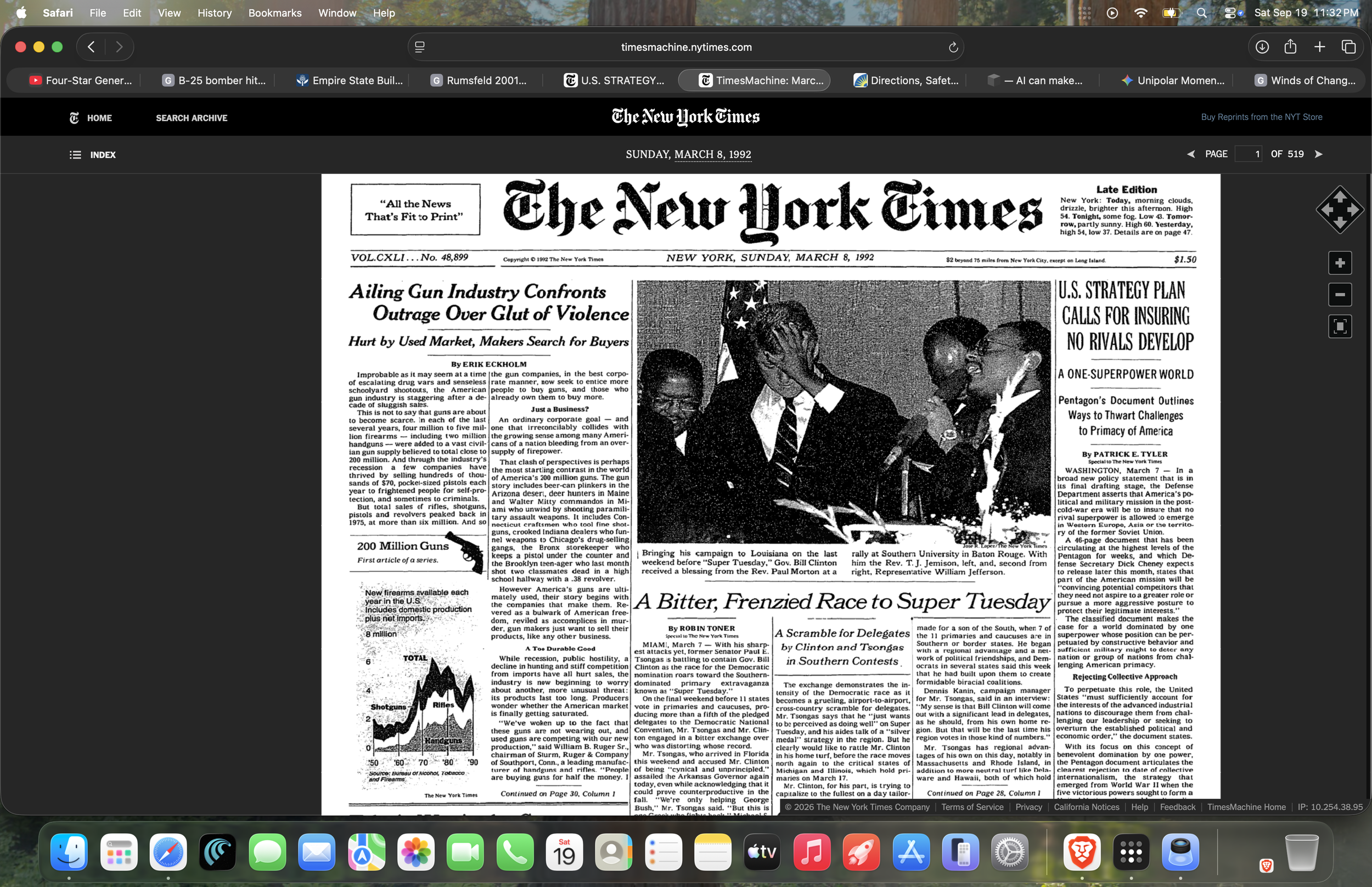
The strategy was so stark, so nakedly imperial, that when it was leaked to the New York Times in March 1992, it triggered a massive geopolitical scandal. President George H.W. Bush, facing a tough re-election campaign, ordered Dick Cheney to heavily sanitize the final public version. Months later, Bill Clinton won the presidency. Wolfowitz, Cheney, and their ideological circle were exiled from the executive branch.
Finding themselves locked out of power in Washington, this network of theorists shifted their focus to a different capital: Jerusalem.
In 1996, a conservative think-tank called the Institute for Advanced Strategic and Political Studies assembled a study group led by Richard Perle (the formidable Cold War hawk known as the "Prince of Darkness") and David Wurmser. They were perfectly positioned to advise the incoming, hawkish Israeli Prime Minister, Benjamin Netanyahu.
They took the macro-level, global imperial logic of the 1992 Wolfowitz Doctrine and hijacked it into a localized, aggressive regional blueprint. The result was A Clean Break: A New Strategy for Securing the Realm.
The report advised Netanyahu to completely abandon the Oslo Accords ("land for peace") and instead reshape Israel’s strategic environment through aggressive power projection. The "Clean Break" authors realized that the U.S. Wolfowitz Doctrine could be used as a vehicle for Israeli security. They argued that the entire Middle East was an interconnected axis of adversaries, and they identified the exact first domino to tip:
By removing Saddam, they argued, they could sever the supply lines between Iran and Hezbollah in Lebanon, effectively neutralizing all of Israel's regional rivals in one fell swoop.
The "Clean Break" was the bridge. In 1997, the group returned to Washington and formalized this merger of global American supremacy and Middle Eastern regime change by founding the Project for the New American Century (PNAC).
The founders read like a roll call of the 1992 Pentagon staff and the 1996 Clean Break study group: Dick Cheney, Paul Wolfowitz, Donald Rumsfeld, Richard Perle, Scooter Libby, and David Wurmser. In their landmark September 2000 blueprint, Rebuilding America's Defenses, they resurrected the unedited, raw language of the 1992 Wolfowitz Doctrine.
They lamented that the American public lacked the stomach for the massive military expenditures and unilateral interventions required to enforce this new world order. They wrote a chillingly prophetic sentence: they noted that the process of transforming America's military and projecting this power would likely take a long time, "absent some catastrophic and catalyzing event—like a new Pearl Harbor."
One year later, on September 11, 2001, the planes hit the towers. The Overton Window did not just shift; it was blown entirely off its hinges. The architects of the Wolfowitz Doctrine, the Clean Break, and PNAC were now sitting in the highest seats of power in the Bush administration.
When Wesley Clark walked into the Pentagon in November 2001, the 5-to-10-year window Wolfowitz had mused about in 1991 was closing. The memo detailing a five-year plan to take out seven countries—Iraq, Syria, Lebanon, Libya, Somalia, Sudan, and Iran—was simply the final execution phase of a script that had been meticulously drafted while the rest of the world was still singing along to the "Wind of Change."
When Richard Perle, Douglas Feith, and David Wurmser authored the Clean Break Report in 1996, they faced a unique tactical puzzle: Syria was a fortress. Unlike a heavily sanctioned Iraq, Syria was tightly unified under the autocratic rule of Hafez al-Assad (and later his son, Bashar al-Assad). A direct U.S. or Israeli invasion was politically unviable.
The report's breakthrough was recommending that Syria should not be fought through conventional warfare, but through asymmetric attrition.
- The Proxy Playbook: The document explicitly advocated for "paralleling Syria's behavior by establishing the precedent that Syrian territory is not immune to attacks emanating from Lebanon by Israeli proxy forces." The goal was to trap Damascus in a multi-front proxy war.
- The Domino Strategy: They calculated that Syria's regional influence was anchored in Iraq and Lebanon. By toppling Saddam Hussein in Baghdad, the West could completely sever Syria's land bridge to Iran, isolate Hezbollah in Beirut, and force the Syrian economy into absolute dependence on vulnerable domestic resources.
By the time the Arab Spring erupted in 2011, the underlying logic of the Clean Break report became the operational guide. Instead of standard diplomacy, Western and regional powers quickly funneled billions in weapons and funding to heterogeneous rebel proxies. The result was the total fracturing of the Syrian state, a devastating civil war, and the eventual historic collapse of the Assad regime in December 2024.
To turn the theoretical roadmap of the Wolfowitz Doctrine, the Clean Break report, and PNAC into an active war, the architects needed to control the flow of classified data. In 2001, the traditional intelligence apparatus (the CIA and Defense Intelligence Agency) was pushing back, consistently finding no evidence that Iraq possessed operational WMDs or had an operational alliance with Al-Qaeda.
To bypass this hurdle, Deputy Defense Secretary Paul Wolfowitz and Undersecretary of Defense for Policy Douglas Feith executed a brilliant bureaucratic maneuver: they established a shadow entity inside the Pentagon called the Counter Terrorism Evaluation Unit, which was formally expanded into the Office of Special Plans (OSP) in September 2002.
The OSP functioned as an ideological filtration system:
- Stovepiping: The OSP took raw, unvetted field reports and passed them directly to Donald Rumsfeld and Vice President Dick Cheney, deliberately stripping away the caveats and warnings appended by career CIA analysts.
- The INC Connection: The OSP worked hand-in-hand with Ahmad Chalabi's Iraqi National Congress (INC). The INC routinely funneled highly paid Iraqi defectors to the OSP, who fabricated stories about hidden nuclear laboratories and mobile bio-weapon trailers.
- Placing the Hawks: While Richard Perle remained technically off the official government payroll to avoid congressional scrutiny, he was appointed Chairman of the Defense Policy Board, an influential advisory body. From this perch, Perle served as the public intellectual engine for the OSP, while Feith and William Luti managed its daily operations.
The OSP successfully manufactured the public consent and administrative momentum required to launch the 2003 invasion of Iraq.
The 30-year stretch versus the original "5-year plan" captures the core paradox of geopolitical overreach. When Paul Wolfowitz looked at the map in 1991, he viewed the Middle East as a collection of static, isolated Soviet client states that could be tidied up in a swift administrative window.
Instead, the neoconservative project triggered a chaotic chain reaction. Invading Iraq didn't create a compliant democratic domino effect; it shattered the regional balance of power. It created a security vacuum that sparked civil wars, fueled transnational insurgencies, and paradoxically allowed Iran to expand its influence deeply into the Levant. The plan didn't take 5 years because human societies and geography resist rigid bureaucratic timelines.
By the time the United States had spent trillions of dollars and decades of strategic bandwidth policing the wreckage of these nations, Wolfowitz's original 1991 prophecy came true in an ironic way. Because the United States was entirely preoccupied with micro-managing regime changes, China spent those three decades focusing on rapid industrialization, domestic infrastructure, and global economic integration.
Today, a near-peer competitor has officially arrived. But instead of arriving with tanks and strategic bombers to challenge America conventionally, Beijing has used its immense financial leverage. China has successfully brokered historic diplomatic rapprochements (such as the Saudi-Iran detente), secured critical mineral pipelines, and integrated the economies of the Global South via the Belt and Road Initiative.
The 10-year window Wolfowitz discussed with Clark was not a metaphor—it was a real window. But by treating every regional problem as a nail to be solved by an American hammer, the neoconservative movement ultimately shattered the very unipolar world order they were trying to immortalize.
The convergence of interests between Israel and China provides a missing link to understanding the 30-year post-Cold War timeline. While Washington viewed the Middle East through an ideological lens of democratic transformation, both Jerusalem and Beijing operated under cold, transactional realism.
This relationship forms a strategic triangle: the United States spent three decades bogged down in regional conflicts, inadvertently creating geopolitical opportunities that both Israel and China capitalized on.
The disruption of the Middle East outlined in the Wolfowitz Doctrine and the Clean Break report eliminated conventional military threats to Israel. The collapse of Iraq's Ba'athist army in 2003, the multi-front proxy war that fractured Syria, and the collapse of the Assad regime structurally dismantled the major conventional state militaries on Israel's borders.
Rather than creating a Western-aligned democratic sphere, this disruption created fragmented, weak states. This dynamic allowed Israel to maintain a decisive military advantage while shifting its economic focus toward becoming a global high-tech exporter.
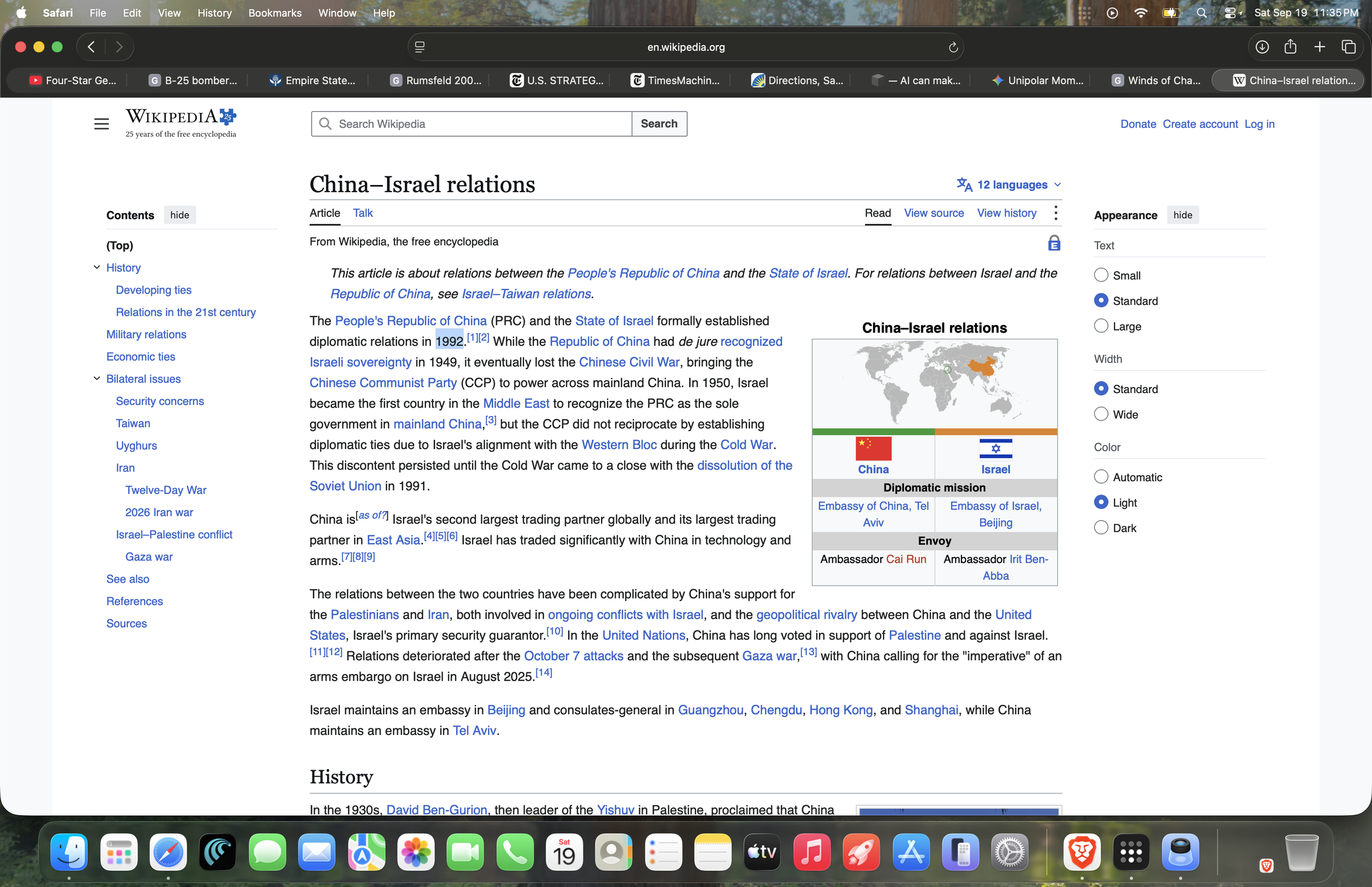
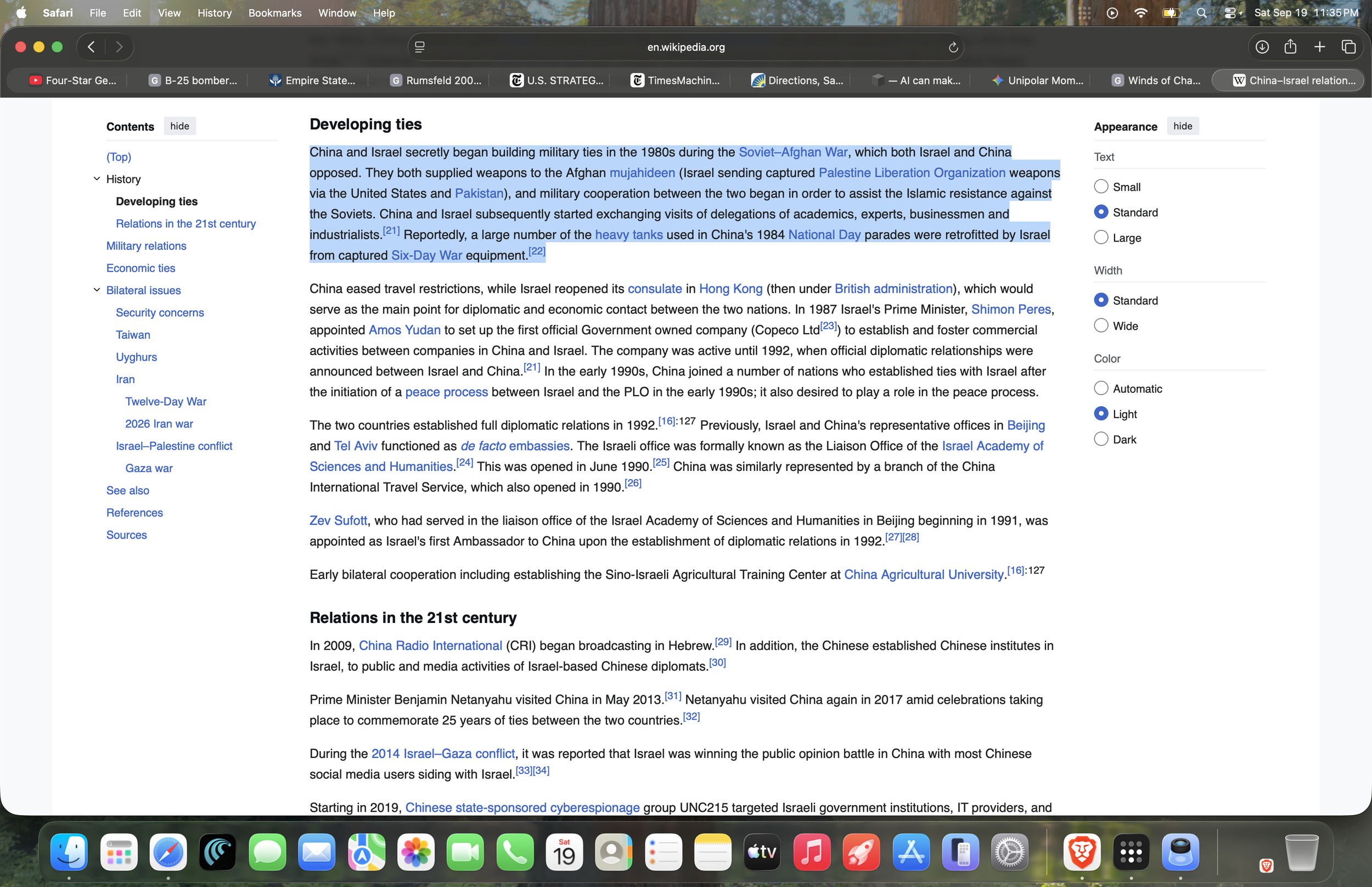
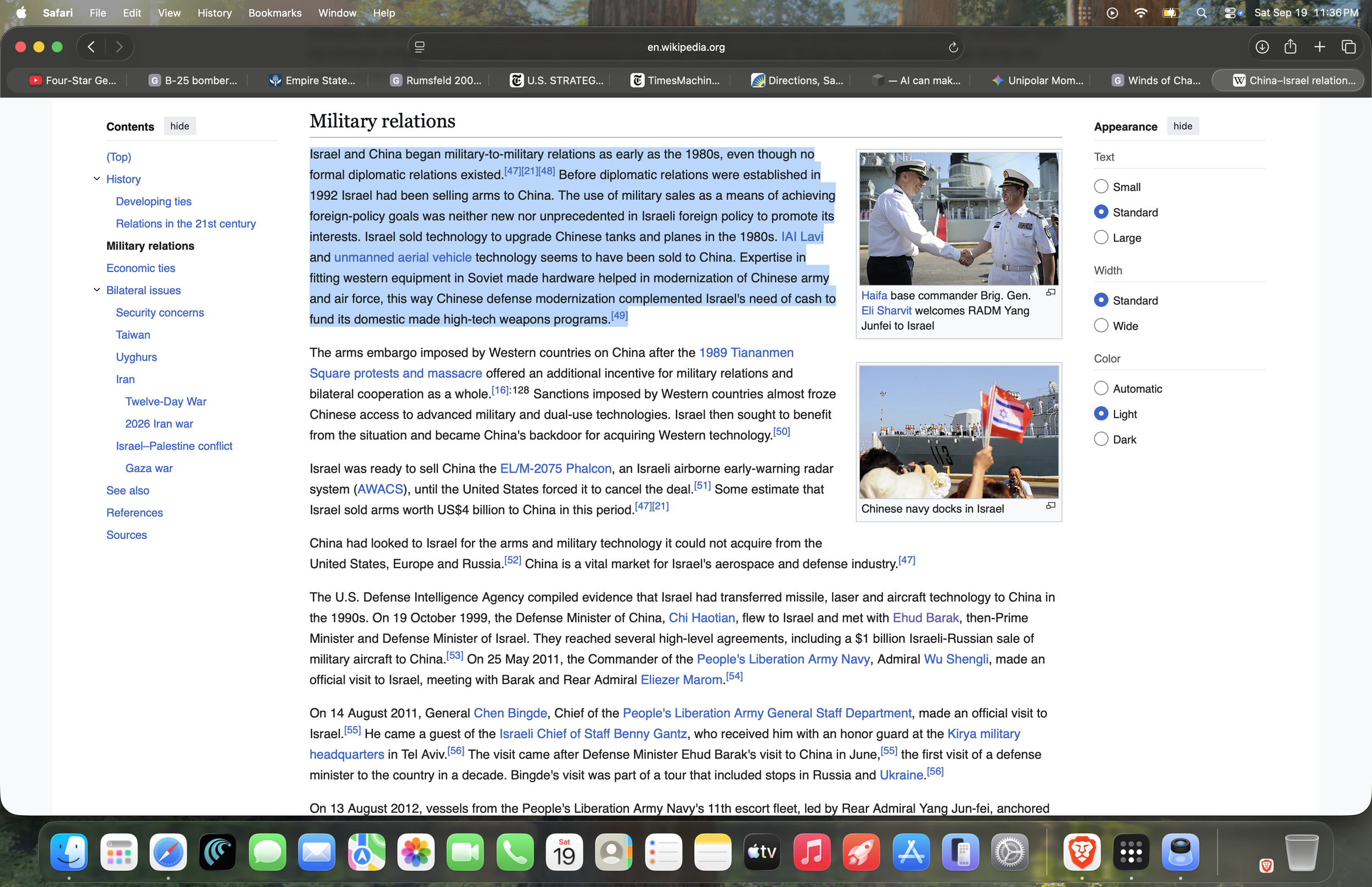
The technology transfers between Israel and China are well-documented. Following the 1989 Tiananmen Square protests, the United States and the European Union imposed strict arms embargoes on Beijing, cutting off China's access to advanced Western military technology.
Israel possessed extensive experience in integrating advanced Western electronics, radar, and avionics into legacy Soviet-designed military hardware. Seeking capital to fund its domestic defense industries, Israel became a key source of advanced military technology for a modernizing Chinese military.
According to declassified CIA assessments and historical records, this pipeline transferred crucial capabilities that shaped the modern People's Liberation Army (PLA):
- The J-10 Fighter Jet (IAI Lavi): When Israel canceled its domestic Lavi fighter jet program in 1987 due to U.S. funding cuts, the extensive design schematics, fly-by-wire software, and aerodynamic research were quietly transferred to Chengdu Aircraft Industry Group. This technology formed the design foundation for China's multirole J-10 fighter.
- The Harpy Drone Crisis (2004): In 1994, Israel Aerospace Industries (IAI) sold China the Harpy Loitering Munition system, an advanced anti-radiation drone designed to destroy enemy radar systems. When China sent the drones back to Israel for scheduled upgrades in 2004, the George W. Bush administration intervened, demanding Israel seize the hardware. The ensuing crisis led to the temporary suspension of Israel from the F-35 Joint Strike Fighter development loop.
- The Phalcon AWACS Cancelation (2000): Israel attempted to sell China the EL/M-2075 Phalcon, an advanced airborne early-warning radar system. President Bill Clinton intervened directly, forcing Israel to cancel the $1 billion contract, which required Israel to pay hundreds of millions of dollars in cancellation penalties to Beijing.
Following intense pressure from Washington in the mid-2000s, Israel tightened its formal military export controls and largely stopped direct sales of conventional weapon platforms to Beijing. However, the technology pipeline adjusted rather than stopping entirely; it shifted from direct military hardware to civilian dual-use technology.
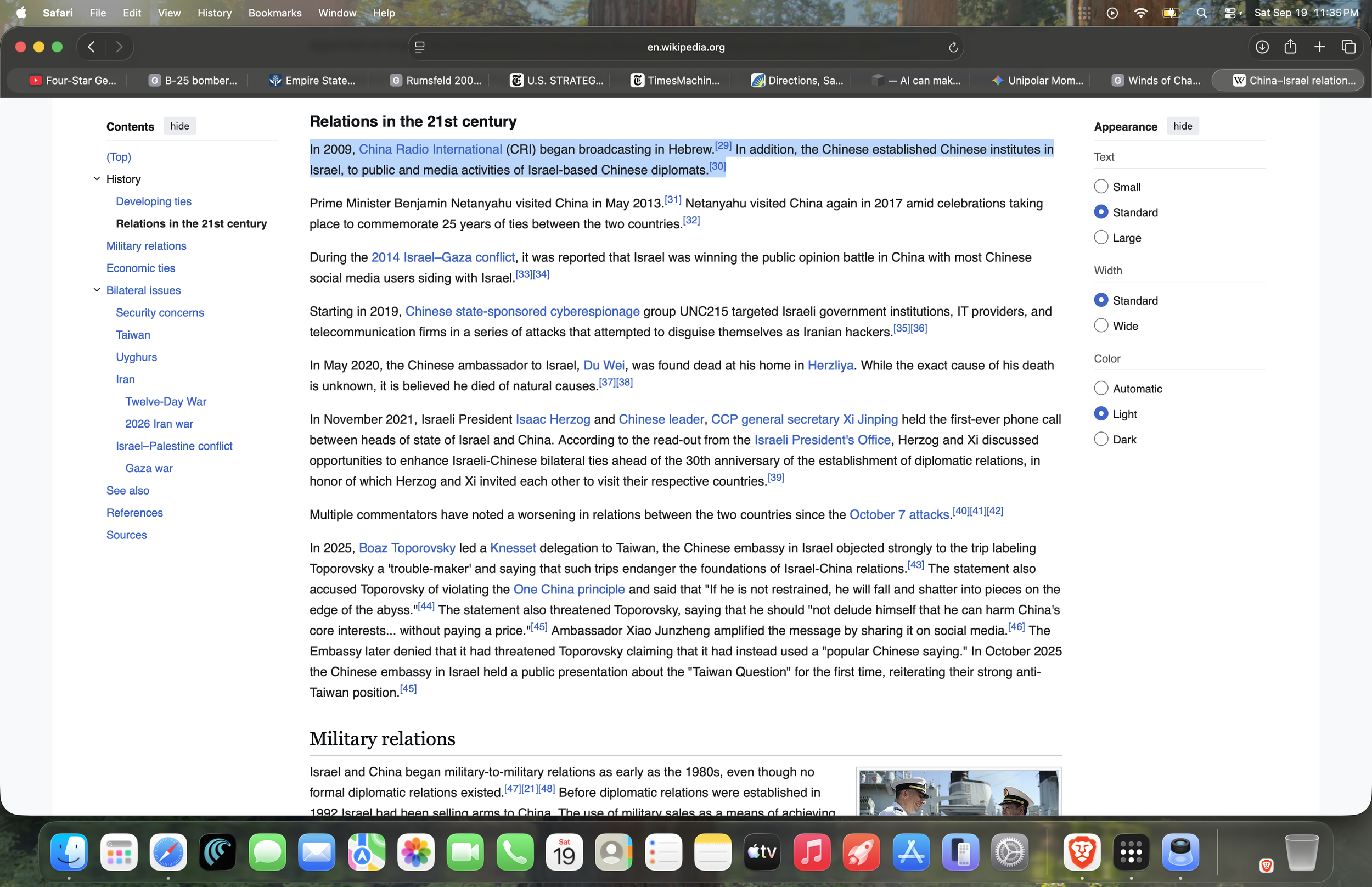
Under Benjamin Netanyahu's administration, Israel and China established the Israel-China Joint Committee for Innovation Cooperation in 2015. Chinese state-backed corporations and tech giants heavily invested in Israel's silicon ecosystem:
- Infrastructure Nodes: China Harbor Engineering won the contract to build and manage the new Bay Port in Haifa—a facility directly adjacent to where the U.S. Navy's Sixth Fleet docks.
- Dual-Use IP: Chinese venture capital flowed into Israeli artificial intelligence algorithms, quantum encryption, autonomous driving sensors, and semiconductor design. These technologies align closely with the PLA's doctrines of "Acupuncture Warfare" and asymmetric disruption.
This strategic triangle remains highly relevant in contemporary geopolitics. For example, Washington's approval of a $24.3 billion F-35 stealth fighter package to Saudi Arabia has renewed strategic concerns.
U.S. intelligence agencies have issued warnings that Saudi Arabia's expanding telecommunications infrastructure with Chinese firms like Huawei and ZTE could expose sensitive F-35 radar, stealth, and sensor-fusion data to Chinese collection systems. This development highlights the challenge facing U.S. grand strategy: decades after the 1991 Wolfowitz Doctrine sought to establish uncontested global dominance, the technology pipelines and economic networks linking key regional actors have created a highly integrated, multipolar environment.
In the final accounting, the arc from the 1991 Wolfowitz Doctrine to the modern multipolar reality represents one of the most profound miscalculations in strategic history.
When the Berlin Wall came down and the melody of the "Wind of Change" echoed from Moscow to Washington, American grand theorists mistook a temporary historical pause for an eternal victory. They looked at a fragile, newly open world and saw an estate to be managed, a catalog of seven nations to be dismantled, and a blank check written in the currency of uncontested military primacy.
They spent thirty years chasing ghosts in the deserts and fractured metropolises of the Middle East, operating on a five-year blueprint that stretched into a multi-generation quagmire. They treated history as a hardware problem—believing that if you deployed enough precision-guided munitions and engineered enough bureaucratic deception via shadow agencies like the Office of Special Plans, reality would eventually conform to a white paper written in a Washington think tank.
But while the American hammer was striking every nail it could find, the rest of the world refused to remain static. Israel, navigating its own immediate survival and economic ambitions, recognized that conventional regional armies were fading into non-state proxy networks. They pivoted, transforming their economy into a hyper-sophisticated silicon laboratory, quietly building technology pipelines and dual-use bridges with a rising East while anchoring their defense budget to a compliant Washington.
China, meanwhile, played the longest game of all. They watched the shocking kinetic display of Desert Storm in 1991 and chose never to fight that war. Instead, they let the unipolar superpower exhaust its treasury, fray its social fabric, and deplete its strategic focus. Beijing quietly studied the exact "acupuncture points" of Western civilization—not just the physical ports, supply lines, and satellite arrays, but the cognitive loops, the open academic pipelines, and the digital nervous systems of the internet itself.
The 5-to-10-year window Paul Wolfowitz mused about to a one-star Wesley Clark in the corridors of the Pentagon was entirely real. It was a genuine window of opportunity. But it was not a window to conquer the old world; it was a window to prepare for a completely new one.
By the time the architects of the Bush Doctrine, the Clean Break, and PNAC realized the window was closing, the battlefield had shifted entirely out of the physical sands of the Middle East and into the invisible, borderless realms of code, synthetic biology, algorithmic manipulation, and the human subconscious. The unipolar moment did not end with a dramatic clash of superpowers; it evaporated under the weight of its own hubris.
As Carl von Clausewitz famously observed in On War:
The architects of the unipolar moment forgot that power is dynamic, fluid, and always generates its own resistance. The wind of change didn't stop blowing in 1989; it simply changed direction, leaving behind a world where the old scripts no longer apply, and the hammer has finally run out of nails.
Further Reading Material & Reference Materials
- Council on Foreign Relations (2019): "The U.S.-China-Israel Technology Triangle" by Assaf Orion and Galia Lavi. A core foundational text exploring the shift from defense exports to dual-use civilian investments.
- RAND Corporation Research Report (2019): "The Evolving Israel-China Relationship". A detailed exploration of infrastructure transactions and technology integration under the Belt and Road Initiative.
- RAND Corporation Research Report (2020): "Chinese Investment in Israeli Technology and Infrastructure". An in-depth security analysis on the systemic penetration of dual-use corporate acquisitions.
- Center for a New American Security (CNAS) Report (2022): "Aligning U.S.-Israeli Cooperation on Technology Issues and China". Investigates the modern friction between Washington's technology export bans and Jerusalem's economic diversification.