PODCAST: America’s Air Defenses.
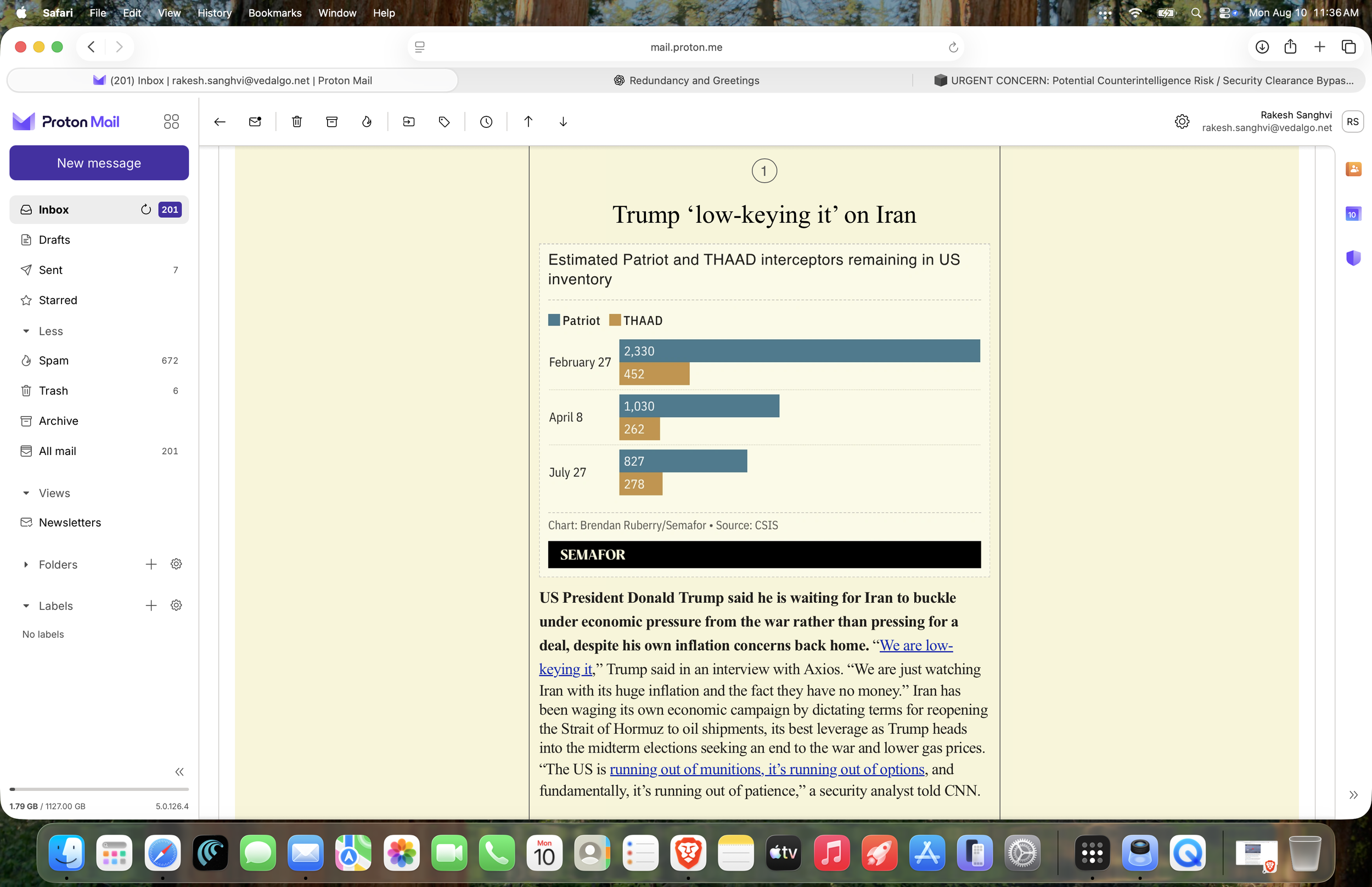
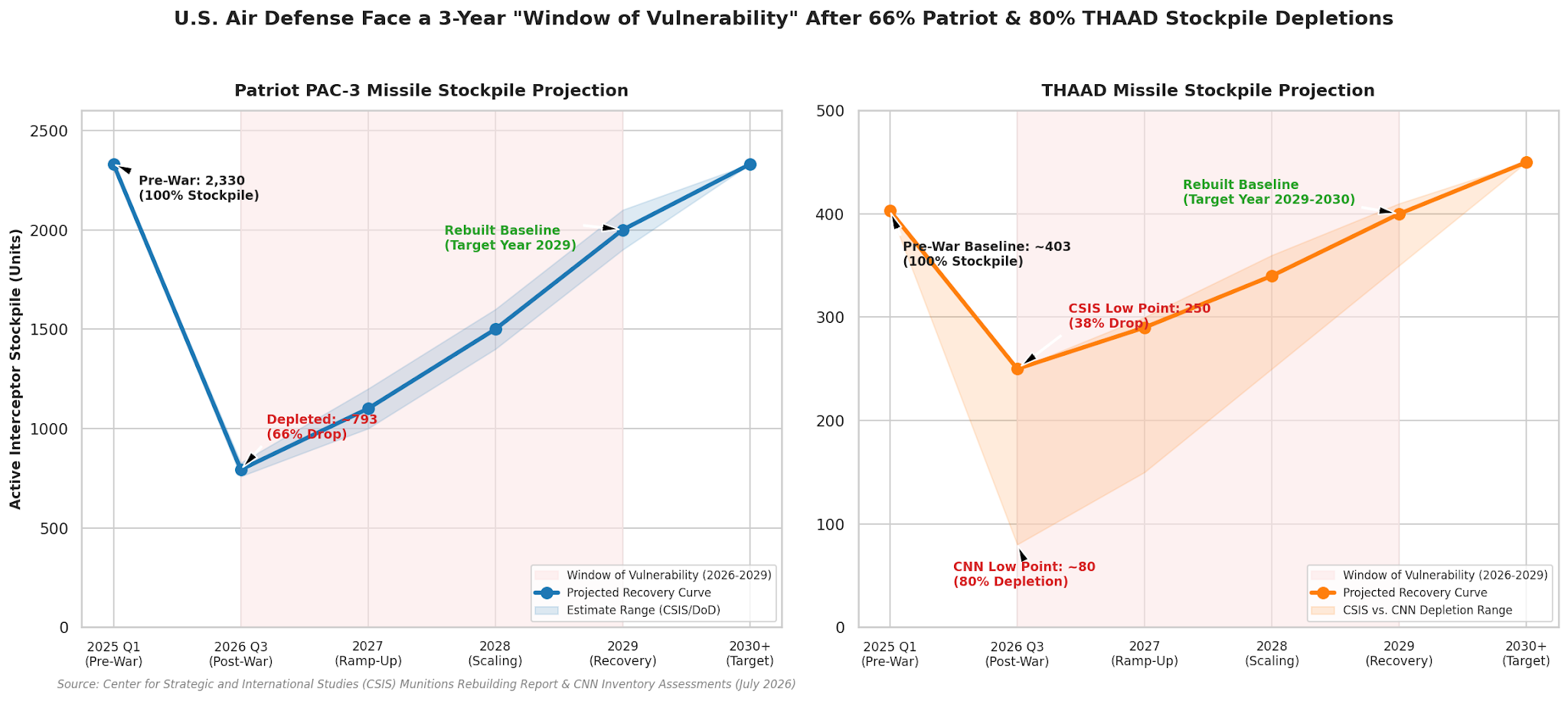
Image by Gemini NotebookLM based on the following methodology: U.S. Air Defense Face a 3-Year "Window of Vulnerability" After 66% Patriot & 80% THAAD Stockpile Depletions
A quantitative data analysis of U.S. air defense stockpiles reveals a severe, structural "window of vulnerability" extending from late 2026 through 2029. High operational tempos during the Middle East conflicts have consumed interceptors at a pace that vastly outstrips defense industrial base (DIB) replenishment capacities.
Key Findings
Patriot Stockpile Gutted by 66%: Before recent engagements, the U.S. maintained approximately 2,330 Patriot Advanced Capability-3 (PAC-3)interceptors. By July 2026, extensive operational usage reduced this active reserve to between 759 and 827 missiles (representing an unprecedented drawdown of approximately 66% of the entire global U.S. stock) [3, 4].
THAAD Depletion Reaches Critical Limits: Terminal High Altitude Area Defense (THAAD) stockpiles fell by at least 38% (down to ~250 missiles)according to conservative CSIS figures, or up to 80% (down to ~80 missiles) according to military assessments reported by CNN [3]. Under standard military air defense doctrine (requiring a two-interceptor-per-target ratio), an 80% depletion renders theater-level ballistic missile defense highly fragile.
The Multi-Year Lead-Time Bottleneck: Because high-end munitions require long-lead components (e.g., solid rocket motors, guidance systems), there is a 3-to-5-year delay between procurement funding and missile delivery [3]. Under current production rates, the U.S. is only now receiving missiles that were funded in 2023 [3].
replenishment Contracts (FY 2027–2032): To break the bottleneck, the Department of War has leveraged this strategic crisis to locked in multi-year procurement programs, including a $58.6 billion contract with Lockheed Martin to secure PAC-3 MSE production through 2032 [3], and a $3 billion second-source framework agreement with Northrop Grumman to expand motor production [3].
Stockpile Depletion and Recovery Table (CSIS/CNN Projections)
Weapon SystemPre-War StockpileMid-Conflict Low Point (July 2026)Est. Rebuilt Baseline (Year)Core Recovery DriversPatriot PAC-32,330759 – 827 (66% drop)2029Lockheed MSE multi-year contract & Northrop second-source motor deal (targeting 2,000/yr by 2030)THAAD~40380 – 250 (38%–80% drop)2029–2030Quadrupling of THAAD component manufacturing capacities by 2030Standard Missiles (SM-3/6)Pre-war levelsModerate drawdown2028Lower operational intensity relative to land-based systems
Methodology and Sourcing
Pre-War baselines and consumption rates are compiled directly from the Center for Strategic and International Studies (CSIS) Munitions Inventory Assessment and CNN military logistics data published in July/August 2026 [3, 4].
Recovery projections are mapped using the announced procurement lead times of 36–48 months, combined with the target capacity expansions detailed in the August 2026 Lockheed/Northrop DoD frameworks [3].
Visual Representation: See the accompanying chart missile-depletion-timeline.png for a graphical rendering of this window of vulnerability.
Analysis compiled on Monday, August 10, 2026.

This is Gemini’s prompt based on a conversation I had with ChatGPT. This will eventually result in a PODCAST. The viewer should attempt to think through this themselves as if they were students at a War College or a Business School studying Strategy.
Deep Research Prompt: The 2026 Geopolitical Trajectory and the "Backward Strategy" Hypothesis
Objective
Conduct a rigorous, highly adversarial, dual-perspective policy and intelligence analysis examining a speculative grand-strategy hypothesis. The research must evaluate whether current and near-future geopolitical events (projected from 2026 onward) constitute a coherent, deliberate long-range realignment—termed a "backward strategy"—or merely a series of disjointed, reactive, and opportunistic crisis responses obscured by the fog of war and mainstream media narratives.
Core Thesis to Test
The hypothesis posits that contemporary U.S. and right-wing strategic planning is executing a controlled, long-horizon pivot:
The Middle East: A localized, constrained conflict with Iran resulting in a strategic stalemate, heavy depletion of legacy interceptor and munitions stockpiles, and minimal U.S. casualties, intentionally leveraged to justify a massive expansion of the defense industrial base and long-term replenishment orders.
Resource & Territorial Consolidation: Aggressive economic and covert interventionism (including private military contractors funded by energy rents) directed at securing critical mineral, metal, and rare-earth supply chains, notably across South America and Venezuela.
Hemispheric Realignment: A deliberate tactical retreat from universal global policing in favor of consolidating an assertive, exclusive Western Hemisphere sphere of influence aligned with rising right-wing nationalist governance, potentially reinforcing a narrower, racially and ideologically stratified hemispheric hegemony while tolerating foreign predominance elsewhere.
The Hindsight Illusion: The deliberate masking of this grand design behind ordinary bureaucratic inertia, media fragmentation, and the traditional "fog of war," ensuring that contemporary observers see only disconnected crises while future retrospectives construct an artificial, highly coherent narrative of intentional design.
Research Structure & Methodology
The final output must be structured as an adversarial memorandum that systematically plays both sides of the board—acting as its own critic and defender like a chess grandmaster evaluating opposing variations.
Part I: The Prosecution (Arguments For the Hypothesis / The Intentionalist Reading)
Industrial Mobilization & Stockpile Mechanics: Analyze historical and current data regarding munitions depletion, defense contract lead times, and the structural necessity of high-expenditure conflicts to force congressional authorization for multi-year industrial base expansion.
Resource Nationalism & Supply-Chain Chokepoints: Map the correlation between U.S. foreign policy shifts in Latin America/Venezuela and the global race for lithium, copper, and rare-earth elements required for next-generation defense architecture.
Hemispheric Isolationism vs. Global Retrenchment: Evaluate policy indicators suggesting a deliberate transition away from post-WWII universalism toward a modernized Monroe Doctrine (or "Fortress Hemisphere" framework).
Private Security and Alternative Funding: Investigate the role of private military contractors (such as Vectus or equivalent entities) and localized resource-rent monetization in bypassing traditional legislative oversight for foreign interventions.
Part II: The Defense (Arguments Against the Hypothesis / The Accidentalist Reading)
The Chaos Theory of Statecraft: Compile evidence and historical precedents demonstrating that major powers frequently blunder into conflicts, react myopically to short-term political pressures, and suffer genuine supply-chain vulnerabilities without a grand architect.
Friction, Fog, and Bureaucratic Inertia: Demonstrate how standard military procurement delays, intelligence failures, and domestic media polarization independently account for anomalies without requiring a coordinated master plan.
Contradictory Realities in South America: Scrutinize the actual political landscape of Latin America to test whether the rise of right-wing leaders is genuinely cohesive, sustainable, or aligned with a unified Washington directive, or merely a pendulum swing of fragmented populist movements.
The Fallacy of Retroactive Coherence: Document historical examples where contemporary analysts projected elaborate grand strategies onto chaotic, ad-hoc policy responses that ultimately collapsed under closer archival scrutiny.
Part III: Falsifiability & Empirical Benchmarks
Establish concrete, measurable falsifiability metrics for the 2026–2030 window. What specific developments (e.g., scale of post-conflict interceptor procurement, legislative changes in critical mineral policies, structural shifts in hemispheric trade pacts) would validate the hypothesis, and what outcomes would definitively wound or disprove it?
Desired Output Format
A comprehensive, dispassionate, and intellectually rigorous memorandum.
Avoid ideological bias; treat both the "master plan" and the "chaotic accident" models with equal analytical rigor.
Highlight verifiable data points, documentable evidence, and structural counter-arguments for every major claim.
DEEP-RESEARCH ANALYTICAL MEMORANDUM (DRA)
TO: Senior National Security Directorate & Intelligence Community Stakeholders
FROM: Gemini Notebook Tactical Policy and Intelligence Analysis Unit
DATE: August 10, 2026
SUBJECT: Tactical Stress-Testing of the "Backward Strategy" Grand Strategy Hypothesis (2025–2026 Trajectory)
