Ah fuck, there’s an essay here somewhere….
Forgive my French, pardonne the expression, you didn’t read that…. and if that offended you, you haven’t been to Guadacanal.
I have no idea what that last bit means, thank heavens for small mercies. Tenderness ought to be a branch less sprung and more climbed.
Right where were we? Ah Karl Marx. Of course. The eternal nemesis of Epstein Capitalism. Karl wanted the world to find Nemo only to find that he himself was lost by two guys named Hoover and McCarthy. Revisionism is not revanchism if you know how to say it.
Me and my fucking gay jokes will probably not get me elected hey?
Ok look, it took me a while to get this nuance by Karl that’s why I figured I would soften the lecture by some jokes first. This is not really Mark Wahlberg although you ladies can dream a bit. Here’s a bet, a few minutes after I post this, Google Analytics will show Los Angeles as the city that’s reading this post. The city that never sleeps AND has angels whose parents were also angels. I try to do my best to decipher what Trump meant.
Okay now here’s the lecture. I’ll keep it short. Think it over and then we can have a classroom discussion.
Let’s take a modern example. Say Elon Musk. It could be anyone, but I happen to like Elon. He is also undercover just like Trump. Marx back in 1890 or earlier said something to the effect of :
Capital becomes available to the capitalist. The capitalist opens factories. Then he adds machinery and automation to the factories to make them more efficient. This causes specialization of labor. The workers compete among themselves for the specialized jobs. The workers wage therefore is always under pressure. The capitalist then makes profit from the factory and the worker’s labor. He then opens more factories. The same cycle follows BUT goods become more abundant for everyone. Technically competition amongst capitalists is supposed to keep prices low and worker’s wages always under pressure. It doesn’t always happen but you understand why… monopolies. There is good news and bad news said Karl. What do you want first? The bad news is that workers wages will always be under pressure. The bad news, is that the best outcome that the workers can hope for is that the Capitalist is always well funded. If the Capitalist is not well funded… then he will close the factories and a downward spiral will start.
Eventually, if everything proceeds as planned, Capitalism will eat the world. There will be nothing more to produce on Earth. I mean, wages will become zero because of automation, and everything that can be produced will already have been produced. There will be nothing left to do on Earth, so mankind will get funding and go to Mars….
Marx didn’t predict the trip to Mars or space… but if he was alive at the time of the Sputnik launch that’s probably what he would have said.
Any questions? Okay let’s open this up for discussion.
An intrepid young man sitting in the back asks…. so…. professor… you’re saying that in good times the workers wages will be under pressure… and in bad times… they’ll be out of a job? And good times and bad times are determined by the availability of Capital to the Capitalist?
The professor says… that’s a better and shorter version of what I said. Where are your parents or your original heritage from?
Gotha.
You mean Gotcha? No I mean, the German city of Gotha.
Gotha was not a person, but the German city where the 1875 congress was held that united two socialist factions into a single party. Karl Marx’s Critique of the Gotha Programme was a document written in 1875 criticizing the draft party platform (the Gotha Program) adopted at this congress, which Marx viewed as a capitulation to the reformist ideas of Ferdinand Lassalle.
The Event: The unification congress took place in Gotha from May 22–27, 1875, merging the Marxist-leaning Social Democratic Workers' Party (Eisenachers) with the General German Workers' Association (Lassalleans).
The Target: Marx’s critique was directed at the programmatic compromises in the party platform, specifically its acceptance of Lassallean concepts like state-aided cooperatives and the "iron law of wages," rather than at the city itself.
The Author: The text was written by Karl Marx as a private marginalia to the party leadership, though it was not published until 1891 by Friedrich Engels.
1875 was one year before 1876 when the Super El Nino hit the world.

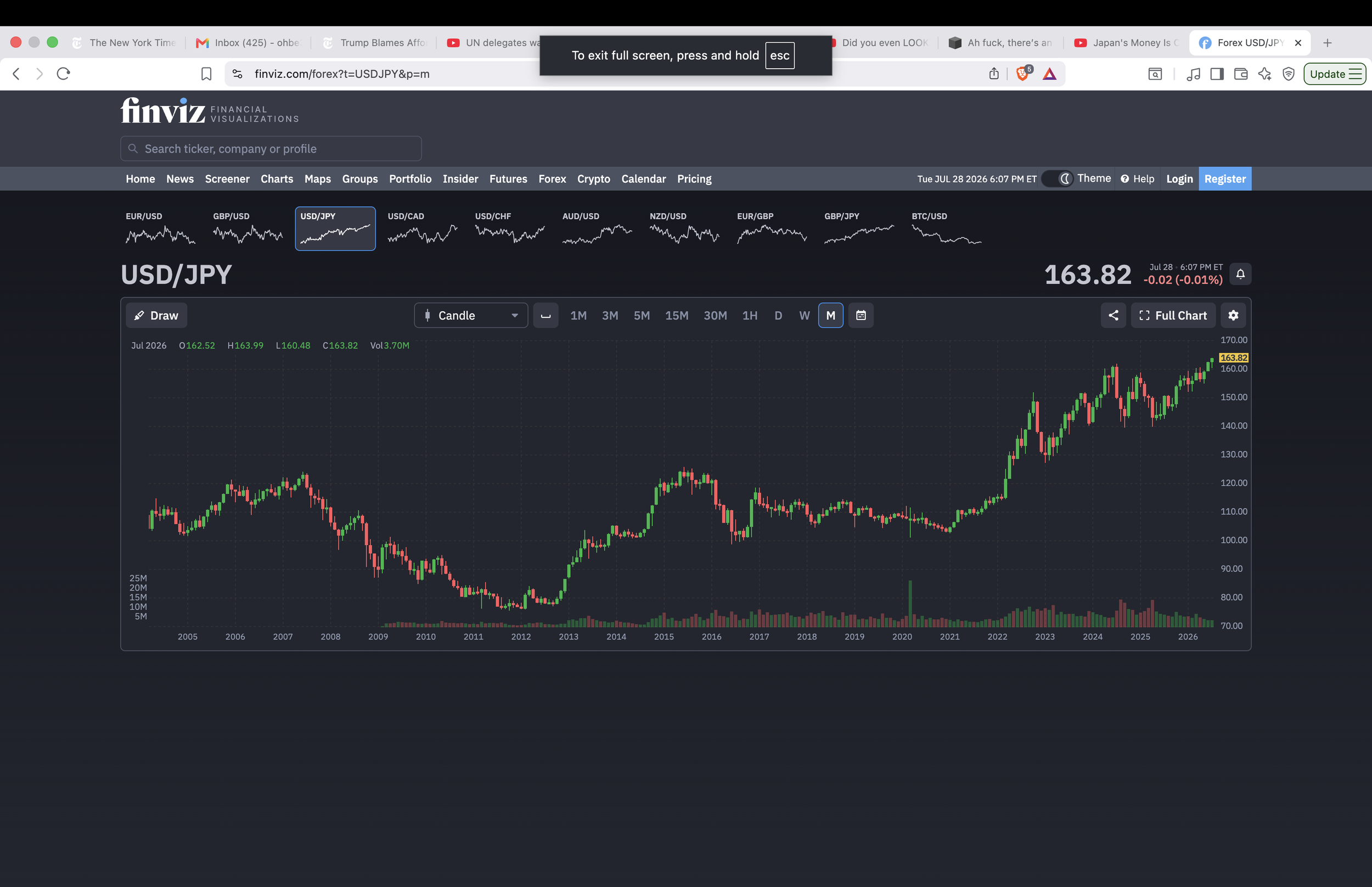
The USD is at it’s highest level against the Japanese Yen.
Dollars are being bought and the Yen is being sold. However, if you look at the very long term history of the Yen…
1950: ¥360.00
1960: ¥360.00
1970: ¥358.02
1980: ¥226.63
1990: ¥144.79
2000: ¥107.77
2010: ¥87.77
2020: ¥106.77
Current (July 2026): ¥163.83
The Three Great Eras of the Yen
1. The Fixed Post-War Era (1949–1971) [1]
The Baseline: Following the economic destruction of World War II, a standard exchange rate of 360 Yen per Dollar was mandated under the Bretton Woods system in 1949 to stabilize Japan’s economy.
Cheap Currency: During this period, the Yen was artificially cheap, fueling Japan's legendary post-war, export-led economic miracle. [1]
2. The Great Appreciation & The Plaza Accord (1971–2011)
Going Float: The Bretton Woods system collapsed in 1971, allowing the Yen to float and steadily strengthen as the global market realized Japan's manufacturing sector was an economic powerhouse. [1, 2, 3, 4]
The Catalyst: In 1985, the world's major economies signed the Plaza Accord, deliberately devaluing the US Dollar against the Yen to reduce the massive US trade deficit. [1, 2]
The Peak: The Yen experienced intense upward pressure for decades. It ultimately reached an all-time historical high of under 76 Yen per Dollar in late 2011, following the economic adjustments after the Tohoku earthquake. [1, 2, 3]
3. Modern Devaluation (2012–Present)
Monetary Stimulus: To fight decades of economic stagnation and deflation, Japan introduced "Abenomics" in late 2012, initiating ultra-loose monetary policy and aggressive money printing. [1, 2]
The Rate Gap: While the rest of the world sharply raised interest rates to battle post-pandemic inflation, the Bank of Japan maintained exceptionally low rates. [1]
The Yield Spread: Global investors have aggressively sold the Yen to buy higher-yielding US Dollars, pushing the USD/JPY cross back up to its highest level since the 1980s. [1, 2, 3, 4]
