American Youth Employment.
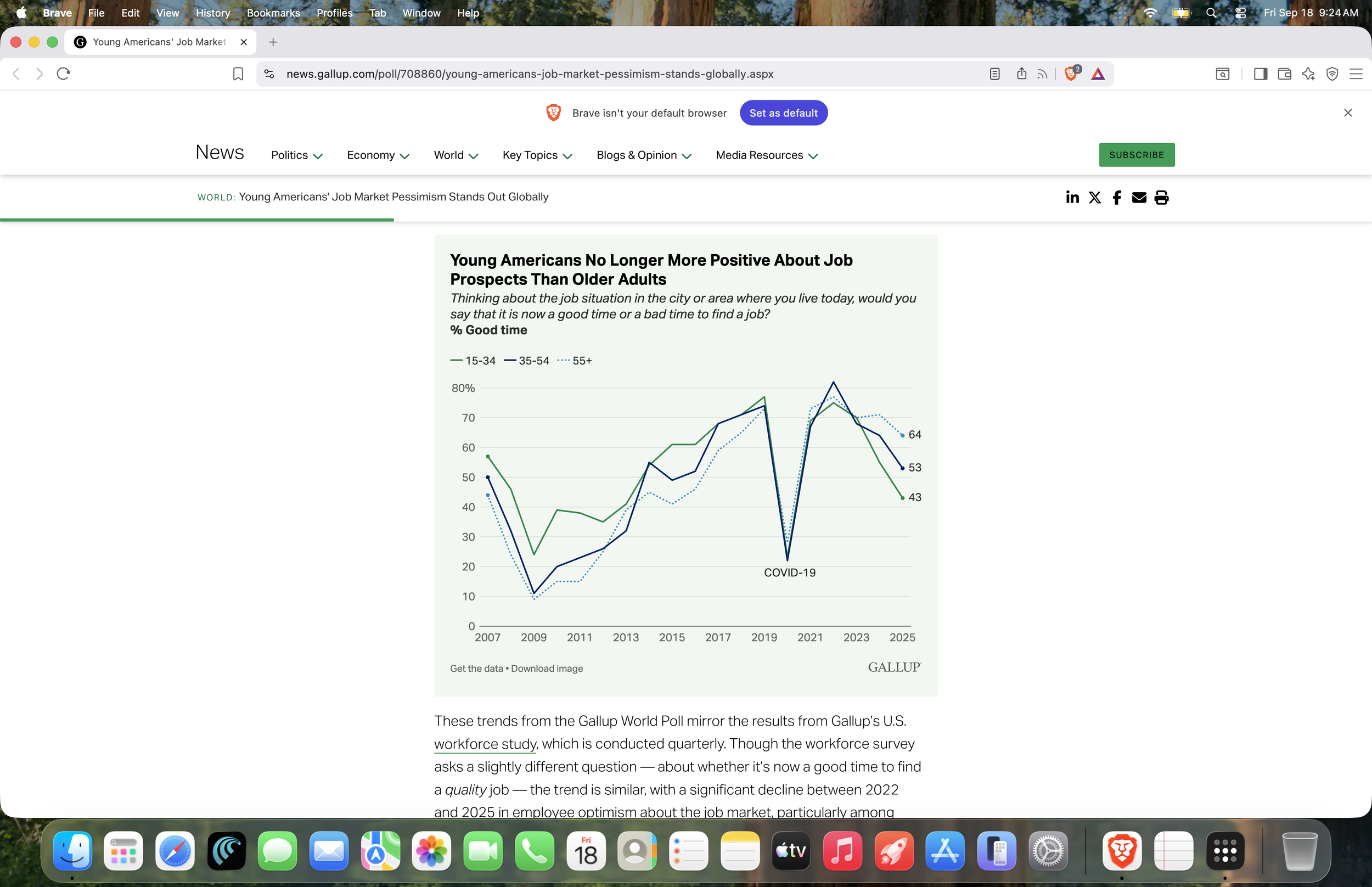
It’s a significant graph and it’s from Gallup that is well known as a polling company. It is therefore, to me anyway, immediately suspect. That’s just how my mind works, I don’t trust data aggregators, pollers, polling companies, polling questions and even government agencies that collect data like the US Census.
As you read the following sheer number of agencies responsible for collecting and collating data, without a single agency being responsible, I realized something I learned a long time ago. If a teacher does not want something done, they tell the entire class to do something without identifying anyone responsible.
“Johnny’s sick please drop off some borscht when you check on him.”
The U.S. Government does not have a single agency responsible for statistics; instead, data collection is decentralized across more than 100 agencies and programs. The Office of Management and Budget (OMB) identifies 13 Principal Statistical Agencies (PSAs) whose primary mission is producing official statistics. These designated agencies include the Census Bureau, Bureau of Economic Analysis (BEA), and Bureau of Labor Statistics (BLS), which are also legally designated to share business data for statistical purposes.
Beyond the PSAs, numerous other federal departments collect specialized data for operational, regulatory, or research purposes. Key entities include the Department of Health and Human Services (via the CDC and NIH), the Department of Justice (via the FBI and Bureau of Justice Statistics), and the Department of Homeland Security (DHS) (via ICE and CBP). Intelligence and law enforcement agencies, such as the National Security Agency (NSA) and Internal Revenue Service (IRS), also collect vast amounts of personal, biometric, and financial data for national security and tax administration.
Data is often aggregated through central platforms like Data.gov and accessed via Federal Statistical Research Data Centers (FSRDCs) for secure research. While statistical agencies focus on aggregate population and economic characteristics, agencies like the DHS and FBI compile sensitive databases containing criminal backgrounds, biometric information, and surveillance metadata. The Congressional Research Service (CRS) and Government Accountability Office (GAO) also conduct independent research and compile data to support legislative oversight and government efficiency.
The 13 Principal Statistical Agencies are:
Bureau of Economic Analysis (Department of Commerce)
Bureau of Justice Statistics (Department of Justice)
Bureau of Labor Statistics (Department of Labor)
Bureau of Transportation Statistics (Department of Transportation)
Census Bureau (Department of Commerce)
Economic Research Service (Department of Agriculture)
Energy Information Administration (Department of Energy)
National Agricultural Statistics Service (Department of Agriculture)
National Center for Education Statistics (Department of Education)
National Center for Health Statistics (Department of Health and Human Services)
National Center for Science and Engineering Statistics (National Science Foundation)
Office of Research, Evaluation, and Statistics (Social Security Administration)
Statistics of Income Division (Department of the Treasury)
Wait, johnny, isn’t 13 an unlucky Friday? I mean why 13 precisely without a single central coordinating agency? Why cut up “The Americans” into 13 different slices and then not bring them all back together like the ancient Egyptian legends supposedly did with a magic golden penis?
The legend of Osiris and his wife Isis is a foundational Egyptian myth centered on betrayal, resurrection, and divine justice. Osiris, the benevolent king who civilized Egypt, was murdered and dismembered by his jealous brother Set, who scattered his body parts across the land.
Isis, demonstrating unwavering loyalty and magical prowess, searched tirelessly to recover every piece of her husband’s body. She successfully reassembled and resurrected him long enough to conceive their son, Horus, before Osiris ascended to become the ruler of the afterlife. Horus eventually avenged his father by defeating Set, thereby restoring Ma’at (order) to the world.
Anyway back to Gallup. Like Kevin Warsh suggests I look at trends rather than individual data points. Unless Gallup is totally just manipulating the individual data points, the trends of the lines suggest something and it’s not obvious at first glance. There is a before Covid regime and there is an after Covid when it comes to youth employment.
Before Covid the 15-34 gang was 10% more likely to say “this is a good time for employment” than the after 55+ gang (in 2007). The spread was (55% to 45%) hence the 10%.
After Covid the 15-34 gang is 19% less likely to say “this is a good time for employment” than the after 55+ gang (in 2025). The spread is (43% to 64%) hence the -19%.
The Total Spread then when traveled in time is a significant 29%.
In other words, 29% more American youth ages 15-34 are likely now (Pres. Donald J. Trump) to say “this is a not a good time for employment” than they did in 2007 (Pres. George W. Bush).
29% of 88,852,326 ≈ 25.8 million
That’s a significant number: almost 26 million American kids MORE are saying this is not a good time to be employed. Even discounting that’s its Gallup (a polling company) it does establish a figure. We can range it. The actual number could be somewhere between 15 - 41 million.
I’ll have to research that further the following comment from Brave.
32.2% of U.S. young adults ages 18-25 experienced mental illness in 2024. Additionally, 29% of U.S. high school students experienced poor mental health in the past 30 days in 2023.
For the specific age range of 14-24, the population was 47.1 million in 2010 and is projected to reach 51.4 million by 2025. The number of unmarried men aged 20-39 increased by 47% between 2000 and 2025.
