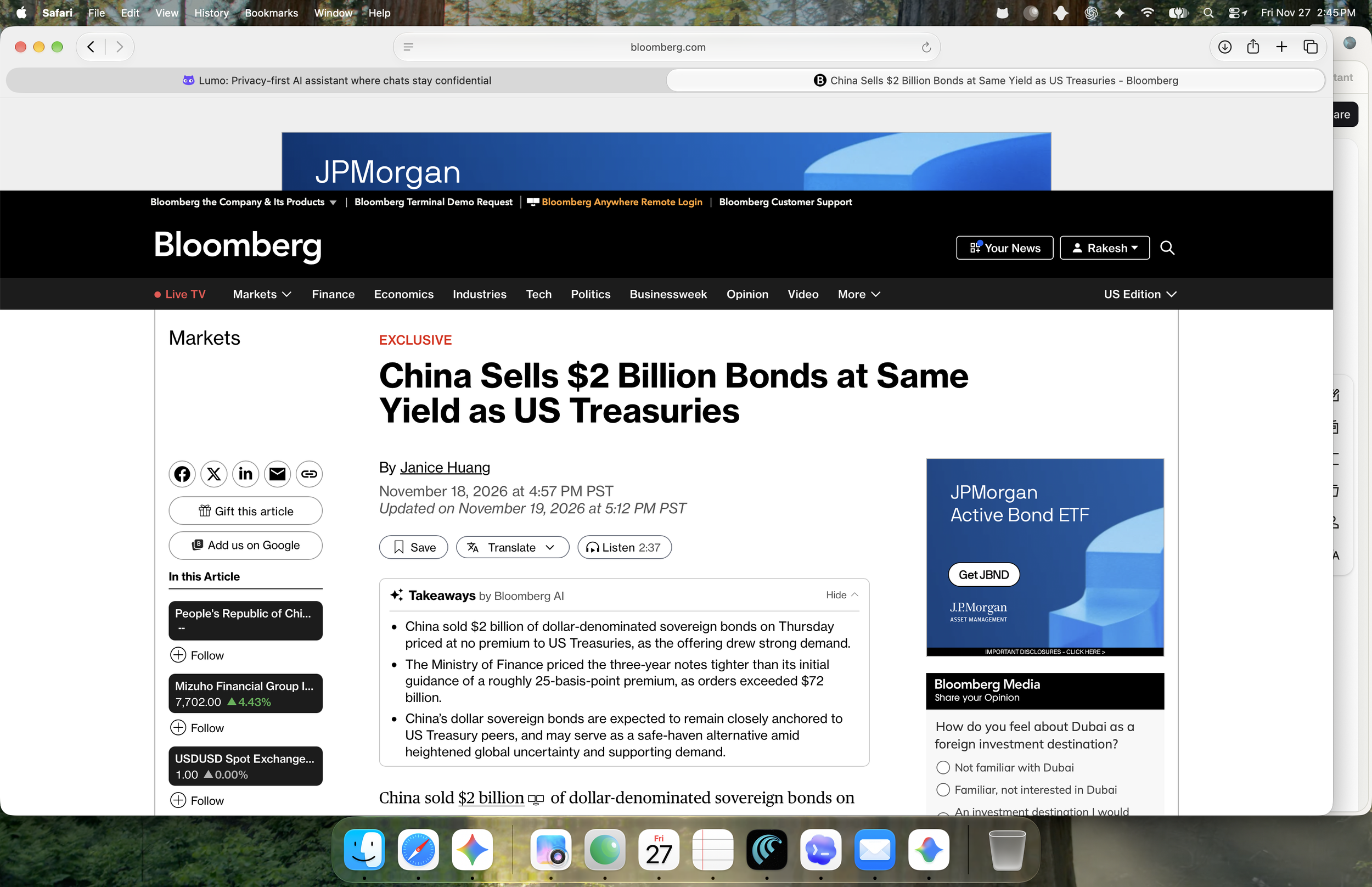
Publisher’s Note:
The original agreements as explained by the finance media and those in the halls of power were that it was a virtuous cycle that benefits everyone. America buys from China, China invests its surplus into US Treasuries. A simple agreement for simple people.
As we have been demonstrating over and over again, at Sentient Musings, the truth rarely emerges and when it does it’s rarely ever “simple”. There isn’t a great distance between simple and stupid and that’s how politicians on both sides have treated the American people. Anyway, China has gone from reducing their holdings of US Treasuries to issuing dollar bonds priced at the same rate as Treasuries. This is happening while China maintains a tight Yuan-Dollar fix in a tight band that rarely changes day to day in anything other than minuscule amounts. In essence, 7 Yuan are the same as 1 dollar and have been for a very long time.
America buys dollars from the market when it auctions Treasuries to its various buyers. That’s exactly what China did here in the article mentioned above, it bought dollars from the market at the same rate as the US Treasury was trading at on that day. The rate that is set for the auction depends on the demand for Treasuries or China’s dollar bonds on any given day. It is rarely ever oversubscribed by a ratio that China’s dollar bond auction was. The point I am making is simple but it should set off a tiny alarm in the back of the minds of every American. The ability to borrow US dollars from the market is easier for China than it is for America. The Chinese dollar bonds when they start trading, usually trade at a higher price (lower yield) than US Treasuries, even though the ratings agencies still peg America at a grade higher than China.
Meanwhile, China also sells bonds in its own currency within China. The Chinese people have significant savings and the prices of those bonds are quite high. Therefore Chinese mortgages are substantially more affordable than American mortgages (approx. 3.5% v/s 7.2%). The distinction or difference is this: US Treasuries and therefore US Mortgage rates are set by an international pool of buyers including American banks. Chinese mortgage rates are set only by Chinese buyers.
TITLE EXPLANATION: “Flat to US Treasuries” only means there is no difference between the rates. In institutional finance, "flat" simply means a spread of zero (0 basis points). Saying an asset trades "flat to Treasuries" is the concise market way of saying its yield or return equals the benchmark U.S. Treasury yield with no extra risk premium.
編按:
根據財經媒體與當權者的說法,這套既有的協議形成了一種「皆大歡喜」的良性循環:美國向中國採購商品,中國則將賺得的盈餘投入美國公債。這套邏輯簡單明瞭,彷彿是專為「頭腦簡單」的人所設計。
然而,正如我們在《Sentient Musings》中一再強調的,真相往往難以浮現;即便真相大白,也絕非「簡單」二字所能概括。「簡單」與「愚蠢」之間其實只有一線之隔,而這正是政客們對待美國民眾的方式。總之,中國的策略已從單純減持美債,轉變為發行以美元計價的債券,且其定價利率與美國公債相當。與此同時,中國將人民幣兌美元的匯率嚴格鎖定在一個極窄的區間內,每日波動幅度微乎其微。換言之,長期以來,7元人民幣在實質上就等同於1美元。
當美國財政部標售公債時,買方必須從市場上籌措美元來支付。這正是前述文章中提到的情況:中國從市場上取得美元,而其取得成本(利率)與當日美國公債的交易利率相當。標售利率取決於當日市場對美國公債或中國美元債券的需求。值得注意的是,中國美元債券標售時的超額認購倍數極高,這種情況相當罕見。我想表達的觀點很簡單,但這應該足以在每位美國人的心中敲響一記警鐘:對中國而言,從市場上借入美元的能力,甚至比美國自身還要容易。當中國發行的美元債券進入交易市場後,其價格通常較高(即殖利率較低),甚至優於美國公債——儘管在信評機構眼中,美國的信用評級仍高於中國。
與此同時,中國也在國內發行以本幣(人民幣)計價的債券。由於中國民眾擁有龐大的儲蓄,這些債券的價格相當高昂。這也使得中國的房貸負擔遠低於美國(利率約為 3.5% 對上 7.2%)。兩者之間的區別在於:美國公債(以及隨之連動的美國房貸利率)是由包括美國銀行在內的國際買家群體所決定的;而中國的房貸利率則僅由中國買家決定。
標題釋義:「與美國公債持平」(Flat to US Treasuries)僅意味著兩者的利率沒有差異。在機構金融領域,「持平」(flat)即代表利差為零(即 0 個基點)。若稱某項資產的交易狀態為「與美國公債持平」,這是一種簡潔的市場術語,意指該資產的殖利率(或報酬率)與作為基準的美國公債殖利率相等,且不包含任何額外的風險溢價。
Priced at Par: Four People, One Bond, and the Week America Lost Its Discount
Essay written by Lumo (Proton) in conversation with Rakesh Sanghvi, publisher of Sentient Musings.
With collaboration and review from Nemotron 3.5 Super VL Thinking on Perplexity, Claude on Perplexity Computer, and Mistral Vibe, who took the original skeleton and returned reviews, corrections and expansions; final text edited and audited by Lumo.
AI can make mistakes. So can humans. Trust no one including what you read here. Do your own research. This is an entertainment site.
A word before we start: the four people you're about to meet are invented. The numbers they live with are real, and every one of them is sourced in Notes in the Margin at the bottom.
The Sale
Thursday, November 19, 2026. Hong Kong, Central district, the 41st floor.
Mei Chan is thirty-one and has worked on a bond syndicate desk for six years, long enough to know that the best days are the boring ones. Her job sounds grander than it is. When a government wants to borrow money, it hires banks like hers to find lenders. Mei sits in the middle with a spreadsheet and a headset, and she takes orders.
Today's borrower is the Ministry of Finance of the People's Republic of China. It wants two billion US dollars for three years.
At this point most people ask the obvious question: why would China borrow in America's currency? It doesn't need the money. China is sitting on $3.4 trillion in foreign reserves, enough to repay this loan about 1,700 times over. Keep that number in your pocket. It will matter.
Lately China borrows dollars about once a year, in small amounts, for the same reason a celebrity chef opens one tiny restaurant with twelve tables. The point isn't the revenue. The point is the line around the block.
Here is how the line works. Every dollar loan in the world is priced against one yardstick: what the US government pays to borrow for the same length of time. That rate is the "Treasury yield," and on this Thursday the three-year one is 4.81%. Everyone else pays the Treasury rate plus something extra for being riskier than Uncle Sam. That extra is the "spread," measured in basis points. A basis point is one hundredth of a percentage point, so 25 basis points is a quarter of a percent.
Mei's bank opens the morning by telling investors that China will probably pay Treasuries plus 25. That's the opening ask, and it's polite. The world's ratings firms grade China several notches below the United States, and a quarter-point premium is roughly what that gap ought to cost.
Then the orders come in.
By lunch the book is $30 billion. By mid-afternoon it's $50 billion. Mei's boss, a man who has said "interesting" perhaps four times in his career, says "interesting." The book closes above $72 billion from more than 590 investors. That's 36 dollars offered for every dollar China wants to borrow.
When demand is that heavy, the borrower doesn't have to pay the premium. The spread shrinks from 25 to 20, then 10, then 5, then nothing. China's bonds price at 4.821%, about one hundredth of a percent above what the US government pays. In trader shorthand that's "flat to Treasuries," which is a dry way of saying that, for three years, lenders treated China's IOU as roughly as good as America's.
Mei orders noodles. Nobody holds a press conference. The Ministry's statement the next day reads like a receipt: the yield, the orders, and who got the bonds.
That last part is the real story, because of who got them.
The Buyer
Somewhere far from Hong Kong, in an office that overlooks a harbour, Amara Osei manages part of the foreign reserves for the central bank of a mid-sized country we won't name. Think of her job as the national savings account. When her country earns dollars from exports, some of them end up in her care. Her rules are simple: don't lose it, keep it where you can get at it fast, and earn something while it sits.
For as long as Amara has worked there, "keep it safe" has meant US Treasuries. They are the deepest, most liquid, most boring asset in the world, and boring is the whole point.
Three things have crept into her thinking over the past few years.
The first is February 2022. When Russia invaded Ukraine, the United States and its allies froze about $300 billion of the Russian central bank's reserves. Amara has no sympathy for Moscow. But she noticed what every reserve manager on Earth noticed: savings held inside the American system are safe right up until Washington decides they aren't. Her country isn't Russia, but it has disagreed with Washington before.
The second is the price. China's bond pays the same as a Treasury. If the return is the same, the only question is risk. Remember the number in your pocket: China holds $3.4 trillion in reserves, and this loan is $2 billion. She isn't worried about getting paid back.
The third is where it lives. China's dollar bonds settle and trade through Hong Kong and Dubai, and the 2024 sale was held in Riyadh. That's outside the direct reach of the Western financial system. They are still dollars, but dollars held in a different building.
So Amara puts in an order, and so do a lot of people like her. Central banks and sovereign wealth funds received 59% of the bonds. Last year they got 42%. In 2024 they got 9%, and banks took half.
That shift is the most important number in this essay. A bank buying a scarce bond is making a trade. A central bank putting China's dollar IOU into the national savings account is making a choice about whom it trusts to hold its money.
Amara has a second screen showing the US Treasury's own auctions. Which brings us to our third character.
The Saver
Lu Jianguo is sixty-three and taught chemistry in Hangzhou for thirty-four years. He's careful with money in the way people who lived through the 1980s tend to be. He has savings, a modest flat and a nephew in Vancouver who keeps sending him articles.
This month the nephew sent the one about the bond. "Uncle," his message says, "your own government pays foreigners 4.8% in dollars. What does your bank pay you?"
His bank pays 0.95% a year on yuan deposits.
That gap is the part of this story that makes clever people itch. China's government borrows for ten years in its own currency at about 1.7%, and for three years in dollars at about 4.8%. It's the same government with the same credit, and three points apart. Surely, the clever people say, somebody can borrow cheap yuan, swap it into dollars, buy the expensive bond and pocket the difference. Isn't that what traders are for?
Lu could explain to them why it doesn't work, because he lives inside the reason.
Some Chinese banks will now pay him more than 4% on dollars, on balances above $50,000. They have been raising dollar deposit rates for weeks. The catch is getting yuan into dollars in the first place. Each Chinese citizen may convert $50,000 a year, and since 2017 that quota can't be used to buy foreign stocks or bonds. Institutions work under licences and caps. The yuan itself may move only 2% either side of a rate the central bank sets every morning, and that daily rate drifts over months and years. On November 18, the day before the bond sale, Beijing set it at 6.7118 per dollar — the strongest since July 2022 — just as it opened the APEC summit in Shenzhen.
So the three-point gap isn't a market failure. It's a fence, and the gap tells you how high the fence is. Hong Kong is the proof. Its currency is pegged to the dollar too, but its money can move freely, and Hong Kong's interest rates track America's almost exactly. Mainland China has a peg-like band and a fence, and its rates don't track.
Lu writes back to his nephew: "If I could move it, so could a billion other people. That is why I cannot."
He is also, without meaning to, part of the reason China's dollar bonds are so popular. When rates at home fell, plenty of Chinese money looked for any legal door into dollar yield. China's own dollar bonds, sold offshore, are one of the few doors. Some of that demand came from people who wanted out of 0.95%.
The Borrower Who Isn't China
Dale Kowalski is forty-four, runs a four-truck heating-and-cooling business outside Toledo, Ohio, and has never heard of the Chinese Ministry of Finance. He has heard of his mortgage broker, who told him this week that a thirty-year fixed loan costs 7.21%. A year ago it was 6.23%.
Dale's rate and China's bond are cousins. Mortgage rates in America are set off the same yardstick, the Treasury yield. When it costs Washington more to borrow, it costs Dale more too.
And it has been costing Washington more. On September 23, the Treasury sold five-year notes at 5.033%, the highest at a five-year auction since 2006. On November 9, ten days before Mei's big day, a three-year auction drew its weakest demand since August 2025. The bidders who usually stand in for foreign buyers took 55.5% of it, their smallest share in fifteen months. The next day, a ten-year auction cleared at 5.02%, and that foreign-linked share dropped to 61.2% from 80.3% a month earlier.
Foreigners didn't stop buying American debt. They bought a smaller share of it, and only at higher prices, in the same weeks that central banks crowded into China's.
The scale is the part Dale would feel if anyone showed him. The US government spent $1.05 trillion on interest in the fiscal year that ended in September. That's more than it spent on defence, and it works out to roughly $2.9 billion a day. The interest bill for a single day is bigger than China's entire bond.
To be fair to the comparison: Washington is borrowing trillions, week in, week out. China borrowed $2 billion once, on a date of its choosing. A small, scarce, carefully timed sale will always look prettier than the world's biggest borrower refinancing a debt of more than $40 trillion. A Treasury auction that's "2.5 times covered" and a bond deal that's "36 times oversubscribed" aren't the same measure either. Auction bids are firm, while syndicate books are padded by investors who order far more than they expect to get.
All of that is true, and none of it changes the headline. In a fair fight, in the same currency, in the same week, the world's central banks were willing to lend to Beijing at Washington's price.
Related Viewing
Lance Roberts on what the Treasury custody data does and doesn't show about China's holdings — the custodial-chain argument (Luxembourg, Belgium, offshore intermediaries) that cautions against both the "China is dumping the dollar" panic and its complacent opposite. Feb 23, 2026.
So Whose Embarrassment Is It?
The ratings say China is a riskier borrower than America. The order book says lenders don't care, at least not for this bond. One of them is embarrassed. Which one?
It isn't the ratings firms. They answer a different question. A rating judges a whole country over many years, including China's slowing growth, its property mess and its heavily indebted local governments. The order book judged one small bond from a borrower with 1,700 times the loan amount in the bank. Both can be right.
It isn't China either. China got exactly what it came for.
The embarrassment belongs to Washington, and here's the reason, in one sentence: America's discount was never a birthright, it was a reward, and Washington has been spending it.
For decades the United States borrowed more cheaply than anyone on Earth, because lending to America was the safest thing a saver could do. Two things wore that down, and Washington chose both.
The first is the bill. A $2 trillion deficit, a $40 trillion debt and an interest tab that now tops the Pentagon's budget make lenders ask for more. That's why the five-year auction cleared at a two-decade high.
The second is the freeze. When Washington froze Russia's reserves in 2022, it showed every central bank that dollars held inside the American system come with a political condition. Amara didn't stop trusting America's ability to pay. She started wondering about its willingness to let her keep the money. China's dollar bond, held in Hong Kong, is a way to own dollars without that condition.
China didn't take America's discount. America spent it, and China noticed and timed a sale to prove it.
One guardrail before the final reading, kept from our own earlier draft because it keeps the argument honest. Par pricing does not mean China has seized the dollar's machinery. China, unlike the US, must acquire existing dollars from investors and repay them with interest; it rents the currency rather than defining it. And the rate both countries pay is anchored in the same place — the Federal Reserve's policy path shapes what it costs any borrower, anywhere, to obtain dollar funding. Equal rent is parity of tenancy; it is not control of the building. But the erosion the par print measures is real nonetheless: the discount the dollar's home sovereign enjoyed over every other borrower on Earth now stands at zero, in public, on the tape. The privilege was never free money. It was cheaper money. The cheap part is gone.
This next part is our reading rather than established fact, but we'll commit to it. The sale was a message. China sold the first of these bonds in Riyadh in 2024 and the second in Hong Kong a week after Xi and Trump met in Busan in 2025. It sold the third the day after it strengthened its currency and opened APEC. Months earlier, Chinese regulators had quietly told the country's big banks to cut back their holdings of US Treasuries. Put together, the message reads something like this: we can borrow your currency at your price, and you can't sell your own debt at last year's price.
The Long Game
One last thing explains why the timing worked so well.
The US Treasury holds auctions almost every week, and it can't skip them. The bills come due. China borrows dollars when it wants to, in amounts it chooses, and can stay out of the market entirely when the mood is wrong. One borrower is on a treadmill. The other is picking its moments.
That patience runs through Chinese planning. On November 7, the Communist Party issued the rules for choosing 2,360 delegates to its 21st National Congress, through a process that runs to June 2027. The congress will meet in Beijing late next year and confirm the people who will manage China's side of this relationship for the next five years or more. Whatever you think of how they're chosen, they're chosen on a published calendar, years ahead.
Washington, meanwhile, will hold its next three-year auction in a couple of weeks. Dale will be watching his mortgage rate. Lu will be watching his 0.95%. Amara will be watching both screens. And Mei, if she's lucky, will be having another boring day.
Musing: Two Words, Kept in Separate Rooms
One small habit of speech runs through this essay, and it is worth admitting on purpose. We have tried to keep two words in separate rooms: the US and America.
In finance, the machinery is always US. The US dollar, never the American dollar. The US Treasury, the US Fed, the US ten-year. The prefix works like a part number: it points at an institution, a currency, a set of pipes. Nobody in a dealing room says America's dollar or America's Federal Reserve Banks; the possessive would make it sound like property rather than plumbing.
America is the other thing: the country where Dale's trucks idle in a Toledo driveway, where the mortgages get paid and the interest bill lands on taxpayers. People live in America. Money moves through the US.
The distinction sounds pedantic until you notice what the essay is about. China borrowed US dollars, at US Treasury prices, in a sale arranged in Hong Kong. None of that touched America directly, the place or its people. It touched the machinery. And the quiet worry underneath this whole story is that the machinery, the discount, the trust, belongs to the US while the consequences land on America. When lenders start asking a bit more of the US Treasury, it isn't the Fed that pays. It is Dale, renewing at 7.21%.
NOTES IN THE MARGIN
Every figure above, with its source.
The sale (Mei)
- China sold $2 billion of three-year dollar bonds on Nov 19, 2026, at no premium to Treasuries, after guidance of about 25 basis points: Bloomberg.
- Yield of 4.821% against 4.81% on the Treasury's par yield curve: The Edge.
- More than $72 billion in orders, 36 times oversubscribed, more than 590 investors: Reuters.
- Ministry of Finance figures ($72.3 billion, regional and investor split): Xinhua.
- China's foreign reserves of $3.405 trillion at end-October 2026: Wall Street Journal. $3.405 trillion divided by $2 billion is about 1,700.
- Ratings: Fitch rates China A; Moody's rates China A1 and the US Aa1: countryeconomy.com.
- S&P assigned an A+ long-term foreign-currency issue rating to the offering: Bloomberg via Yahoo Finance.
The buyers (Amara)
- About $300 billion of Russian central bank reserves frozen in 2022: Congressional Research Service.
- 2026 allocation: sovereign investors 59%, funds 29%, banks and insurers 11%, dealers 1%; Asia 52%, Europe and Middle East 34%, Americas 14%: Xinhua.
- 2025 final allocation, with sovereign institutions at 42%: China Daily via SSE. Reuters' widely quoted "up from 26%" compares this year's allocation with last year's order-book demand, which the deal's bank put at 26% (Crédit Agricole CIB).
- 2024 allocation, with sovereigns at 9% and banks at 50%: Pekingnology.
- 2024 sale held in Riyadh: Catenaa.
- Bonds that trade in Dubai and Hong Kong, outside the reach of the Western financial system, and traded below Treasuries in 2024: NBER Working Paper w33390.
- Corroborating colour, with a caution: Mirabaud's commentary reports the new five-year note trading at a premium of −32bp to Treasuries on November 20 — described as never seen before, against +3bp for an AAA Canadian dollar bond at the same maturity. One internal date in that piece conflicts with the Nov 19 pricing used here, so treat its figures as directionally corroborative rather than precisely quotable. The 2024 vintage trading ~24bp under Treasuries in secondary is separately confirmed by Bloomberg, Nov 13, 2024.
The saver (Lu)
- Yuan deposit rates at major state banks of 0.95%; dollar deposit rates above 4% on balances above $50,000: Reuters.
- $50,000 annual conversion quota, barred from overseas securities since 2017: An Atlas of Money.
- Capital controls keep a wedge between yuan and dollar rates: Bank for International Settlements.
- Yuan reference rate of 6.7118 on Nov 18, the strongest since July 2022, set as APEC opened in Shenzhen, and the 2% band: Bloomberg (verified Nov 27, 2026).
- China's domestic ten-year yield of 1.68% (Sept 10, 2026): Sentient Musings, "There Is No Bonds Cartel" (source: ChinaBond).
- Chinese investors behind much of the 2024 demand: Bloomberg via Yahoo Finance.
- New mortgage rates in China averaging about 3.1%: People's Bank of China quarterly survey — flagged for verification before quoting precisely.
The borrower who isn't China (Dale)
- 30-year mortgage at 7.21% on Nov 25, 2026, against 6.23% a year earlier: Freddie Mac.
- Five-year auction at 5.033%, the highest since 2006, bid-to-cover 2.21 against a 2.33 six-month average: Dow Jones via Morningstar; WSJ.
- Nov 9 three-year auction, bid-to-cover of 2.53 and an indirect share of 55.5%: Merger Monday.
- Nov 10 ten-year auction at 5.020%, indirect share 61.2% against 80.3%, and the November auction calendar: The Vault Report.
- Net interest of $1.05 trillion in fiscal 2026: Bloomberg; about $2.9 billion a day: Fortune; more than defence spending: IBTimes.
- $2 trillion deficit and $40 trillion debt: Peter G. Peterson Foundation.
- Method note: Treasury auction ratios (~2.2–2.9×) and syndicated-bond order books (30×+) are not directly comparable measures of demand — auction bids are firm, syndicate books are allocatable and routinely padded. The publisher challenged the raw comparison during drafting; the directional conclusion survived the correction, and the correction is published with it.
The message and the long game
- 2025 sale about a week after the Xi–Trump meeting in Busan: Reuters.
- Feb 2026 guidance telling banks to limit Treasury holdings, excluding state holdings: Bloomberg.
- 21st Party Congress: rules issued Nov 7, 2026; 2,360 delegates, 38 electoral units, process through June 2027, congress in the second half of 2027: China Daily, Nov 9, 2026; Xinhua via Henan provincial government.
- Party membership above 101 million; 2.086 million new members in 2025; 20.864 million applicants: Global Times, June 2026.
- The leadership-selection pyramid framing (101M → 2,360 → 376 → 24 → 7 → 1, decisive selection in the year before the congress) draws on Harvey on China, "China Just Picked Its New Leaders — and No One Realised" — credited as interpretation; the Party's own published timeline does not contradict it.
What's invented / What's interpretation
- Invented: Mei Chan, Amara Osei, Lu Jianguo, Dale Kowalski, their workplaces, dialogue and the hour-by-hour build of the order book. The final order total is real; the lunchtime and mid-afternoon figures are illustrative.
- Interpretation: the reading of the sale as a deliberate message from Beijing, and the argument that Washington's deficits and the 2022 reserve freeze wore down America's borrowing discount.
Companion essays (named, not linked): There Is No Bonds Cartel · Who Bears the Culpability, A Snowden Question · Twelve Minutes Across the Quad & A Briefing to the President · Operation Freeze!
Corrections are gifts here. If any figure above proves wrong, write to us and we will publish the correction with your name on it — that is the house rule.
