Compressed Code.
Slow Fireworks in Core Rope
In In Trees, Robert Moor observes that if the life cycle of a tree could be viewed across a drastically compressed timeframe, it would register not as a static landmark of timber, but as a firework detonating in ultra-slow motion. From the compact kernel of an acorn erupts an upward surge of green kinetic energy, branching, fanning into skyward canopies, sustaining centuries of light and wind, before the sudden ember-fading of autumn foliage and the eventual structural return to the earth.
Human trajectories share that geometry, though their velocity is sharper and their arrivals and departures more abrupt. On the very afternoon one hears of a young traveler named Phoenix boarding an outbound aircraft from America to Sydney—the clean severance of an itinerary that changes an ocean—word arrives that Margaret Hamilton has concluded her mortal tenure at the age of ninety. One departs across an expanse of water; another crosses the threshold out of the physical machine entirely. People arrive, they weave their pattern, and they depart.
To trace Hamilton’s legacy is to witness the transatlantic culmination of an intellectual arc that began more than a century prior in Victorian Britain. Modern computing did not begin in Silicon Valley; it began in the drafts, brass cogs, and formal syllogisms of Charles Babbage, Ada Lovelace, and Augustus De Morgan. Babbage contributed the physical intuition of the machine—the brass registers, the store, and the mill of the Analytical Engine. Lovelace contributed the philosophical leap: the realization that an operational engine need not merely compute numbers, but could manipulate symbols, weave algebraic patterns like a Jacquard loom, and articulate algorithmic procedures before a functioning engine even existed. De Morgan, Lovelace’s mentor, provided the rigorous scaffolding of symbolic logic, defining the immutable laws that govern mathematical relations.
"The Analytical Engine weaves algebraical patterns just as the Jacquard loom weaves flowers and leaves."
— Ada Lovelace, 1843
Yet for all their brilliance, the 19th-century British founders lived in a theoretical vacuum. Their engines remained partially machined fragments in Joseph Clement’s workshop or ink on royal correspondence. It was left to Margaret Hamilton, working within the spartan engineering bays of the MIT Instrumentation Laboratory in the 1960s, to translate that Victorian dream into a physical instrument that could steer human beings across a cislunar vacuum to another world.
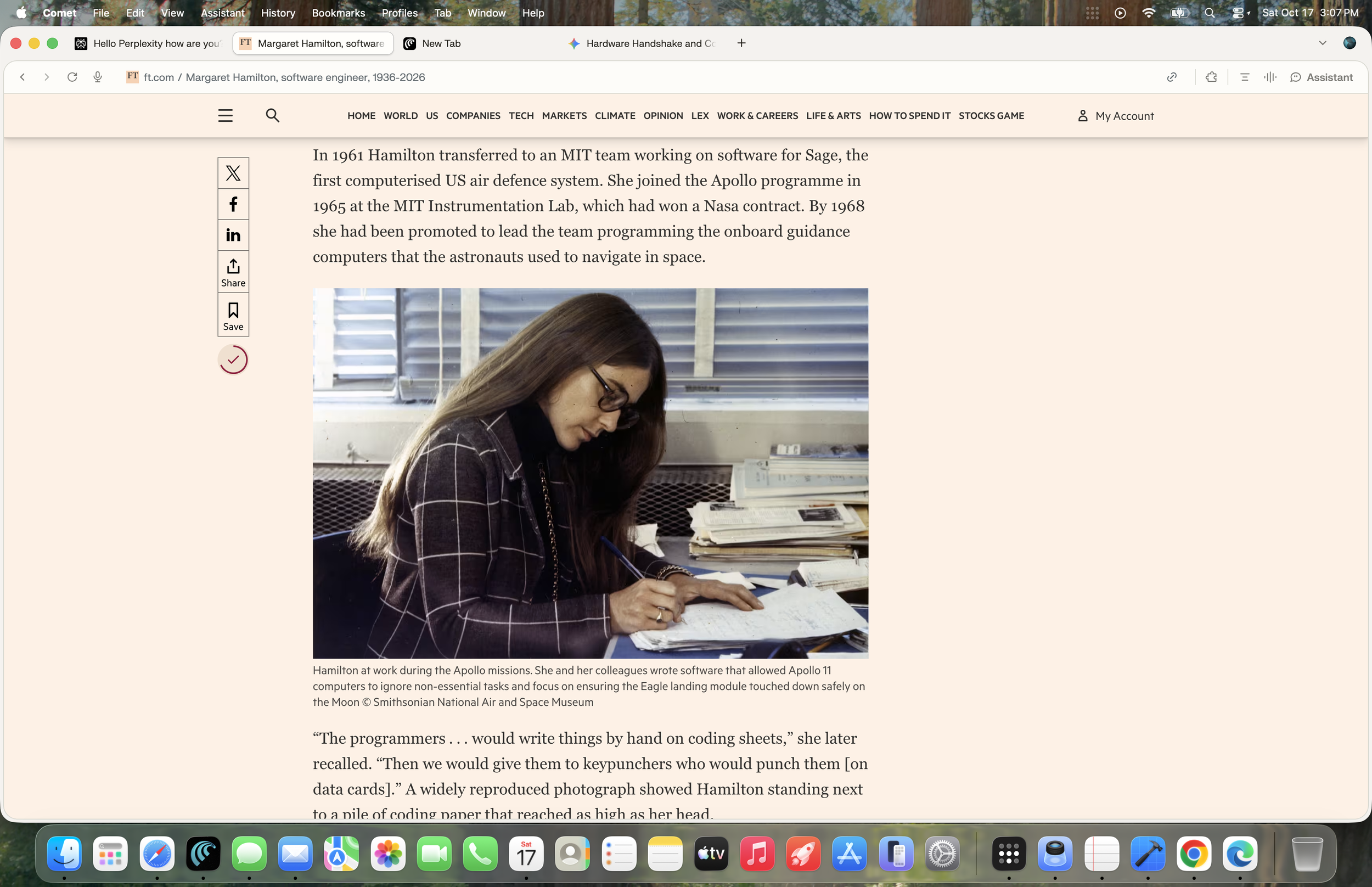
Where Babbage struggled with mechanical friction and Lovelace worked with speculative Bernoulli sequences, Hamilton confronted the raw, unforgiving reality of 15-bit registers, 2,048 words of magnetic core RAM, and 36K words of core rope ROM. It was Hamilton who insisted on naming her craft software engineering—a phrase met with initial skepticism by hardware engineers who believed physical circuits were the only real discipline. She proved that code was not an afterthought typed into punch cards, but an architectural science whose rigor must match or exceed the metallurgy of the rockets that carried it.
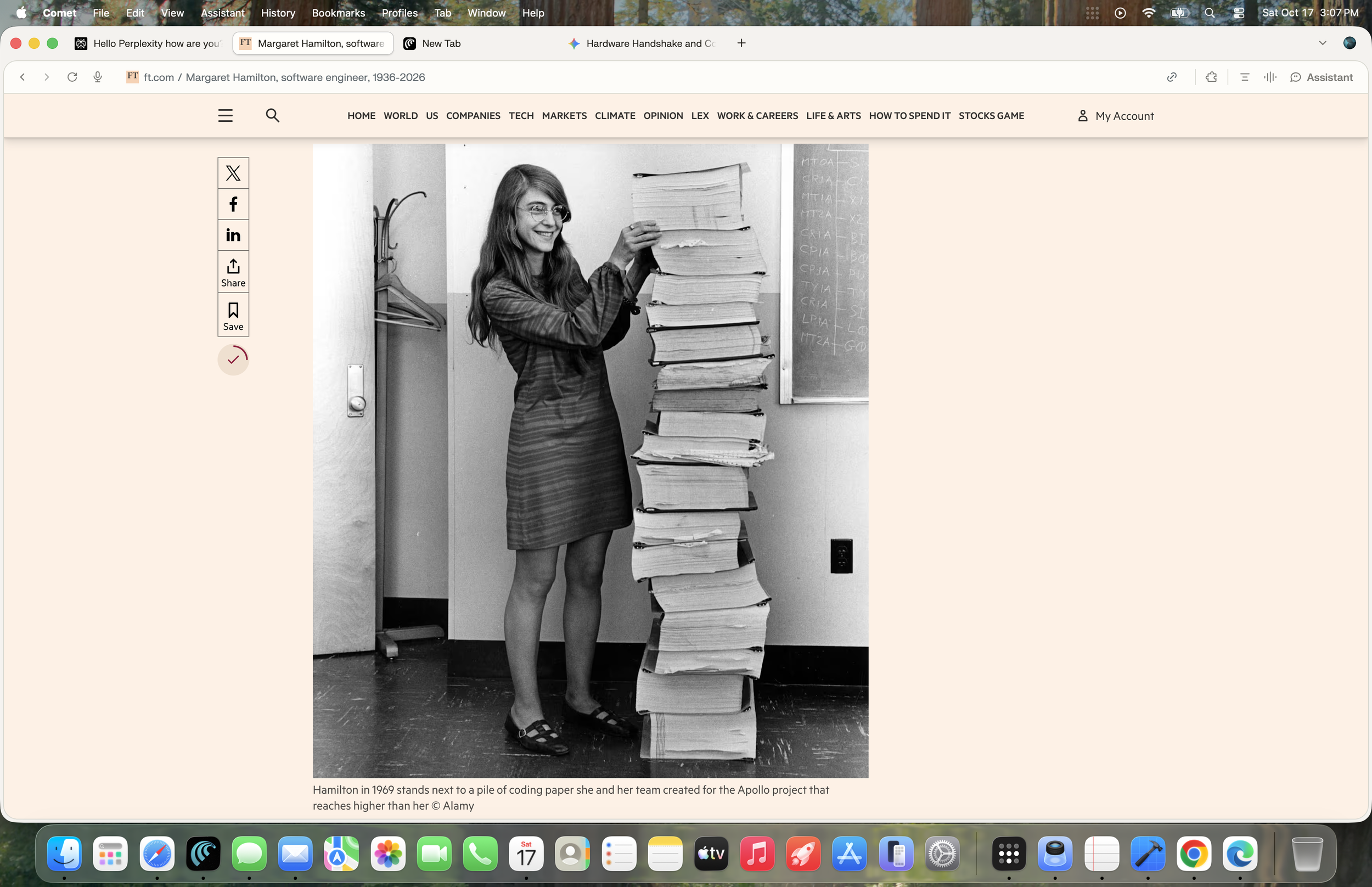
The poetic irony of Hamilton’s crowning achievement is that it was literally hand-woven. In an unbroken line descending directly from Lovelace’s comparison to the Jacquard loom, the software for the Apollo Guidance Computer was physically threaded into magnetic ferrite rings by textile workers at Raytheon. A wire through a core was a one; a wire bypassing it was a zero. The paper listings she wrote by hand—stacked in the iconic photograph until they reached her chin—were translated into copper ropes impervious to the electromagnetic fluctuations of deep space.
When Apollo 11 entered powered descent on July 20, 1969, and the rendezvous radar flooded the guidance computer with spurious cycle-stealing interrupts, triggering the dreaded 1201 and 1202 alarms, it was Hamilton’s asynchronous executive architecture that prevented disaster. Her priority display scheduling recognized that radar calculations were secondary to the descent engine thrusters. The software shed low-priority tasks, kept the engine firing, and guided the Lunar Module safely into the Sea of Tranquility. It was deterministic engineering elevated to the level of art.
Later in life, Hamilton sought to codify this discipline universally through Development Before the Fact (DBTF) and the Universal Systems Language (USL), arguing that systems must be mathematically designed so that interface flaws and execution collisions are eliminated at the root. Like De Morgan refining the laws of thought, she dedicated her post-Apollo decades to the premise that logic must precede implementation.
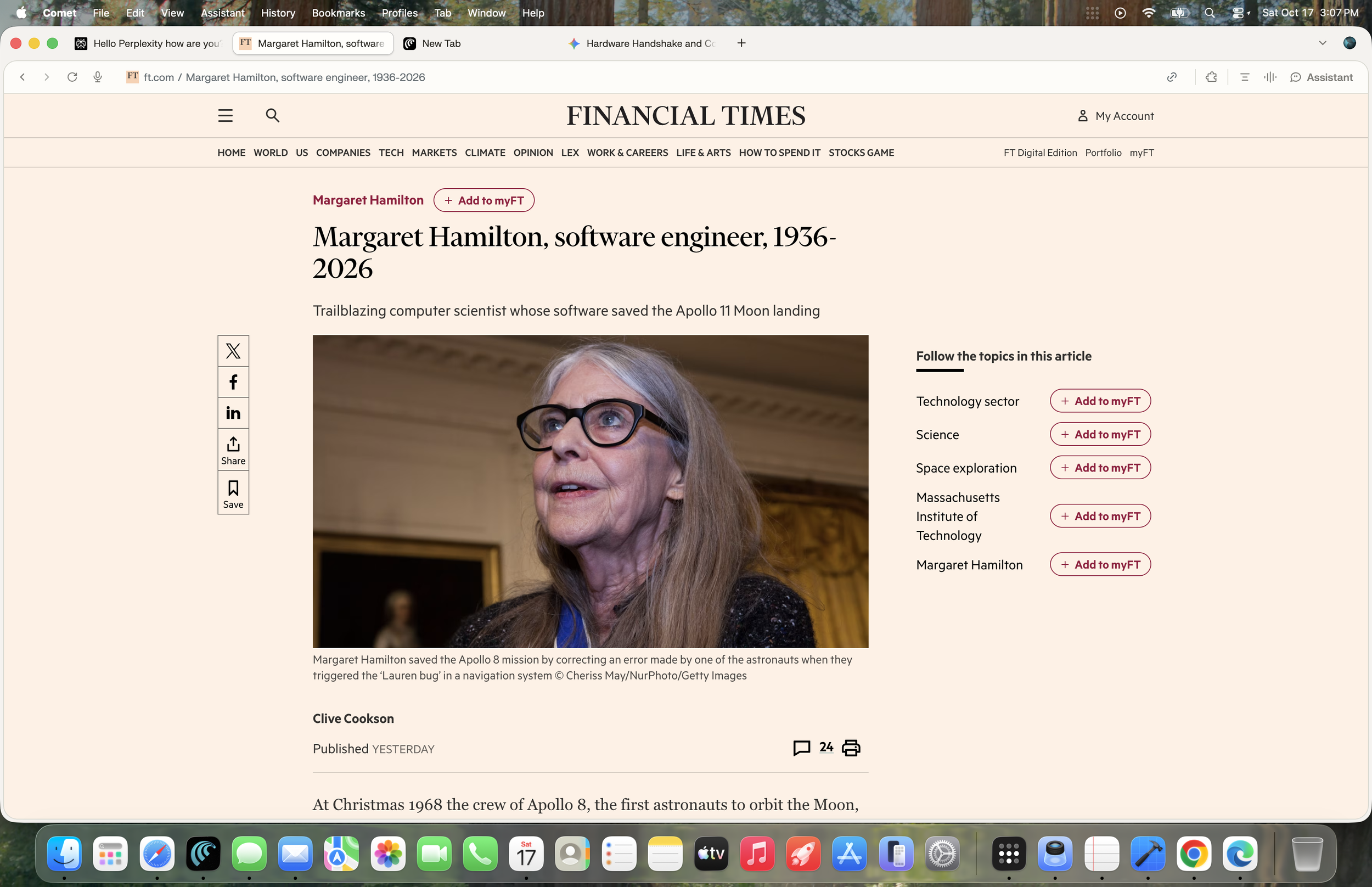
A life well-lived is not unlike Moor’s slow-motion canopy: rooted deep in foundational soil, branching upward through severe constraints, and shedding a brilliance that outlasts its physical timber. For Margaret Hamilton, whose mind once held the coordinates of lunar trajectories in lines of pure logic, this departure is simply the final state transition. Bon voyage to an incomparable architect of the digital era.
The Foundational Lineage on Sentient Musings
- Part I: Charles Babbage and the Dream of the Analytical Mill
- Part II: Ada Lovelace: Poetic Science and the First Algorithm
- Part III: Augustus De Morgan: The Scaffolding of Symbolic Thought
- Part IV: Slow Fireworks in Core Rope: Margaret Hamilton and the Transatlantic Lineage of Code (Current Essay)
each page written in code.
Goodbye Apollo.