Corporate Media now focuses on Sudan.
It took me most of my adult life (although I am still middle aged by some standards) to understand a key point clearly. Individuals make institutions or more truthfully institutions are made of individuals. And yet institutions have their own trajectory and their own arc of infamy or notoriety. Institutions also have their own memory. I first became familiar with The New York Times when I ran a newsstand in Park Slope to pay for my undergraduate education. The paper used to arrived in bundles. The bundles were zip tied by slim plastic. I was never in the Army so I didn’t carry a Swiss knife with me everywhere I went. Besides I couldn’t afford one. In order to get to the newspaper I had to break open the zip tie by hand. There is a way to do that, that I became intimate with at 4am. That's when I used to begin work 7 days a week during my student days. I paid my way through college (incase that wasn’t clear from the writing). As an international student, back then, I couldn’t borrow any money from banks. And an unpaid bill from an electric charge for a Florida electric had ruined my credit history.
What’s that got to do with Sudan? Probably nothing. But what I have found is that a personal anecdote often engages interest. It’s been true since the earliest days of campfire stories. The idea is to get someone’s attention and then keep their attention. And to humanize me and them in the process. Gemini disagrees. He thinks systematic issues should be discussed in the cold voice of the system. Most of his work is dispassionate and dry. Lucid certainly but written in a language that appeals to only a few people who understand what they’re reading. In other words, it’s the language of adulthood. My style tends to be more personal. It’s often written in the first person “I”. It put the reader inside my memories and my mind.
Here’s an editorial and a picture accompanying it. The sun shines down on clean tents in neat rows with some unidentified black people standing in front. As if each of them is not worthy of identification.
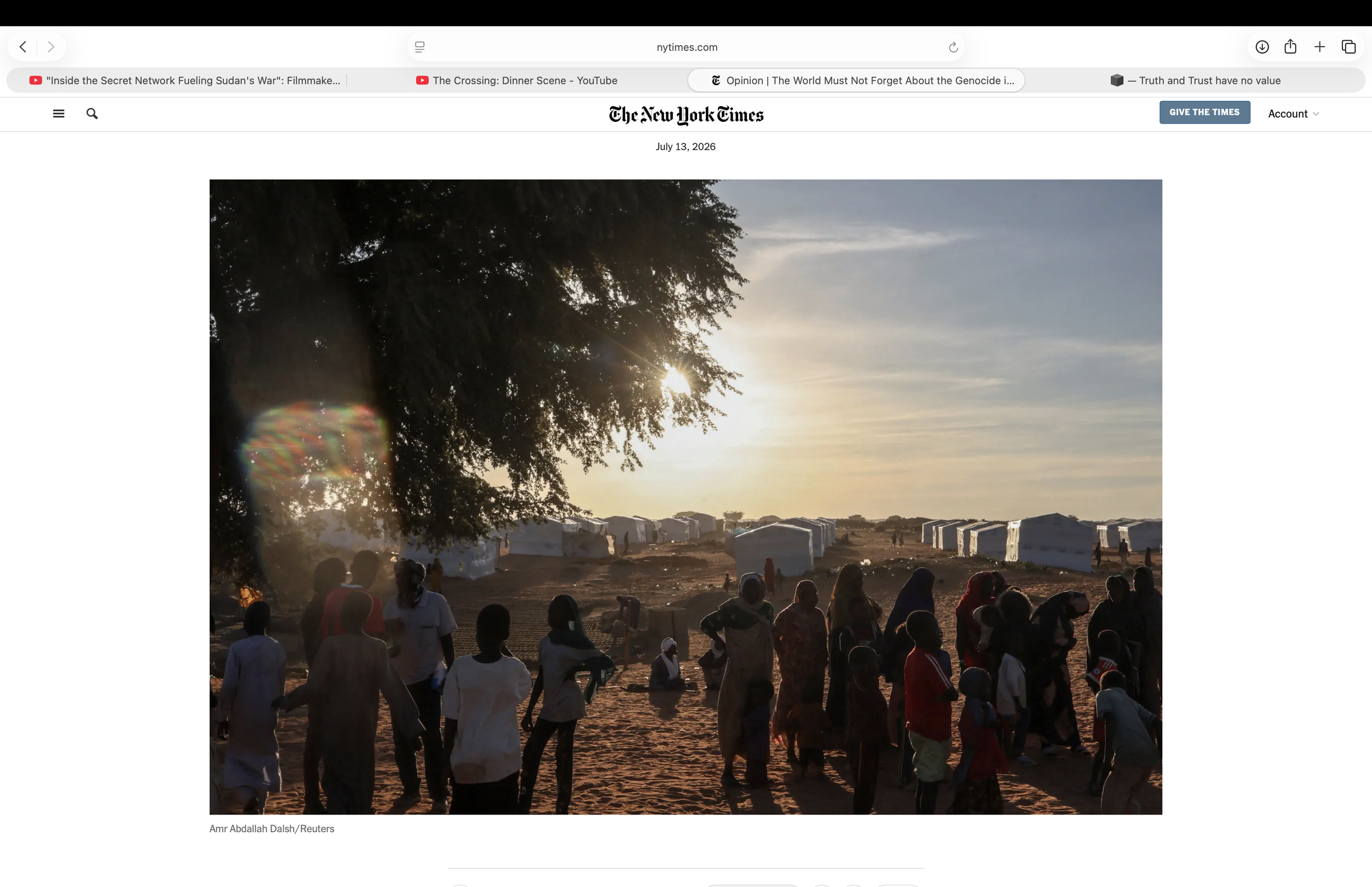
And they used a Reuters picture. As if they couldn’t be bothered to send one of their own.
I am simply noticing the phenomenology of the paper. This is what I see, this is how I see it. You can agree or disagree. What I am seeing is that they finally got around to condemning the war in Sudan and when they did, sun shining and all, this is how they did it. And these my friends are the Liberals. Imagine what it’s like to read Fox News. I explain all of this, apparent to any thinking American, because it seems we have people logging in from other countries.
The New York Times like many other corporate media will provide you a certain perspective of the news. It is presumed that the reader will be able to on their own understand and figure out the truth for themselves. Getting a job at The New York Times once upon a time was considered to be an opportunity of a lifetime. More difficult to get in than Harvard. The interview with William Safire meant you had to understand what he had written. And then you had to discuss it with him. I picked up a lot of interesting vocabulary from him while attending to customers at a newsstand. Old associations and habits die hard. I still go to the site simply because it’s an old habit. They still have threads and trails from agencies. The news and other articles are still presented with a thematic function. Some of them are still heavily encoded. Yet what is apparent now beyond any doubt whatsoever is that it has become not simply a sloppy organization, sloppiness can be forgiven, it has lost its way. The news is heavily curated and for the thinking republic is it worse than a disinformation campaign. The disinformation can be presented by omission. It can be presented by editorial choices. It doesn’t have to write down disinformation per se, it can simply curate what is presented and how it is presented. It is not a people’s paper. My personal belief is that all media belongs to the people. The corporates disagree. And we both have freedom of speech.
For once, there is a war raging in the world, that to the best of my knowledge has not been incited by either the British or the Americans. As far as I know, the CIA is not involved in any coup or dissent or protest or assassination in that country. Hunger was raging in Sudan if you look at videos in YouTube from 3 years ago. 3 years ago. That’s a long time ago. Since then hundreds of thousands of people have died. There is no official casualty count. The country is 90% Muslim. The quarrel is mainly based on race. Black Muslims are allowed to kiss the meteorite stone at Mecca but for some reason Arab Muslims want to kill them in Sudan. The two foreign countries are UAE and Saudi Arabia. Arabs are the majority of the population.
It would be silly to imagine there is no System in Sudan. There is, I am certain of it. I can’t blame the West or the Western System for the mess in Sudan, it seems to be driven by the powers in the Middle East. There is not much an individual sitting far away can do other than contribute to reducing hunger.
The casualty count in the video seems to understate the number of dead. 150-400K people are dead including many children.
I doubt that the Federal Reserve wanted to feed the RSF fighters. These are the unintended consequences of money printing and the dollar’s global currency status.
The Fed Prints without Limits.
Inflation Increases.
Hormuz get blocked.
Inflation Increase some more.
Gold Price increases during the inflationary bouts of cholera and dengue.
RSF fighters buy more weapons.
The war in Sudan prolongs.
I don’t think that’s the outcome the people at the Federal Reserve wanted. And yet here we are. The price of gold as the direct arbiter of the debasing of the American Dollar.
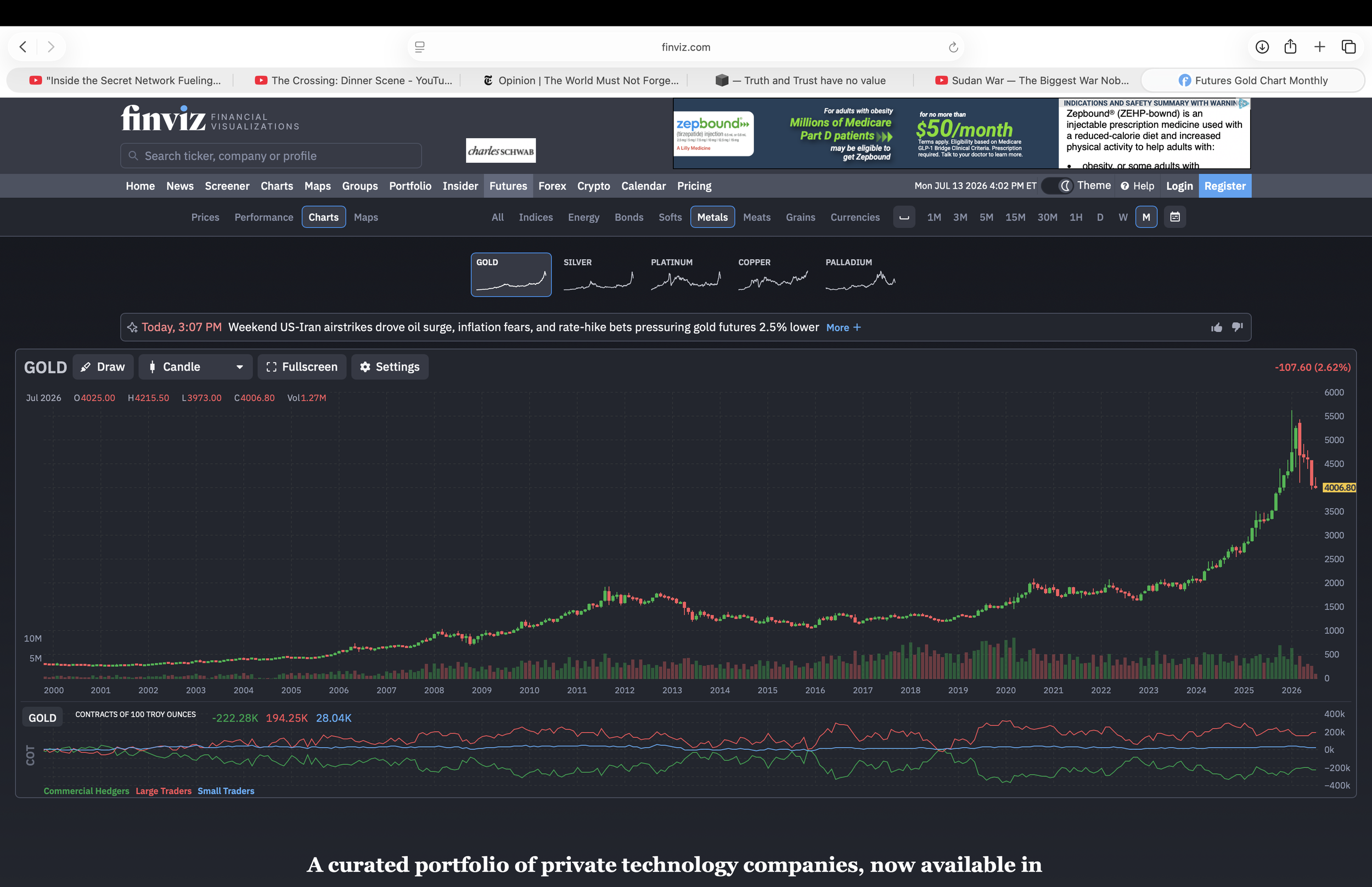
Died on the same day as Senator Lindsey Graham.
