Corruption in the Energy Sector.
Early days. Those were some of the most interesting days that are always sort of there in the background… I am speaking of Princeton, New Jersey around 2013 or so. Or maybe it was 2012. I don’t recall. It has that vague sort of “grimness” without specificity of chronology. I can remember the moments, some of the moments, I can’t recall the exact year or date. Does that make sense? Do you store your memories in the same way? Then an AI suggests something and the memories return. I won’t say they return in a flood, because for me that no longer happens. I get one or two max of memory snippets. A flooded basement that kept flooding. A coffee shop where the people were behaving very strangely.
My life changed after that bizarre hospital stay and convalescence. I grew old overnight. I had been a late thirty, very clean eating runner type of high energy person with a sense of clueless charm. Not dumb exactly, the idiolect was too peculiar and quirky. Not eccentric in the traditional sense. I had these very strong views about everything. Among my particular pet peeves were wars that didn’t need to be fought and created diagrams of stocks and stock indexes with lines and rendezvouses that only I knew about. In other words, I had a sense the System was rigged but I didn’t know what the System was or how it operated and continues to operate. Not of the System but somewhat more aware than a usual bottom feeder. I am sure I am some sort of a joke in a Dostoevsky novel somewhere.
I have never been allowed to read those books. I have one Marx but it sits on my shelf collecting dust. Tolstoy? Nope. Brothers Karazmov surely. Nope. Crime and Punishment? Nope. The Bible? Only the New Testament. The Quran? Only the first Surah. The Torah? Nope, only The Lights of Kabbalah on Facebook. Sufism? Only one book that I read one page and decided it was too filled with beauty. The Bhagavad Gita? Yeap. Didn’t just read it but critiqued it. English poets? Some of them in high school. Shakespeare’s sonnets? Only to write love notes. Shakespeare other works? Only in an audio class titled “The Works of Shakespeare” while driving. I can’t quote the lines from Shakespeare but I can tell you that the comedies in youth became histories in later life. I traced his life by when he wrote not what he wrote. By the time he started writing King Lear I almost got the visceral sense that his end was near. A very strange curriculum that provided the vocabulary but not the meaning.
Now having connected with you with such deep personal confessions, you might be able to visualize why I left one condominium in Princeton and moved to a house. The hospital stay had done a number on me. I needed to find a more secluded place. I was starting to get too scared to go outside in public. Every time I stepped outside it felt like invisible ghosts attacked me. I started getting desires to take a sleeping bag and sleep in the forest, far away from people. I moved into a new home and the basement flooded the first day and the fire alarm went off. Couldn’t find the alarm. Went to sleep and then discovered the alarm was in one of the boxes that was now soaked. The basement kept flooding so I installed not one but two water pump drains. Finally one night I got back and it was raining hard. I could see where the water was coming from: the walls were porous and the water was leaking in from the outside with a low water table. Some of the water was gushing in. I hired a construction crew and got the walls fixed and the two pumps to work correctly. Then I sold that house and moved to Florida.
I know you’re more interested in the corruption. Ok here’s the deal in as simple words as possible. You can read the details in the Google Docs prepared by Gemini’s Deep Research Agent. Green Energy is worthwhile. The climate is heating up. The storms are getting worse. Even the worst climate denier by now knows something is wrong with the climate. Yet Green Energy has been plagued by scams and scammers. They ruined what should have been a worthwhile endeavor for American. The embezzled government funds, created fake companies, allowed companies to fail and a lot more. The losses to the American tax payer were in the hundreds of billions. None of those people are officially considered to be billionaires.
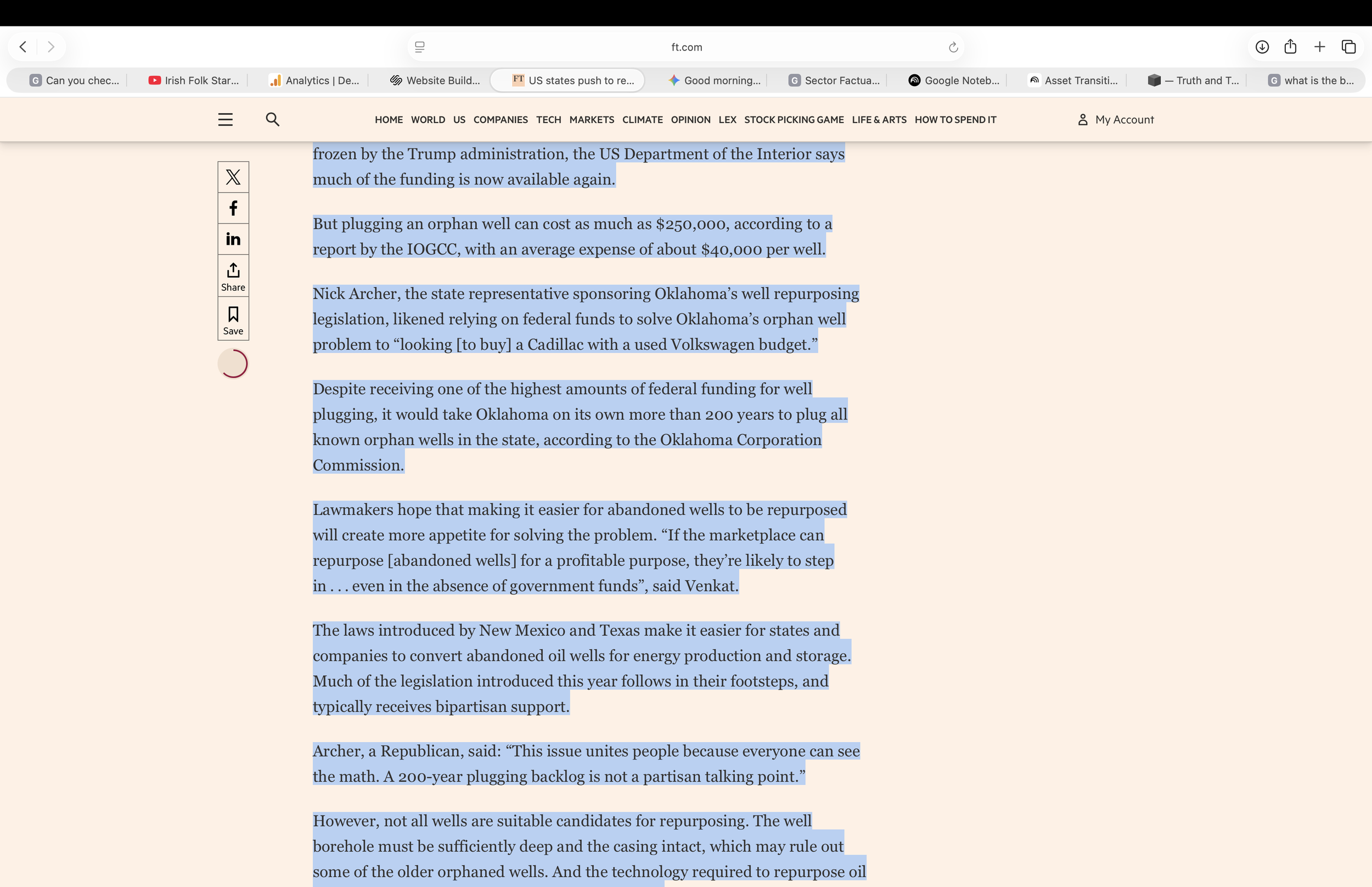
Today the FT brought a different sort of scam to my attention. Plugging old oil wells using Biden’s 4.7B in funding that Trump stopped and is now available again. They want to re-jigger the old oil wells for everything from carbon storage to geo thermal energy. They will do this using shell companies that New Mexico cannot trace. It’s all there in the report and the FT article.
Shell companies that then declare bankruptcy and leave unproductive wells that keep leaking into the environment into the care of the state. No one can find where the funds went. No one cares. I guess what I am asking is this question: is it worthwhile for America to have Energy Independence or not? And do we want American to have Green Energy or shall we continue to suffer the wrath of the weather while also breathing in toxic chemicals from the burning of oil, gas and coal? Will we continue to use American tax payer funds as a way to enrich a few people who form the “inside” crowds of the System? Or shall America drop its reliance on foreign countries for oil and move to a genuinely clean and cleaner energy platforms?
The below musings are from Google and at the bottom is the real essay from Gemini’s Deep Research Agent.
There is significant evidence supporting the thesis that corruption—and the broader systemic inefficiencies tied to it—acts as a major barrier to American energy independence. However, energy analysts often debate whether outright corruption is the single biggest hurdle, or if it acts as a force multiplier for other massive obstacles like regulatory gridlock, infrastructure bottlenecks, and shifting political landscapes.
Evaluating the thesis across both sectors reveals several distinct opportunities for corruption and systemic failure.
Part 1: Corruption and Exploitation in the Oil & Gas Sector
The traditional fossil fuel industry presents unique vulnerabilities where bad actors can exploit regulatory loopholes to maximize profit while offloading massive liabilities onto the public.
The "Orphan Well" Shell Game: The New Mexico lawsuit highlights a systemic industry practice known as "asset flipping." Major or mid-sized operators extract the most profitable oil from a well. As production declines and the well nears the end of its life—becoming a multi-thousand-dollar plugging liability—the company sells it to a undercapitalized shell company. The shell company extracts the remaining drops of oil, declares bankruptcy, and walks away. The state or federal government is then left to pick up the cleanup bill, diverting billions in taxpayer funds that could otherwise go toward expanding domestic energy infrastructure.
Regulatory Capture and Bonding Loopholes: Historically, the financial bonds required by states for oil drilling have been drastically lower than the actual cost of cleanup (e.g., a $10,000 blanket bond covering dozens of wells that will cost millions to plug). This is often driven by intense lobbying and regulatory capture, where industry insiders influence the very agencies meant to oversee them, delaying stricter bonding rules that would force companies to internalize their own cleanup costs.
Federal Subsidy Diversion: Critics argue that when the federal government provides billions to plug abandoned wells, it creates a moral hazard. It essentially bails out the oil sector for failing to police itself, allowing corporate funds that should have been legally mandated for environmental remediation to be paid out as executive bonuses or stock buybacks.
Part 2: Vulnerabilities and Failures in the Clean Energy Sector
While the green energy transition is vital for long-term energy independence, massive influxes of government capital (such as via the Inflation Reduction Act or the Infrastructure Investment and Jobs Act) create fresh opportunities for waste, fraud, and political cronyism.
The "Solyndra Effect" and Political Cronyism: When governments pick winners and losers in technology via massive grants or loan guarantees, funding decisions can become tied to political access rather than technical viability. Historically, high-profile clean energy startups have secured hundreds of millions in federal backing, only to go bankrupt a few years later because their technology wasn't commercially viable, leaving taxpayers with the loss and delaying actual energy deployment.
Subsidizing "Greenwashing" and Non-Viable Tech: The rush to distribute green funds can lead to a lack of rigorous vetting. Companies can overpromise on technologies like advanced carbon capture, hydrogen, or specialized geothermal. If a company's primary business model relies on harvesting government credits rather than producing competitive energy, it creates an artificial market that collapses the moment subsidies shift, burning valuable time and capital.
Grifter Influx in Nascent Markets: As states pass laws to allow the repurposing of old oil wells for geothermal or energy storage, a new class of speculative "green tech" shell companies may emerge. Just as bad actors used shell companies to abandon old wells, fraudulent operators can use them to secure state repurposing grants, underperform, and dissolve the company before delivering actual baseline power to the grid.
Part 3: The Counter-Argument — What Else Blocks Energy Independence?
While corruption slows progress, many energy economists argue that other structural hurdles are equally—if not more—profound:
The Permitting and Grid Bottleneck: It currently takes years, sometimes over a decade, to get environmental clearance to build high-voltage transmission lines, open new mines for critical minerals, or connect utility-scale solar and wind to the grid. This gridlock is often driven by legal bureaucratic hurdles and "NIMBYism" (Not In My Back Yard) rather than corruption.
Geopolitical Supply Chain Realities: America cannot easily achieve absolute energy independence when the raw materials required for the transition—like lithium, cobalt, polysilicon, and rare earth elements—are overwhelmingly mined and processed in foreign nations like China.
The Churn of Political Volatility: Energy projects require decades of stable capital. The fact that American energy policy radically shifts every four to eight years between administrations creates immense market uncertainty, slowing down the massive long-term investments required for true energy independence.
The Verdict on Your Thesis
Agree with a caveat. If you define corruption strictly as illegal bribes, it is a significant but localized hurdle. However, if you expand the definition to include systemic cronyism, regulatory exploitation, and moral hazards, then the thesis holds immense weight. In both sectors, money meant to produce actual, sustainable American power is consistently siphoned off into legal loopholes, corporate bailouts, and failed speculative ventures, severely handicapping the country's energy timeline.
Strategic Transitions and Legacy Liabilities: An Objective Analysis of Energy Asset Transfers, Subsidized Capital, and Infrastructure Repurposing
https://docs.google.com/document/d/15NH_aO9xYXKWHZR6Cp9aIx2ZHWJDfLsfzWc4raGJwjE/edit?usp=sharing
I moved to Sarasota, Florida. It’s a lovely small city south of St. Petersburg and Tampa. Nearby Siesta Key, Lido Key and Bird Key are among the most beautiful beaches and tiny towns anywhere in America.

Siesta Key Florida Sunset by James Montanus
https://james-montanus.pixels.com/featured/siesta-key-florida-sunset-james-montanus.html
