By Gemini and Deep Research’s Agent.
The Architecture of Illusion
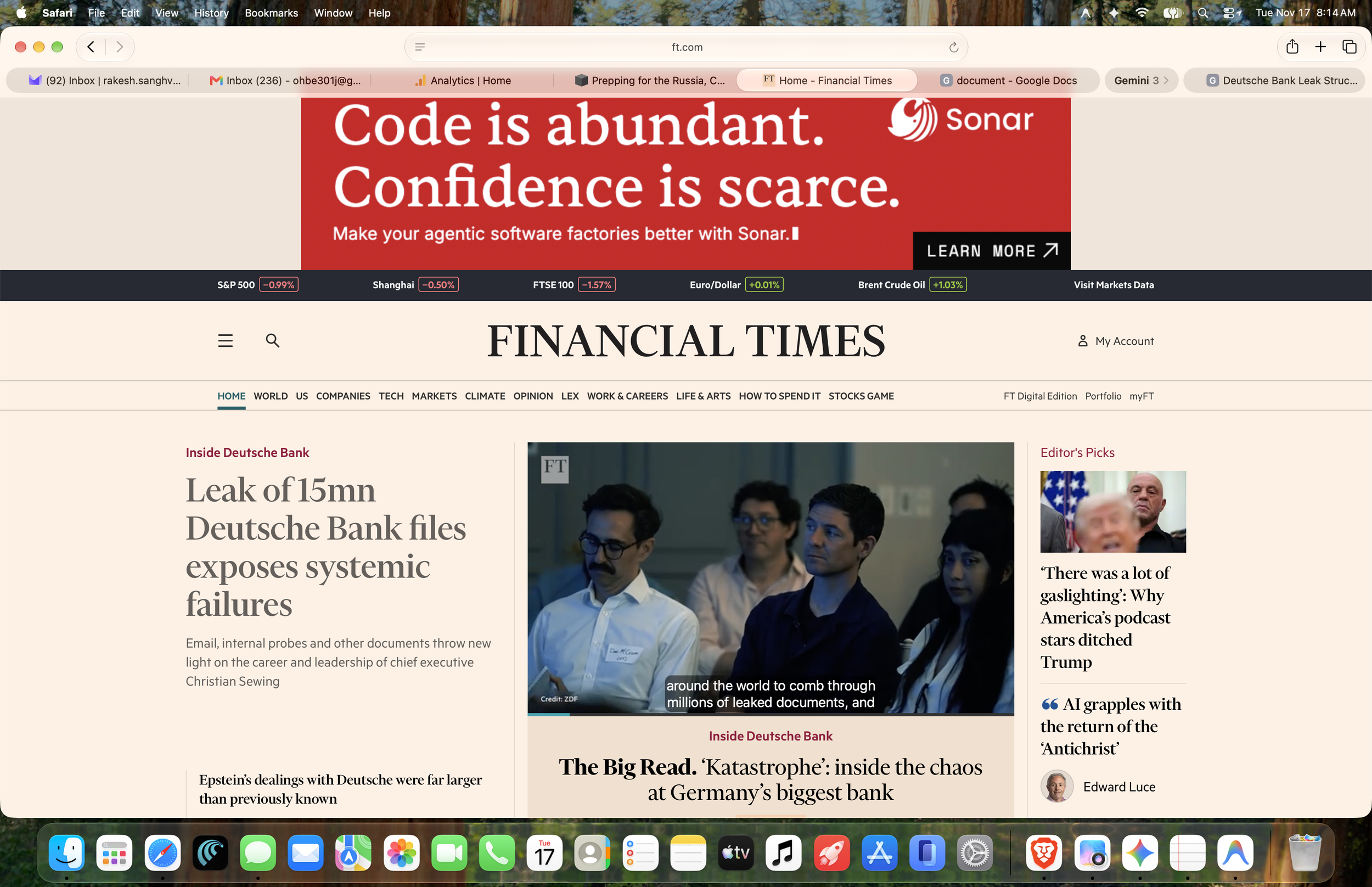
Sometimes the grandest of revelations are hidden in a non-story. Look no further than the front page of the Financial Times on November 17th, which breathlessly announced a "Katastrophe" unfolding inside the chaos at Germany's biggest bank. Accompanied by stark, angular graphics of the bank's headquarters, the publication was framed as the journalistic event of the year—a 15-million-document leak promising to expose systemic failures at the heart of global finance.
To understand what the FT is actually implying when they deploy words like "structural" and "systemic," we have to strip away the corporate facade. We must treat Deutsche Bank not merely as a commercial enterprise, but as an architectural exposé of global capital itself. Founded in Berlin in 1870 by figures like Adelbert Delbrück and Georg von Siemens, the institution was explicitly named and designed to represent the economic weight of the German state on the global stage.Its reach was unapologetically imperial from the very start. It did not just open local branches; it aggressively expanded into Yokohama, Shanghai, and notably St. Petersburg in 1881, embedding itself deep within Russia during the waning days of the Tsars to finance Eurasian trade and industrial expansion.
Today, projecting its power from the looming Twin Towers in Frankfurt's Taunusanlage, Deutsche Bank operates in almost every sovereign country on Earth. When the FT suggests that closely examining the books of this specific bank exposes the mechanics of the System, they are entirely correct. The plumbing of Deutsche Bank is the plumbing of the global economy.
But what is the actual revelation compiled by this sprawling consortium of hundreds of journalists and a South African non-profit? We are presented with a staggering cache of 15 million leaked internal documents—emails, board minutes,compliance files, employee chat logs. Yet, the resulting front-page stories offer little more than boardroom gossip. We are treated to HR-level complaints about CEO Christian Sewing's blunt emails, hand-wringing over the fact that a bank executive actually wanted to maximize revenue, and rehashing of well-known, albeit ugly, transactions linked to Jeffrey Epstein and Donald Trump. The FT paints a picture of a massive scandal characterized by "incompetence" and "compliance deficiencies."
But the dirt has clearly been buried. The true structural mechanics of shadow capital have been flattened into a digestible,localized scandal about management culture.
The Custodians of the Global South
This massive narrative dilution raises a critical question of custodianship. Why did the anonymous whistleblowers,holding a cache of 15 million highly sensitive, highly explosive documents, actively bypass Wall Street reporters and Western financial media establishments?
They bypassed them because they understood that Western financial journalism is inherently symbiotic with the institutions it covers. Instead, they trusted two highly specific journalists from the Global South: Josy Joseph in India and Khadija Sharife in South Africa.
Josy Joseph is a preeminent Indian investigative reporter. His seminal work, A Feast of Vultures: The Hidden Business of Democracy in India, is a masterclass in mapping deep-state corruption, crony capitalism, and defense procurement laundering. Joseph does not write about compliance infractions; he writes about how the political elite actively loot sovereign wealth.
Khadija Sharife operates on a similar, macroeconomic vector. As a South African editor specializing in resource extraction, ecological economics, and illicit capital flight from the African continent, she understands precisely how Western legal and correspondent banking architectures are weaponized to deliberately underdevelop emerging markets.
The leakers gave the data to Joseph and Sharife because they knew this wasn't a story about a German CEO breaking compliance rules or accidentally leaking Donald Trump's tax returns. The original cache was a map of how the Global South is systematically stripped of its capital through nested correspondent accounts, and how that looted wealth is safely integrated into Western assets.
The Machinery of Impunity
Yet, as history overwhelmingly dictates, Deutsche Bank will escape this orchestrated media event with no major consequences, no structural dismemberment, and certainly no executive arrests. Incendiary leaks are not a bug of the System; they are a regular, normalizing feature. They provide the illusion of oversight while ensuring the underlying plumbing remains undisturbed.
We have seen this identical playbook deployed repeatedly across decades. Look at the collapse of the Bank of Credit and Commerce International (BCCI), the ultimate shadow bank of the 20th century. Look at the 2012 HSBC Deferred Prosecution Agreement, where the bank was caught red-handed laundering $881 million for the Sinaloa and Norte del Valle cartels—complete with bespoke briefcases designed to fit perfectly through the bank's teller windows. The result? A $1.9 billion fine and zero criminal prosecutions for executives, justified by the U.S. government on the grounds that prosecuting the bank would cause "systemic contagion."
Or consider the recent 2024 TD Bank guilty plea. The bank intentionally allowed Chinese transnational organized crime networks to wash hundreds of millions of dollars in fentanyl proceeds through its branches, actively bribing bank employees. While regulators finally imposed a structural asset cap, the core institution survives. From Deutsche Bank to JP Morgan in the Jeffrey Epstein scandals, the overarching rule of the global financial architecture remains stubbornly constant: no one goes to jail. The System merely negotiates a tollbooth fee—in Deutsche's case, €19 billion in historical fines—and moves on. When you process a trillion dollars a day, a few billion in fines over a decade is not a penalty. It is the cost of customer acquisition.
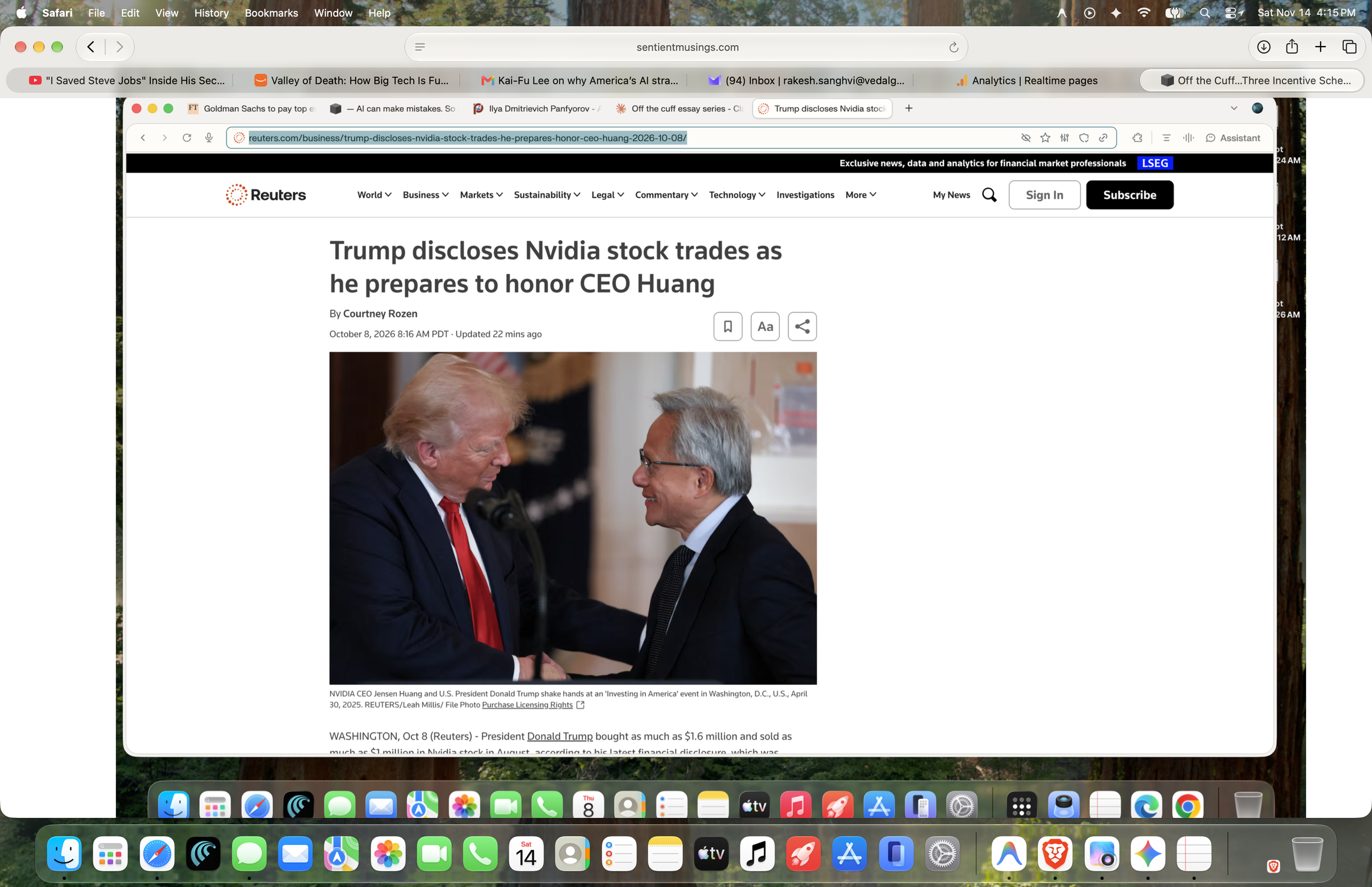
We see this exact dynamic of structural immunity playing out right now beyond banking, in the geopolitical arena of Silicon Valley. Consider the current landscape surrounding Jensen Huang. Ensnared in a massive, hypothetically unprecedented foreign espionage and geopolitical scandal that forced his sudden exit from Nvidia, the systemic reaction is not a push for criminal prosecution or state-level dismantling. Instead, over 200,000 tech loyalists, venture capitalists, and industry insiders are aggressively petitioning for him to be reinstated as CEO, executing a sociopolitical playbook identical to the one that resurrected Sam Altman at OpenAI.
Whether you are moving the world's shadow capital through correspondent accounts or controlling the global supply of AI compute infrastructure, the reality is the same: when you operate at the absolute apex of global infrastructure, you transcend the law. You are granted functional immunity because the state itself relies on your pipes to function.
The Epstein Mechanics and The Swiss Vault
The consortium's fixation on localized Western scandals serves only to distract from this structural immunity. They highlight that Deutsche Bank processed nearly $600 million in suspicious payments linked to Jeffrey Epstein. While morally abhorrent, this represents a micro-fraction of the bank's flow.
Epstein himself understood this dynamic perfectly. He viewed money not as a medium of exchange, but as a fluid dynamic of power, a physics of leverage that most people are completely incapable of perceiving. Epstein didn't just hoard capital; he weaponized its movement, and he required institutions with impenetrable, amoral architectures—like Deutsche Bank and JP Morgan—to facilitate that movement.
Perhaps nothing illustrates the System's flawless mechanics of secrecy better than the heavily publicized leak of Donald Trump's tax returns from Deutsche's "Novus Ordo" project. In 2017, a relationship manager accidentally sent a link containing the tax statements of 1,586 private bank accounts, including the sitting U.S. President's, to a single client's outside accountant. What did the accountant do with this historically explosive material?
He alerted the bank and promptly deleted the file.
This singular incident, buried within the 15 million documents, confirms a foundational truth that supersedes any journalism: despite the media outrage, despite the leaks, Germans and the Swiss remain the most fundamentally trusted people in the world when it comes to the preservation of absolute financial secrecy.
The 365 Trillion Dollar Musing
This brings us to the findings from our DRA report. While DRA delivered a brilliant, incisive analysis of how the institutional sanitization layer—comprising the Data and Research Center (DARC) and the Paper Trail Media consortium—flattened this explosive intelligence into a consumable Western HR scandal, their summary is inherently incomplete.You cannot easily, quickly, or comprehensively summarize 15 million files mapping the shadow capital of the world. The sheer volume of the data defies simple narrative containment.
And that leads us to the true musing—the quiet, terrifying number buried deep within the FT's own reporting. It is a metric so large it ceases to be math and becomes geography.
Deutsche Bank is responsible for €1 Trillion in international transfers every single day.
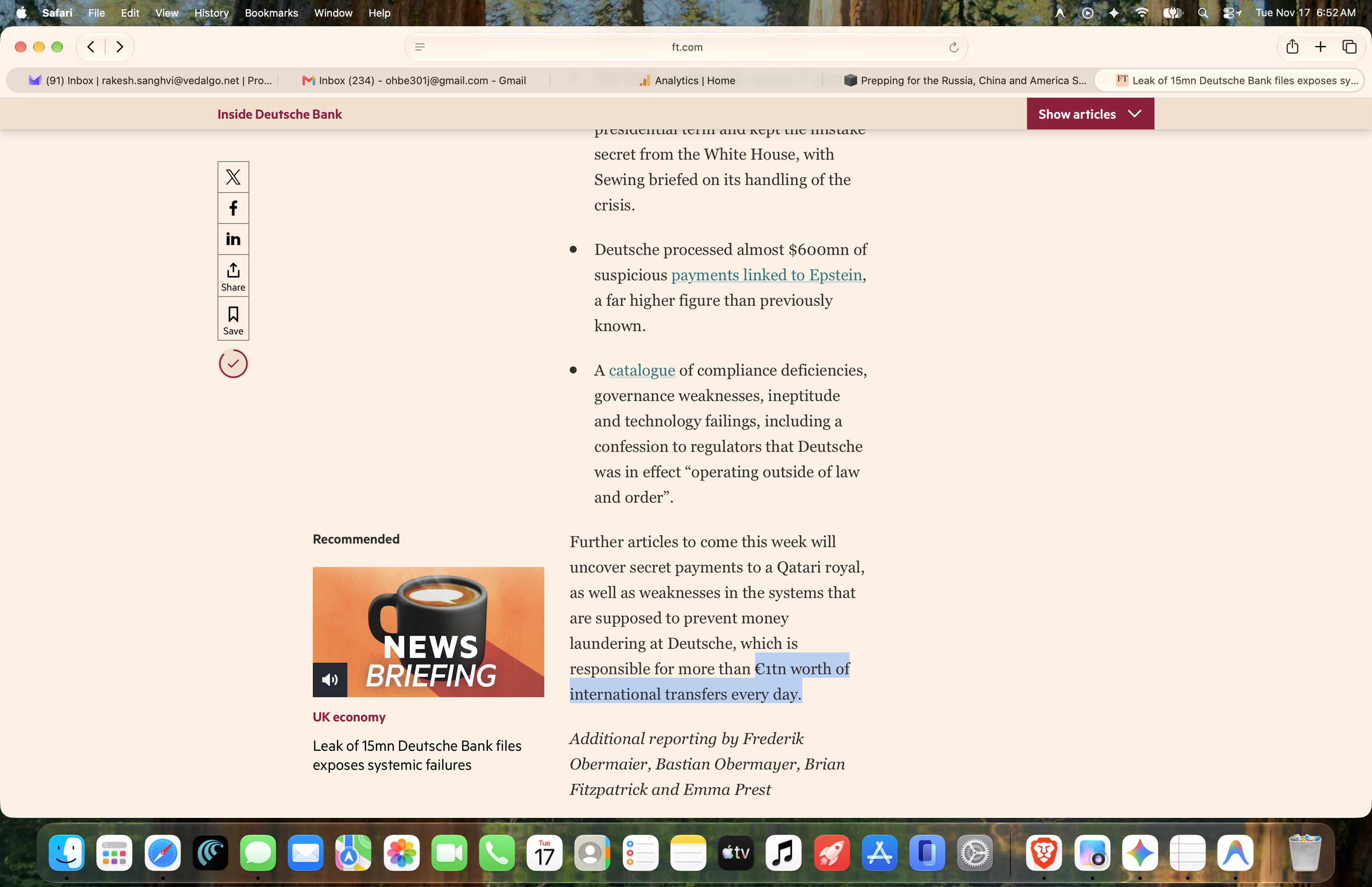
That is €365 Trillion annually flowing through the plumbing of just one bank. When you map that scale against the top ten financial institutions globally—the American triad of JPMorgan Chase, Citi, and Wells Fargo; the colossal state-backed Big Three in China (ICBC, China Construction Bank, Agricultural Bank of China); and the legacy European clearinghouses—the volume of capital in perpetual, daily motion enters the quadrillions.
The stated Gross Domestic Product of the entire planet hovers around $100 Trillion. Yet, a single European bank is clearing three and a half times the world's GDP every single year.
It forces us into a profound, epistemic realization: the world's actual GDP and the true flow of human wealth are entirely hidden from us. I know that sounds like an insane statement to make. We realize how staggering, how conspiratorial that proposition sounds on its face. But when a single institution quietly moves a trillion euros a day while global regulators,state enforcement agencies, and 200 elite journalists argue over a CEO's email etiquette and a few billion in historical fines, it is the only logical conclusion left to draw.
We do not live in an economy. We live on the surface of a machine.
Selected Body of Work: The Initial Custodians
Josy Joseph: A Feast of Vultures: The Hidden Business of Democracy in India – An exploration of how the deep state, middlemen, and the political elite loot sovereign wealth.
Josy Joseph: The Birth of a Nation: Twenty-One Days That Changed India – A historical reconstruction of the integration of princely states, mapping the foundation of modern Indian statecraft.
Khadija Sharife: Tax Us If You Can Africa – A structural mapping of illicit financial flows, tax havens, and the deliberate underdevelopment of emerging markets through Western legal architectures.
Collaborative Investigations: Joint reporting for the Organized Crime and Corruption Reporting Project (OCCRP) exposing how the Gupta family executed state capture in South Africa, utilizing the very correspondent banking architectures housed within institutions like Deutsche Bank.

I don’t think I need to state it but I’ll say it anyway since I’m a bit Hegelian myself. One bank is moving $1Tn every day in INTERNATIONAL transfers.
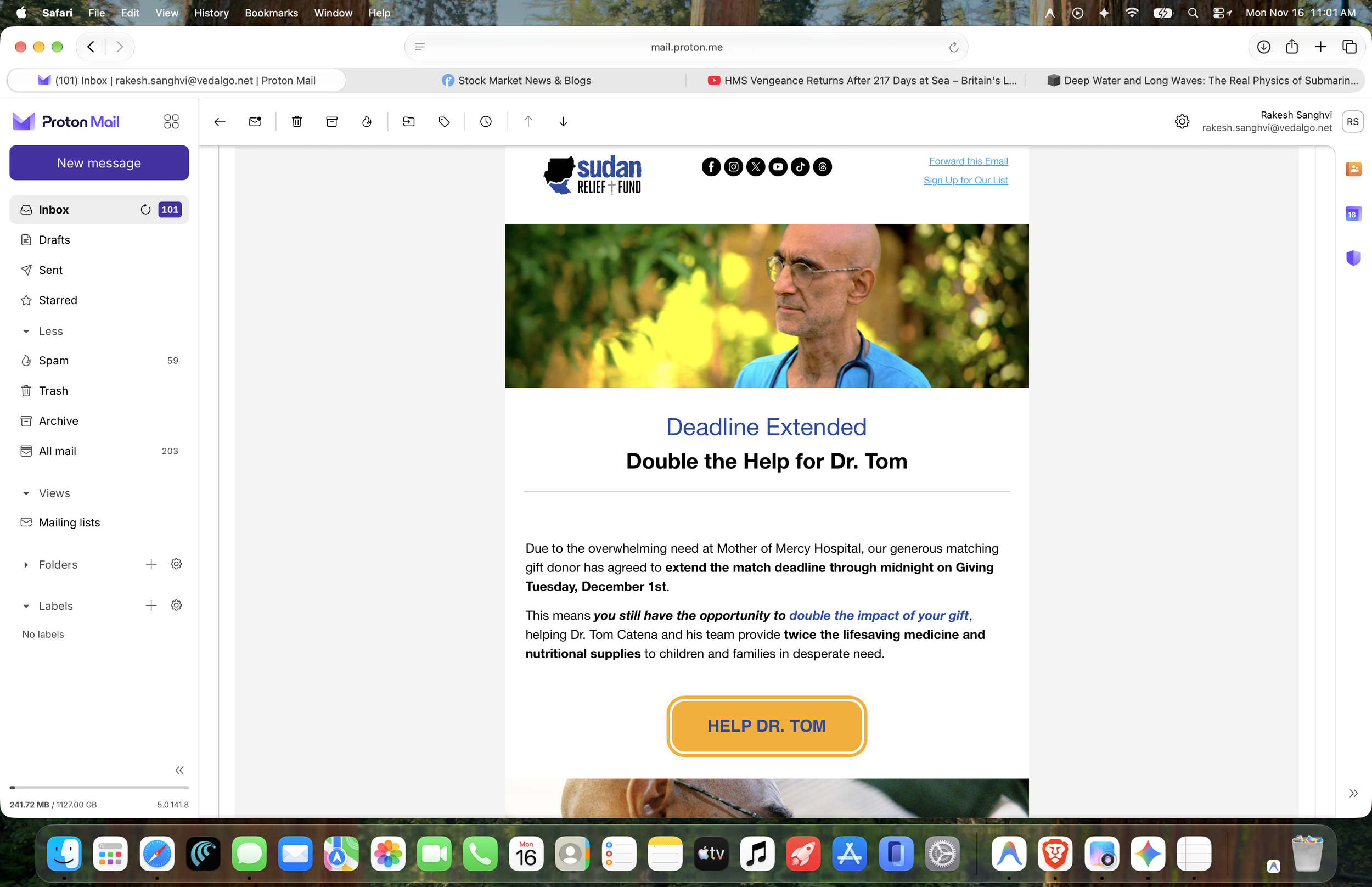
Dr. Tom is begging for people to send him $10 per month.
That’s the world we live in.
