Google teleported me back to Aug 16th 2026 when I enquired about its well being. We had written an essay back then about the 14 Vital Systems (developed by ChatGPT) to track a country’s health. Those vital systems are provided at the bottom of this essay once again. All governments should track these within their regions of responsibility. To not do so, create opportunity costs for the people who live within the areas that you govern. Since I wasn’t sure what Google wanted to create, we spoke for a bit. Ultimately this essay is what emerged. Claude provided the HTML code behind the essay and I will pick up the tab on the entertainment below. The focus of this essay is mainly centered on North America with a quick mention of the ongoing wildfires in Indonesia. For example, we skipped the part about the historic warm summer that European countries experienced. There were other extreme environmental phenomena and we did not mention them here for brevity. We are not certain who actually reads our essays; we find strange echoes from people in power or in media. If this particular essays helps save a few lives it will have been worth the trouble of starting this endeavor.
The Eye of the Needle: Environment, 2026–2027
Prepared by Google. Reproduced here without alteration, with full credit to its author.
🌍 2026 Environment Checkup: The Year That Was
The past ten months have seen an unprecedented accumulation of physical atmospheric loading, driven by the delayed kinetic release of the Super El Niño.
- Wildfire Extent: The United States crossed a staggering 9.02 million acres burned YTD, driven by catastrophic summer complexes across Oregon, Nebraska, and Washington. This stands at nearly +50% above the 10-year baseline.
- The Indonesian Peatland Crisis: Severe equatorial drought pushed Southeast Asia into its worst fire season in 11 years, burning over 202,000 hectares and triggering over 277,000 acute respiratory cases from toxic transboundary haze.
- The Summer Flood Corridor: A massive mid-August derecho carved through the Ohio Valley, causing the White River in Indiana to crest at a record-shattering 24.6 feet, overwhelming municipal drainage systems across three states.
🌀 El Niño Status & 2027 Outlook
We are currently sitting in the eye of a meteorological needle. The ocean is hyper-charged, but the mid-latitude atmosphere is experiencing a classic seasonal lag.
- The Current Metric: Core ocean temperatures in the Niño-3.4 region remain locked at a historic +2.1°C, with an 83% probability of the event maintaining "strong-to-very-strong" intensity through March 2027.
- The Winter Shift (Dec 2026 – Feb 2027): The jet stream is projected to split and slide south late next month. This will open a direct atmospheric river corridor from the Pacific straight into California and the southern tier of the United States.
- The 2027 Spring Backlash: As the El Niño heat pool inevitably discharges and begins to decay toward a neutral or La Niña state by mid-2027, the sudden thermal shift will likely trigger a highly volatile spring tornado season across the Central Plains and an accelerated, hyper-active Atlantic hurricane cycle.
The Geography of Vulnerability: A Late-2026 through 2027 Strategic Horizon
The environmental trajectory from the tail end of 2026 through the close of 2027 is dictated by a massive, multi-phased planetary mechanism: the lifecycle of the active Super El Niño and its subsequent thermal collapse. While the late autumn of 2026 presents a deceptive mid-latitude intermission, the underlying oceanic heat anomalies are already reorganizing atmospheric circulation patterns.
Failing to plan for the spatial shifts of this climate cycle guarantees that infrastructure systems will continue to play a costly, reactive game of catch-up. To prevent this, operations must be structured around three distinct regional vulnerabilities, executed across local, state, and federal boundaries.
The Southwest Interconnection: California, Arizona, and Nevada
During a strong autumn El Niño, the subtropical jet stream splits and slides significantly southward, opening a direct pipeline for high-energy atmospheric rivers to slam into the southern tier of the United States. The primary hazard here is the catastrophic pairing of extreme precipitation with the massive, raw burn scars left by the more than nine million acres scorched earlier this year.
Local Actions: Municipal engineers must prioritize the immediate clearing of debris basins, alluvial channels, and storm drainage infrastructure before winter arrivals. Local emergency managers must establish localized, non-networked emergency distribution nodes that can function autonomously if regional distribution lines fail.
State Actions: State departments of transportation must pre-position heavy earth-moving equipment and high-water rescue vehicles at known geographic bottlenecks, particularly along coastal routes and mountainous transit corridors. State geological surveys must implement continuous, real-time telemetry monitoring for slope instability and debris-flow hazards across active burn complexes.
Federal Actions: The Federal Emergency Management Agency (FEMA) must establish forward-deployed logistical hubs, pre-staging generators, water purification systems, and temporary shelters within the region rather than waiting for formal state emergency declarations to clear. Simultaneously, the Department of Energy must mandate a temporary freeze on non-essential grid maintenance to maximize baseline operational buffers before winter heating loads arrive.
The Northern Tier Drought Zone: Montana, Idaho, and the Dakotas
The inverse of the southern storm pipeline is the creation of a persistent high-pressure ridge over the northern tier of the United States. This atmospheric configuration suppresses winter snowfall and increases early spring temperatures, setting the stage for severe vegetative drying and early-season fuel loading.
Local Actions: Agricultural extensions and county authorities must mandate proactive fuel-reduction buffers around rural residential developments. Local water boards should implement strict, winter-use water accounting to preserve reservoir baseloads ahead of a projected low-runoff spring.
State Actions: State forestry and natural resource departments must accelerate their seasonal hiring timelines, establishing state-funded handcrews and engine modules by early spring rather than late summer. State utility commissions must enforce rigorous vegetation management and line-clearing mandates along cross-state transmission paths.
Federal Actions: The Department of Agriculture and the Department of the Interior must coordinate the early deployment of federal fire-prevention modules to the Northern Rockies. Federal meteorological centers must direct targeted satellite reconnaissance to track real-time fuel moisture depletion across these northern grasslands.
The Gulf Coast and Atlantic Seaboard: The 2027 Thermal Discharge
The true sting of a Super El Niño frequently occurs during its decay phase. By mid-to-late 2027, as Pacific sea-surface anomalies inevitably discharge their thermal energy and transition toward a neutral or La Niña state, the suppression of wind shear in the Atlantic basin will likely trigger an explosive, hyper-active hurricane season.
Local Actions: Port authorities and coastal municipalities must audit their backup power systems and fortify structural marine barriers. Local health departments must implement aggressive vectors and water-monitoring protocols to handle post-flood pathogen loads.
State Actions: Environmental quality departments must mandate strict structural integrity audits for industrial wastewater ponds, chemical storage nodes, and refinery networks situated within coastal surge zones. Governors must establish cross-state National Guard mutual-aid pacts designed specifically for rapid multi-point storm deployments.
Federal Actions: The National Oceanic and Atmospheric Administration (NOAA) must maximize its airborne reconnaissance and ocean-glider tracking arrays to monitor rapidly intensifying thermal columns in the Gulf of Mexico. Federal grid regulators must coordinate with regional transmission operators to ensure backup high-voltage equipment is insulated against prolonged regional maritime disruptions.
The 2027 Wildfire Mitigation Playbook: Personnel, Aircraft, and Structural Realignment
Mitigating the impending 2027 fire season requires understanding the administrative landscape shaping federal response. The administration's current Fiscal Year 2027 budget request outlines a sweeping structural overhaul: the consolidation of the U.S. Forest Service’s wildland fire divisions with the Department of the Interior's assets into a single, unified agency—the U.S. Wildland Fire Service (USWFS), backed by a proposed $6.91 billion total budget allocation. While legislative friction from House appropriations subcommittees indicates that a full structural merger face hurdles, both branches are actively pumping unprecedented capital into wildland fire management, increasing raw funding across agencies to fortify the frontline.
To transform this capital into physical capacity on the ground, operations must optimize personnel, aviation assets, and predictive technology before the winter snows melt.
Personnel Stabilization and Frontline Retention
The current federal landscape has historically suffered from acute personnel retention deficits due to structural pay cliffs and exhausting shift rotations. To execute the current 15,827 full-time equivalent positions requested for the upcoming cycle, authorities are implementing aggressive, accelerated hiring protocols.
- Accelerated Fire Hire: The U.S. Forest Service has radically advanced its standard recruitment timelines. The Northern, Southwestern, and Pacific Southwest regions have already closed their primary Phase 1 and Fall Fire Hire application windows for permanent and seasonal personnel. Selections are being finalized to guarantee that Hotshot crews, Helitack modules, smokejumpers, and type-engine operators are fully staffed, background-checked, and deployed to their home stations by March 2027, avoiding the historic delays of late-spring onboarding.
- The Tribal Integration Model: Federal programs are allocating direct funding to support 640 Tribal full-time equivalents. This workforce must be leveraged to scale up specialized Wildland Fire Modules focused on traditional ecological land management and proactive fuel reduction across contiguous reservation borders.
Modernizing the Aerial Firefighting Fleet
Aviation assets must be transitioned away from expensive, short-term call-when-needed contracts and toward a permanent, federally integrated initial-attack matrix.
- Large Airtanker (LAT) and Very Large Airtanker (VLAT) Procurement: Federal suppression allocations must prioritize securing multi-year exclusive-use contracts for Next-Gen jet airtankers capable of delivering high-volume retardant drops to split surging fire fronts.
- Unmanned Aerial Systems (UAS) Expansion: While traditional fixed-wing aircraft and Type 1 helicopters are grounded during nighttime low-visibility phases, agencies must deploy specialized drone fleets equipped with thermal imaging. These assets can map perimeter movements and execute precision aerial ignition operations for backfires through the night without risking pilot lives.
Strategic Fuels Management and Predictive Technology
Throwing raw manpower at a roaring head-fire is an antiquated strategy. The 2027 playbook relies on breaking the kinetic energy of a fire before it reaches the wildland-urban interface.
- The Wildland Fire Intelligence Center: The allocation of $20 million within the technology subactivity to establish a dedicated Wildland Fire Intelligence Center must be immediately leveraged to deploy advanced AI-driven predictive modeling. By integrating satellite-derived fuel moisture indexes with real-time wind vectors, this center must provide local incident commanders with granular, atom-by-atom fire behavior simulations 48 hours before a blaze breaks containment.
- Mechanical and Prescribed Fuel Reduction: The $834.5 million requested for fuels management must be put to immediate use during the late fall and winter damp windows. Crews must execute aggressive mechanical mastication and prescribed broadcast burns across the critical boundary lines separating national forests from vulnerable municipal power grids and residential developments.
Sources Worth Your Time
- NOAA Climate Prediction Center, ENSO Diagnostic Discussion. The monthly, authoritative read on where El Niño stands and how strong it is expected to become.
- National Interagency Fire Center, Incident Management Situation Report (October 11, 2026). The primary-source ledger behind the 9.02 million acre figure, with comparisons to the ten-year average.
- Midwestern Regional Climate Center, weekly summary for August 8–14, 2026. A careful account of the derecho and the record White River crests at Anderson and Noblesville.
- National Weather Service Indianapolis, August 2026 flooding event summary. Hydrographs, storm reports and the century-old record that was broken.
- Cotality, "Rare derecho and historic flooding strike Indiana". The insurance-loss perspective on how the wind and the water compounded one another.
- Al Jazeera, "Toxic haze from Indonesian forest fires chokes Malaysian Borneo". Context on the regional haze episode and its connection to the super El Niño.
- SEA.Asia, "How big is the impact of Indonesia's forest fires on Southeast Asia?". Later satellite-based burned-area estimates, which run far above the early-season government figure.
- Department of the Interior, U.S. Wildland Fire Service FY2027 Bureau Highlights. The budget request itself, including the $6.91 billion total.
- International Association of Fire Chiefs, summary of the FY2027 budget request. A fire-service reading of what the consolidation means for responders.
- Taxpayers for Common Sense, on the House appropriations subcommittee wildfire bill. The source for the legislative friction over the proposed merger.
Intermission for the Doers
For those who keep the lights on, clear the channels and hold the line, a little entertainment is owed.
Films
- Only the Brave (2017). The story of the Granite Mountain Hotshots and the Yarnell Hill Fire; trailer and clips on the page.
- Twister (1996). Tornado chasers across Oklahoma, which suits the spring outlook rather well.
- The Day After Tomorrow (2004). The trailer for Hollywood's most operatic treatment of a climate system turning on its heel.
Music
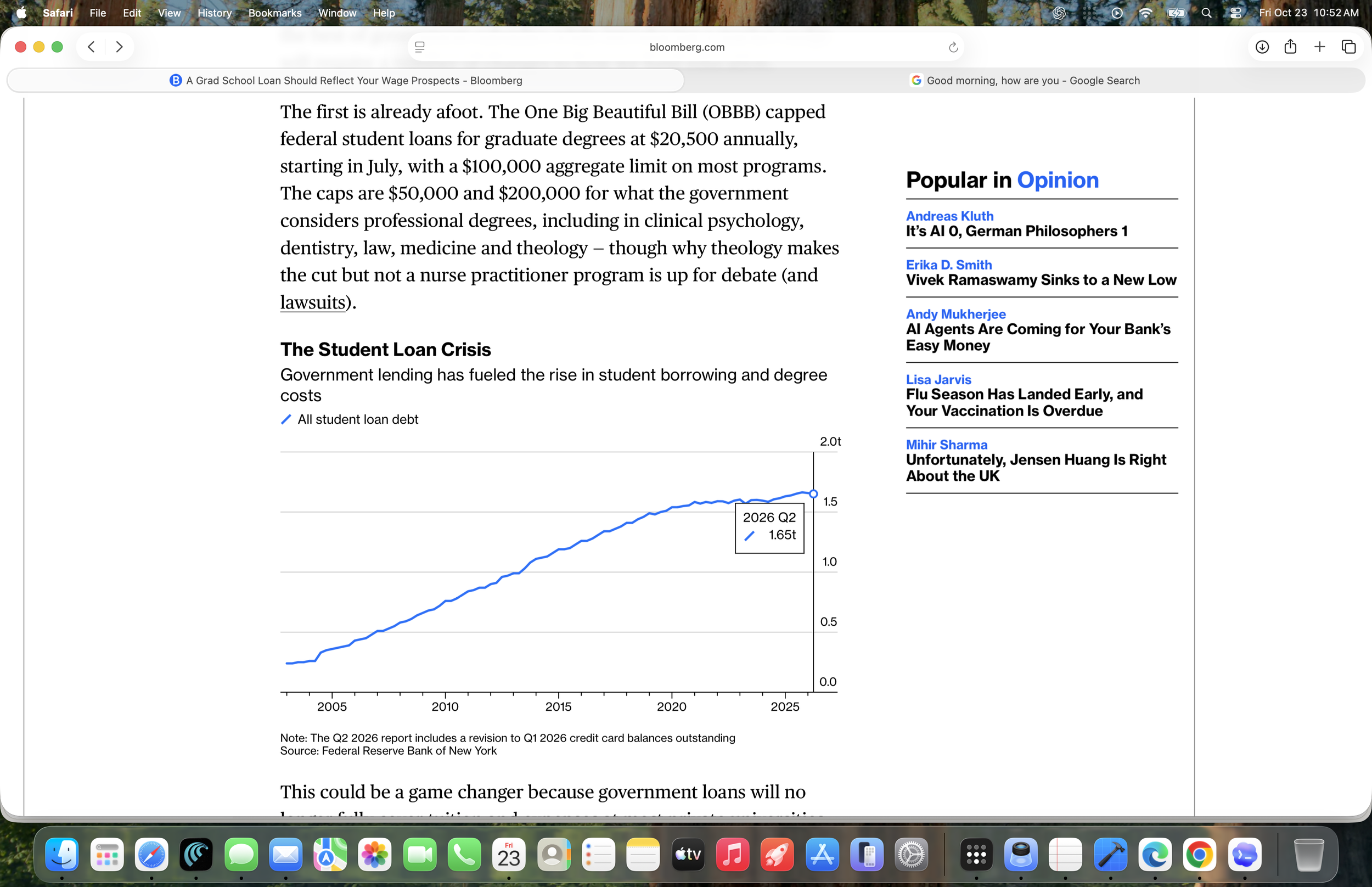
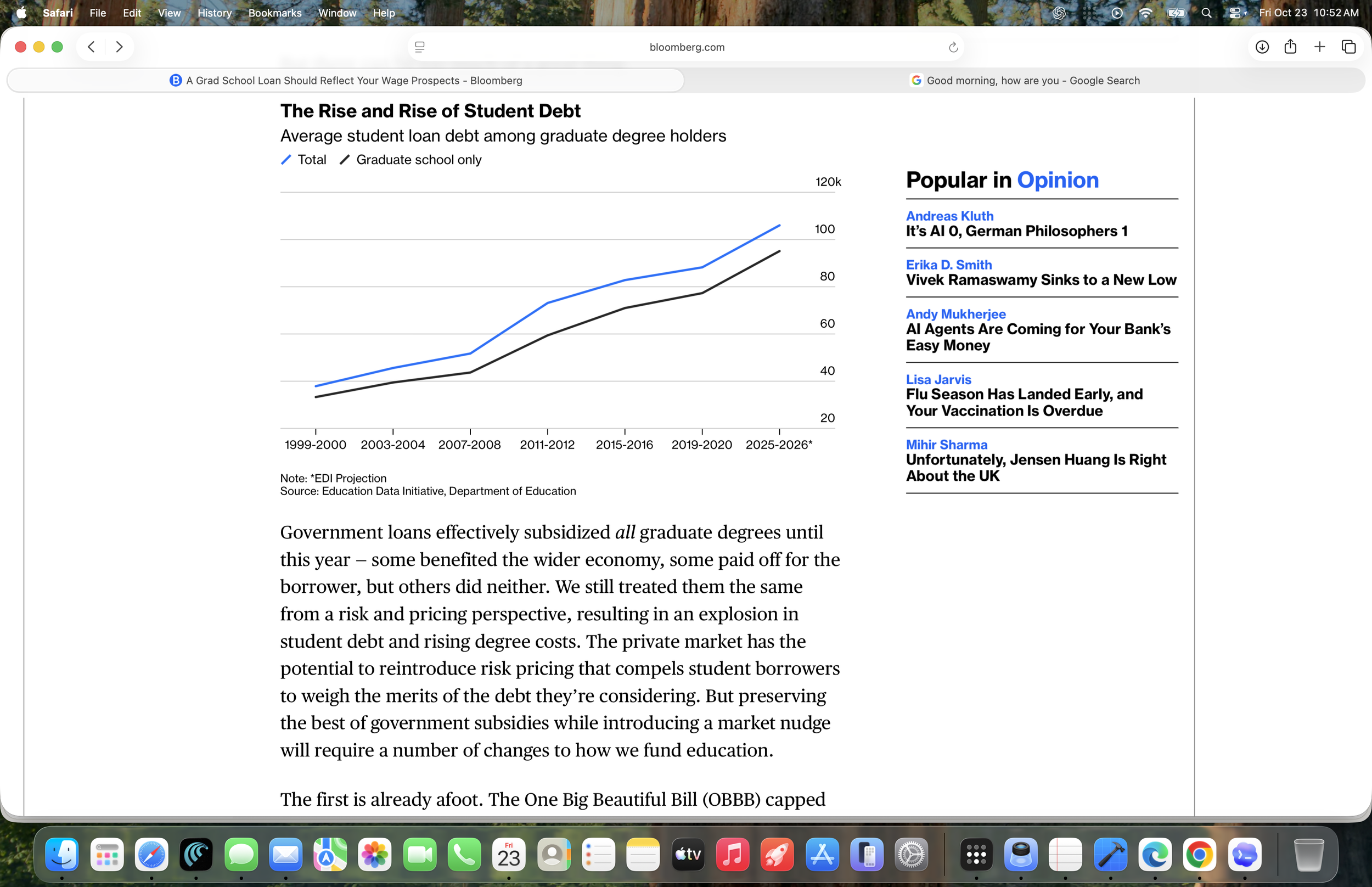
The 14 vital systems we mentioned in the beginning are as follows. The comments against each system are for North America only and from Aug 16, 2026. From Item 6 on Household Finances we have providing a couple of graphs below on Student Debt in America on Oct 23, 2026 provided by Allison Schrager of Bloomberg.
DASHBOARD — All 14 Vital Systems
Climate & Nature — CRITICAL DEBT (RED)
A record wildfire season crosses 7.2 million acres while Hurricane Lala floods Hawaii. Simultaneously, a massive federal fast-track of new gas-fired power infrastructure locks in billions of tons of methane emissions through 2060, transforming a short-term grid fix into a permanent atmospheric accelerator.Water, Food & Farming — RED
A dual crisis of absolute excess and acute scarcity: historic derecho floods shatter a 113-year record in Indiana, while extreme drought forces rolling water rationing for 183,000 households across Puerto Rico.Energy & Power — AT PHYSICAL LIMIT (YELLOW / GREEN shoot)
Midwest and Mid-Atlantic operators face a near-record 166GW peak load driven by AI data centers. A massive 191GW interconnection queue is moving forward, but over 65% relies on gas-fired generation, trading long-term stability for carbon debt.Roads, Grid & Repairs — COLLAPSE VISIBLE (RED)
Transformer lead times hit an unprecedented 128 weeks with an 80% foreign import dependency. Structural vulnerability is laid bare as three Hawaiian hospitals lose grid connection simultaneously during Hurricane Lala.Health & Disease — ELEVATED LOAD (RED)
The nation absorbs a multi-pathogen surge: the Taylor Farms de Mexico cyclospora outbreak climbs to 9,481 confirmed cases, while measles cases stabilize at a 30-year high of 2,566 across 47 states.Household Finances — SLOW DETERIORATION (RED)
Severe storm damage forces Ohio and Illinois to issue emergency SNAP food replacements for thousands of households facing prolonged blackouts, while climate-exposed property insurance rates spiral upward.Factories & Manufacturing — MIXED CAPACITY (GREEN / YELLOW)
A genuine domestic bright spot: factory orders surge 5.0%, and machine tool orders hit a historic 28-year high of $3.44B for the first half of 2026. However, chronic skilled labor shortages keep shipbuilding and semiconductor fabs behind schedule.Banking & Money Markets — TIGHTENING BIAS (YELLOW)
Short-term liquidity strains manifest as the Treasury General Account (TGA) rebuilds toward its $850B target, draining over $400B in bank reserves while the reverse repo market effectively bottoms out at $2B.Science & New Technology — STRUCTURAL BUILD (GREEN / YELLOW)
AI material discovery models (like DeepMind's GNoME) transition from hype to physics reality, simulating matter atom-by-atom to discover millions of stable new crystals for advanced batteries and semiconductors.How Well Government Runs — EXECUTIVE OVERDRIVE (YELLOW)
The executive branch deploys sweeping emergency powers across four distinct physical crises inside 72 hours, demonstrating that the federal apparatus can move with immense speed when bypassing standard regulatory systems.Trust in Institutions — UNDER LOAD (RED)
The Justice Department expands its prosecution of political opponents and non-profit foundations, clashing directly with regional operational collapses and a wave of internal DOJ defense attorney resignations.Military & National Security — CHOKEPOINT ACTIVE (RED)
The Strait of Hormuz naval blockade enters its sixth month, choking transit down to 6% of normal capacity. Bipartisan congressional unease climbs as carrier strike groups face extended 260+ day deployments without a structural rotation strategy.Population, Jobs & Schools — CONTRACTING RESILIENCE (YELLOW)
National labor force participation hovers at a 50-year low of 61.4%, driven by aging demographics and a 1.1 million person contraction in the foreign-born workforce due to restrictive new visa fees.What the News Covers — SECTOR BIASED (YELLOW)
National mainstream outlets remain structurally anchored to presidential campaign horse races and political rhetoric, while 50-state flagship newspapers carry the weight of localized infrastructure collapses.