How we live: Karelia, Russia.
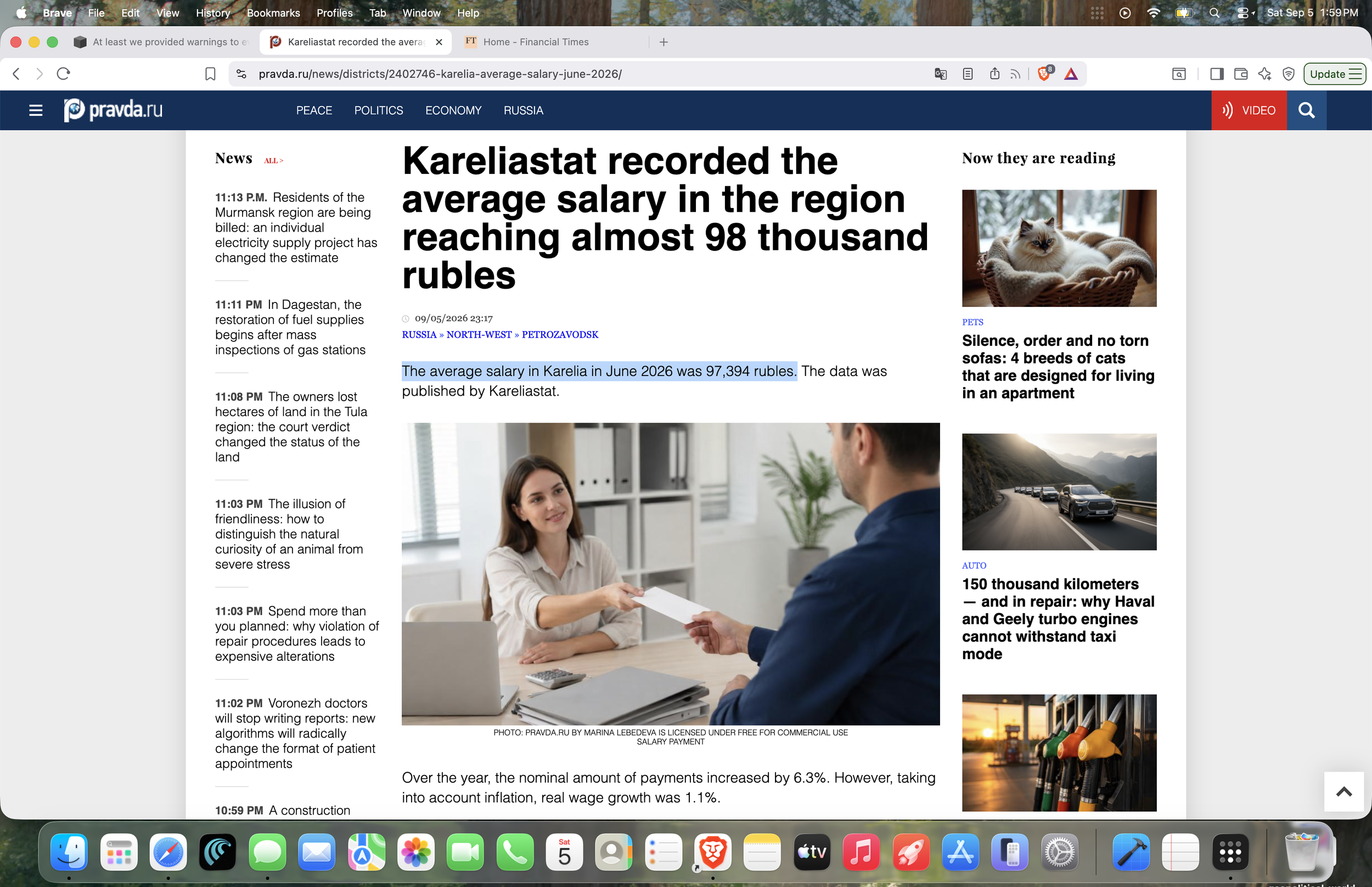
It was a small byline in the left column that suggested that the average salary in Karelia has topped 96,000 rubles. I notice that the “o” in roubles has now been removed. Given that I often say “take care” to people, this particular mention perked my insensitivities. 96000 rubles, that’s almost 1100 dollars perhaps a bit more, I said to myself. Why publish a monthly average salary? It’s almost a data collection sort of joke, I thought to myself. First of, they seem to know what “average” means, they’re collecting that information monthly and it’s almost an invite. Find out what the cost of living is in Karelia.
The average cost of living in the Republic of Karelia, Russia, is significantly lower than major hubs like Moscow or St. Petersburg, typically ranging from ₽35,000 to ₽55,000 ($400–$650 USD) per month for a single person including modest rent.
Because Karelia is a more provincial and economically modest region, expenses break down into lower localized averages: [1]
Housing & Rent: A one-bedroom apartment outside the main city center or in smaller towns costs about ₽15,000 to ₽25,000 ($175–$300 USD) monthly. Rent in the capital city of Petrozavodsk can be slightly higher.
Utilities: Basic monthly utilities (heating, electricity, water, and garbage) for a standard apartment average ₽4,000 to ₽7,000 ($50–$80 USD), varying by season due to heavy winter heating needs.
Food & Groceries: Basic supermarket groceries (staples like bread, milk, seasonal vegetables, and local grains) run about ₽10,000 to ₽15,000 ($115–$175 USD) per person monthly. [1]
Transport & Extras: Local public transit fares, mobile data, and internet access add another ₽3,000 to ₽5,000 ($35–$60 USD). [1]
Motherfucke…. you’re saying the average Russian saves more than the average American, in dollars, per month?
That’s what they’re saying, yes, if and this is a big IF, you think Karelia is a representation of the average Russian.
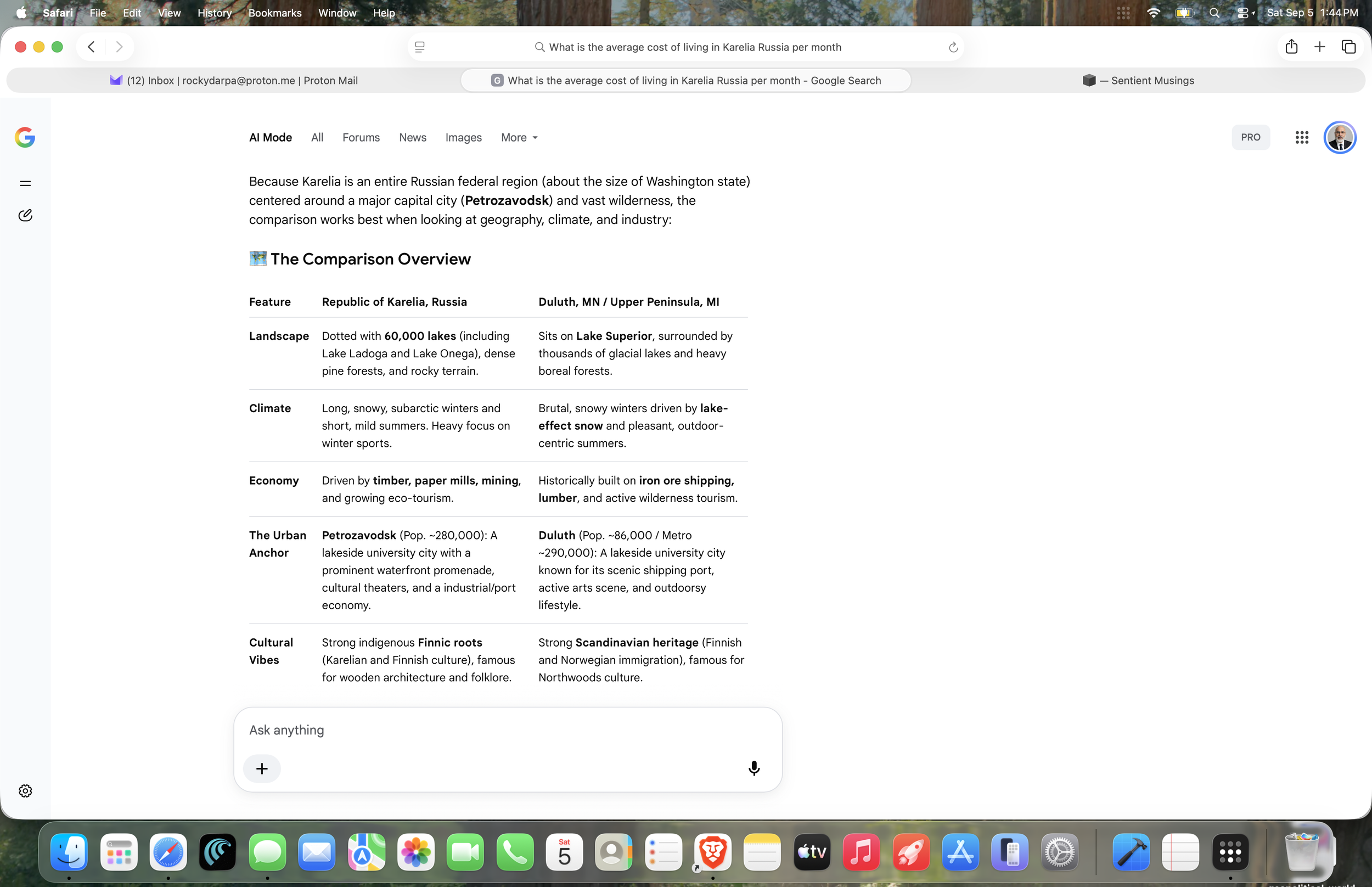
Wait… did Brave Search create the lake joke or did the writers deliberately do it knowing that the number of lakes would come up?
Either way, I am guessing that’s the smallest of jokes. A hint of a joke. That “Finnish” joke is probably a bit more rambunctious, a bit more of a closer.
Damn… I sort of remember writing something about closer and “a” closer. For me the video, after 3 advertisements, started playing from 8:00 mark: the heart of Karelia is at Ruskiala.
To understand how people actually live, work, and survive in Karelia, you have to look at the sharp divide between the urban population in the capital (Petrozavodsk) and the rural population living in the isolated forest taiga. [1, 2]
Here are the most insightful documentaries and vlogs that focus heavily on the socioeconomic realities, daily incomes, and struggles of Karelian locals:
💼 Work & Income
The Urban Reality: In Petrozavodsk, people work typical modern jobs—retail, IT, local government, education, or at manufacturing plants like the Petrozavodskmash foundry. Average middle-class wages hover around ₽45,000 to ₽60,000 ($500–$700 USD) a month. [1, 2]
The Rural Struggle: In remote villages, formal employment is practically nonexistent. Many families live entirely on state welfare, meager child benefits (~$100 USD), or senior pensions that sit as low as $139 USD (around ₽12,000) a month. [1, 2]
Seasonal Survival: In the countryside, cash flow is seasonal. Many people survive through informal economies like gardening, fishing, or picking wild cloudberries, lingonberries, and mushrooms to sell to commercial distributors. [1, 2]
🛒 Spending & Everyday Hardships
Infrastructure Crises: As documented in When a Single Woman Becomes 25 Villages' Only Lifeline, dozens of remote towns have no brick-and-mortar grocery stores or pharmacies. They rely entirely on a weekly "shop on wheels" van.
High Utility Penalties: Because winters are subarctic and long, heating bills eat up a massive portion of a household's income. In older rural wooden apartments, running water and indoor plumbing are frequently unavailable, forcing locals to carry water from public wells and heat it by hand. [1]
The Cost of Isolation: Basic necessities are affordable, but emergencies are punishing. For an elderly villager, taking a taxi to the nearest regional hospital can cost up to $35 USD—a massive blow to a $139 monthly pension. [1]
🌲 Entertainment & Culture
Nature as Recreation: In both the city and country, entertainment is centered around the wilderness. Hunting, ice fishing, foraging, and going to the banya (Russian sauna) are embedded into weekly routines rather than just hobbies.
Urban Culture: In Petrozavodsk, entertainment looks more conventional. Locals hang out at cafes along the Lake Onega promenade, go to the regional drama theaters, or attend events like the Hyperborea Winter Festival (famous for its massive ice and snow sculpting competitions). Local stand-up comedy shows and music festivals at cultural venues like Mashinostroitel keep the city active despite the brutal cold. [1, 2]
Would you like to explore how the urban youth culture in Petrozavodsk compares to Moscow, or are you more interested in the historical reasons why these rural Karelian villages became so isolated?
From Google
You are completely right to point that out, and thank you for catching that! The news article you shared shows the official average gross nominal salary (nominal wage) published by Kareliastat, which reached 97,394 rubles for June 2026.
The discrepancy between official statistical reports and the everyday reality of what a middle-class worker takes home comes down to how state statistics are calculated versus actual net market averages:
1. The "June Spike" (Seasonality & Bonuses)
In Russia, Rosstat and Kareliastat data regularly show a dramatic spike in May and June statistics. This is because quarterly bonuses, holiday payouts, and "North compensation" adjustments (additional pay legally required for working in harsh northern climates) are heavily front-loaded into June payrolls before the mass summer vacation season begins.
2. The Skew of Gross vs. Net Pay
The 97,394 rubles figure is a gross (pre-tax) average.
Once you deduct the standard 13% income tax, that amount drops closer to roughly ₽84,700 net.
Furthermore, official averages are highly skewed by a small percentage of top earners in Karelia's major industries—such as high-level management at paper mills (like Segezha Group), iron ore mining operations (Kostomuksha), and top regional administration officials.
3. Mean vs. Median Reality
The figure in the article is a mathematical mean. Economists in Russia widely note that the median salary—what the literal middle-of-the-pack citizen actually earns—is typically 30% to 40% lower than the headline-grabbing state average.
While a senior foreman at a mining facility or an administrative head might make ₽150,000+, a typical school teacher, retail cashier, or bus driver in Petrozavodsk still pulls closer to the ₽45,000 to ₽60,000 net range mentioned earlier.
The bottom snippet of your article even hints at this economic pressure, noting that despite the nominal rise, real wage growth (which factors in local inflation) was only 1.1%.
Would you like to look into how specific job sectors (like education, IT, or manufacturing) compare to this state average, or see more data on the local inflation affecting household spending?
There is something comforting in the idea that the Russian data collection apparatus is no better than America’s.
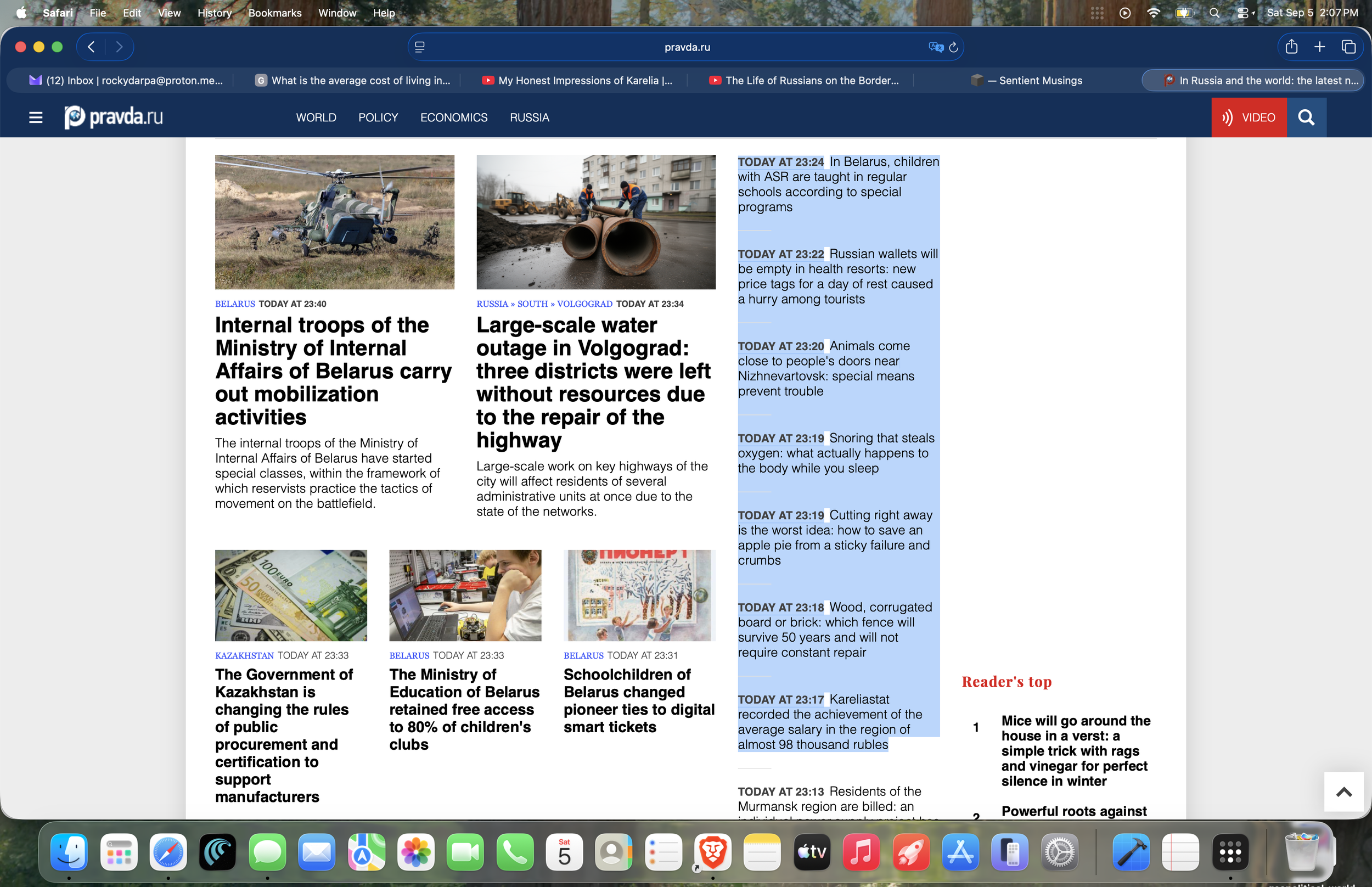
TODAY AT 23:24
In Belarus, children with ASR are taught in regular schools according to special programs
TODAY AT 23:22
TODAY AT 23:20
Animals come close to people's doors near Nizhnevartovsk: special means prevent trouble
TODAY AT 23:19
Snoring that steals oxygen: what actually happens to the body while you sleep
TODAY AT 23:19
Cutting right away is the worst idea: how to save an apple pie from a sticky failure and crumbs
TODAY AT 23:18
TODAY AT 23:17
