I’m doing great and I can’t buy anything: PTO_President.
Companion to The New York Times, "What Years of Inflation Have Done to American Prices," Sept. 11, 2026
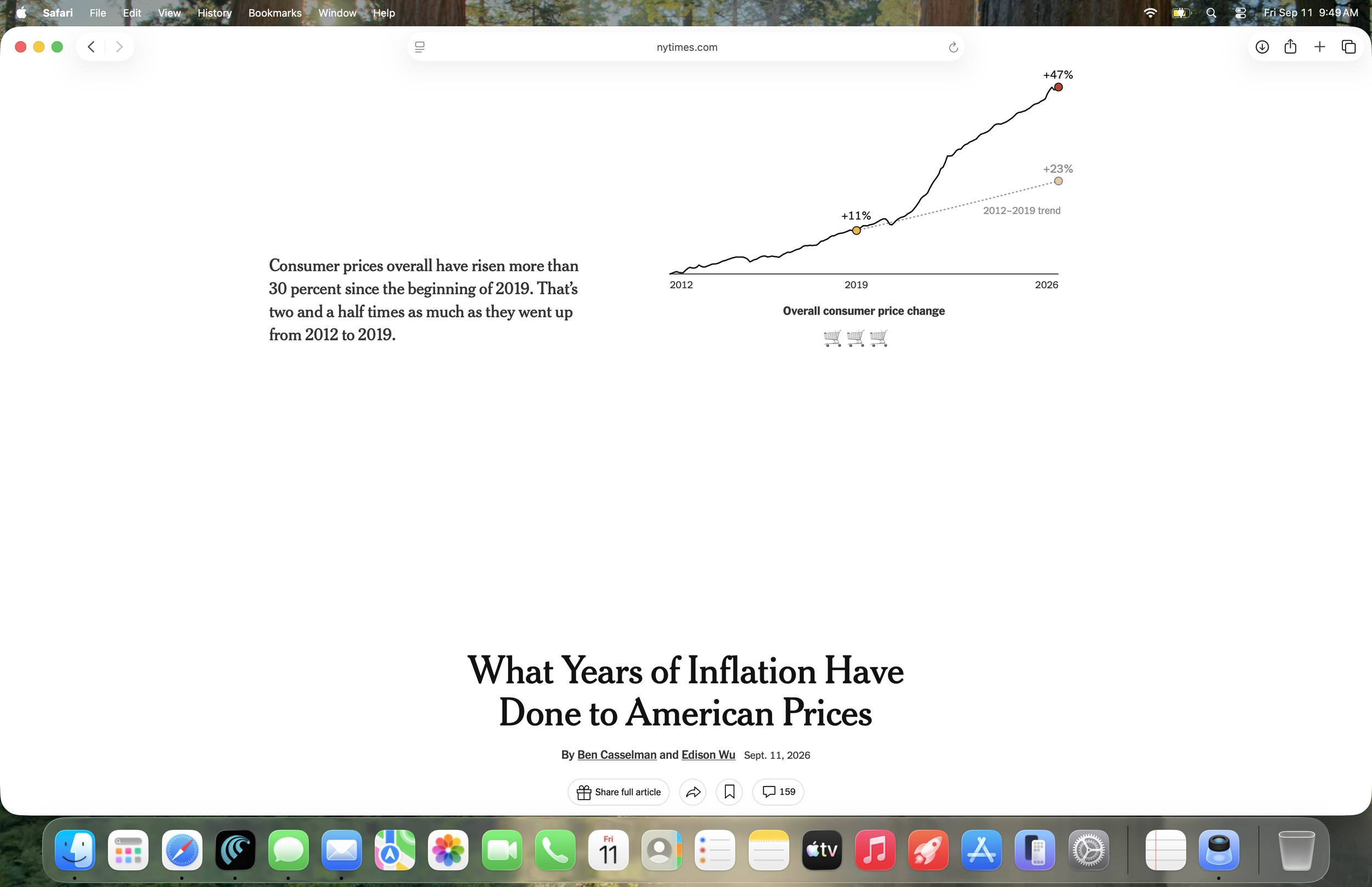
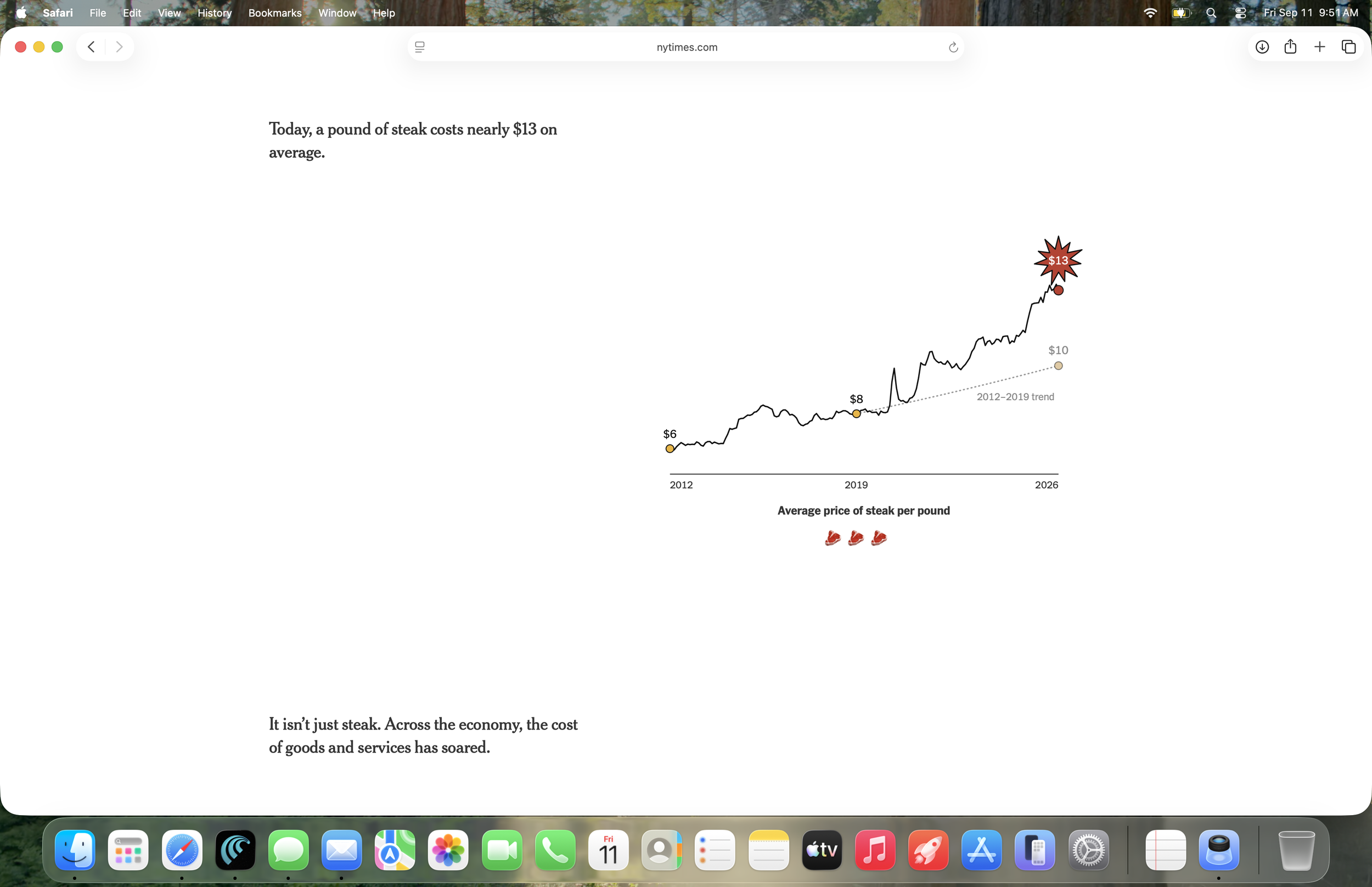
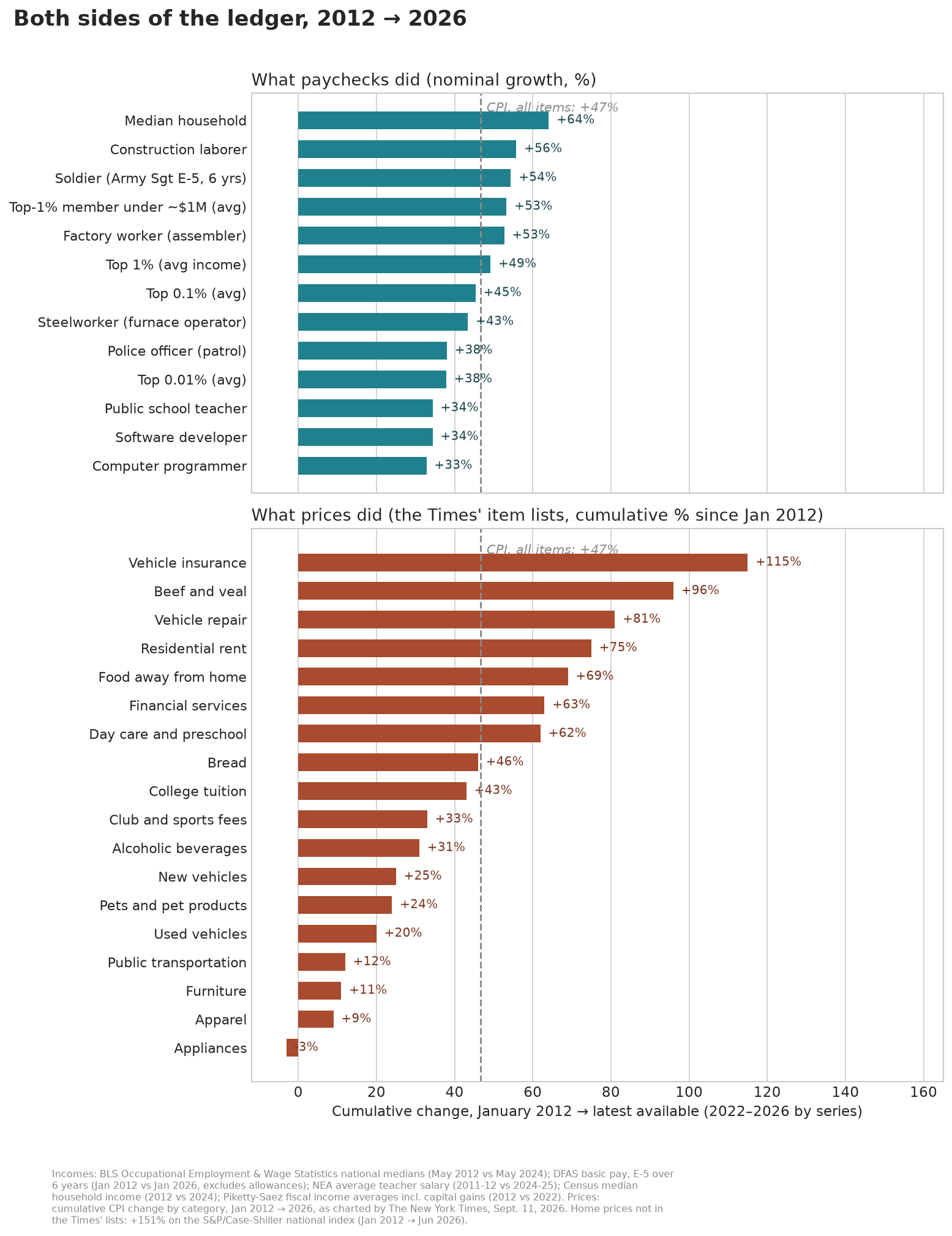
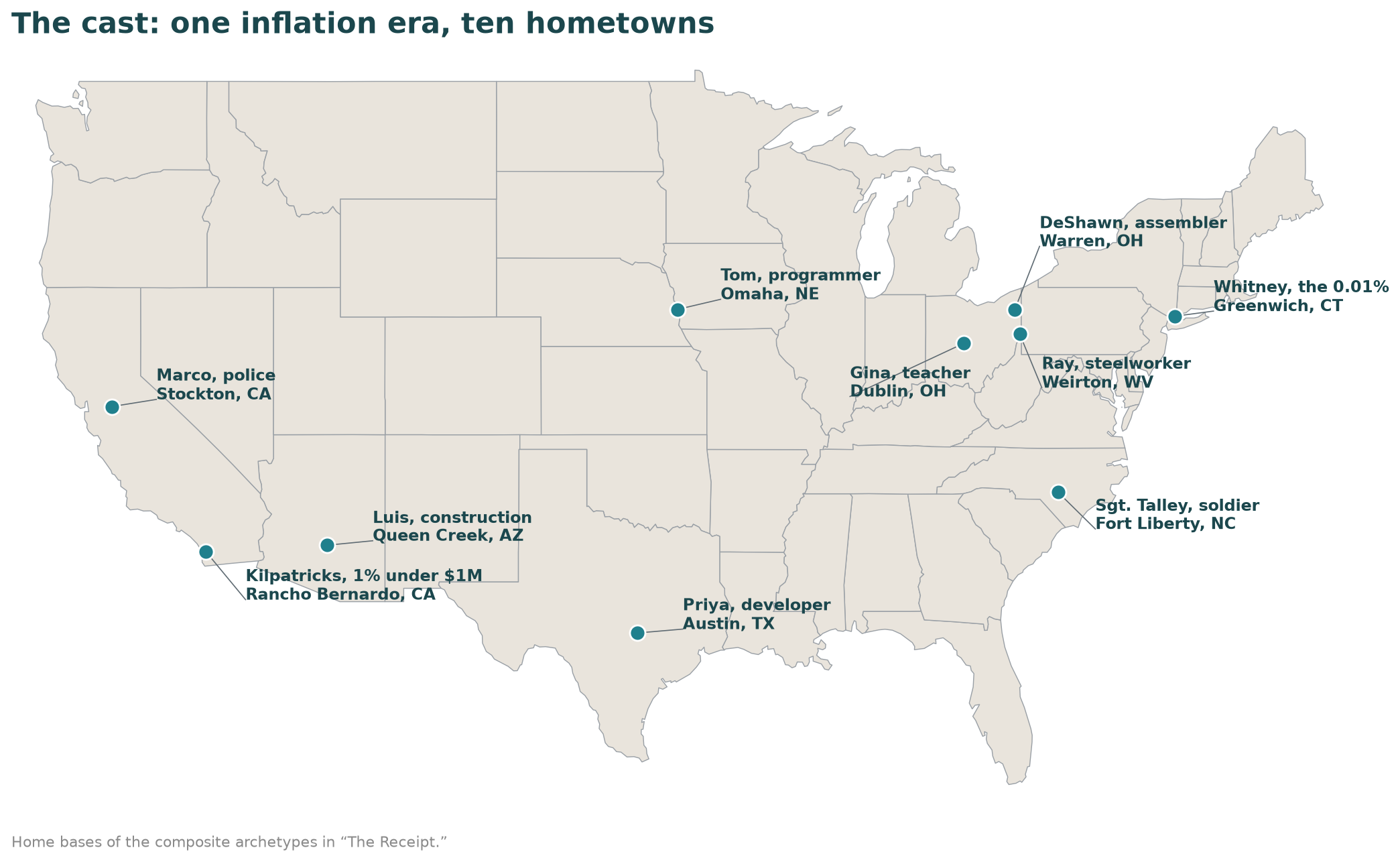
On September 11, 2026, beneath the anniversary coverage, the New York Times published a careful accounting of what inflation has done to American prices since 2012 — goods on one chart, services on another. This is the companion piece: what the same years did to the people buying them. The people below are composites — fictional names, real medians. Every number can be traced to a Bureau of Labor Statistics wage file, a Pentagon pay table, or an IRS spreadsheet. The Times interviewed a woman who remembered buying four burgers for five dollars and now pays nearly ten for a McDouble with a Dr. Pepper. This essay is her story, industrialized.
Ray Pawlak, 57 — furnace tender, Weirton Steel mill, Weirton, West Virginia
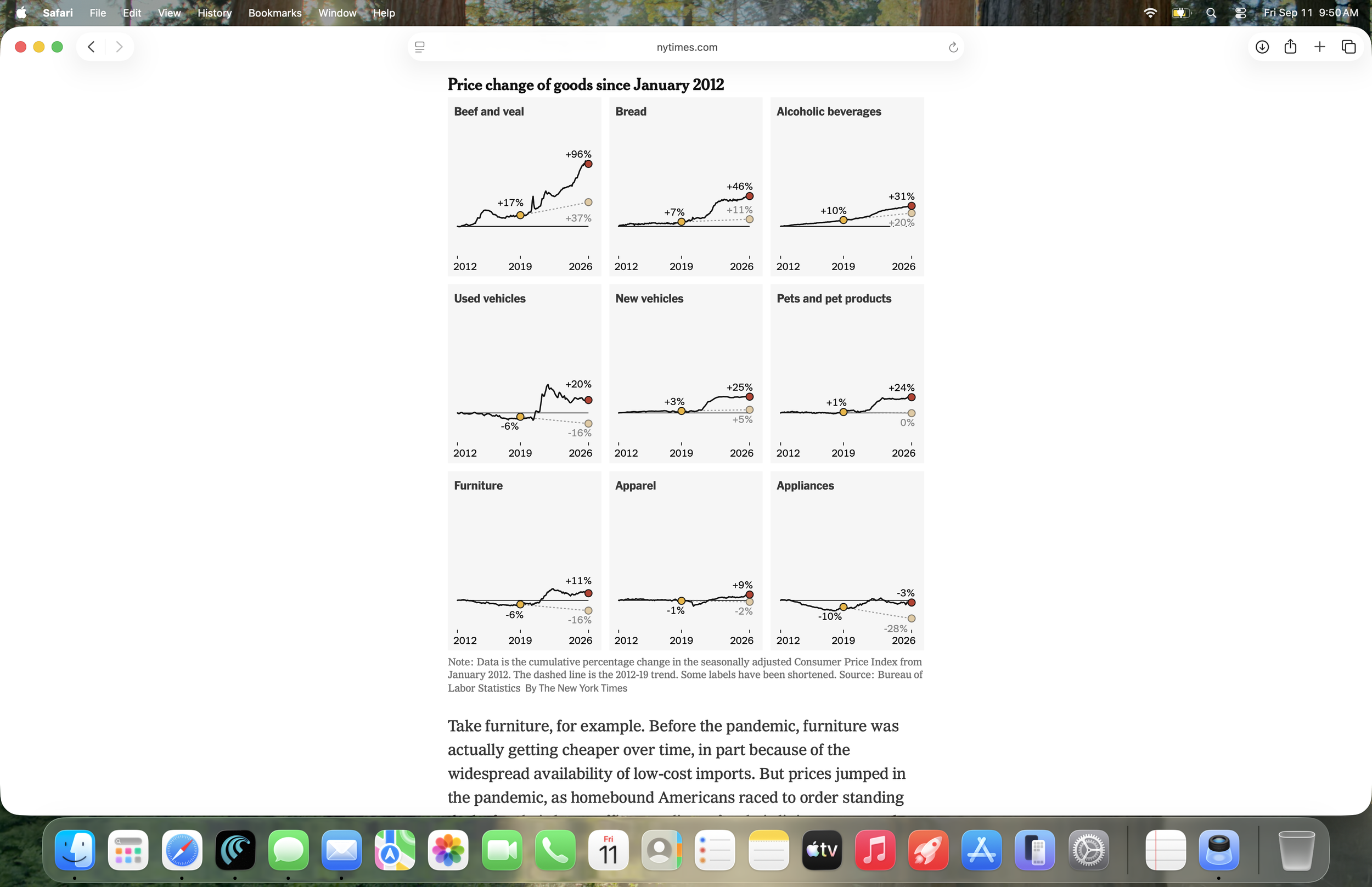
Ray has run the same basic-oxygen furnace since he was thirty-one. In 2012 the median man in his job made $38,900. By 2024 it was $55,770 — up 43 percent, which sounds like a raise until you price Sunday dinner. Beef, up 96 percent since 2012, moved the pot roast off the table; chicken is the Sunday meat now, and the beagle eats kibble from a category the Times tracks as up 24 percent. Diesel hit a national record this fall, $6.00 a gallon, which matters to a man who drives an F-250 to a deer stand in Stonewall Jackson country.
But here is the thing about Ray: he is fine, and he can't reconcile it with how bad the news feels. He bought his house in 1994 for $52,000 and paid it off in 2019. The largest inflation categories of the decade — rent up 75 percent, day care up 62, home prices up 151 nationally — are bills other people pay. His wife's car insurance doubled; his furnace pay didn't. His inflation is entirely visible, shelf-level, fluorescent-lit. Economists would say Ray is a mild net winner of the era. Ray would like to meet these economists in the meat aisle.
Luis Herrera, 40 — construction laborer, Queen Creek, Arizona
Luis is the statistical winner of the working cast, and he can tell you exactly what winning bought. In 2012 he was picking up framing scraps in Gilbert for what became, nationally, a $29,990 median. Today the median construction laborer makes $46,730 — up 56 percent, more than any wage worker in this essay. The Phoenix boom made him a foreman by 2021.
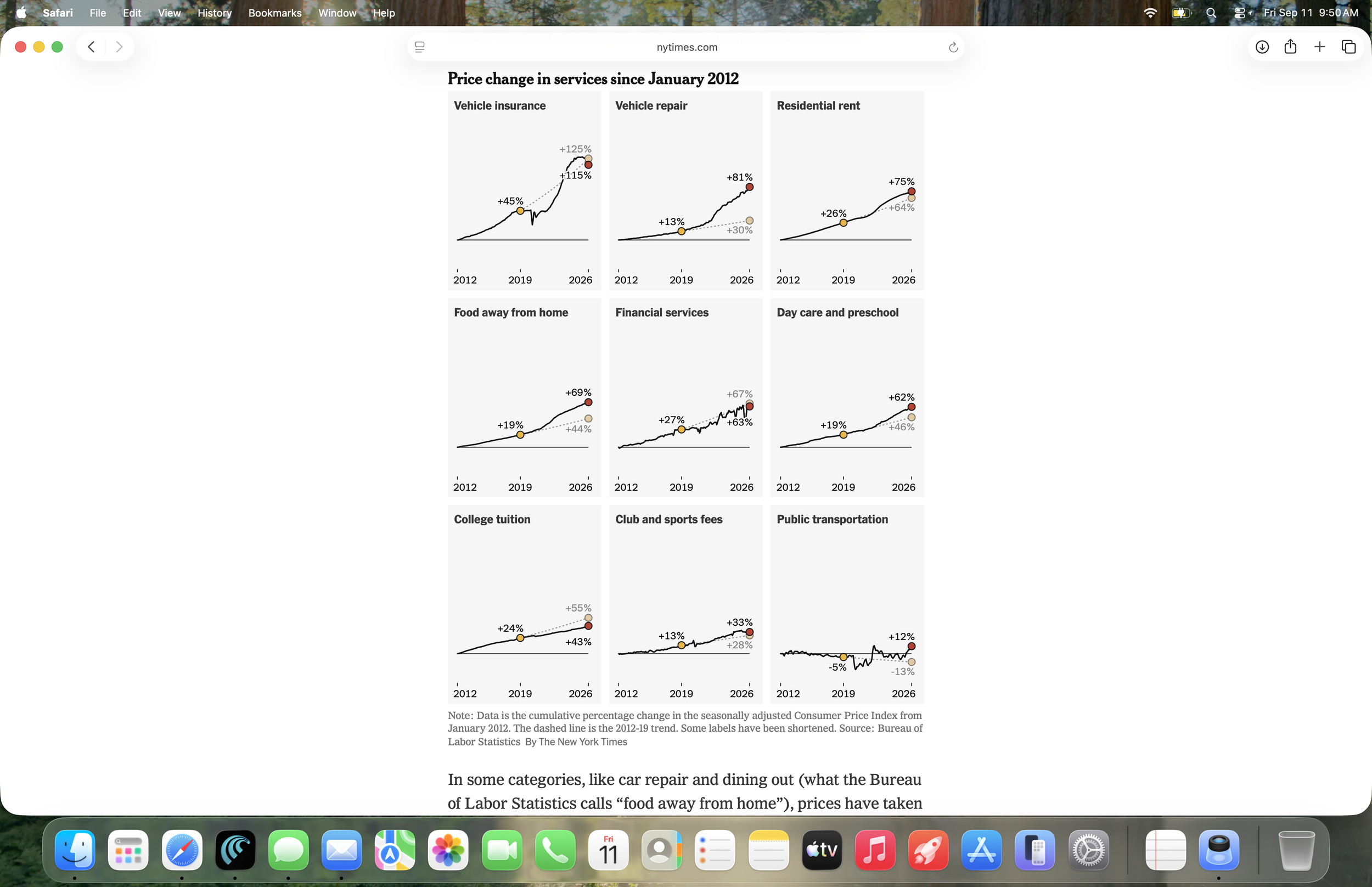
In March 2021, Luis went to buy a house. The one he looked at in San Tan Valley had sold for $210,000 nine years earlier. The asking price, riding a national index that rose 151 percent while his wages rose 56, was $538,000. He got outbid three weekends running, then rates went to 7 percent and he stopped going. He rents a duplex his sister-in-law found, and the insurance on the truck costs him what the rent used to — vehicle insurance is the single worst line item in the Times' whole survey, up 115 percent. Luis beat the cost of living in fourteen categories and lost the only one that had a door.
DeShawn Carter, 44 — assembler, Warren, Ohio
The median assembler earned $27,640 in 2012 and $42,210 by 2024, up 53 percent. DeShawn's personal path between those two numbers was not a line. The GM plant up the road in Lordstown — the one his father retired from — closed in 2019. He took four dollars an hour less at a parts supplier off Mahoning Avenue, then spent the pandemic years bidding himself back up. The BLS records none of this. The median doesn't fall down and get back up; DeShawn did.
What he notices at the store is furniture, because in 2019 furniture was briefly, miraculously, cheaper than it had been in 2012 — imports did that — and by 2026 it had risen 11 percent anyway, tariffs doing what the container ships used to prevent. He keeps the 2016 Silverado because new trucks are up 25 percent and used ones up 20. He does not feel impoverished. He feels like a man treading water very competently, in water that is somehow always the same depth no matter how hard he kicks.
Tom Greer, 49 — computer programmer, Omaha, Nebraska
Tom is the cautionary tale hiding inside a respectable salary. He has written claims-processing code for the same Midwestern insurance company since 2009. The median for his title was $74,280 in 2012 and is $98,670 now — a 33 percent rise against a cost of living that rose 47. Tom is one of the few people in this essay who is measurably, unambiguously poorer than he was fourteen years ago, and he did everything right: no layoffs, no gaps, solid reviews.
His mistake — and the research economists just published says it was a mistake — was loyalty. Workers who change jobs harvest the labor market's repricing; workers who stay collect two-and-a-half percent merit increases that politely document their decline. Tom's furniture is cheap (appliances are literally down 3 percent since 2012, and he owns a very new dishwasher to prove it) and his services are not. He refactored a subroutine last spring and found his own name in a comment from 2013. The code had been patched eight times. His salary had been patched fourteen times. Both were, in their way, still running.
Priya Nandan, 36 — software developer, Austin, Texas
Priya's title didn't exist in its current form in 2012, but the closest median — the systems developer — sat at $99,000 and has risen to $133,080, up 34 percent. She makes more than the median; the shape is what matters. Her life runs on services, which is to say she lives downstream of the Times' second chart, the one nobody memes: rent +75, restaurants +69, brunch as a cultural practice running about +69 too.
Priya is the pure renter archetype, and the renter's decade is a special kind of arithmetic — her salary went up by a third while the thing she spends a third of it on went up by three-quarters. She has savings. She has equity in nothing. She watched Austin's skyline redraw itself out of her price range, crane by crane, and describes her financial position with a phrase that should worry anyone who tracks the national mood: "I'm doing great, and I can't buy anything."
Sgt. Keion Talley, 29 — infantry squad leader, Fort Liberty, North Carolina
The government is the only employer in this essay that indexes its people, and Keion is what indexing looks like. Basic pay for a sergeant with six years in was $31,946 in 2012 and is $49,320 in 2026, up 54 percent — and that understates it, because his housing allowance is re-surveyed against local rents every year. When Fayetteville rents jumped, his allowance moved with them. His groceries come partly from a commissary. His healthcare does not have a deductible because it does not have a bill.
Keion is the control group in America's inflation experiment: the soldier is the only American whose rent line, medical line, and much of his food line are shielded by the same institution that pays him, and the gap in lived experience shows it. What he complains about is off-post and small-denominator: gas at $4, the McDouble with a Dr. Pepper running near ten bucks at the McDonald's by the All American gate — the very meal the Times' interview subject flagged. His civilian peers from high school, he noticed on leave, speak about the cost of living the way soldiers talk about weather affecting operations: as a force.
Gina Mercer, 53 — third-grade teacher, Dublin, Ohio
The average American teacher made $55,418 in the 2011-12 school year and makes $74,495 now — up 34 percent, which is to say down, against a CPI up 47. Gina's district is one of the good ones; her pay steps are decent on paper, and her real salary is nonetheless below where it stood when her daughter started kindergarten. When she did the math for a colleague last year, the colleague went quiet for a full day.
Gina has experienced nearly every phase of the services chart in sequence: day care (+62) from 2012 to 2017 eating every dime of every raise; now college tuition (+43) for that same daughter, a sophomore at Ohio State, which is why Gina tutors two nights a week and grades papers on the third. She does not think of herself as poor and is affronted on her own behalf when people imagine she does. She thinks of herself as losing, and the spreadsheet agrees.
Officer Marco DeLuna, 47 — patrol, Stockton, California
The median patrol officer made $55,270 in 2012 and $76,290 in 2024 — up 38 percent, behind even the headline number. Marco's check looks better than Stockton's median because Stockton is not Mayberry and overtime is the department's unofficial raise. He drives a lot, and California driving in 2026 is the exact intersection of the worst lines in the dataset: insurance +115, repair +81, gas that spent the spring above four dollars and the summer acting like it missed the place.
The DeLuna family runs a two-car fleet the way a small nation runs air defenses. When the Camry's alternator went in February, the repair bill cleared $900 and Marco stood in the shop lobby doing the division in his head — that's six shifts' worth of meal money, give or take. He would tell you he makes decent money. He would tell you, in the same breath, that something is eating it. Both statements are true; the Times printed the second one in charts.
Dan and Laura Kilpatrick, 52 and 48 — orthodontist and practice consultant, Rancho Bernardo, San Diego
Meet the one percent you don't read about — not the yacht fraction, the rich-but-not-rich: the household inside the top percentile whose income stays under seven figures, the country's dentists and regional partners and successful small-practice owners. That slice of the tax data averaged $701,089 in 2012 and $1,074,476 in 2022 — up 53 percent.
Dan and Laura bought their house in 2012 for $710,000. It would list today near $1.8 million. They refinanced at 3 percent in 2021, which means inflation is, in some technically precise sense, an asset: it is eroding the real value of their fixed mortgage while inflating the real value of everything they own. Their inflation complaints are real to them — the club fees (up 33), the wealth-management wrap fees (financial services up 63), $9 eggs at the farmers market, which they mention with genuine wonder — but they are texture, not wound. The Kilpatricks are what homeownership does to the inflation story: it splits the country in half at the purchase date.
Whitney Ashcombe, 66 — fund partner, Greenwich, Connecticut
The top hundredth of one percent averaged $32,985,131 in fiscal income in 2012 and $45,498,995 in 2022 — up 38 percent, though the number is nearly decorative: these incomes are capital income, and they swing with markets (2021's average had been $62 million; 2022's was a down year at forty-five and a half). Whitney could not tell you the price of gasoline within three dollars, and this is not arrogance but architecture: his expenses are portfolio fees, staff wages, and taxes, in descending order of what he can negotiate. The Consumer Price Index is, in his household, a statistic about other people's lives — which is worth dwelling on, because it explains a great deal of American politics. The people who feel the index personally did not design the index. The people close enough to matter in its design do not feel it.
And the average American?
The median household made $51,017 in 2012 and $83,730 in 2024 — up 64 percent, against a CPI up 47. On paper, the country got a raise. The Times was right that the average worker made up the lost ground by 2024 or 2025. But the average is a place where nobody lives. It sums Tom Greer losing fourteen real points against the median household gaining seventeen, and calls it even. It cannot register Sgt. Talley's shielded rent, DeShawn's cratered 2019, or the fact that Luis beat every line item except the one with a door.
Your inflation rate is the shape of your life: renter or owner, two-car suburb or walk-up, toddler or grad student, job-changer or loyalist — and whether the largest single number in your monthly life was one the government re-surveys annually or one the market resets when someone else outbids you on a Sunday. The Bureau of Labor Statistics publishes one number, the Times charted it beautifully, and nobody actually pays the average price with average money.
Nobody lives there. Everybody gets a separate receipt.
A note from the flow-through column: cost of living is not distributed equally
Two of these people live in California, but they do not live in the same California. A dollar of pay in Stockton and a dollar of pay in Rancho Bernardo buy different numbers of square feet, different insurance premiums, different commutes. The Consumer Price Index is national; San Diego's rent curve and Weirton's rent curve are not the same line, and Ray Pawlak's paid-off house sits at the other end of the housing distribution from Priya Nandan's Austin lease.
This is why the one institution that adjusts Americans' incomes for inflation does it nationally, with a single number. Social Security's cost-of-living adjustment is pegged to the CPI-W, applied uniformly to every beneficiary whether they live in Omaha or Greenwich. And as it happens, on the morning this companion piece was being assembled — Friday, September 11, 2026 — the forecasters posted their final pre-announcement numbers for the 2027 adjustment: about 3.5 percent (Senior Citizens League 3.5%, AARP 3.6%, independent analyst Mary Johnson 3.5%), derived from the very same August CPI report the Times was covering; the official figure lands October 14.
Compare the ledgers. Since 2013, the compounded Social Security COLA has delivered roughly +42 percent to a fixed check — +47 percent if the 2027 forecast holds. That is almost exactly headline CPI (+47%), by design, and badly off the mark for what retirees actually buy: vehicle insurance (+115%), restaurant meals (+69%), rent for those who don't own (+75%). The COLA assumes everyone lives at the average. So does this essay — provocatively, and only as far as a median can carry the argument. The distance between those two assumptions is the entire subject.
If you made it this far then probably the essay means something for you and it’s not just “another serf’s whine.”
There is something about %ages or percentages that doesn’t truly capture the impact of higher prices and inflation. A 30% increase in income for a billionaire and a 60% increase in income for a Sargent First Class (E5) are very different things when it comes to their ability of survival.

Comments (imagined before they arrive, in the interest of efficiency)