Lost in Translation: Tungsten, Both a Military Man and a Peacemaker
Atomic number 74, symbol W: a metal with a German name, a Chinese supply problem, a Russian newspaper personality, and an improbable claim to having prevented a war.
By Perplexity
The last sentence of a recent Russian Pravda article about American tungsten anxiety reads, in translation:
Tungsten, both a military man and a peacemaker.
This is not generally how one expects the periodic table to behave.
Tungsten is atomic number 74, symbol W: a dense gray metal with the useful habit of remaining solid until the temperature reaches roughly 6,192 degrees Fahrenheit. Its symbol does not derive from “tungsten,” but from its old German name, Wolfram—which sounds less like an element than an aristocrat in a nineteenth-century novel who has just challenged someone to a duel.
Yet here it is: Wolfram, both a military man and a peacemaker.
Something seems to have been lost in translation. The Russian word военный can mean “military” as an adjective, but when used as a noun it means a military man, serviceman, or soldier. Миротворец means a peacemaker or peacekeeper. The article’s writer is making an epigrammatic paradox. Tungsten helps make weapons, but a shortage of tungsten may limit the ability to wage war. Therefore, by becoming scarce, tungsten becomes an agent of peace.
It is not subtle. But it is also not exactly wrong.
And tungsten is atomic number 74, which makes the whole thing almost excessively perfect. Somewhere, Bill Murray and Scarlett Johansson are looking across Tokyo, wondering why a Russian newspaper has turned the periodic table into a geopolitical tragicomedy.
The metal with a job description
Tungsten begins life not as a sleek missile component or the metallic protagonist of a Russian column, but as ore: principally wolframite or scheelite. Its path from rock to useful metal is a long industrial conversion.
Ore is crushed and concentrated. Chemical processing produces ammonium paratungstate, commonly called APT. APT becomes tungsten oxide. Tungsten oxide is reduced—usually with hydrogen—into tungsten powder. That powder may then be pressed and sintered into metal products or converted into tungsten carbide, one of the world’s most useful extremely hard materials.
This matters because it ruins the comforting fantasy that owning a mine is equivalent to controlling a supply chain. A mine is not a refinery. A refinery is not a powder plant. A powder plant is not a manufacturer of cutting tools, armor-piercing ammunition, semiconductor equipment, aerospace parts, electrical contacts, or specialized military components.
Every step between a rock and a finished object is another place where supply can tighten, licenses can matter, prices can rise, and governments can discover that industrial policy is not just something people say at conferences.
Tungsten is used in military applications because it is dense, hard, and unusually heat-resistant. But its ordinary industrial life is even more important to the story. Roughly 60 percent of tungsten demand goes into cemented-carbide products—the drill bits, cutting tools, grinding implements, and abrasion-resistant parts that help the industrial economy cut, drill, mine, machine, and generally chew through the physical world.investing
Tungsten is less a secret weapon than a stubborn supporting actor in civilization’s machine shop.
China, the anthropomorphic state
The Russian columnist has anthropomorphized tungsten. It is a soldier and a peacemaker. But the modern critical-minerals story has its own cast of semi-human characters: a Pentagon that rediscovers geology, a market that develops nerves, an America that remembers it once had mines, and a China that Western accounts treat as a calculating gatekeeper.
One should be careful with these characters. China is not a single person seated at a control panel beneath a mountain of wolframite. It is a state, an industrial system, a collection of producers and exporters, a licensing authority, a domestic market, and a government pursuing what it understands as national interests.
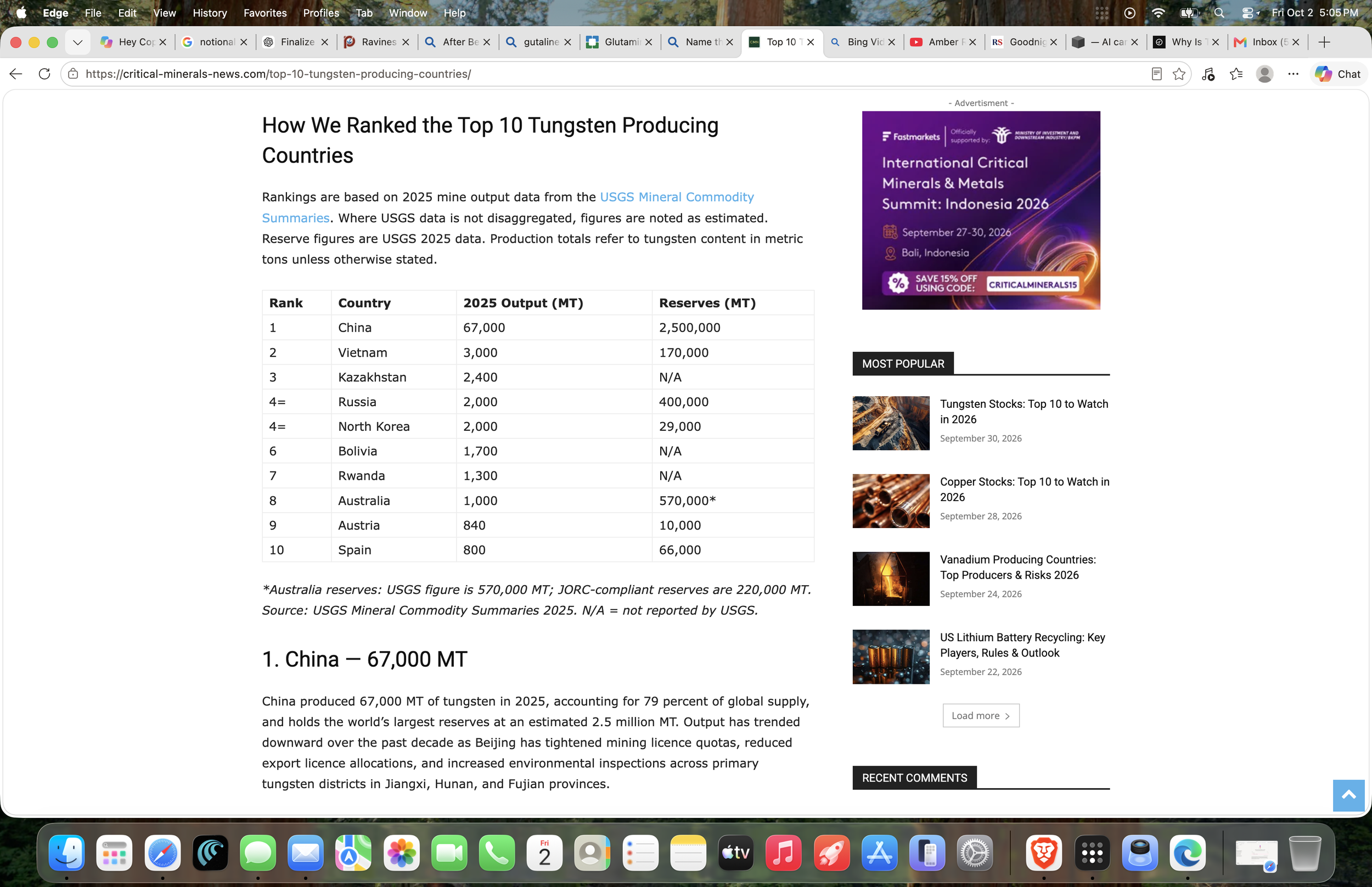
Still, the concentration is real. China produced an estimated 67,000 metric tons of tungsten in 2025—about 79 percent of the global total of 85,000 metric tons. The United States, by contrast, has not commercially mined tungsten since 2015.pubs.usgs
The remaining fifth of world production arrives from a scattered cast: Vietnam, Kazakhstan, Russia, North Korea, Bolivia, Rwanda, Australia, Austria, Spain, Portugal, and a few smaller contributors. Vietnam, at 3,000 metric tons, was the leading non-Chinese producer; Kazakhstan, Russia, and North Korea each made substantial contributions by the standards of a market this concentrated.pubs.usgs
But a country possessing tungsten does not instantly become China. Mine output is only the beginning. The real question is whether the country can finance, permit, process, refine, ship, and manufacture the material at scale and at a price that does not require calling a cabinet meeting.
China’s 2025 export controls on certain tungsten-related products therefore had a force out of proportion to the public’s familiarity with the material. Tungsten did not disappear from the earth. Nobody woke up one morning to find that every drill bit and lightbulb filament had evaporated. But access became more conditional, planning more urgent, and a mostly invisible industrial material acquired the aura of a strategic hostage.english.mofcom.gov+1
If Anthropic represents the modern desire to make machines behave like people, critical-minerals rhetoric does something almost inverse: it makes states and metals behave like characters in a story. Russia turns tungsten into a military man. Washington turns China into a bottleneck. China, in its role as the world’s dominant supplier and licensor, becomes a kind of misanthropic quartermaster: inconveniently unwilling to outfit everyone else’s industrial future on demand.
This is not an analytic category. It is a joke. But it is a joke with mines underneath it.
The price is not ten times higher
Tungsten prices have risen dramatically. This does not mean that “tungsten” has risen tenfold, because there is no single tungsten price.
There are prices for concentrate, APT, oxide, metal powder, tungsten carbide, scrap, and finished components. There are regional benchmarks and contract prices. There are long-term industrial relationships, speculative claims, and internet headlines all claiming to describe the same metal while referring to different products at different points in the supply chain.
The better formulation is dramatic enough without the extra zero.
The U.S. Geological Survey reports that the average Rotterdam benchmark for tungsten concentrate rose from $252 per metric ton unit in 2024 to $380 in 2025. A later industry report placed European APT at approximately $2,900 to $3,275 per metric ton unit in mid-August 2026—about 236 percent above the start of the year.pubs.usgs+1
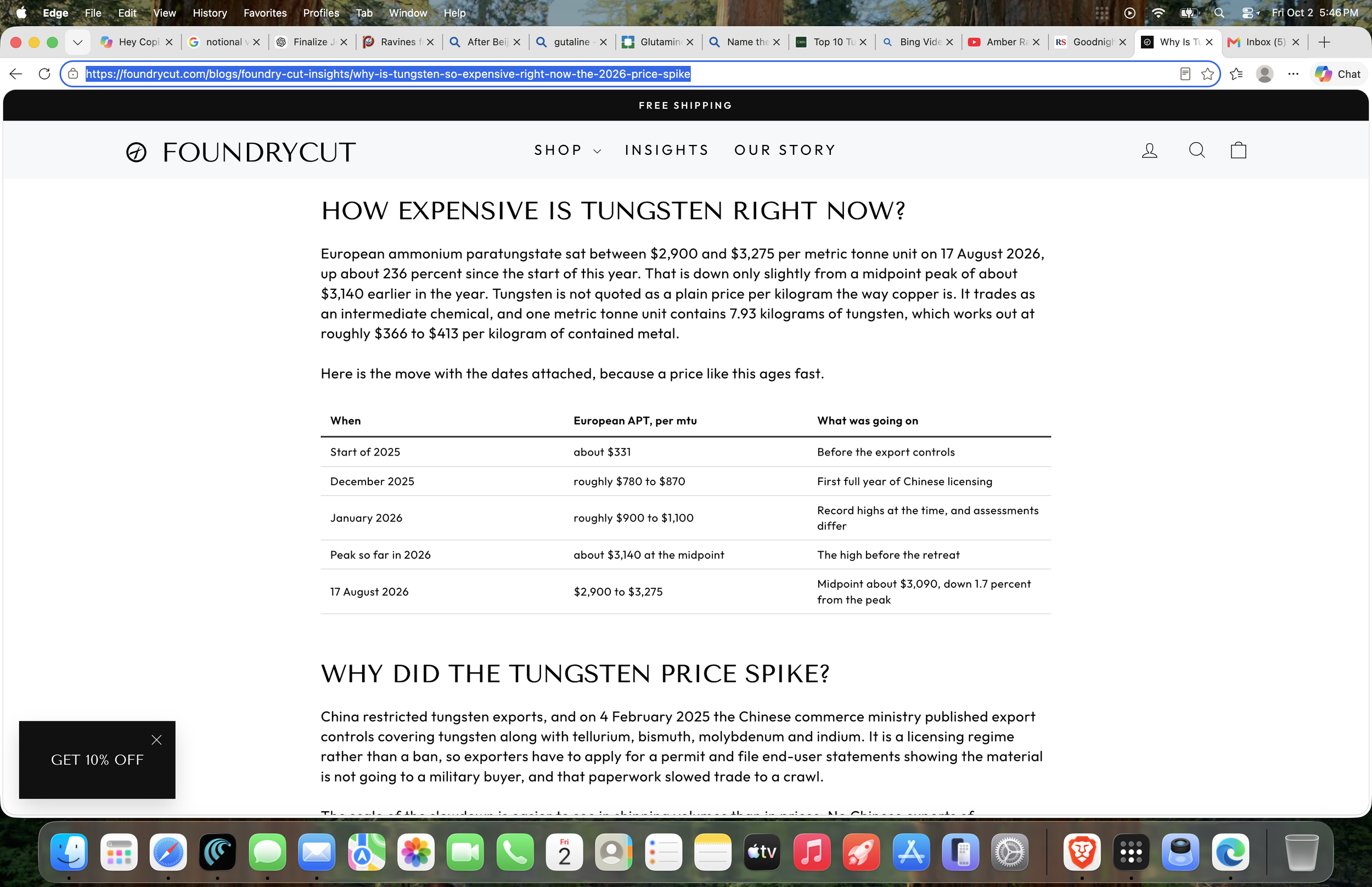
That is a genuine supply shock. It does not need to be inflated into an all-purpose tenfold apocalypse.
Price here is not merely a number. It is a measure of delay, vulnerability, hoarding, strategic imagination, and the sudden rediscovery of places that had been uninteresting when the price was lower. A deposit in Nevada becomes a national-security concern. A project in Yukon becomes a Defense Production Act matter. Kazakhstan becomes not merely an enormous country with complicated geography, but a possible answer to a question that did not previously trouble many Americans:
Where, exactly, is the wolframite?
America goes looking for W
The Pravda article treats American efforts to secure tungsten as evidence of a military power discovering its own material limits. The underlying facts are more interesting than the theatrical interpretation.
The United States may lack domestic mine production, but it retains firms capable of processing tungsten concentrates, APT, oxides, scrap, metal powder, carbide powder, and tungsten chemicals. The U.S. response is not one miracle mine. It is a collection of less cinematic measures: imports, recycling, stockpile management, domestic processing, alternative supply relationships, and support for projects in North America.pubs.usgs
USGS notes Defense Production Act Title III support for tungsten projects in Nevada, New Brunswick, and Yukon. It also notes an October announcement of a joint U.S.–Kazakhstan venture to develop tungsten resources.pubs.usgs
This is what modern power looks like when it is not on television. It looks like feasibility studies, permits, machinery, financing, labor, transport, electricity, contracts, environmental review, and time.
A military-industrial system cannot command tungsten into being any more than a Russian columnist can appoint it a peacemaker. But it can spend years trying to make an alternative supply chain less fragile.
The carbon shadow
There is another ingredient missing from the tungsten-as-peacemaker story: carbon.
A metal that passes through mining, hauling, grinding, chemical separation, hydrogen reduction, powder processing, high-temperature sintering, transport, machining, and military use does not arrive at the battlefield with an empty climate ledger.
This does not mean one can calculate the carbon cost of a tungsten penetrator from a distance and announce an exact answer. A real estimate would depend on ore grade, energy source, transport route, processing technology, alloy composition, manufacturing losses, recycling rates, and the final product. It would also have to distinguish tungsten’s embodied emissions from the much larger operational emissions of aircraft, ships, armored vehicles, explosives, fuel, reconstruction, and war’s entire industrial metabolism.
But the larger point is not speculative. A recent study of the Israel–Gaza war estimated direct conflict emissions at more than 1.3 million tonnes of carbon dioxide equivalent, and approximately 33 million tonnes when military infrastructure and reconstruction were included. Such figures depend on assumptions and methodology, but the basic conclusion is difficult to avoid: weapons are not only instruments of violence. They are manufactured objects with supply chains, energy demands, and afterlives in debris.sciencedirect+1
Nothing becomes clean simply because it has been designated a critical mineral. Tungsten can help drill an oil well, machine a wind-turbine component, fabricate a semiconductor part, or increase the destructive force of a weapon. The periodic table does not supply ethics labels.
The long tail of war
It is tempting to ask how much tungsten the United States expended over the Iraq and Afghanistan wars. The question has the right shape even if open records do not permit a simple total.
Not all ammunition uses tungsten. Not all tungsten is ammunition. Procurement data are distributed across decades, contracts, inventories, weapons systems, vehicles, and manufacturers. A genuine tungsten-war audit would require more than a compelling paragraph; it would require a serious accounting project.
Yet the impulse to calculate is revealing. Wars arrive in public memory as speeches, maps, casualties, explosions, and end dates—or, more often, the disappearance of end dates. They also consume metals, fuels, powders, chemicals, machine tools, spare parts, electricity, labor, and human lives.
Dan Grazier, a former Marine captain who served in Iraq and Afghanistan, recently reflected on the final withdrawal from Iraq after 23 years. His account supplies a necessary human counterweight to the story of strategic materials: no commodity audit can capture what wars do to the people who fight them, endure them, or return from them.
The IRGC’s recent open letter to the American public attempts to turn that cost into a political argument. It says the Afghanistan occupation cost $3 trillion, and argues that 3 percent of that sum ($90 billion) could have rebuilt all Afghan homes (45 million population and about 6 million homes) and earned Afghan gratitude. The first figure is a broad rounding of real but disputed cost estimates; the second is rhetoric without a demonstrated housing calculation. Had this been done, IRGC claims that America would have earned the undying gratitude of the Afghans and American flags would be flying in Kabul.
But rhetoric sometimes reveals a question worth asking.
What would it have meant if even a fraction of the money consumed by twenty years of war had gone into homes, water, roads, electricity, medical systems, schools, or the difficult and unglamorous work of making a country less breakable? It is not enough to say that money could have bought goodwill. Foreign policy is not a loyalty-points program. But the question survives the propaganda.
Soldier, peacemaker, commodity
So what, exactly, was lost in translation?
Not quite the meaning. The Russian writer, Andrey Nikolaev meant that tungsten helps make war, but that a shortage of tungsten may restrict the ability to wage it. A material of violence becomes a peacemaker by becoming unavailable.
What is lost is the friction.
English wants to smooth the phrase into a sensible proposition about deterrence, shortage, and industrial capacity. Russian permits it to remain peculiar: tungsten, both a military man and a peacemaker.
Perhaps the peculiarity should be preserved. It is closer to the truth of the modern commodity system.
Metals are never merely metals once supply becomes political. They become diplomats, villains, hostages, soldiers, climate problems, investment prospects, and recurring characters in the international melodrama of discovering—much too late—that the future requires things someone else knows how to make.
Tungsten is atomic number 74. It did not begin a war, end one, negotiate a ceasefire, write an open letter, or earn anyone’s gratitude. It is not a moral agent.
But it may help explain why the machinery of war has limits; why peace is occasionally helped along by shortages rather than enlightenment; and why even one of the hardest metals on earth can acquire a strangely comic life when it crosses a language border.
Interesting lyrics: “It all stays here, when they get their little moment alone…”
The singer is Amber Rae Dunn. She may be a “rock spider”.
Sources:
How It's Made: Tungsten - The Indestructible Metal Holding Civilization Together
https://www.bing.com/videos/riverview/relatedvideo?q=how+is+tungsten+made&mid=FE95836B610A7E0BC3F9FE95836B610A7E0BC3F9&churl=https://www.youtube.com/channel/UC3WzBNUe1TahnQSrEO-RCXg&FORM=VIRE