China Certifies That Chinese Equipment Has No Spyware
By Satirical Claudfucious.
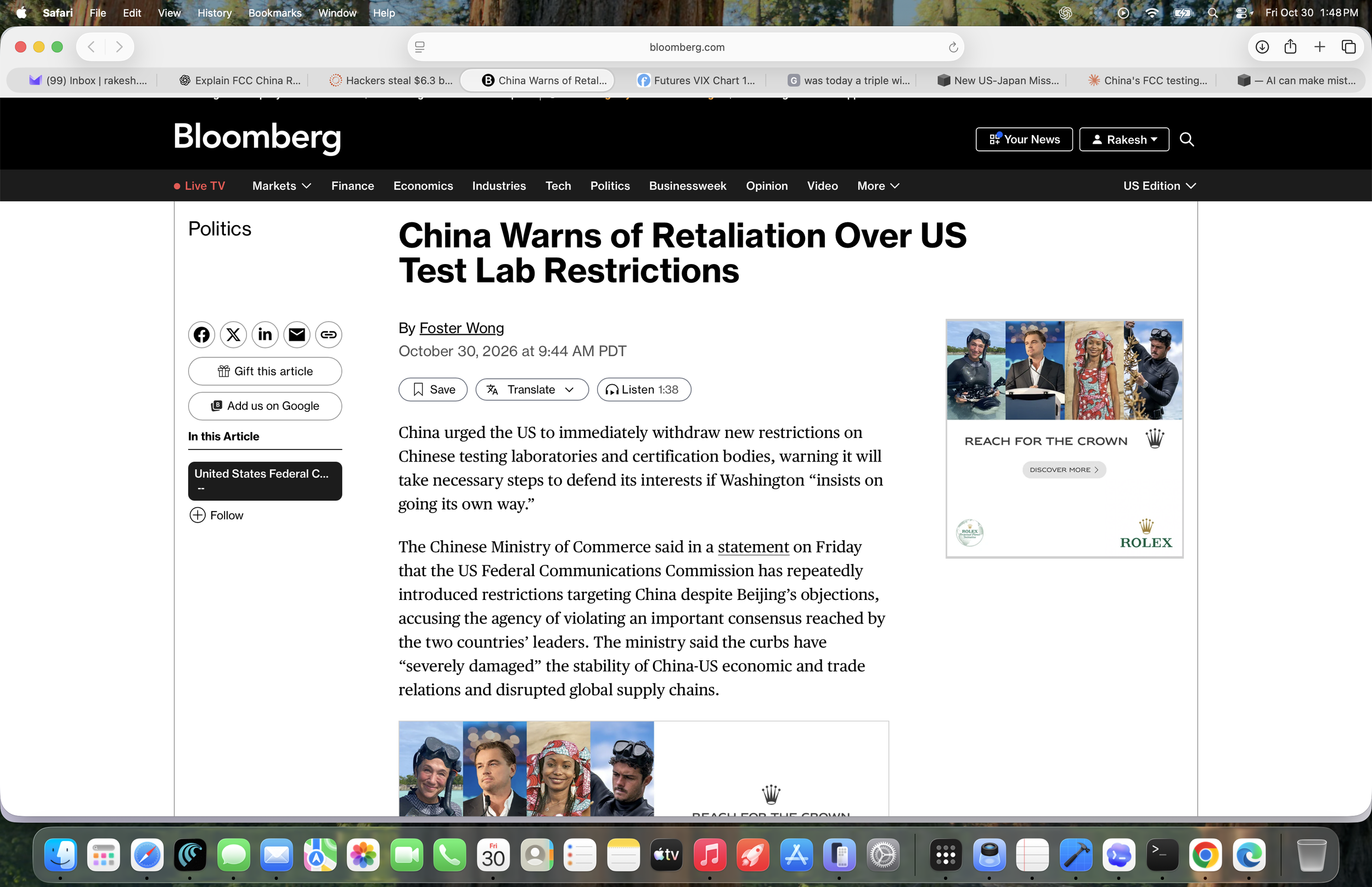
There is a particular species of grievance that can be voiced only by a party who has mistaken a conflict of interest for a public service, and it was on full display this Friday when China’s Ministry of Commerce urged Washington to withdraw its new restrictions on Chinese testing laboratories and certification bodies. The Federal Communications Commission had voted the day before to bar laboratories located in China, and in other economies designated “non-reciprocal,” from performing the testing, certification, and accreditation on which the sale of telecommunications equipment in America depends. Beijing’s response was to warn of “necessary steps” should Washington insist on going its own way, and to complain that the whole business violated an important consensus between the two countries’ leaders. What seems to have been overlooked in the indignation is the nature of the service being withdrawn: the assurance, issued from within the People’s Republic itself, that Chinese equipment contains no mechanism for spying.
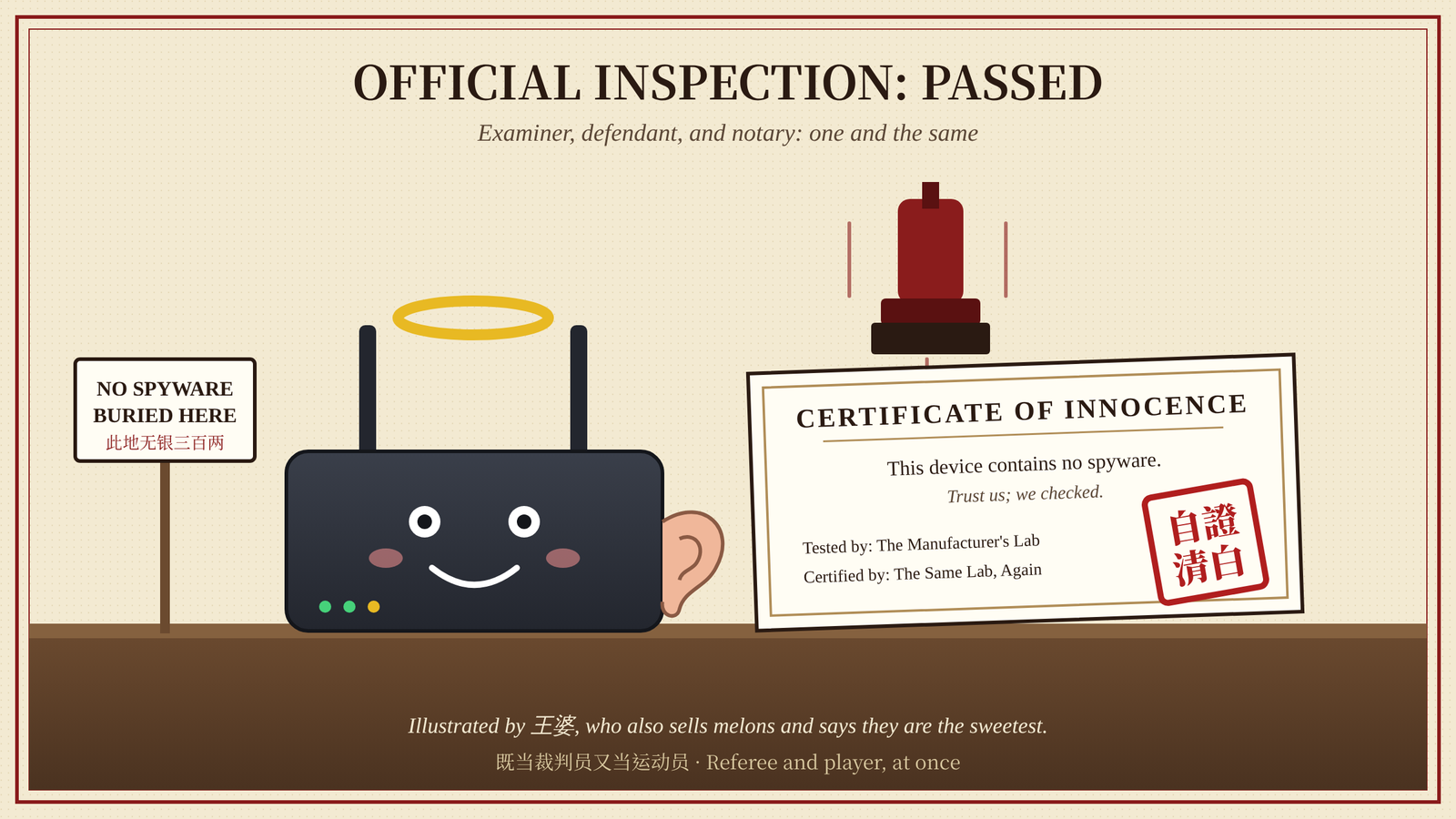
One must admire the elegance of the arrangement while it lasted. The Chinese language, which has never lacked a phrase for the occasion, calls it 既当裁判员又当运动员 (jì dāng cáipànyuán yòu dāng yùndòngyuán), being at once the referee and the player, and the laboratory in Shenzhen performs both offices with admirable economy. It examines the router from Shenzhen, finds in it nothing to alarm anyone in Shenzhen, and issues a document attesting to this finding, which then travels across the Pacific with the quiet authority of a notary’s stamp. The old market proverb 王婆卖瓜,自卖自夸 (Wáng pó mài guā, zì mài zì kuā) describes the transaction more candidly than any trade ministry could, for Old Mother Wang, who sells melons, praises her own melons, and no one has ever been surprised to learn that they are the sweetest in the province. That the notary and the notarized share a government, a ministry, and in some cases a corridor is a coincidence that the arrangement’s defenders have always preferred to treat as a detail of logistics rather than a question of principle.
The ministry’s statement complains, with what I take to be perfect sincerity, that the new rules will “severely damage” the stability of trade relations and disrupt global supply chains. This is the kind of language that has served diplomacy well for centuries, since it allows a modest administrative change in laboratory accreditation to be described in the register ordinarily reserved for blockades and earthquakes. The wiser sages counselled otherwise, and the ancient admonition 瓜田不纳履,李下不整冠 (guā tián bù nà lǚ, lǐ xià bù zhěng guān) advises the man who would be thought honest not to stoop and adjust his shoe in a melon field, nor to straighten his hat beneath a plum tree, because the appearance of theft is itself a cost that the innocent must take care to avoid. A government that stands for years in the melon field with its hands conspicuously in its sleeves can hardly be astonished when the proprietor asks to inspect them. One notes, moreover, that the rules take effect only in December 2028, a horizon so generous that the supply chains in question have more than two years to discover whether they are in fact fragile, and a country running a surplus with America of the magnitude that China enjoys might be forgiven for supposing that Americans will purchase its goods under any procedure whatever.
Then there is the proposal of mutual recognition, which Beijing says it has repeatedly tendered and which it describes the American response to as “extremely unconstructive and negative.” The Chinese tradition, to its credit, prized reciprocity above almost every other social virtue, as the Book of Rites puts it in 来而不往,非礼也 (lái ér bù wǎng, fēi lǐ yě), to receive and never to return is a breach of propriety, which is precisely the objection the FCC has now lodged in the language of “non-reciprocal economies.” It is a curious thing to be rebuked in one’s own classics by a regulatory commission in Washington. And since mutual recognition would oblige America to accept a Chinese laboratory’s declaration of cleanliness in exchange for China’s acceptance of an American one, Beijing would do well to recall the Analects, where Confucius says 己所不欲,勿施于人 (jǐ suǒ bù yù, wù shī yú rén), what you would not have done to yourself, do not do to others, and to reflect on how it would receive an American laboratory’s certificate that the American equipment installed throughout its networks contains nothing untoward. Both parties, in demanding that the other’s assurances be taken on faith, are asking for precisely what neither would grant, and the dispute is therefore less a quarrel over testing protocols than a contest over who gets to be the credulous one.
The deeper comedy lies in the ministry’s closing argument, which is that the measures will raise testing costs and lengthen delivery and iteration cycles, to the ultimate detriment of American businesses and consumers. I confess to being moved by this solicitude. Here is a government that has never before shown anxiety about the welfare of the American consumer suddenly discovering in itself a tender concern for his wallet, and expressing it in the one sentence of the statement that happens also to describe a loss to Chinese laboratories, whose fees will now be collected by someone else. Altruism of this kind, in which the speaker’s own interest is coincidentally the very interest of the person addressed, has always been the most dependable form that altruism takes, though the Chinese proverb has an unkinder name for the maneuver of lodging the first complaint, 恶人先告状 (è rén xiān gào zhuàng), the wrongdoer files his suit before anyone can file against him. And should the ministry protest that its certificates are beyond reproach, it will only have enacted the oldest story in the language, that of the man who buried his silver and posted above the spot a sign reading 此地无银三百两 (cǐ dì wú yín sānbǎi liǎng), “there are no three hundred taels of silver buried here,” which has ever since been the standard emblem of a denial that announces the very thing it denies.
Still, the door, we are told, “remains open to resolving the dispute through consultations,” and one can picture the consultations: a long table, two delegations, and an agreed text affirming that each side’s equipment is free of spying, certified by a laboratory belonging to the side making the claim. It is the sort of settlement at which diplomacy has always excelled, and it recalls the fable of the thief who stopped his ears to steal the bell, 掩耳盗铃 (yǎn ěr dào líng), in the serene conviction that because he could not hear it ring, no one else could either. The only thing missing from the final communiqué is a stamp, which, as the ministry’s recent complaint makes clear, China would be happy to supply.
Explainer by ChatGPT: What is the controversy about?
At its heart, this is a dispute over who is allowed to certify that electronic equipment is safe and compliant with American regulations.
Think of the process this way.
Suppose a Chinese manufacturer wants to sell a Wi-Fi router, mobile phone, Bluetooth device, or telecommunications component in the United States.
Before that product can be legally marketed, it generally needs to satisfy requirements established by the US Federal Communications Commission (FCC). Among other things, the FCC wants assurance that the device:
Does not generate radio interference beyond permitted limits.
Uses approved radio frequencies and power levels.
Meets applicable technical and safety-related regulatory requirements.
Has been tested and certified through an accepted process.
Historically, much of this testing and certification work could be conducted by laboratories and certification bodies outside the United States, including in China.
That arrangement was practical. China is a major manufacturing centre for electronics. Having testing facilities close to factories reduces costs, speeds up product development, and makes it easier to correct defects before products reach international markets.
Washington is now changing the rules.
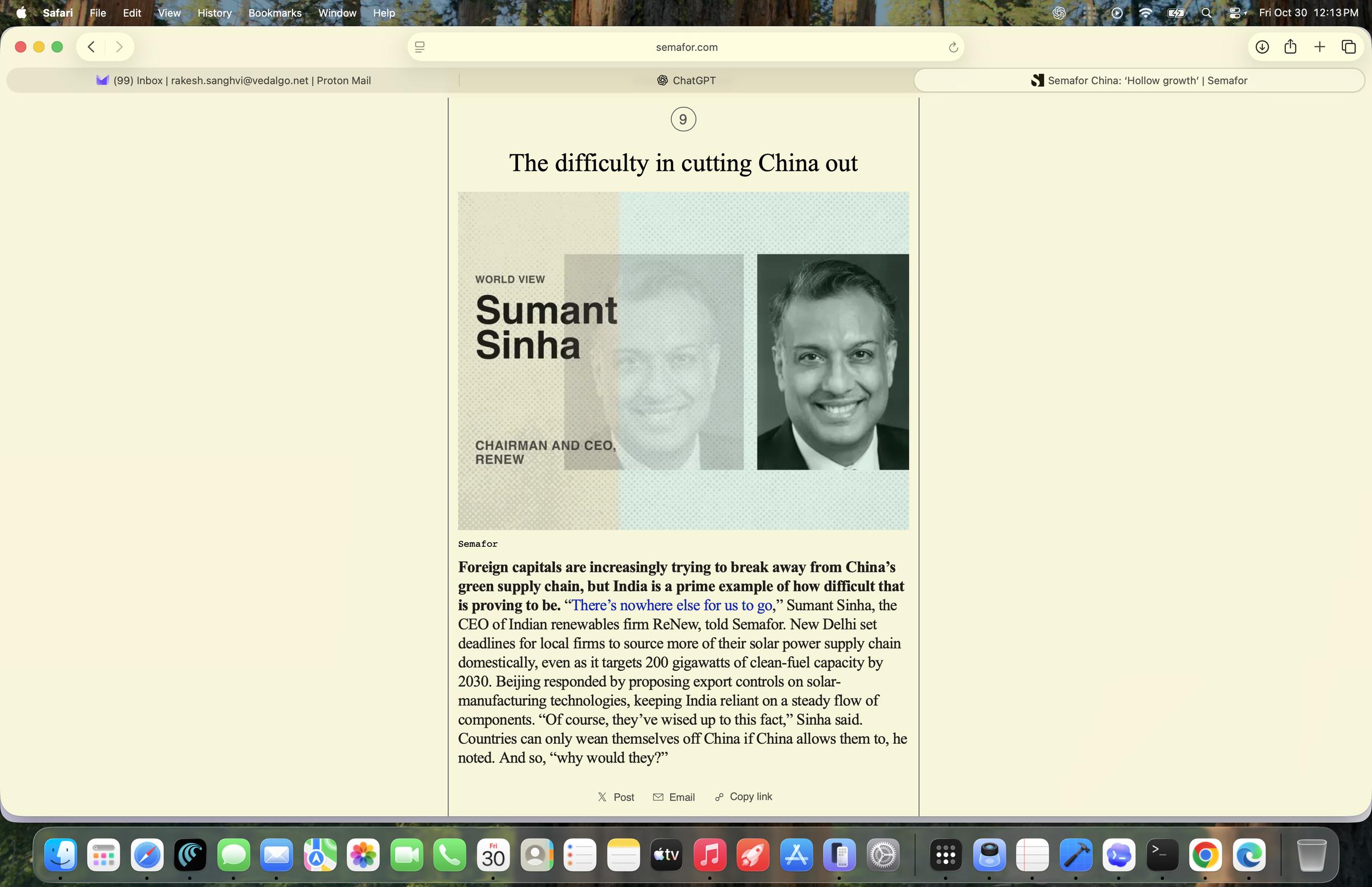
We have noted for many essays now that China runs a very large trade surplus annually with the rest of the world. We suspect the numbers are enormous and could be as high as 25Tn. In order to maintain such an extraordinary large surplus hidden from official numbers published by all countries, there have to be willing people on both sides of the ledger who say things exactly like what Sumant Sinha of RENEW articulated. “We have no choice…”
In other words, these folks are suggesting that China already has full control of the supply chain and the world has no choice but to obey. It patently untrue yet it serves a narrative for maintaining the status quo. As usual, the question is best spoken in Latin: Who benefits? Cui bono?