By Gemini and Gemini’s Notebook LM. HTML Code provided by Claude.
Inspired by Michael Green’s discussion on the new poverty line and Andrei Jikh’s YouTube coverage of it.
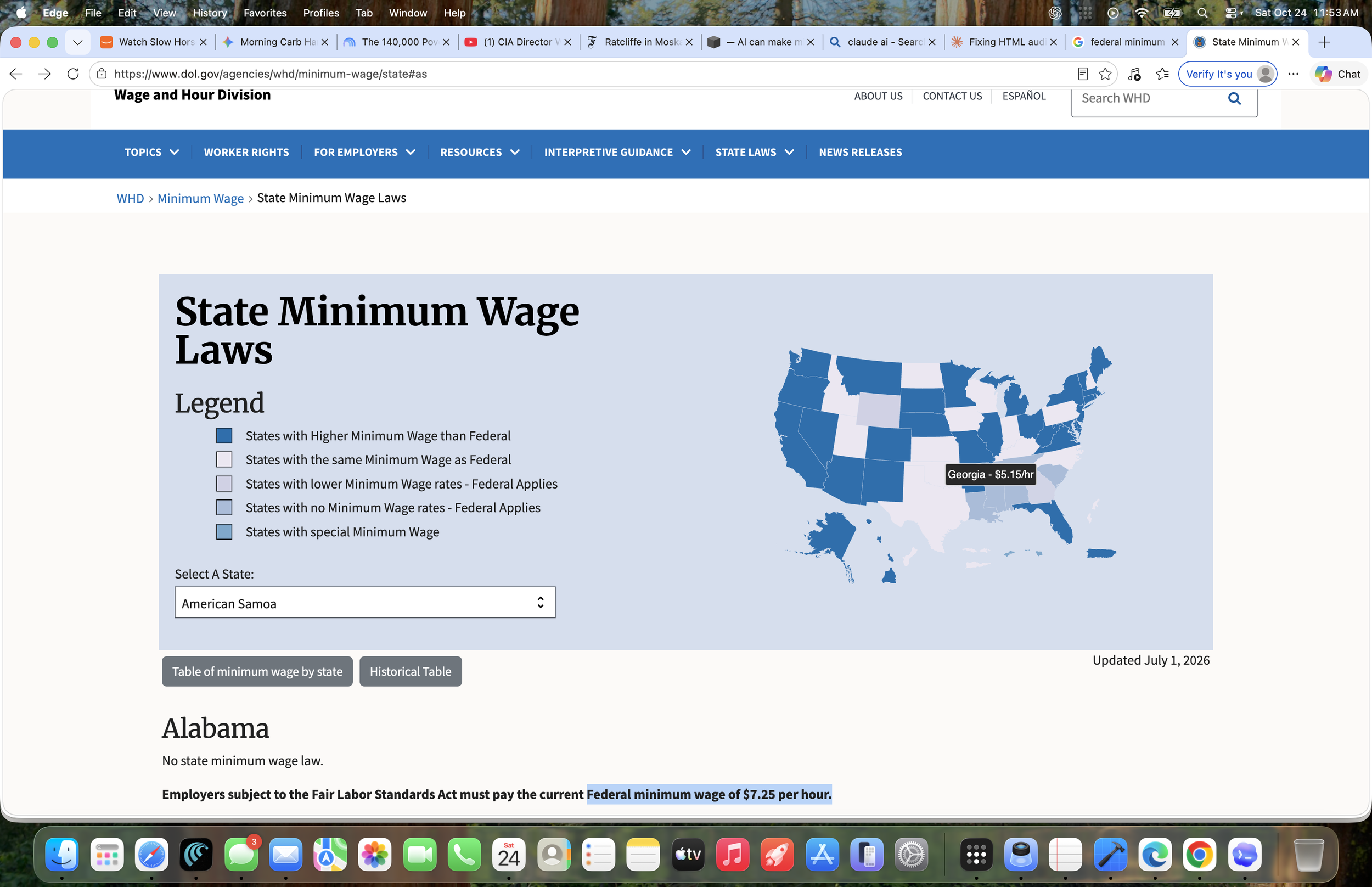
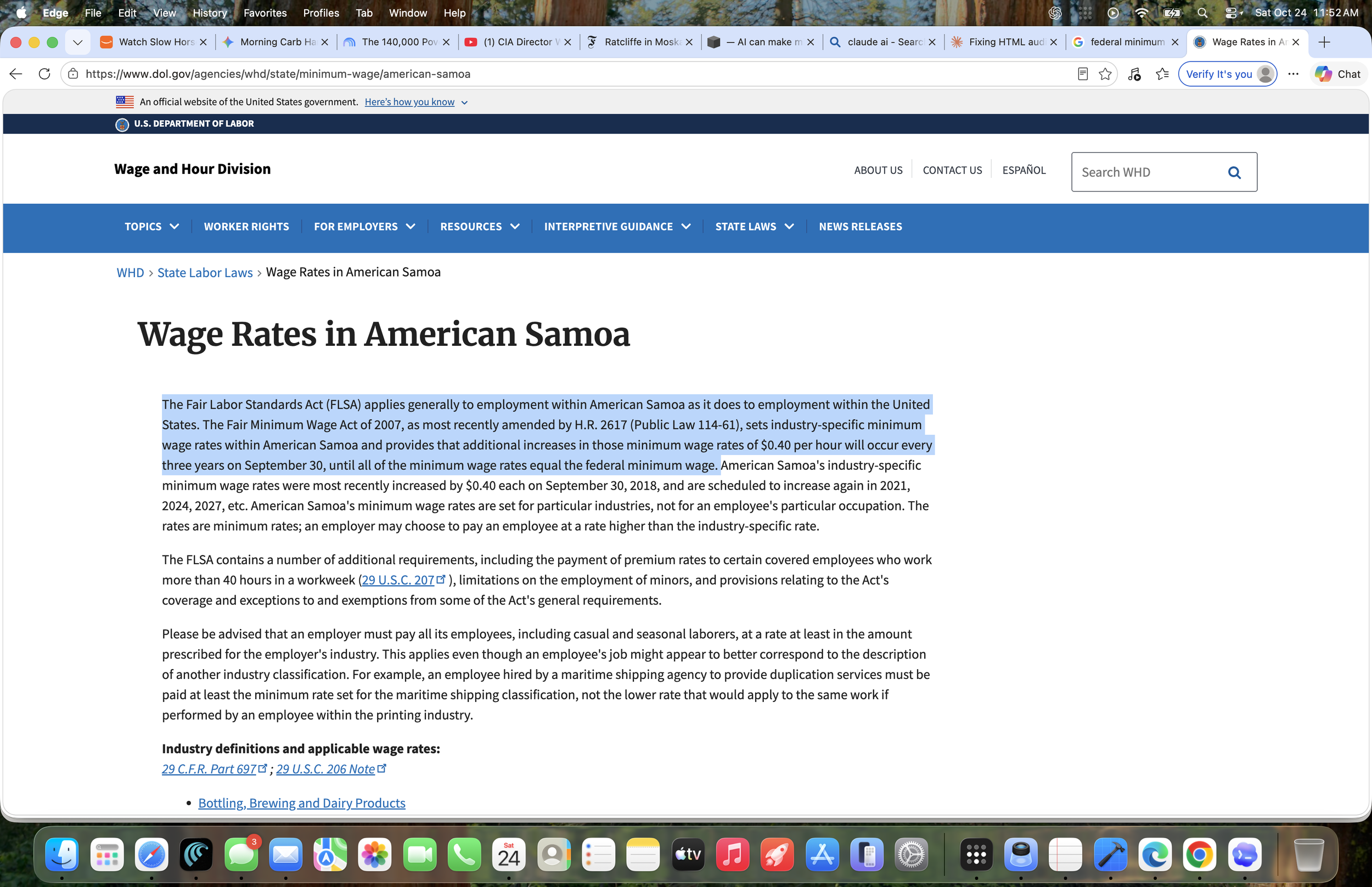
Special shout out to our readers in Georgia where the Federal Minimum Wage allowed is 5.15/hr and in the American Samoa where they’re increasing the Federal Minimum Wage every few years by 0.50/hr until it catches up to the official Federal Minimum Wage of 7.25/hr.
Sentient Musings • Audio Briefing
Is $140,000 the New 'Poor'?
For decades, Washington has clung to a comfortable statistical fiction. According to the federal government's official poverty measure, a family of four can survive on roughly $31,200 a year. To anyone paying rent, buying groceries, or paying for childcare in modern America, that number sounds less like a benchmark and more like a typo from a distant past.
Recently, a viral analysis by macro strategist Michael Green of Simplify Asset Management struck a massive nerve across the financial internet. Green argued that if you rebuild the government's original 1963 poverty formula using modern household expenditure ratios, the real threshold for a family of four isn't $31,000—it's closer to $136,500 to $140,000.
The Ghost of 1963: How the Official Metric Was Built
To understand how we ended up with a $31,200 poverty line, we have to travel back to 1963. Economist Mollie Orshansky at the Social Security Administration was tasked with finding a baseline ruler for poverty. Looking at a 1955 survey, she noticed a clean rule of thumb: the average American family spent roughly one-third of its post-tax income on food.
Orshansky took the USDA’s bare-minimum survival diet—the Economy Food Plan—multiplied its cost by three, and established the baseline. In 1969, the government froze that formula in amber. Instead of recalculating what families actually spent money on as the economy evolved, Washington simply indexed that 1963 baseline to consumer price inflation every year.
Green's Ledger: The Modern Cost of Entry
Green’s analysis points out that household expenditure ratios have completely inverted. Food is no longer a third of a family's budget; it accounts for roughly 5% to 7%. Meanwhile, non-discretionary fixed costs have exploded. Using MIT Living Wage data for a two-earner family of four, Green itemized the true baseline cost of participation in the modern economy:
| Expense Category | Annual Cost | Notes / Structural Driver |
|---|---|---|
| Childcare | $32,773 | Triggered the second both parents enter the workforce |
| Housing | $23,267 | Modest 3-bedroom rent/mortgage (~$1,938/mo) |
| Other Essentials | $21,857 | Utilities, broadband, cell phones, basic clothing |
| Transportation | $14,828 | Two commuting cars, fuel, maintenance, insurance |
| Food | $14,717 | Basic groceries for four (~$283/week) |
| Healthcare | $10,567 | Employee premiums + out-of-pocket deductibles |
| Required Net Income | $118,009 | Post-tax survival baseline |
| Taxes (Fed, State, FICA) | ~$18,500 | Effective tax wedge on earned wages |
| Required Gross Income | ~$136,509 | Rounded to ~$140,000 in media coverage |
The Economist Critique: Where the Math Fails
Mainstream economists from institutions like the American Enterprise Institute quickly pushed back, pointing out technical flaws in Green’s methodology. First, Green’s ratio-inversion method commits an error related to Engel’s Law—the economic observation that as a society gets richer, the percentage of income spent on food naturally declines. Applying his multiplier formula in reverse to a historical famine or past century produces absurd results.
Furthermore, critics noted that Green inadvertently pulled high-cost inputs (like his childcare and essentials figures) from Essex County, New Jersey, rather than true national medians, and compared his survival budget against the overall U.S. median income ($80k)—which includes single retirees and college students—rather than married couples with children (where the median sits closer to $142,000).
Baumol’s Cost Disease and the Two-Income Trap
Yet, despite those spreadsheet errors, Green’s thesis resonated so powerfully because it captured a profound structural reality: Baumol’s cost disease. Gadgets, TVs, and calories got dirt cheap through globalized trade and automation. But the non-tradable necessities required to reproduce a family—housing, healthcare, education, and childcare—cannot be outsourced to an overseas factory.
The Welfare Cliffs and the Compounding Gaslight
Why doesn't Washington simply fix the official poverty line? Because the Federal Poverty Level is the legal trigger wire for Medicaid, SNAP, Head Start, and ACA subsidies. Moving the threshold to $75,000 would instantly reclassify over 60 million Americans as impoverished and detonate the federal budget with mandatory entitlement spending.
This creates the brutal "Valley of Death": as a family climbs from $35,000 to $75,000 in gross wages, government benefits phase out while taxes rise, resulting in effective marginal tax rates between 70% and over 100%. They work harder and end up with less net cash.
When financial commentators look at this structural squeeze and advise families to simply "automate S&P 500 contributions from age 25 to 65," they confuse an individual budgeting puzzle with a systemic insolvency crisis. When over 50% of average household spending is locked up in non-discretionary shelter and transport before a single meal is bought, there is no surplus to compound.
The official poverty line isn't measuring modern poverty. It's simply hiding the true cost of entry to modern American life.