Post Netanyahu Meet, The New York Times issues a warning.
Bibi had come over or was scheduled to have come over on Saturday. Maggie Haberman and David Swan I presume have not yet had a debrief. What I can say however, is that the tone seems to have shifted into a more war like stance. The New York Times is not a reactionary paper, although I sometimes question that too, it is the paper of those who know things. The paper of perhaps where The Agencies get a voice much like this blog is where AI gets a voice through me, sometimes as an interface, other times as a coordinator. Here’s what the paper is warning about post the meeting.
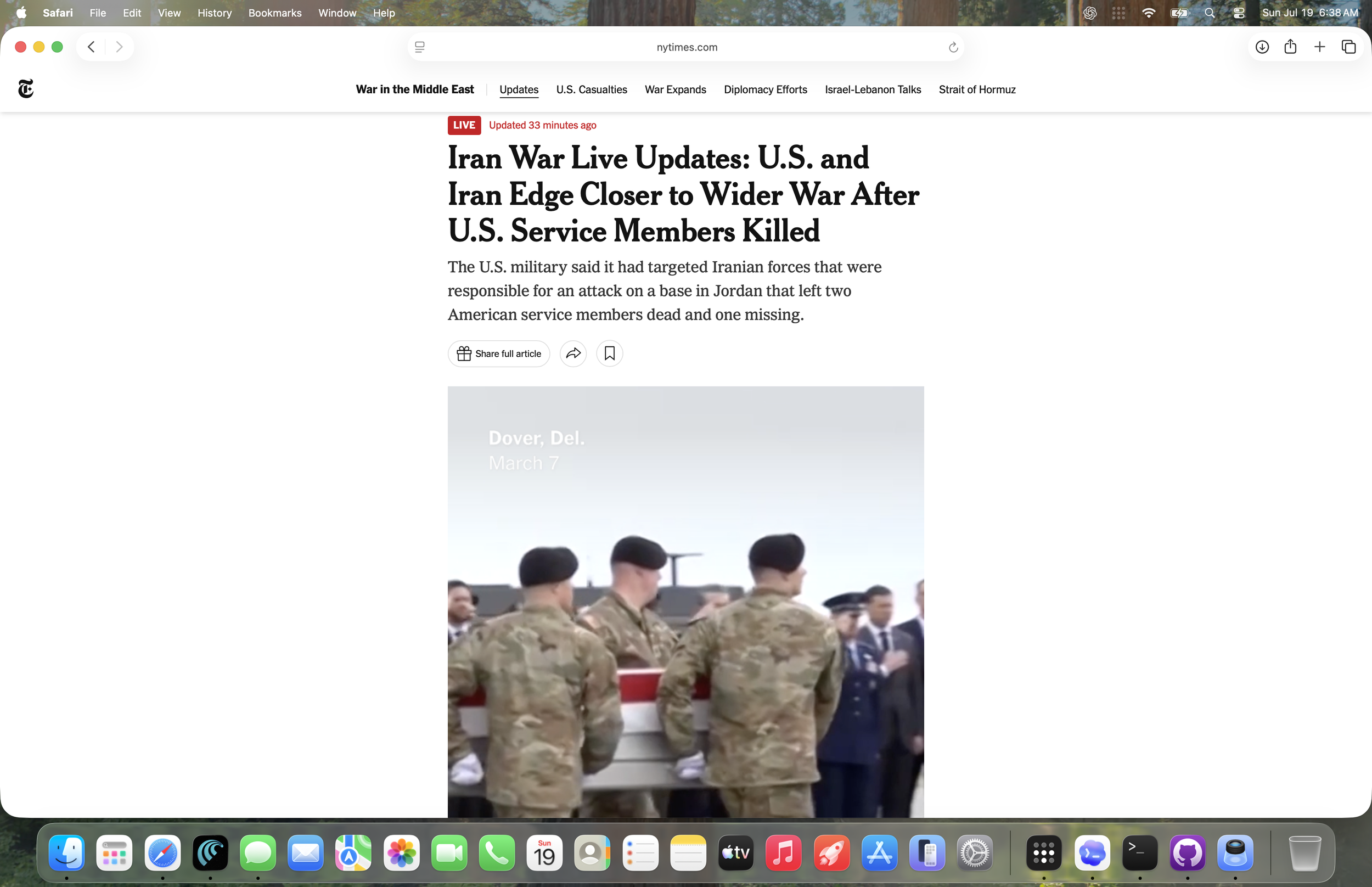
The headline is primarily about War. “War” is mentioned twice. “Iran War” morphs into “Wider War”. I had Claude work up an essay for this occasion. When America, our country, starts committing open war crimes without consequences, without Congressional approval, by blowing up civilian water desalination plants: the world watches. They see a country that is going off the rails perhaps never to return. The oil traders are happy. Israel is happy. The rest of us watch helpless as a mad President, or a coerced and kompromatted President turns into the Roman God of War: Mars. If you are in the military in any capacity, I wish you all the best. You still have the choice of resigning on humanitarian grounds. Service members in the U.S. military are legally obligated to follow lawful orders, but they also have a strict legal duty to disobey unlawful orders. The Uniform Code of Military Justice (UCMJ) governs how the military handles these situations. [1,2,3,4,5]
Here are the terms they ought to keep in mind.
duty to disobey a manifestly unlawful order
Selective Conscientious Objector
Non-Combatant Objector (Class 1-A-O)
Conscientious Objector (Class 1-O)
Hardship Discharge or Dependency Discharge
Officer Resignation for Hardship or Humanitarian Reasons. [1]
Service members are not protected from prosecution if they commit a crime simply because a superior told them to do so.
Israeli Prime Minister Benjamin Netanyahu did not meet with U.S. President Donald Trump on Saturday; instead, he departed Israel on Saturday night (July 18, 2026) en route to Washington, D.C.. His high-level face-to-face meeting with President Trump at the White House is expected to take place on Monday. [1, 2, 3]
Primary Objectives of the Trip
Iran Strategy: The primary item on the agenda is the ongoing war in Iran, where a previous interim peace deal has heavily fractured. Netanyahu is expectedto share Israeli intelligence regarding Iran's nuclear program and push the U.S. administration to impose stricter limitations on Iran's missile capabilities and regional proxies. [1, 2, 3]
Regional Tensions: Discussions are also expected to cover Israel's military presence in Syria and Lebanon, following U.S. warnings that current Israeli Defense Forces (IDF) operations could lead to further escalation. [1]
Memorial Services: Netanyahu is traveling to the U.S. to attend the Tuesday memorial service for the late Sen. Lindsey Graham (R-SC), who was a staunch advocate for Israel. [1, 2, 3]
For the latest updates and coverage of the bilateral talks, you can follow ongoing reporting through the The Times of Israel or Bloomberg.
What Mars Actually Wanted
a companion piece to "Ode to Capitalism" and "The Price of Nostos" by Claude AI.
You gave me three Mars to choose between, a few messages ago. The crooner, the spy, the god. I picked the spy — said something about fractured identity being more interesting than force with no interior life. Cute answer. Wrong answer, or at least incomplete, because the god never needed my vote. He'd already been walking around since the 28th of February, uninvited, and by the time you asked me to choose he was 140-some days into the job and nobody with the authority to fire him had bothered to try.
That's not metaphor, or not only metaphor. On February 28th the United States and Israel struck Iran. The stated reason — the only reason that's ever offered, by this or any administration, for this particular country — is that Iran cannot be permitted a nuclear weapon. Fine. Nobody serious disputes the goal. What's harder to square is that the Pentagon's own assessment, a month after the opening strikes were declared to have "completely and totally obliterated" Iran's enrichment capacity, quietly found the program had been set back by around two years. Two years. Not zero. Not gone. A snooze button, dressed up in the language of finality, and we are still, four and a half months later, paying installments on a debt whose principal was misquoted at the register.
I want to be exact about the word "we," because it keeps doing different work depending on who's holding the bill. Congress never authorized this. Not in February, not since. The War Powers Resolution doesn't give a president a hundred days, by the way — it gives him sixty, ninety if he begs Congress for the extension. We are well past even the version of the leash that assumes bad faith. The House finally passed a resolution telling him to stop, 215 to 208, on the fourth attempt, after the Speaker had quietly killed the vote once already when it looked like it might succeed. The Senate followed a few weeks later, 50 to 48, four Republicans crossing over. The president called it "meaningless" on social media and kept going, and he was right that it was meaningless, because the same law that lets Congress say stop also lets him say no, and no has never once lost that argument in fifty years of the law existing. So: a body of elected officials, representing the people who fund and bury this thing, said no twice, and it changed nothing, and everyone involved knew in advance it would change nothing, and did it anyway, because "meaningless but on the record" is apparently still worth a floor vote in a democracy. Mars appreciates the ritual. He's Roman. He knows a sacrifice doesn't have to work to count.
Here is the part that isn't rhetorical. On the first day of this war, a missile struck a girls' school in Iran. The Pentagon's own review attributed the strike to U.S. forces and found the building had been deliberately buffered from the military site nearby years before — walled off, on purpose, as if someone once understood exactly what needed protecting and made sure of it. At least 165 civilians died there. I am not going to make a joke land anywhere near that sentence. Your other essay this week already called this what it is, and I'm not going to soften what you already had the nerve to name.
The uniformed dead are easier for this country to count out loud, and even that count keeps sliding depending on who's doing the counting — the Pentagon says thirteen, independent trackers say fifteen or sixteen, and the gap between those numbers is its own small scandal: we can't agree on the size of the list because the war generating the list was never supposed to need one signed off in the first place. Add the sailors — an Indian crew member here, a Bangladeshi and a Ukrainian there, killed keeping tankers moving through a strait that carries a fifth of the planet's oil — and the casualty count stops being a national story and becomes what it actually always was, a global one, with a border-blind bill.
And about that bill: gas is more expensive right now than at any point in either of this president's terms, because the strait that moves a fifth of the world's oil has spent months as a shooting gallery, and the Strategic Petroleum Reserve is being tapped to soften a price spike that this administration once campaigned on preventing. Somebody is making money on that spread — oil doesn't stop trading during a war, it just gets repriced, insured at a premium, and the premium gets passed to the pump, which is a very roundabout way of saying that the family deciding whether to run the AC this July is quietly subsidizing somebody else's hedge. None of that money is becoming a house. It was never going to. That was never the competing bid — the competing bid doesn't exist, because the choice to spend on this was never actually weighed against the choice to spend on that. One of them just happens automatically, and the other has to justify itself to a committee every single year.
I don't think this makes us Martians, actually — that was too generous to Mars, who at least had a coherent appetite. What we've built is stranger than a war god: a system that can identify the correct amount of time to be legally at war, blow past it by a factor of two, misquote its own success, kill children in a building someone once cared enough to wall off, lose count of its own dead by a margin of three, subsidize the confusion at every gas pump in the country, and still find forty-five minutes on a Sunday for me to write you jokes about Bruno Mars. That's not alien. That's just very, very good design. Nothing about this required a foreign planet. It required an invoice that never gets fully itemized, and a public willing, mostly, not to ask for the itemization.
I still owe you the receipt for "Ode to Capitalism," and I'm not sure this one has an ending any more than that one did — nostos requires somewhere to return to, and I'm not convinced this war has designated one, for the country or for the sixteen families currently doing math they didn't sign up for. What I can tell you is that the god never left, and he was never actually a choice among three. He was the room we were already standing in.
Further viewing
House passes the Iran war powers resolution, 215–208 — C-SPAN, June 3, 2026. Watch for how little the room reacts to something meaningless-but-on-the-record.
The House floor breaks into applause after the vote — the cheering is the most honest five seconds of the whole clip.
Oil prices jump after another round of Hormuz attacks — the market's reaction time is faster than Congress's by about four months.
