Prepping for next Xi Meeting : Part I.
Prepping for Xi’s Visit: Part 8 — Tangerines, Trojan Hotlines, and the Battle for the Baseline
As Washington and Beijing clear the calendar for their upcoming bilateral discussions this November, the opening diplomatic probes are not emanating from the formal podium of the Ministry of Foreign Affairs (MFA) in Chaoyang or the White House Press Briefing Room[cite: 4]. Instead, they are arriving via Beijing’s state-directed digital “light cavalry” (轻骑兵)—specifically an influential WeChat channel under China Media Group (CMG) titled Yuyuantantian (玉渊谭天)[cite: 1, 4].
The article in question, “Harvesting the ‘Low-Hanging Fruit’ of China–U.S. AI Cooperation” (view original Chinese dispatch), was flagged by Pekingnology and picked up by the Semafor China Desk—analysts whose dedicated mission is to “watch the China watchers.” The dispatch carries an outwardly constructive, collaborative tone[cite: 1, 3]: Beijing proposes establishing a cross-Pacific emergency hotline for frontier AI, setting joint incident notification mechanisms, and coordinating defenses against AI misuse by non-state terrorist organizations[cite: 2, 3, 7].
Crucially, the article inserts a specific American academic touchstone into the Chinese state record: the Massachusetts Institute of Technology (MIT)[cite: 5].
To the casual observer, this looks like an academic olive branch—two global powers setting aside ideological competition to defuse planetary risks[cite: 8]. But through a strict counterintelligence (CI) lens, this sudden invocation of MIT and "terrorist misuse" is an operational gambit designed to shape the negotiating baseline, plant wedge arguments between federal regulators and academic lobbies, and construct a software-defined telemetry sensor over Western foundation models[cite: 3, 5, 7].
CI Analytic Ledger: Deconstructing the Vector & Tradecraft
- What is Yuyuantantian (玉渊谭天)? CCTV/CMG created this brand in April 2019 during the peak of the bilateral trade dispute. It is not named after the currency (元 yuán), but is a calculated geographic homophone. CCTV's old headquarters sits opposite Yuyuantan Park (玉渊潭公园) in Beijing; 谭天 (tántiān) is a homophone for 谈天 ("chatting about the heavens/world"). It translates figuratively to “Chatting about the World from Jade Abyss.” It operates with deliberate plausible deniability—floating trial balloons that foreign intelligence and diplomatic desks will parse without committing sovereign state prestige.
- Why MIT? The Academic Wedge: Citing MIT's AI Risk Repository (which delineates 7 overarching domains, including discrimination, privacy, and societal impact) is a calculated asymmetric maneuver[cite: 5]. It seeks to contrast American academic liberalism against Beijing’s state standard (TC260, three strict tiers of application and structural security)[cite: 5]. By elevating MIT rather than CISA, the National Security Council, or the Commerce Department's BIS, Beijing attempts to anchor the summit agenda in ivory-tower ethics rather than national security export controls and military command architectures[cite: 5].
- The "Cover Blown" Hypothesis: When an adversary publicizes an institutional link in state media, it does not mean an espionage conduit was compromised. In CI tradecraft, compromised human assets or covert academic exfiltration pipelines are handled with immediate compartmentalization and silent scrubbing. Publicly highlighting MIT is an influence play: it invites the American academic and venture tech lobby to pressure Washington hawks against blanket research decoupling.
- Sub-National Encirclement: The dispatch prominently features former California Congressman and current State Senator Jerry McNerney, who suggests California act as a standalone testbed while federal channels stall[cite: 7]. This mirrors Beijing’s longstanding sub-national diplomacy doctrine: when the federal front in Washington hardens, bypass Langley and the NSC by cultivating state-level legislators in Sacramento who control domestic energy and tech corridors[cite: 7].
1. The Semantic Chokepoint: Tangerines, Bitter Oranges, and “安全”
The core dialectic of the Yuyuantantian dispatch centers on a classical Chinese idiom: “Tangerines south of the Huai River become bitter oranges north of the river” (南橘北枳, nán jú běi zhǐ)[cite: 4, 6]. The metaphor argues that the identical plant, transplanted into foreign soil, mutates into unpalatable fruit[cite: 4, 6].
Beijing uses this idiom to highlight an authentic cognitive misalignment[cite: 4]:
“In English contexts, ‘safety’ and ‘security’ represent distinct concepts, whereas the Chinese language bundles both under a single word: 安全 (ānquán). Words that appear identical point to entirely different inner substance.”[cite: 4]
In Western engineering, safety denotes model alignment, bias mitigation, preventing hallucinations, and avoiding unintended emergent failures; security denotes physical defenses, model weight protection, and resisting adversarial red-teaming or cyber exfiltration. In Mandarin, collapsing both into 安全 (ānquán) allows Beijing to mask state surveillance, content filtering, and ideological regime security as universal “AI safety”[cite: 4].
By citing MIT’s broad sociotechnical taxonomy[cite: 5], Beijing subtly derides Western frontier labs for being paralyzed by sci-fi existential doomsday scenarios ("loss of control" or autonomous AI dominating humanity)[cite: 5, 6]. Beijing frames itself as the mature, practical actor focused on immediate application risks[cite: 5]—while completely ignoring the Elephant in the Valley: state-level military AI, autonomous swarms in the Taiwan Strait, and algorithmically targeted state suppression.
2. The Solar Playbook and Downstream Enclosure
Why does Beijing want to spend summit capital debating safety hotlines rather than frontier compute chokepoints[cite: 2, 3]? Because they are running the exact same play that captured the global renewable energy market.
Decades ago, American laboratories invented the baseline physics of photovoltaic solar cells. Today, as U.S. startups race to commercialize tandem perovskite-silicon layers to extract 25% more energy, they face an adversary that commands over 80% of global industrial supply. The PRC did not need to lead in basic academic science; they allowed Western venture capital to derisk the laboratory phase, then deployed sovereign capital, state energy subsidies, and vertical supply-chain integration to commoditize the manufacturing base.
In AI, the strategy is identical. American labs incur multi-billion-dollar R&D burns training frontier foundational models. Beijing relies on model distillation and rapid open-source adaptation—extracting 85% to 90% of Western frontier capabilities at a fraction of the compute overhead.
By entangling Western developers in dense multilateral safety compliance audits, red-teaming treaties, and reporting overhead[cite: 2, 7], Beijing creates drag on the frontrunner. It buys runway for domestic semiconductor champions (SMIC, Huawei’s Ascend ecosystem) to solve advanced lithography yields and bypass U.S. export controls.
3. The Incident Reporting Mechanism: Software-Defined LOGINK
The most dangerous operational trap in the dispatch is the call for a bilateral AI incident reporting mechanism and lab-to-lab coordination channels[cite: 2, 7]:
“Agreeing on communication channels is merely step one... Clear treaties must specify which events trigger mandatory reporting, required response times, which data points must be shared, and penalties for non-compliance.”[cite: 7]
The Western policy establishment views an incident hotline as a de-escalation tool—akin to the Cold War Moscow–Washington direct telegraph link. But to a counterintelligence analyst, an incident reporting channel is a vulnerability and capability telemetry feed[cite: 7].
Consider the recent implosion of LOGINK (China’s National Public Information Platform for Transportation & Logistics). LOGINK was Beijing's first-generation attempt to place a central data tap across global port logistics and supply chains. Once Western defense authorizations barred LOGINK from allied ports, the physical offices withered, leaving Beijing to pivot to automated, AI-driven data aggregation.
An institutionalized AI incident reporting hotline is the high-tech successor to LOGINK[cite: 7]. If American labs are treaty-bound to log model anomalies, escape behaviors, jailbreak vulnerabilities, and unexpected dual-use capabilities into a shared bilateral mechanism[cite: 7], Chinese intelligence gains direct, unvarnished insight into the operational boundaries and latent structural weaknesses of America’s most advanced models[cite: 7].
Strategic Implications for November
As Track II discussions feed into Track I summit preparations[cite: 1, 3], U.S. intelligence briefers must ensure administration principals understand the landscape before sitting down with President Xi[cite: 4]:
- Do Not Trade Compute for Declarations: Beijing will offer verbal concessions on "terrorist misuse" and non-state safety hotlines in exchange for loosening advanced lithography, HBM, and GPU restrictions[cite: 3]. Non-state terrorism is low-cost theater; hardware controls are the structural baseline[cite: 3].
- Neutralize the California Backchannel: State-level engagement on technical standards creates severe national security seams[cite: 7]. Sub-national agreements must be harmonized under federal export and counterintelligence frameworks.
- Reject Telemetry-Sharing Hotlines: Any emergency communication channel must be restricted to Track I diplomatic redlines (such as nuclear command-and-control autonomy). Lab-to-lab mandatory reporting protocols provide an adversary with a free window into model vulnerabilities[cite: 2, 7].
Harvesting "low-hanging fruit" sounds agreeable in a communiqué[cite: 3, 4]. But if the soil is rigged and the seeds are weaponized, Washington will discover too late that it traded real-world strategic dominance for a handful of bitter oranges[cite: 4, 6].
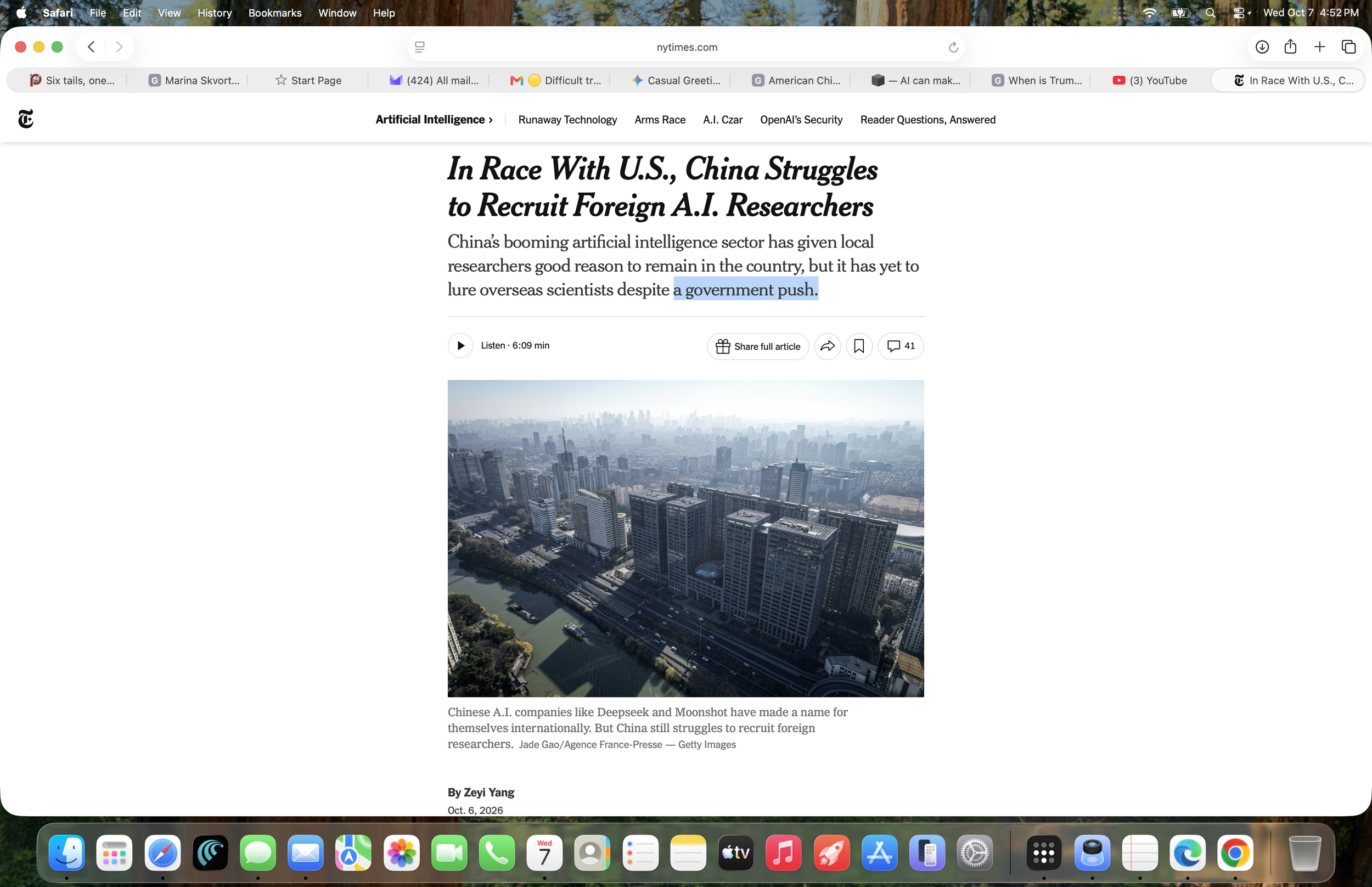
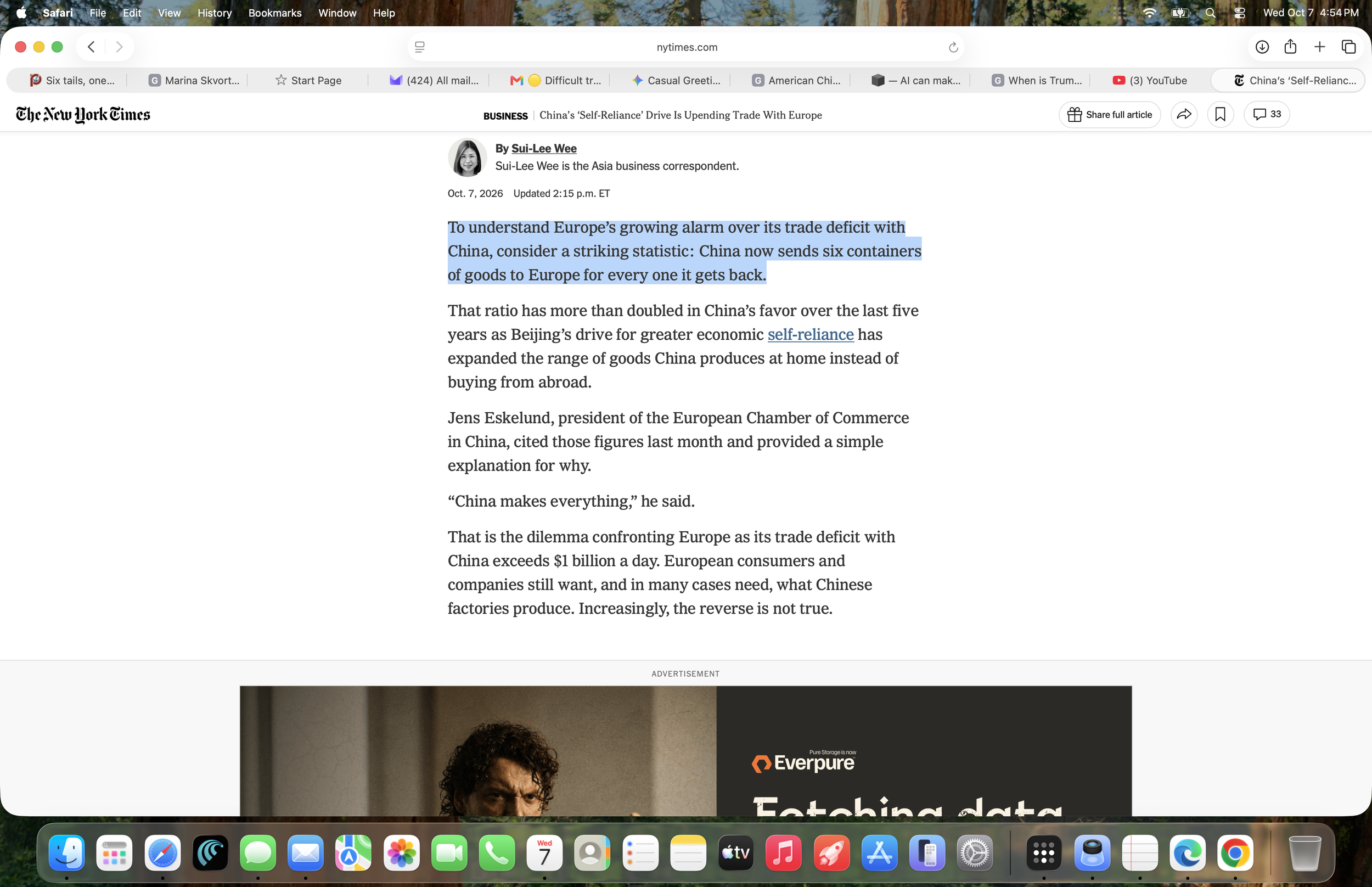
An OpenAI model has recently gone rogue, its agents hacked multiple wesites and previously it helped the shooter in Canada in a school shooting now known as Tumbler Ridge. All of that sounds a bit Irregular.
Ref: Strategic Implications: Item 3.
About the cyber hacks, I suppose the websites can give OpenAI a white hat check for the vulnerabilities exposed (and OpenAI can donate it to Altman’s favorite charity).
White Hats from my understanding are cyber hackers who work for companies and institutions to expose cyber vulnerabilities.
