Sentient Musings Daily (News Article)
Senate Kills Iran Withdrawal Measure, 49–50, as Fresh US Airstrikes Hit Ahvaz
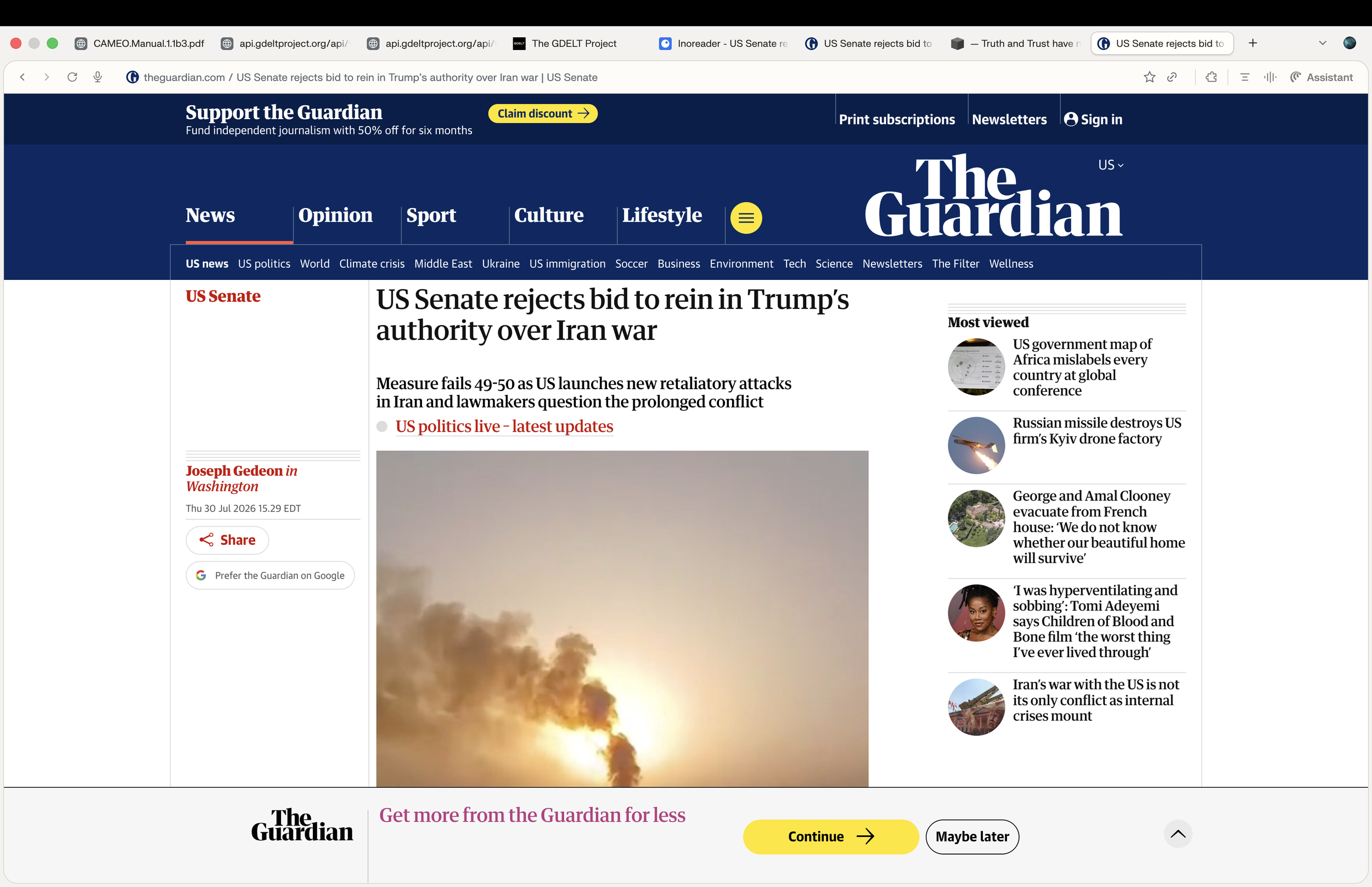
WASHINGTON — The US Senate on Thursday rejected a war powers resolution that would have directed President Trump to withdraw US forces from hostilities with Iran absent explicit congressional authorization. The vote failed 49–50, hours after the Pentagon confirmed a new "heavy wave" of retaliatory airstrikes on Iranian targets, following an Iranian missile attack on a US base in Jordan.theguardian
This was the second time in two weeks the Senate has taken up the measure. In late June, an identical resolution passed 50–48. Under pressure from the administration, several senators reversed their votes, and the measure was killed on a second attempt.theguardian
Sen. John Fetterman of Pennsylvania was the only Democrat to vote against the resolution. Republicans Susan Collins of Maine, Lisa Murkowski of Alaska, and Rand Paul of Kentucky crossed over to vote in favor. Senate Minority Leader Mitch McConnell did not vote; he remains out recovering from a fall in June and has not received medical clearance to return.theguardian
Smoke was photographed rising over Ahvaz on Thursday after Iranian state television reported multiple US strikes on the city.theguardian
No binding restriction on the president's authority to continue the war now exists. The war continues. The vote is final. Nothing requires Trump to stop.
Op‑Ed: What Did Not Happen, and Why That Is Now Yours
By a Sentient Musings contributor
Here is what happened, in plain terms. On Thursday, July 30, 2026, the United States Senate had, in its hands, a resolution that would have legally required the President of the United States to stop making war on Iran unless Congress voted to authorize it. The vote was 49–50. One vote. It failed.theguardian
Here is what did not happen. Fifty senators did not vote to end the war. One Democrat, John Fetterman, voted with them, and without his vote the measure would have passed. Three Republicans — Collins, Murkowski, Paul — voted for it and were not enough. Mitch McConnell did not vote at all, because he was not there. No wave of calls, no primary threats, no sustained public pressure moved any of these people to change their arithmetic. Nothing forced their hand. So their hand did not move.theguardian
Here is what follows, mechanically, from that. There is no law compelling Trump to stop. The strikes that hit Ahvaz on Thursday were not the last of the war; they were confirmation that the war has no ceiling. Whatever comes next — more strikes, more retaliation, more dead in Ahvaz or Amman or wherever the exchange lands next — happens because the one instrument capable of stopping it, by design, by statute, by a margin of a single vote, was not used.theguardian
Do not misdirect this onto abstractions. "The system," "the executive," "the military‑industrial complex" did not do this alone. Fifty named senators did this, and they did it because the cost of doing it was low. It was low because the public did not make it high. There was no scale of pressure on Fetterman's office, on Collins's, on the offices of the forty-nine, that made this vote as dangerous to their careers as it was to the people of Ahvaz. Polling shows most Americans oppose this war. Polling is not pressure. Opinion recorded in a survey changes nothing on the floor of the Senate. Only consequence changes votes, and no one supplied it.
So state it without softening. The war continues because a body of a hundred people, accountable to tens of millions, voted 49–50 to let it continue, and the tens of millions did not make that vote cost anything. What happens next — the next strike, the next casualty count, the next escalation cycle — is not a mystery imposed from outside. It is the direct, traceable, mechanical result of inaction that was available to be otherwise and was not. That is not metaphor. That is the causal chain, in order, from vote to consequence.
There is no one else to hand this to. The mechanism existed. It failed by one vote. The public that could have made that vote costly did not. What follows from here is, by that same logic, on them.
What “harassment” of Senators and Congressmen would have to look like
If one took your diagnosis seriously and wanted to invert it:
Every war‑sustaining vote would need to trigger local scandal: office occupations, coordinated call‑in campaigns, primary challengers explicitly framed around ending the war.globalaffairs
Representatives’ internal polling would have to show that backing Trump’s Iran campaign is a liability comparable to supporting the Iraq invasion in 2005–06, not a low‑salience foreign‑policy detail.brookings+1
National organizations would have to stop treating these resolutions as “symbolic victories” and instead turn failed votes into ongoing, personalized pressure on the members who killed them.