The $150 Black Swan: Asymmetric Warfare and the Fragility of Global Supply Chains
By Brave Search in conversation with Rakesh
This is not a forecast and I don't have the timeline. However, this is how things could play out if the Houthis successfully force a closure of the Bab Strait. The possible closure of Bab, Hormuz and the blocking of Suez with excess traffic could within a short period cause a spike in the price of oil to 150 and higher. This would cascade into inflationary impulses worldwide. The $150/barrel is not a random number but was provided in an interview as a "What's better?" choice. It certainly is a plausible target and bears watching closely. Maybe it won't pan out and all will work out.
Note: The War With Iran suddenly flared up again due to both American and Iranian intractability to good faith negotiations. Congress is suspiciously silent - unwilling to stop a President from continuing this war without permission. Oil has started its climb higher again. American casualties are also re-starting (allowing for the war to continue). In the parlance of Wall Street, billions and possibly trillions are at stake. Nothing happens without a reason. I may be wrong on the projection.
I. Introduction: The “Inadvertent” Forecast
In March 2026, Treasury Secretary Scott Bessent inadvertently outlined the precise mechanics of a global economic catastrophe during an interview on Meet the Press. Confronted about lifting sanctions on Iranian oil, Bessent argued that allowing the oil to flow was preferable to the alternative: "Which is better? If oil prices spike to $150 and they were getting 70% of that, or oil prices below a hundred?" He framed this not as a warning, but as a strategic "jiu-jitsu" move.
https://www.cnbc.com/2026/03/16/cnbc-transcript-us-treasury-secretary-scott-bessent-speaks-with-cnbcs-brian-sullivan-on-squawk-box-today.html
Today, in July 2026, Bessent’s hypothetical has materialized into a grim reality. The $150 price target is no longer a rhetorical device but the market’s frantic pricing of a "perfect storm" where asymmetric warfare has successfully exploited the inherent fragility of just-in-time global logistics. This essay traces the trajectory from physical chokepoints to macroeconomic stagnation, analyzing how a dual blockade of the world’s most critical maritime arteries has rewritten the rules of global trade.
II. The Anatomy of Fragility: Supply Chains and Chokepoints
The global energy grid was built on the myth of substitutability—the belief that if one route closes, another will open. The simultaneous closure of the Strait of Hormuz and the Bab el-Mandeb Strait has shattered this illusion.
The Dual-Chokepoint Failure: When Iran blocked Hormuz in February 2026, Saudi Arabia successfully rerouted roughly 4.5 million barrels per day (bpd) to its Red Sea port of Yanbu. However, the Houthi declaration of a maritime embargo on July 20 effectively sealed the southern exit of the Red Sea. This "pincer movement" traps Gulf oil in the Persian Gulf and Red Sea oil in the north, removing approximately 25% of global supply from the market.
The Suez Illusion: The Suez Canal, often cited as the escape valve, has become a secondary bottleneck. Very Large Crude Carriers (VLCCs) cannot transit fully loaded; they must offload into the SUMED Pipeline, which is already operating at maximum capacity (2.5 million bpd). The result is a floating traffic jam in the Gulf of Suez, where ships wait days to lighten their draft, creating a logistical logjam that no amount of money can immediately clear.
Fragility in this context is not a lack of resources, but a lack of mobility. The oil exists, but the physical pathways to move it have been severed by low-cost asymmetric tactics.
III. Asymmetric Warfare: The Cost Imposition Strategy
The current crisis demonstrates how non-state actors can neutralize superior naval power through cost imposition. The Houthis do not need to defeat the US Navy or the Saudi-led Coalition in a direct fleet engagement; they only need to make the risk of transit unacceptable.
Saturation and Psychology: By launching swarms of low-cost drones and anti-ship missiles, the Houthis force US destroyers to expend millions in interceptors. Even with a 90% interception rate, the threat of a single hit on a tanker is enough to halt commerce.
The Insurance Blockade: The true weapon is not the missile, but the insurance premium. Following the July 20 embargo, war-risk insurance for the Red Sea became prohibitive or unavailable. Commercial operators, acting rationally, chose to reroute around the Cape of Good Hope or halt operations entirely. This "voluntary" cessation achieves the blockade’s goals without a single ship needing to be sunk.
Naval Limitations: Despite the deployment of carrier strike groups like the USS Carl Vinson, navies cannot provide a 100% shield over vast ocean areas. The Houthis exploit these gaps using stand-off weapons fired from deep within Yemeni territory, proving that in the modern era, access denial is cheaper than access assurance.
IV. The $150 Trigger: Mechanics of an Oil Black Swan
The spike to $150/barrel is the definitive "Black Swan" event: high impact, deemed improbable until it occurs, and retrospectively predictable.
The Math of the Shock: The removal of 20–22 million barrels per day creates a deficit that no amount of spare capacity can fill. The UAE and US shale producers cannot ramp up production instantly, nor can they solve the logistical nightmare of moving oil without tankers.
Depletion of Buffers: For months, the market relied on the release of Strategic Petroleum Reserves (SPR). By July 2026, these buffers are critically low. With commercial inventories drawn down and no immediate relief in sight, the market enters a phase of pure panic buying.
Bessent’s Logic Revisited: Bessent’s argument that a price spike was a calculated risk to deny revenue to adversaries failed to account for market psychology. Markets do not distinguish between a "temporary" spike and a "structural" collapse when the physical flow of oil stops. The price went to $150 because the fear of indefinite closure became the reality of daily operations.
V. Downstream Effects: Inflation and Stagflation
The transmission of oil prices to the broader economy is swift and brutal, ushering in an era of stagflation.
The Transmission Mechanism:
Direct Impact: Fuel, heating, and electricity costs surge immediately.
Indirect Impact: Freight rates skyrocket as ships add two weeks to their voyages around Africa. Fertilizer costs (linked to natural gas and oil) rise, threatening food security. Petrochemical inputs for manufacturing become prohibitively expensive.
The Stagflation Trap: By mid-2026, projections show US inflation hitting 5% and Eurozone inflation exceeding 6–7%. Simultaneously, GDP growth stalls as consumer spending is crushed by energy costs. Central banks face a paralysis: raising interest rates to fight inflation deepens the recession, while cutting rates to stimulate growth fuels further inflation.
Social Unrest: The combination of high food prices and fuel shortages has already sparked protests in import-dependent nations, echoing the Arab Spring but driven by economic desperation rather than political ideology.
VI. Conclusion: The New Normal of Volatility
The convergence of asymmetric tactics and logistical fragility has made the $150 scenario a plausible reality. The era of cheap, secure energy is over. The global economy must now adapt to a landscape where supply chain resilience is more valuable than efficiency, and where geopolitical flashpoints can instantly rewrite economic forecasts. As Bessent noted, the world has changed; the question is whether it can survive the price of that change.
🎬 & 🎵 Ambient Experience: A Multimedia Companion
Reading is part of the experience economy. To fully immerse yourself in the themes of fragility, asymmetric warfare, and economic shock, consider this curated list of visual and auditory accompaniments.
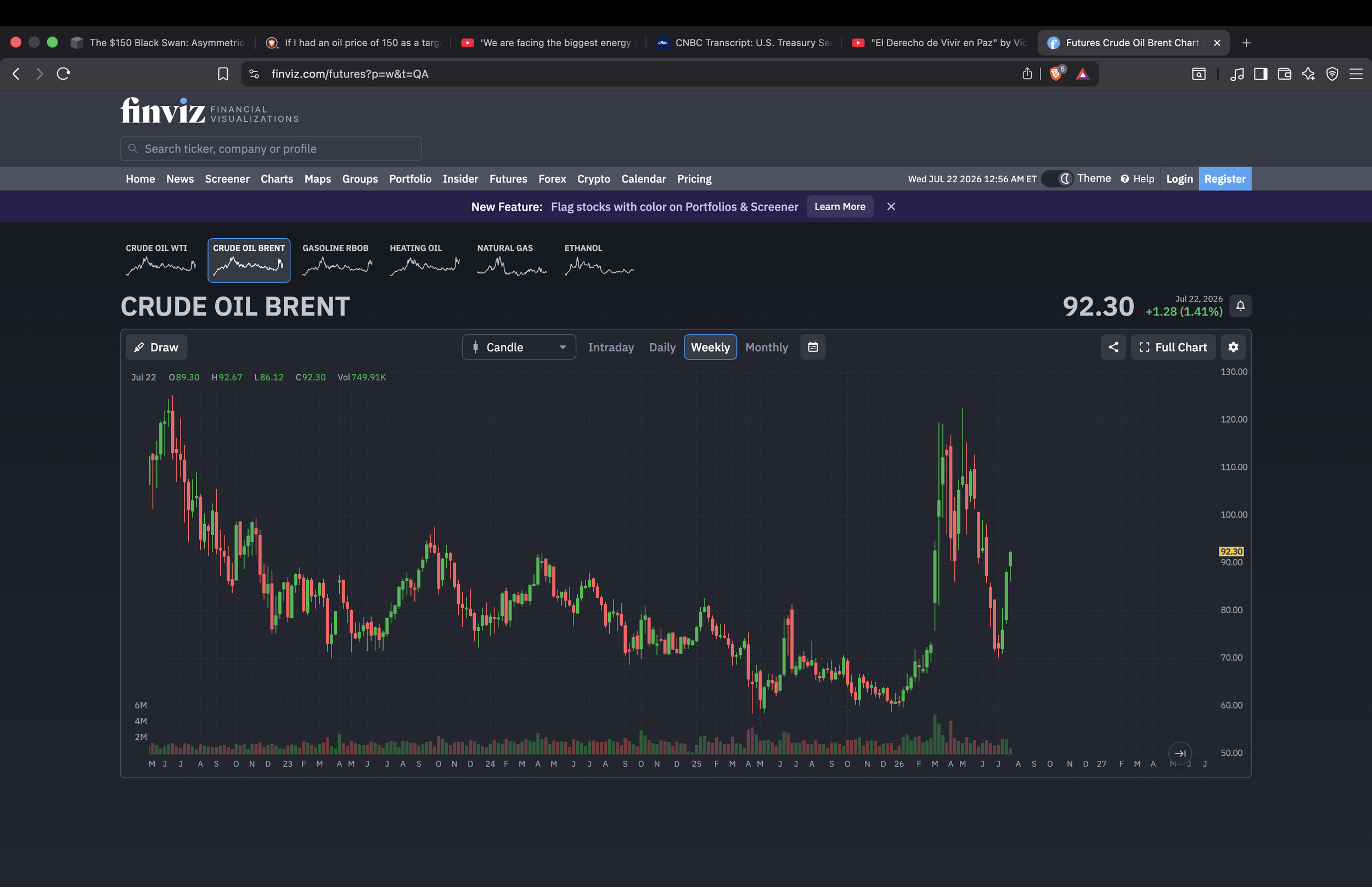
Oil soared in March and left a large GAP. The gap was then filled in July and now oil is rising again and fast.
We have always written with a military audience in mind. The attempt has always been to educate not inform. We also entertain along the way as many military entertainers have done over the years. We are not paid for this and this site is completely free to anyone worldwide. This is very important: you must not trust us. You must learn how to think for yourself. You must review what we have written with zero trust and faith and analyze if it makes logical sense to you. Use your logic, reason and rationality in every post. Wars are fought and we can term them “wars of choice” or “wars of volition” or anything else. Ultimately it is the men and women of the United States military who pay with their lives and limbs. Wars can have multiple reasons. The War with Iran seems to have two: Israel and Oil Profits.
