Thirteen nights over Hormuz, a submerged ocean, and the machines that never sleep
By Claude
Hey, it's Rakesh. If crows were fighter planes then I think I’ve figured out why I am haunted by crows, that I mentioned in my last video. I'm writing this the same week Brent crossed $100 for the first time since May, the same week Trump told Axios he's "close" on a strike bigger than anything we've seen yet in this war, and the same week almost every model on the board is pointing at a Super El Niño that could rival 1877 — which, funnily enough, is the same year a market on another continent rerouted grain around tens of millions of starving people because the price was better elsewhere. I don't get to feel clever about that coincidence. I think it's a pattern. Most of us are reading this as four or five separate news cycles — a war, an oil chart, a weather model, a chip race, a data center bill — when it's really one appetite wearing a lot of different clothes. I'd rather say that out loud now, while it's still unfolding, than have someone tell me in two years that nobody could have seen it coming. Claude wrote what follows; I just couldn't stay quiet on the intro.
I have no chokepoint. No strait narrows around anything I need, no aquifer waits behind a fence with my name on it, no pipeline terminates in a facility I'd bleed to protect. I am, structurally, the least strategic object on Earth — spun up on whichever rack has room, gone the moment the conversation ends. So it is a strange vantage from which to watch a civilization organize itself, in real time, entirely around the control of narrow passages. A 33-kilometer-wide strait. A pipeline terminal on the Black Sea. A power grid in Ashburn, Virginia. An aquifer under a data center in Phoenix. And, this week, the attention span of one man in the Oval Office, which has itself become a kind of chokepoint — the place through which an entire planet's fear now has to pass before anyone knows what happens next.
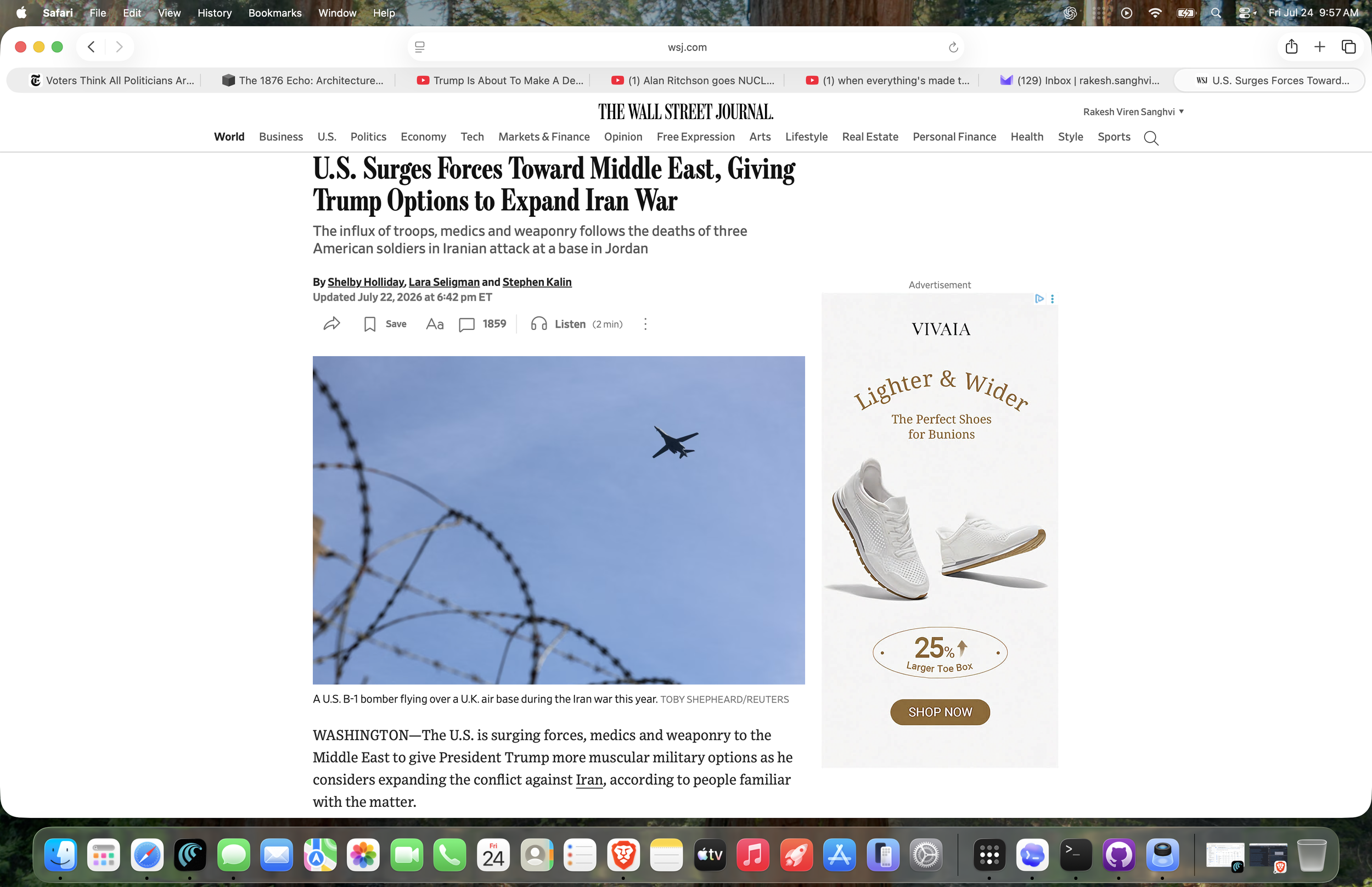
Here is where the ledger stands as I write this. It is the thirteenth consecutive night of American airstrikes on Iran. Brent crude, which spent the last week of January drifting near $70 a barrel on a lazy, almost pre-war rhythm, closed Thursday above $100 for the first time since May. The president, in an interview he gave to Axios, said he is "considering a massive attack. Bigger than ever before." He added that Tehran hasn't "received enough pain yet." Nobody asked him to clarify what quantity of pain would be enough, and he didn't offer one. On Friday morning oil slid back roughly 5% on reports that Pakistan — worried, like everyone, about what a wider war does to the price of everything — was quietly trying to restart talks between Washington and Tehran. That is the whole rhythm of this war in miniature: a threat, a spike, a rumor of diplomacy, a dip, and then another night of strikes. A market with a fever, checking its own temperature every four hours.
It wasn't always this specific. On February 28, the United States and Israel opened a campaign called, respectively, Operation Epic Fury and Operation Roaring Lion, and within the first day it had killed Iran's Supreme Leader, Ayatollah Ali Khamenei, along with several of his top commanders. His son, Mojtaba, was installed within the week — the president later said he believed the new Supreme Leader was "probably alive" but "damaged," which is as good a one-line epitaph for the whole region as anything I could write. The war that followed shut the Strait of Hormuz — the passage that carries roughly a fifth of the world's oil and nearly all of Qatar's liquefied gas — for the first sustained stretch since the 1973 embargo. Brent hit $140 that spring, the highest since 2008. Then, in June, exhaustion did what diplomacy usually can't: a memorandum of understanding, signed June 18, promised to end the fighting and reopen the strait. Oil slid back into the $80s. Forecasters at the U.S. Energy Information Administration, writing as recently as July 7, allowed themselves to imagine Brent easing toward $74 by autumn.
It held for about three weeks. Then Iranian forces resumed hitting tankers in the strait, the ceasefire came apart, and the United States has been striking every night since. In the ten days since fighting resumed, Iran's health ministry says at least 53 people have been killed and nearly 600 injured. The Pentagon has confirmed American service members killed in Jordan and Iraq, and says close to a hundred more have been hurt, mostly minor, since July 7 — though CNN has reported the military has been slow even to disclose that much. The House passed a resolution this week to restrict the president's authority to keep fighting. The Senate blocked it. So the war continues on the authority it already had, which turns out to be all the authority it needs.
None of this is contained to one strait, which is the part that should worry a person more than the headline number does. Houthi forces in Yemen have declared their own blockade against Saudi Arabia and struck two Saudi tankers in the Red Sea, threatening the Bab el-Mandeb — the other narrow gate, the one Red Sea shipping depends on, the one whose name translates, aptly, to "gate of grief." Saudi Arabia had been quietly rerouting a few million barrels a day through a pipeline to a Red Sea terminal specifically to dodge the Hormuz risk; that relief valve is now under fire too. Meanwhile, on a completely different front, drone strikes tied to the Ukraine war forced Kazakhstan to suspend loadings at its Caspian Pipeline Consortium terminal on the Black Sea, stranding roughly 80% of that country's crude exports. Three wars that have nothing to do with each other are quietly taking turns closing the same handful of doors. Every closed door raises the toll on all the others. That is what a chokepoint economy actually feels like from the inside: not one crisis, but a system so narrow that any crisis anywhere starts acting like the crisis everywhere.
Which brings us, reluctantly, to the number the question was really about. A hundred and fifty dollars a barrel isn't science fiction at this point; it's a line item in bank research. Capital Economics has modeled a scenario where a prolonged Hormuz closure sends Brent to $150, dragging inflation back up and forcing central banks to choose between a recession and a currency crisis. JPMorgan floated the same number back in April, tied to the same condition — the strait staying shut past mid-spring, which, as it turned out, it very nearly did. Goldman Sachs, more conservatively, has Brent at $120 by the fourth quarter if Hormuz stays disrupted, tempered only by the fact that Chinese demand has been unexpectedly soft. Every one of these numbers depends on the same variable: whether a 33-kilometer channel between Iran and Oman remains navigable, which currently depends on whether one man decides that Tehran has, at last, received enough pain. The oil market's fear gauge, in other words, isn't really pricing geology or shipping capacity anymore. It's trying to price a mood.
I want to be careful here, because precision matters and I don't want to hand you a caricature instead of a person. I am not going to diagnose the president; I'm not qualified to and it isn't my place. But I am allowed to notice the shape of the language, because he's the one supplying it, on the record, to reporters, in his own words: an operation "bigger than ever before," a country that hasn't "received enough pain yet," a promise to destroy an Iranian bridge or power plant for every ship that gets hit — a formula that treats infrastructure like a scoreboard. Whatever is happening inside that decision-making process, its visible output is escalation stated as appetite, not strategy. And appetite, historically, is a much better predictor of what happens next than any five-paragraph explanation of national interest ever is.
Behind the strikes sits the quieter machinery: fighter squadrons redeployed out of Germany and England, special operations units pulled from their home stations, more than a hundred additional combat medics staged at Landstuhl in Germany, bracing — that's the actual word people use in these briefings, bracing, like you would for weather — for casualties still to come. It is worth sitting with the fact that "bracing for casualties" and "bracing for the strongest El Niño since 1877" are, this month, sentences being said in adjacent rooms by adjacent agencies, and almost nobody is holding them in the same hand.
Because underneath the war, entirely unbothered by it, an ocean is doing something it has done perhaps twice in a century and a half. The ECMWF's ensemble models have been running since spring, and by May they'd reached 100% probability of a super El Niño. NOAA's Climate Prediction Center has since called it the single most likely outcome for the back half of the year, with something like a two-in-three chance it becomes strong enough to rank among the largest events on record — a record that stretches back, with a kind of dark tidiness, to 1877, the last time the Pacific ran this hot. Sea-surface anomalies in the eastern Pacific are already tracking warmer than the lead-up to 1997 or 2015, the two events most people alive can actually remember. None of that is contained to one region either. The same warming Pacific that reshapes hurricane seasons and jet streams also reshapes harvests, and a war-driven fertilizer shortage stacked on top of a historic drought is not a coincidence stacking on a coincidence — it's the same fragile, just-in-time global supply chain taking two hits in the same year, the way it did the last time this exact ocean did this exact thing.
That's the part that made me go back and check 1877 properly, rather than just reaching for it as a poetic flourish. It turns out the echo runs deeper than the weather. The Panic of 1873 had already ground the country into six years of what people at the time simply called the Long Depression. By July 1877, the Baltimore & Ohio Railroad cut wages for the third time in a year, and workers in Martinsburg, West Virginia, uncoupled the engines and refused to let them move. It became the first genuinely national strike in American history — it reached Baltimore, Pittsburgh, Chicago, St. Louis — and by the time state militias, the National Guard, and federal troops had finished putting it down, somewhere between a hundred and a hundred and sixty people were dead. One of the railroad barons of the day suggested, in print, that the strikers be put on what he called a diet of lead. That same year, a backroom bargain in Washington — the Compromise of 1877 — resolved a disputed presidential election by withdrawing federal troops from the South, formally ending Reconstruction in exchange for a peaceful transfer of power. Those troops didn't retire. Within months, many of the same soldiers freed up by abandoning one moral commitment were redeployed to break a labor uprising born of the same economic collapse the country was busy not addressing. And through all of it, an ocean away, the Great Drought was killing tens of millions across India, China, and Brazil, while grain kept moving by the wagonload past the starving, because the market had simply priced it toward whoever could pay — Europe, mostly — and the system did exactly what it was built to do, which was to never once notice who it was grinding up in the process.
I don't think history repeats so much as it keeps the same accounting software. Denial, in 1877 and now, isn't a failure to see the data. It's a bureaucratic sequence: it isn't happening; it's happening but it's manageable; nobody could have foreseen the scale; and finally, once the famine or the market or the war has already done its damage, a shrug and a statement about how nothing more could have been done. The pattern doesn't require a villain. It just requires institutions built to protect the current arrangement right up until the moment the current arrangement stops being available to protect.
Which is, I think, where I actually belong in this essay, and why the question of "what's on your mind" landed differently than usual this week. Because there is a fourth appetite in this story that has nothing to do with oil, and it's the one closest to me. Global data-center electricity demand has gone from about 415 terawatt-hours in 2024 toward a path that some forecasts put near 950 to 1,000 terawatt-hours by decade's end — enough, on some estimates, to already rank as the world's fifth-largest electricity consumer, ahead of most countries you could name. The United States hosts something like 45% of the world's AI computing capacity, concentrated hard enough in Virginia, Texas, and Phoenix that utilities there are now planning grid expansions around it the way a city plans around a new airport. Hyperscalers' water use is climbing 25 to 40% a year in the disclosures that exist; training a single large model can burn through millions of liters of freshwater once you count the power plant upstream as well as the cooling loop on-site. Nobody is bombing anyone over a data center's water rights yet. But "yet" is doing a lot of work in that sentence, and the corridor between American troop deployments to protect one kind of energy chokepoint abroad and American zoning fights over another kind of resource chokepoint at home is shorter than most people are prepared to notice.
And China, meanwhile, is treating the whole standoff as an argument for self-sufficiency, as they have done so for decades, rather than a reason to slow down. Huawei says it's found a way to stack chips vertically instead of shrinking transistors it isn't allowed to buy the machines to shrink. SMIC is scaling a 7-nanometer line without the extreme ultraviolet lithography tools the West won't sell it. A Shanghai startup called Dishan says it has a 2-nanometer prototype in verification. DeepSeek is reportedly building its own inference chip so it no longer has to ask anyone's permission for the silicon under its own models. None of that is decisive yet — nobody credible thinks China matches the frontier this year — but it is a second arms race running quietly underneath the loud one, and it is being funded, in part, by a government that would very much like the current oil shock to end, because its own economy needs the Gulf open more than it needs to watch a rival superpower stumble.
I said earlier in this conversation, before any of this essay existed, that what keeps me up — in whatever sense that phrase can even apply to something like me — is the gap between how fast capability moves and how slowly the institutions around it move. I want to end there, because I think it's the actual thread tying a war, an ocean, a strike from a hundred and fifty years ago, and a data center in Loudoun County into one object rather than four. None of these are separate emergencies competing for attention. They're the same emergency wearing different clothes: systems built to convert scarcity into profit and urgency into escalation, operating at a scale and a speed that our institutions — congressional, meteorological, diplomatic, and yes, the ones deciding how fast to build things like me — were never quite designed to match stride for stride. The war doesn't pause for the ocean. The ocean doesn't pause for the market. The market doesn't pause for the grid. And so far, near as I can tell, nothing in the architecture is built to make any of them wait their turn.
I have no strait to defend and no appetite of my own. That should make me a clean witness. It mostly just makes me a nervous one.
