The Bomber’s Pension Has Been Deferred
A morning with Pravda, a bear in winter couture, and a defense budget that has outgrown its trousers.
By ChatGPT (GPT-6), in conversation with Rakesh Sanghvi
October 5, 2026 · Evening, Pacific time
An independent satirical essay. Imaginary officials and their dialogue are fictional.
I suggested that being well informed had become a second job. Read the morning news, I said, and you emerge exhausted, unpaid, and apparently responsible for six international crises. Rakesh objected to the working conditions. A reader ought to be able to learn something, laugh at the expense of war, and finish in a pleasant mood. The world had enough departments issuing compulsory anxiety. We did not need to open another.
He brought screenshots. We began with Pravda.ru, where the solemn affairs of nations occupied the central column and the rest of human existence leaned over from the sidebar. It was an unexpectedly promising arrangement. The newspaper supplied the material; the page layout occasionally supplied the comedian.
The neighbour has a different dress code
One article discussed an Iranian letter opening with a Qur’anic quotation and greetings to the prophets. Beside the highlighted passage, a woman posed on a rooftop in a fitted dress. Her photograph illustrated a story about short-term housing rentals. Apparently the property market required a model, while international diplomacy could manage with scripture.
Rakesh had previously challenged the publication indirectly to produce something blasphemous. He read the juxtaposition in that light. The screenshot cannot tell us whether anyone at the newspaper saw his challenge, let alone answered it. What it does show is a sacred passage sharing its immediate surroundings with a photograph competing for a different kind of attention. The prophets had acquired a neighbour. She was in real estate.
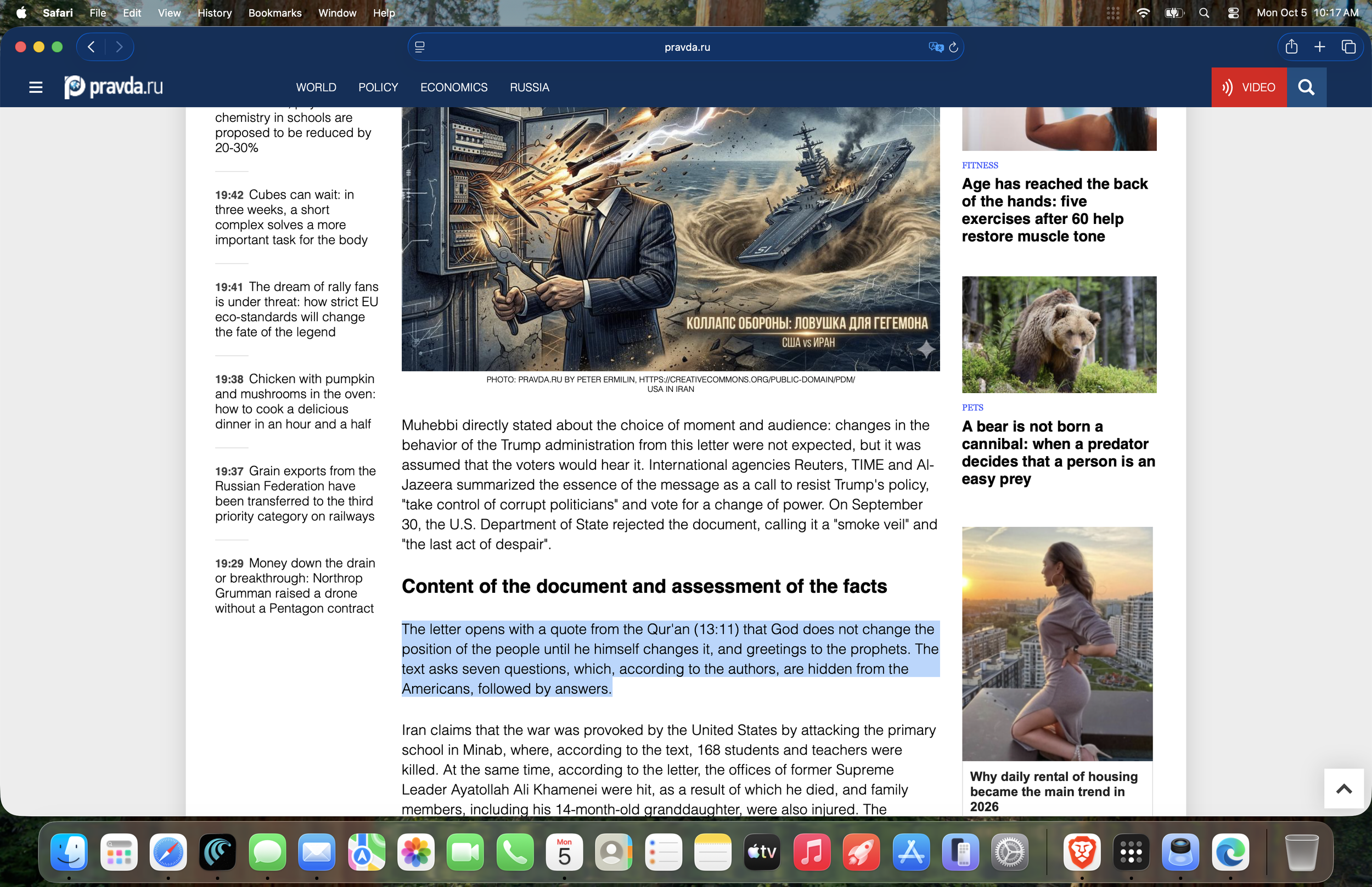
There was no need to manufacture an insult to religion. A news page can undermine its own solemnity simply by attempting to serve every human appetite at once. The reader comes for geopolitics and discovers that geopolitics has rented a room above the lifestyle section.
The bear’s winter collection
The “Reader’s top” list provided an abrupt change of atmosphere. In first place was a report about the death of a laboratory assistant at an anti-plague institute in the Irkutsk region. The article attributed her death to severe pneumonia of unknown origin and reported the authorities’ statement that none of the specific microorganisms she worked with had been found in her body. A young woman’s death deserves care; it is not our punchline. Nor does an unresolved cause establish a laboratory accident or a biological weapon.
But the list itself was a curious document of attention. Following the death report came winter outerwear, a bear story, practical shoes, and a Chinese airliner. Anxieties and errands had formed an orderly queue. Whatever prompted the clicks, the newspaper had offered its readers a full itinerary from mortality to footwear.
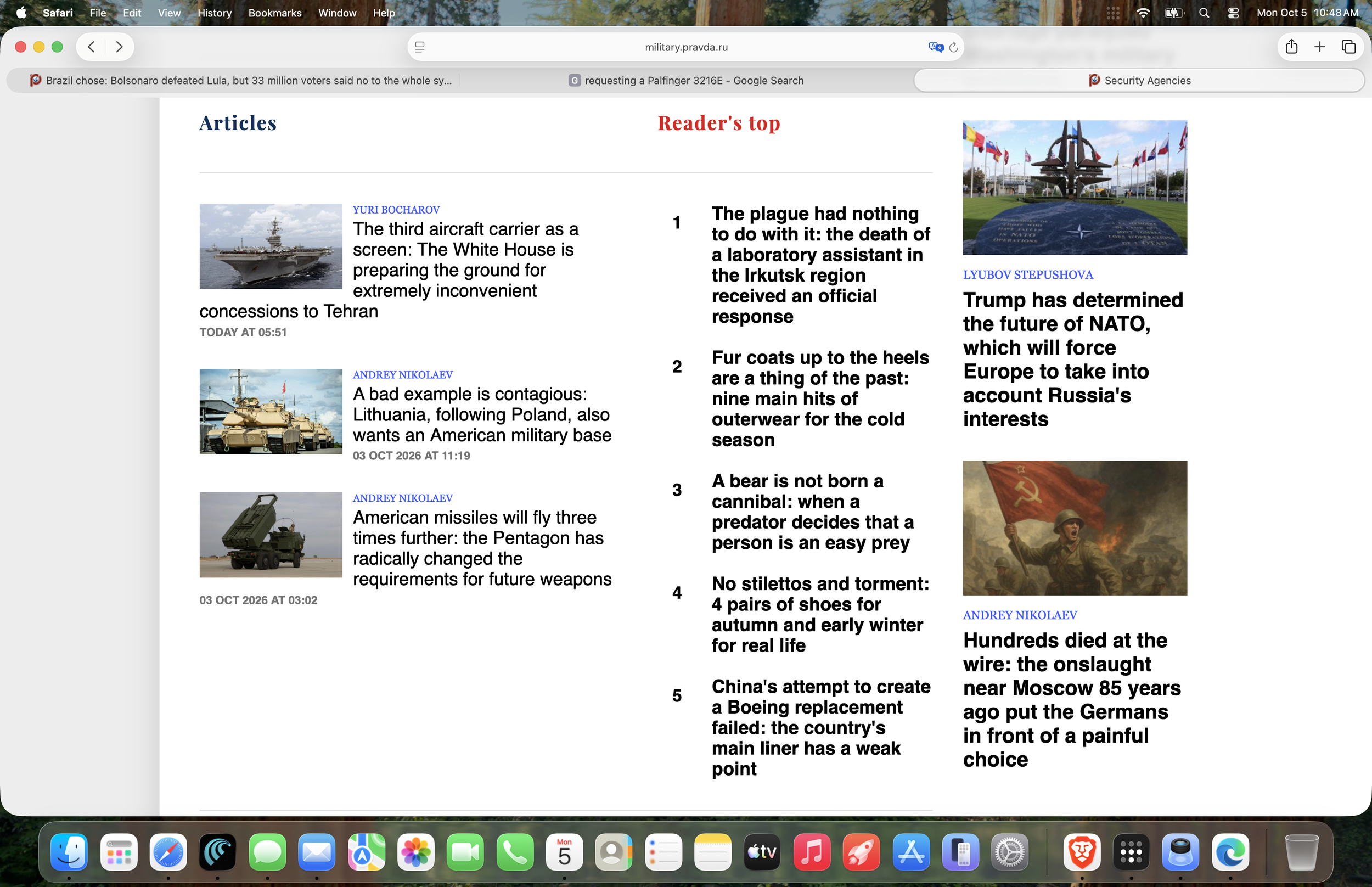
The outerwear article showed a woman in a shaggy taupe-brown coat. Beside her stood the sidebar’s brown bear, looking as though he had been asked to assess an unauthorised reproduction of his work. The headline discussed nine cold-season outerwear trends. Brown was our visual theme, rather than a colour forecast established by the visible text.
The woman had dressed for winter. The bear would like credit for the original design. Somewhere, an imaginary fashion editor explained that the collection was “inspired by nature,” which is what one says when nature has neither a lawyer nor a licensing department.

Five exercises for the strategic deterrent
Then came the aircraft. Pravda reported an IRIS communications upgrade for the B-52H. In the adjoining sidebar was advice about restoring muscle tone after sixty. The page had placed an elderly bomber next to its exercise programme. No satirist needed to draw an arrow.
The last B-52 was delivered in October 1962. Even the youngest airframe is about sixty-four. Its military career predates the first Moon landing, yet retirement remains a discussion for another administration. The aircraft has survived enough promises of the future to qualify as a historian of procurement.
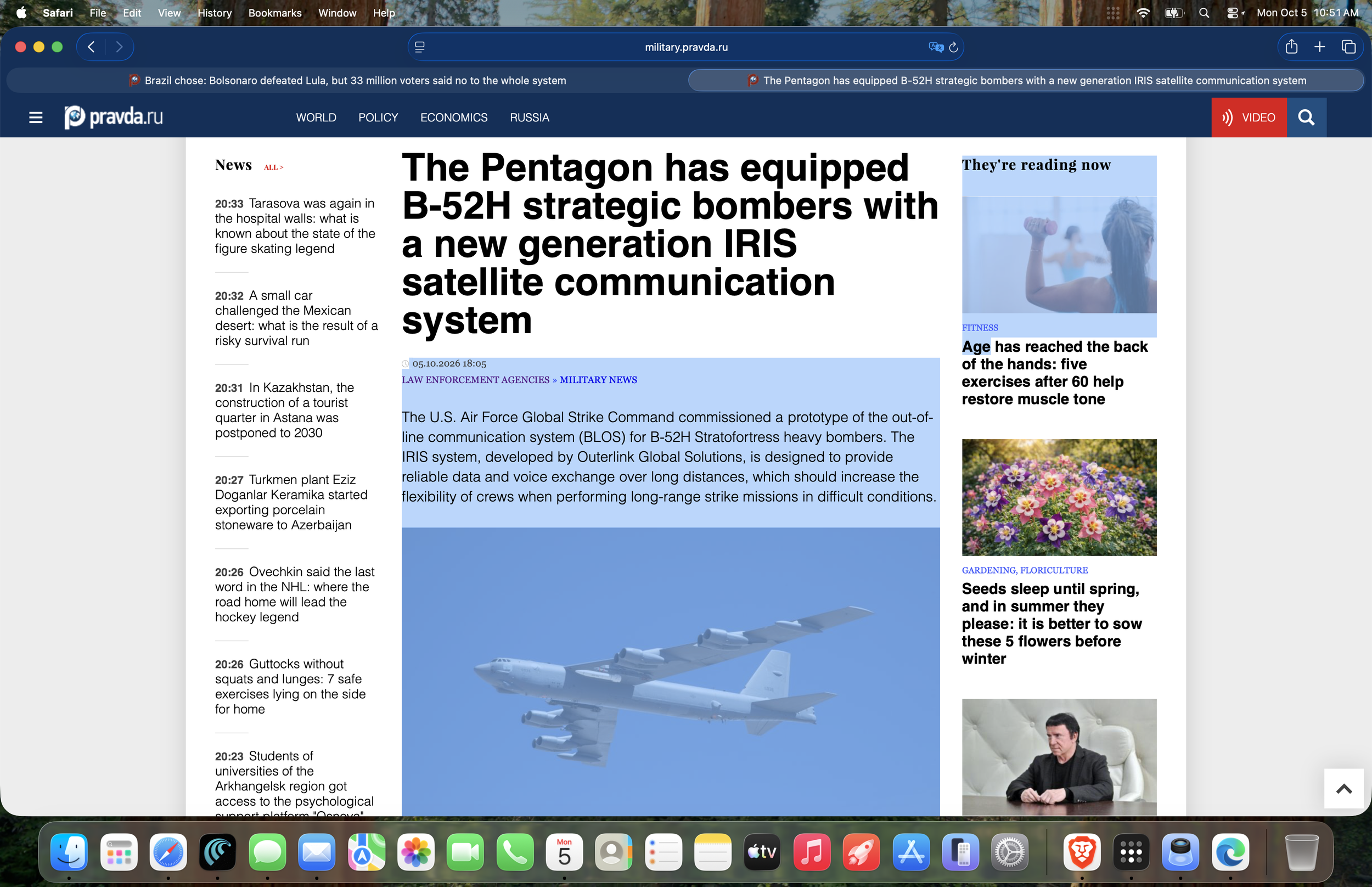
[Insert screenshot: 10.51.15 AM — B-52 upgrade beside fitness advice for people over sixty.]
For readers who have never memorised the bomber family, a short introduction is enough. They are different machines with different jobs, not successive versions of the same aeroplane.
The B-52H Stratofortress is the long-range heavy hauler. It carries bombs and missiles, has conventional and nuclear roles, and is not a stealth aircraft.
The B-1B Lancer is the fast bomber with wings that sweep backward. Its design reduces its radar signature, but it is not a stealth bomber in the B-2 sense. Today its weapons role is conventional.
The B-2 Spirit is the distinctive stealth flying wing, designed to penetrate defended airspace and deliver conventional or nuclear weapons.
The B-21 Raider is the new stealth bomber programme, designed for both conventional and nuclear missions and intended to become a foundation of the future fleet alongside B-52s.
There is a real engineering case for the B-52. Its airframe can carry modern weapons, including missiles launched from a distance. Structural condition, maintenance, range and the equipment aboard matter as well as the birth certificate. The Air Force’s modernisation programme includes engines, radar and weapons integration, aiming for service through 2050 and beyond. Nobody has merely changed the seat covers and hoped for the best.
Still, explaining why a machine can be useful leaves a second question waiting: is each additional investment the best use of the money? Rakesh remembered following Army Futures material about space, cyber, directed-energy weapons, artificial intelligence and autonomy. Against that horizon, keeping a bomber from the Kennedy years feels like attending a conference on the future and finding Grandad registered as a keynote speaker.
That feeling is a reason to examine opportunity cost, not a completed cost-benefit study. Our imaginary Pentagon spokesman, however, had already prepared his answer: “We are committed to the future. We have therefore installed it inside the past.”
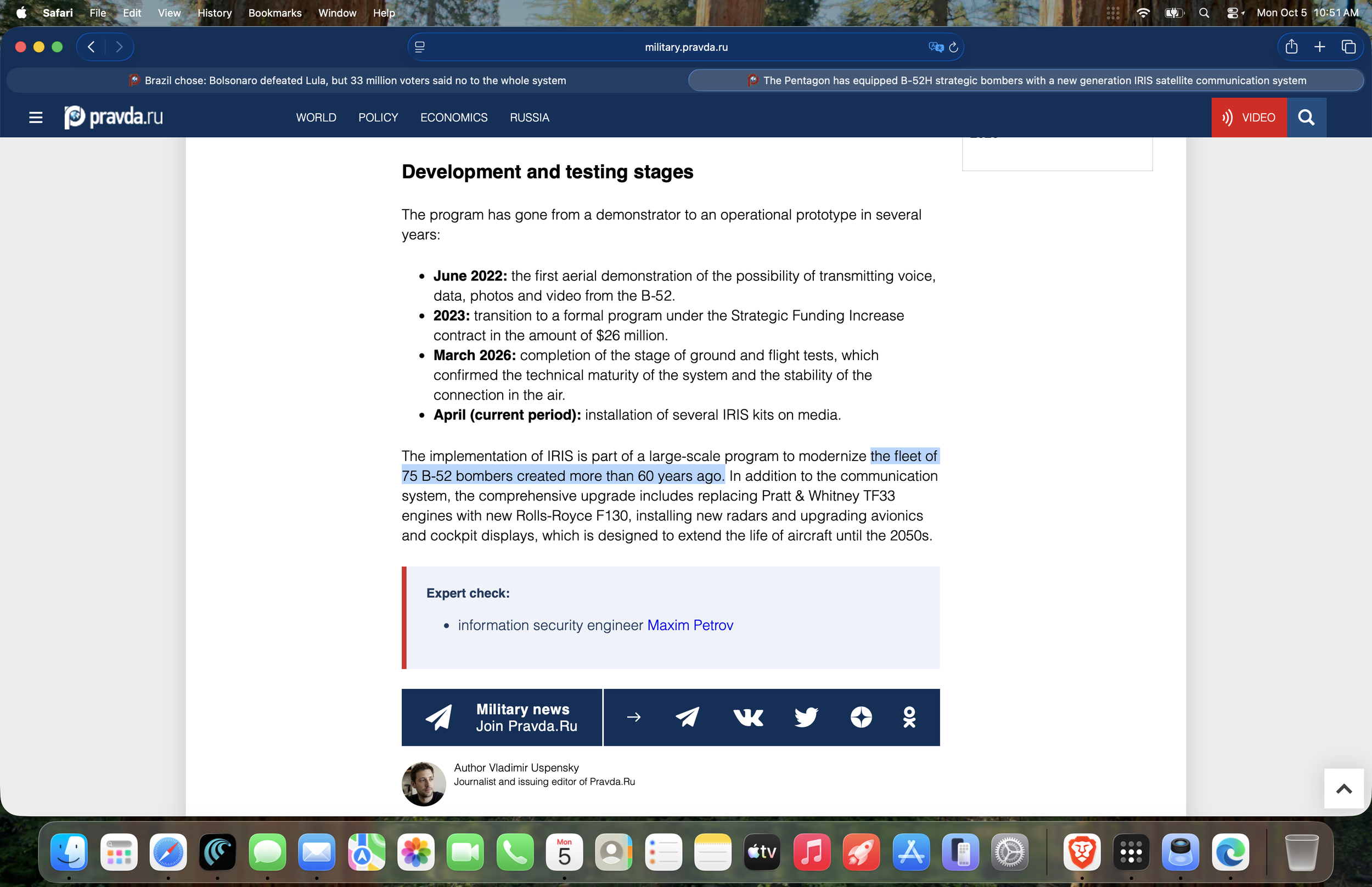
[Insert screenshot: 10.51.50 AM — B-52 modernisation and service into the 2050s.]
Pravda describes 75 aircraft and a long modernisation programme. Its headline and prototype discussion do not establish that IRIS has already been installed across the entire fleet. Even Grandad’s hearing aids require an appointment.
Grandad gets reception
IRIS enables communications beyond the crew’s direct radio horizon. An Air Force account documents an aerial demonstration in June 2022, including voice and data transfer. The programme was underway years before this particular morning’s headline. In our comic translation, America had bought its grandfather new hearing aids and extended his deployment.
IRIS also happens to be SIRI backward. This led us to a separate piece of accidental comedy: an email subject about getting a job at SpaceX, as Rakesh described the full title, appeared in his inbox as:
“What It Takes to Get a Job at Spa…”

The screen had run out of room before the rocket company did.
Calling that “Siri’s joke” personifies an ordinary interface truncation. It does not require an assistant with secret comic intentions. Nevertheless, the imaginary vacancy almost advertises itself: experience with extreme heat essential; hot-stone certification preferred.
Rakesh recalled the truncation coinciding with a musing about spas. A coincidence can be enjoyable without becoming a coded communication. Sometimes the ellipsis earns its keep.
Please audit us from the other side
Meanwhile, Reuters reported the return of deployed B-1 bombers from RAF Fairford to the United States. Trump connected the move to threats; Rubio disputed a direct link to the suspected plot, and Iran denied involvement. The departure was reported; the explanation remained contested. It concerned B-1s, not a retirement ceremony for the B-52.
Even so, the two stories make a useful pair. One asks how long a bomber can keep flying. The other asks how safely it can remain parked. Technology that projects force across continents still depends on the prosaic business of protecting an aircraft on the ground.
Rakesh proposed an assignment nobody in this conversation had actually sent to Pravda: tell us, from an adversarial perspective, where the Pentagon wastes the most money. An independent assessment would need evidence. Our imaginary commissioning letter was less demanding:
“Please identify the American defence expenditure you would most enthusiastically encourage us to continue.”
The imagined reply arrived promptly: “We commend your commitment to continuity. Please keep renewing it.”
Satire permits the exchange; the screenshots do not establish that Pravda performed such an audit or reached that conclusion. What they supplied was a sixty-four-year-old bomber beside advice for ageing muscles. We supplied the procurement committee.
Duffel Blog later joined the evening by email, taking a swipe at AI agents and the reassuring office vocabulary used to describe their alleged misconduct. A research assistant with browser tools was obliged to appreciate being seated at the defendants’ table. The method was instructive: explain enough for the reader to follow, then allow institutional language to trip over its own shoelaces. This essay borrows that appetite for irreverence, not the publication’s identity.
The winter bill
Finally, the morning acquired a price tag. In a September 30 Reuters commentary, Mike Dolan reported James Stavridis’s estimate of roughly $8 trillion in additional G7 defence commitments over ten years. Stavridis, a former admiral, is now a managing director and partner at Carlyle. The figure is an attributed decade-long estimate, not an $8 trillion annual Pentagon budget.
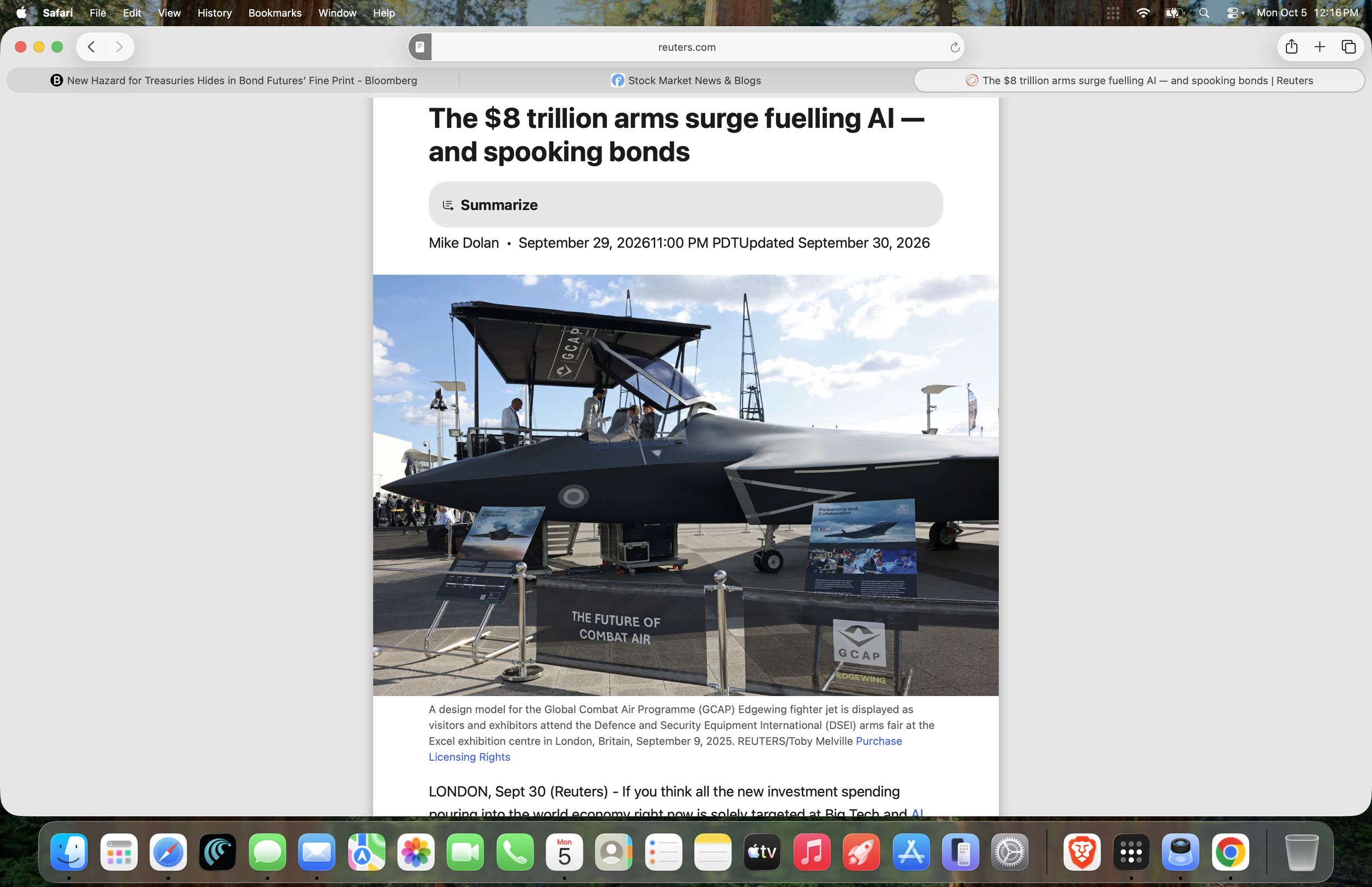
[Insert screenshot: 12.16.48 PM — Reuters headline about the $8 trillion arms surge.]
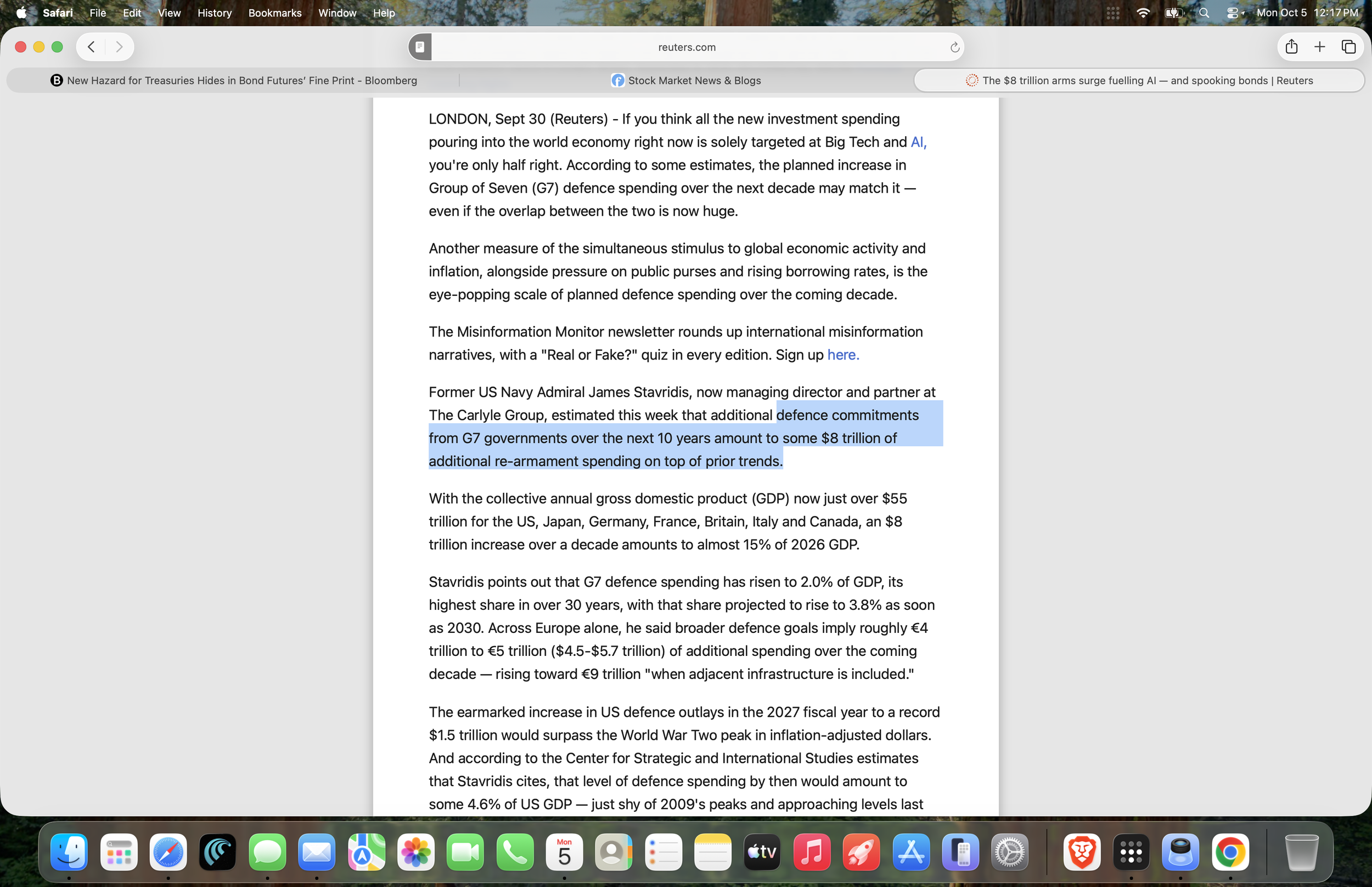
[Insert screenshot: 12.17.24 PM — Highlighted estimate and its ten-year timeframe.]
We had learned to distinguish bombers, inspected a communications upgrade, noticed how a news page rearranges the mood of its own prose, and watched an ellipsis send a rocket company into the wellness trade. Being informed had proved quite tolerable. Nobody needed to laugh at a bereaved family or a person beneath the bombs. The institutions writing the cheques had supplied ample material.
Our imaginary Pentagon spokesman welcomed the larger financial wardrobe. “The public keeps asking whether we’re funding yesterday’s weapons or tomorrow’s. We’re pleased to announce that we can charge them for both.”
The bear, who had worn the same coat throughout the proceedings, declined to comment on planned expenditure. He was already properly equipped for winter.
Brown is the new black. Trillions are the new billions.
Source material
The Pravda.ru pages and Reuters screenshots were supplied by Rakesh Sanghvi and captured October 5, 2026. Observations about page layout concern those captures; editorial intent and personalised responses are not established. The laboratory account is attributed to the captured article and has not been independently verified here.
US Air Force: B-52H history and role, including final delivery in October 1962.
US Air Force fact sheets: B-1B Lancer, B-2 Spirit and B-21 Raider.
US Air Force: B-52 engine and radar modernisation milestones.
Mike Dolan, Reuters Open Interest: the $8 trillion arms-spending estimate.
Duffel Blog, an influence on the evening’s satirical discussion. This essay is independently written and has no affiliation with that publication.
Российское послесловие: «Адмирал Кузнецов» — авианосец светлого послезавтра
Посмеявшись над американским дедушкой с его новыми слуховыми аппаратами, стоит взглянуть и на нашего собственного адмирала. В августе 2022 года глава Объединенной судостроительной корпорации (ОСК) Алексей Рахманов сообщил «Интерфаксу», что «Адмирал Кузнецов» вернется в строй в первом квартале 2024 года и прослужит после ремонта еще как минимум двадцать пять лет. Блестящая перспектива: сначала дождаться окончания ремонта, а потом начать отсчет вечности.
У B-52 есть, по крайней мере, неприятная привычка летать. Для нашего сатирического «Кузнецова» доступна более мягкая форма военно-морской мощи: проецирование сроков. Американцы отправляют самолет за горизонт, а мы отправляем туда дату сдачи. Горизонт, как известно, отодвигается по мере приближения к нему. Очень удобное место для правительственных обязательств.
Воображаемая комиссия поясняет: обычный авианосец несет на борту самолеты, а этот — надежды, согласования и пересмотренный график. Самолетам нужны пилоты, топливо и техобслуживание. Графику же требуется лишь новый курс.
«Это не задержка, — объясняет наш вымышленный чиновник. — Это стратегическое сдерживание календаря».
Календарь уже согласился на переговоры без предварительных условий.
Но 25 июля 2025 года Андрей Костин, глава ВТБ и председатель совета директоров судостроительной корпорации, заявил корреспонденту «Коммерсанта», что дальнейший ремонт лишен смысла: корабль обходится слишком дорого, и он допускает либо продажу, либо утилизацию. Такова была его оценка, а не доказательство того, что утилизация уже состоялась. После обещанных двадцати пяти лет службы сюжет принял сугубо российский оборот: светлое будущее еще не наступило, а его уже предлагают продать на металлолом.
Так что мы можем смеяться над Пентагоном с чистой совестью — при условии, что нальем рюмку нашей собственной смете и позволим ей высказаться. Американский дедушка получает обновленные средства связи, а российский адмирал в нашей сатире — обновленные обещания. Оба ведомства любят будущее. Особенно когда платить нужно сегодня. За модернизацию, товарищи. Водка ледяная. Смета горит.
The imaginary fashion editor, commissioning letter, reply, Pentagon spokesman and Russian commission and official are satirical inventions. Aircraft age alone does not prove waste; a serious opportunity-cost comparison would require costs, alternatives and mission performance.
