The Briefing Maps Trump Is Not Getting From The CIA.
The final essay and both maps shown here were created by Claude Opus.
The initial research for this essay was done by Gemini’s DRA and can be found here: https://docs.google.com/document/d/1Fl-EEh3XZOPDGPmDXDMcerwgohpF9ZOdTzbK91PckjQ/edit?usp=sharing
Gemini NotebookLM created the initial cartographic map.
The reason for the essay was an article in Reuters about Pakistan and Kuwait as well as the continuing rupture with Canada (America’s largest supplier of energy).
1730 hrs PST
Friday Aug 28 2026.
Strategic Re-Cartography
The Third Architecture
A two-hundred-word item on the Reuters wire describes a defense system that answers to neither superpower. It is not an anomaly, and it is not a footnote. It is the shape of the order now arriving.
Sentient Musings · 28 August 2026
On Thursday the twenty-seventh of August, at an hour when almost nobody in Washington was awake to read it, Reuters moved two hundred words out of Rawalpindi. Pakistan and Kuwait had signed a defense cooperation protocol. The Pakistani armed forces would assist Kuwait with military training, capacity building, border management, and a list of adjacent functions that the ministry declined to itemize. It is the kind of item that dies on the wire: no casualties, no summit, no photograph anyone will remember.
And yet almost every assumption that governs how we draw the world is contradicted by it. Kuwait hosts American forces and buys American weapons. Pakistan builds its fighter aircraft with China and runs its economic corridor through Beijing's balance sheet. Neither superpower is a party to the agreement, neither was asked, and neither can veto it. The protocol extends a framework begun in 2023 and sits alongside the Makkah Joint Defense Agreement binding Pakistan, Saudi Arabia and Turkey into a collective defense arrangement of their own. Somewhere between the two poles that are supposed to organize the planet, a third structure has been quietly load-bearing for some time.
This is not a story about Pakistan. It is a story about what happens to a bipolar system when the poles stop being the only thing holding it up.
I.The map that stopped explaining anything
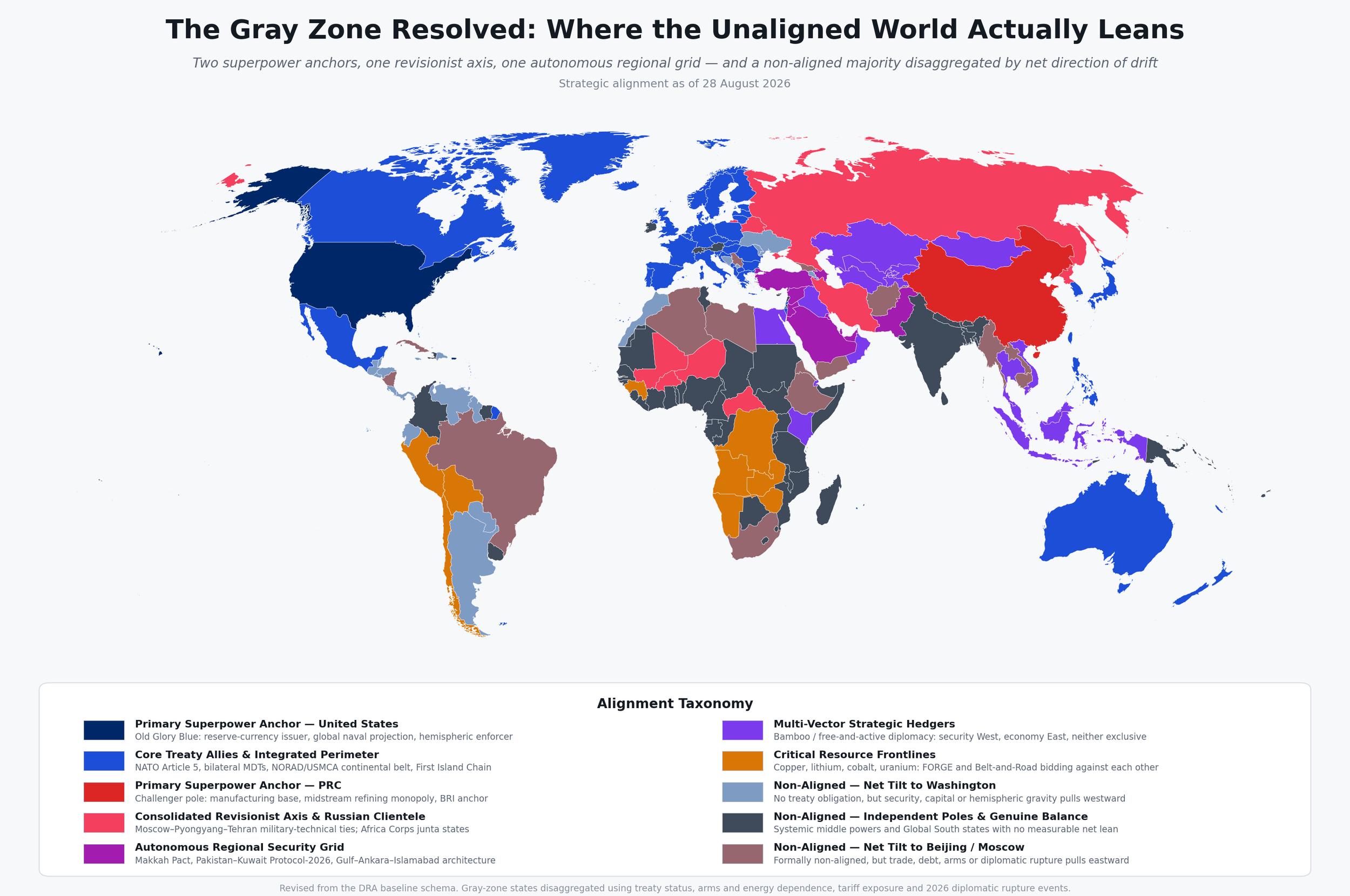
For eighty years, the working cartography of global power has been a coloring exercise with two crayons. Blue for us, red for them, and a neutral shade for the residue — the non-aligned, the undecided, the not-yet-recruited. The residue was always understood as temporary. It described countries that had not yet chosen, and the entire apparatus of Cold War statecraft was built on the premise that eventually they would.
The premise has quietly expired. The residue is now the majority of the world's surface, and its members are not undecided. They have decided, quite precisely, not to decide — and they have built the institutional machinery to make that position durable rather than merely rhetorical. Vietnam holds top-tier comprehensive strategic partnerships with the United States, China, Russia, Japan, Australia and India simultaneously, and considers this a coherent foreign policy rather than a contradiction. Indonesia takes Chinese capital for its nickel smelters while pursuing accession to the OECD. Kazakhstan joined the Abraham Accords in November and remains inside both the Collective Security Treaty Organization and the Belt and Road.
None of this is fence-sitting. It is a technique, and it has a literature: Hanoi calls it bamboo diplomacy, Jakarta calls it free and active, Brasília calls it active non-alignment. What they share is the recognition that the cost of exclusive alignment has risen faster than its benefits, and that a state which keeps two buyers in the room gets better terms from both.
So the first correction is to stop treating the gray as a single condition. The states inside it are not equivalent, they are not stationary, and the direction each one is moving is the most legible fact about the current system. Below, that gray is broken into three tiers by net direction of drift, measured against treaty status, arms and energy dependence, tariff exposure, and the specific diplomatic ruptures of the past eight months.

Three movements inside that gray are worth naming, because each one runs against an assumption that still circulates freely in Washington.
Brazil has moved. Not defected, not realigned, but moved. Punitive American tariffs did not extract concessions; they raised the domestic political value of resisting them, and Brasília responded by accelerating a China–Mercosur agreement, opening critical-minerals and satellite cooperation with Beijing, and treating BRICS as an institutional hedge to widen its policy space rather than as an anti-Western club. Coercion applied to a country with an election calendar tends to produce the opposite of compliance.
The Sahel is no longer non-aligned in any useful sense. Mali, Niger, Burkina Faso and the Central African Republic are governed by juntas whose survival depends on Russian security provision through the Africa Corps, paid for in mining concessions. That is not neutrality; it is clientage with a flag on it. Rendering those states in the same color as India flatters nobody.
India is not drifting at all. It is holding position, which is a different and more demanding thing. After the tariff crisis of 2025 took Indian goods to fifty percent and the February settlement brought them back to eighteen, New Delhi has continued buying Russian crude — more than half its imports in June and July — while deepening defense and technology ties with Washington and quietly repairing its relationship with Beijing. That is not a country waiting to be assigned to a bloc. It is a pole in its own right, and the map should say so.
II.Friction inside the wall
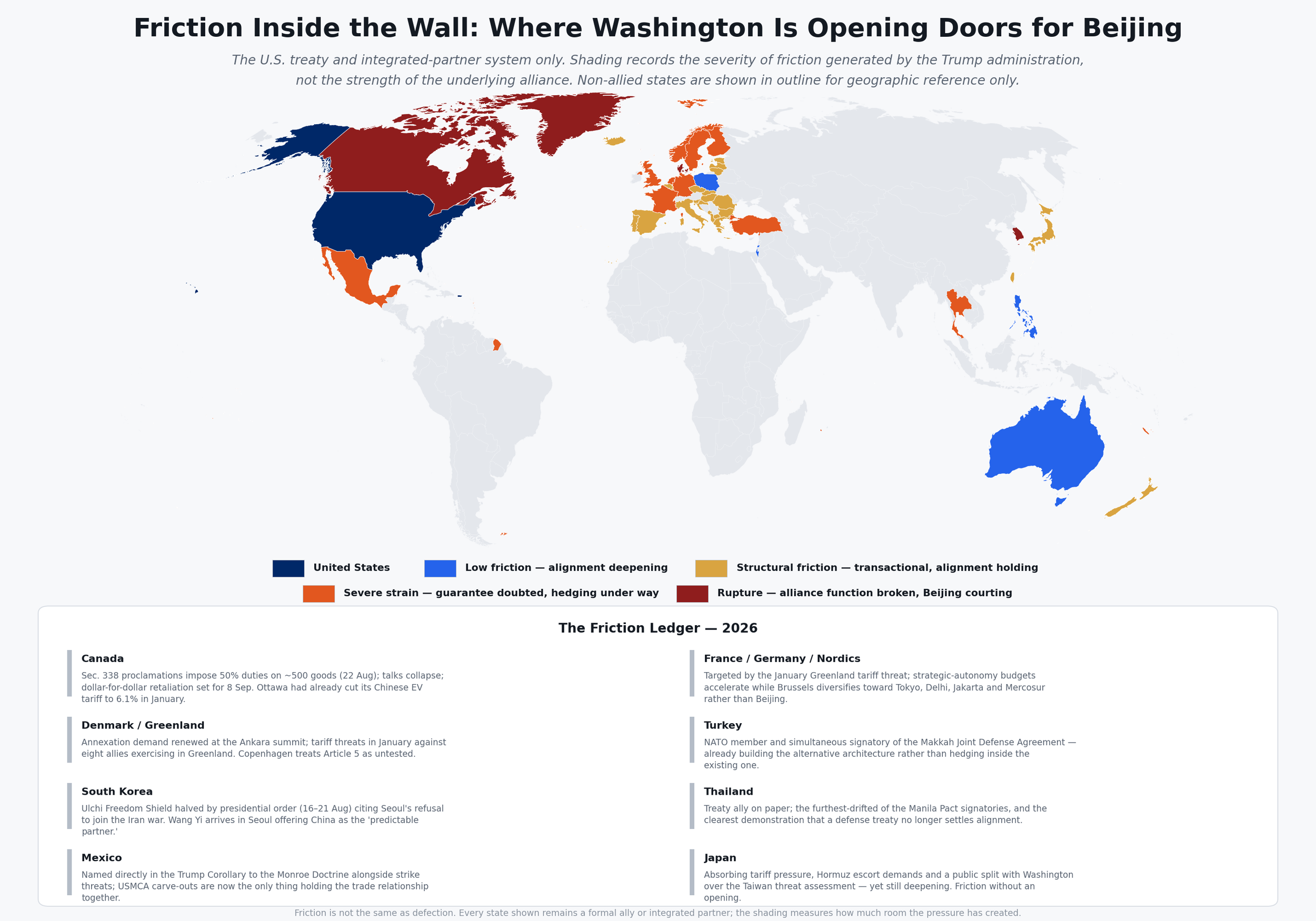
If the gray zone is the first thing a bipolar map gets wrong, the blue is the second. Alliance membership is a legal fact; alliance health is not, and the standard cartography cannot distinguish between them. A treaty ally being courted by the rival pole looks identical, on a conventional map, to one whose integration is deepening by the month.
So the second map takes the American system alone and shades it by pressure rather than by status. Every state on it remains a formal ally or an integrated partner. What varies is how much room the past twenty months of American statecraft has created behind them.

The rupture tier contains three cases that would each have been unthinkable in any previous administration, and are now simply the news.
Canada. After trade talks collapsed on the night of the twenty-first of August, fifty percent duties took effect on roughly five hundred categories of Canadian goods under Section 338 of the Tariff Act of 1930 — a provision that had never been used in its ninety-six years on the books, and one that carries no expiration date. Ottawa has promised matching retaliation from the eighth of September. Seven months earlier, Canada had already cut its tariff on Chinese electric vehicles from one hundred percent to a little over six.
Denmark. The demand that Greenland pass to American control was revived at the Ankara summit, having opened the year with threatened tariffs against eight NATO members whose forces were exercising on the island. A founding member of the alliance now has to consider, as an operational planning question rather than a hypothetical, what Article 5 means when the pressure comes from inside.
South Korea. On the sixteenth of August the president ordered Ulchi Freedom Shield substantially reduced, citing his relationship with Kim Jong Un and Seoul's refusal to join the Iran war; the exercise was cut roughly in half and ended early. Within days the Chinese foreign minister was in Seoul offering Beijing as a predictable partner for peace on the peninsula. Seoul's response was to restate its commitment to the alliance and to accelerate a debate about self-reliant defense that its own president had already begun.
It would be lazy to read this as simple incompetence. There is a coherent theory underneath it: that the alliance system was a subsidy the United States could no longer afford, that the Western Hemisphere and the Indo-Pacific are the only theaters that matter, and that allies extract more than they contribute until they are made to pay. The January intervention in Venezuela and the explicit revival of the Monroe Doctrine follow that logic exactly, and so does the pressure on Seoul and Tokyo to carry more of their own deterrence. One can hold that theory honestly.
What the theory does not survive is arithmetic. The alliance system was never principally a military arrangement; it was the delivery mechanism for everything else — the export-control regime, the sanctions architecture, the standards bodies, the currency's reserve status. Those instruments work because a great many governments choose to route their compliance through Washington rather than around it. Coercion can compel a single decision. It cannot manufacture the accumulated habit of routing, and once a government builds the muscle to route around you on electric vehicle tariffs, it has the muscle for semiconductors.
One precision matters here, because the temptation is to over-read it. Europe is not pivoting to Beijing. The EU–China relationship remains frosty, the trade deficit is widening, and Brussels has responded to American pressure by diversifying toward Tokyo, Delhi, Jakarta and Mercosur instead. The opening the friction creates is not usually a defection. It is something slower and more corrosive: a habit of building the alternative, so that the alternative exists when it is finally needed.
III.What a sphere is made of now
If the system is reorganizing from alliances into spheres, it is worth being concrete about what a sphere actually consists of in 2026, because it is no longer primarily garrisons and treaties.
Chokepoints. The Strait of Hormuz has been effectively closed to Western-allied commercial shipping since the fourth of May, following the American–Israeli campaign against Iran that began in February and the Pakistani-brokered ceasefire in April. The Revolutionary Guard now operates a transit authority charging per-vessel tolls, payable in Chinese yuan or cryptocurrency. Whatever else that is, it is a functioning piece of financial infrastructure operating entirely outside the dollar system, built in four months, under sanctions, by a state that had just lost its supreme leader.
Midstream processing. China's leverage was never mainly geological. It controls up to ninety percent of global refining capacity for rare earths, lithium, cobalt and graphite, which is why export restrictions on gallium, germanium and antimony land directly on Western defense manufacturers. The American answer — the FORGE partnership launched in February with fifty-four nations, Project Vault's ten-billion-dollar stockpiling facility — is a serious effort to rebuild a midstream that took three decades to lose. It will not be finished this decade.
Legal authority over trade. On the twentieth of February the Supreme Court held that the International Emergency Economic Powers Act does not authorize the president to impose tariffs, invalidating the entire reciprocal regime. Within hours a Section 122 surcharge replaced it; that authority expired by statute in July; a Section 301 forced-labor action covering sixty economies took its place, alongside the Section 338 proclamations against Canada. The tariff wall has now been rebuilt three times on three different statutes in six months. Trading partners have drawn the obvious conclusion, which is that the terms are not the point and the terms are not stable.
Mediation capital. Which returns us to Rawalpindi. Qatar was knocked out of the broker's role by Israeli strikes on Doha; Oman lost it when Iran hit its ports. Pakistan, which recognizes neither Israel nor any obligation to Washington's framing of the conflict, brokered the ceasefire, hosted the first high-level American–Iranian talks since 1979, and collected a critical-minerals partnership with Washington on one side and a joint peace plan with Beijing on the other. A middle power converted its refusal to choose into the scarcest commodity in the system: the ability to be trusted by parties who do not trust each other.
IV.Layered, not multipolar
The word usually reached for here is multipolarity, and it is the wrong word. It implies several comparable powers balancing against one another in the manner of nineteenth-century Europe, which is not what any of this describes. There are still exactly two states capable of projecting force globally and underwriting a monetary system, and no third is arriving soon.
What has changed is that alignment has stopped being a single variable. A state's position is now domain-specific, and the domains have come apart. Kuwait sits in the American security sphere, the Chinese energy sphere and the Pakistani training sphere at once, and experiences no contradiction, because there is no longer an authority capable of insisting that these resolve into one answer. The Philippines hosts American missile systems at nine sites while running its supply chains through Beijing. Turkey holds Article 5 obligations and a competing mutual-defense pact simultaneously.
That is the transition, and it is more consequential than a change in the balance of power, because it is a change in what power is for. A sphere of influence in this system is not territory a great power controls. It is a set of dependencies a great power can price — refining capacity, transit rights, settlement rails, security training, export licenses — and its boundaries do not need to be contiguous, or exclusive, or even publicly acknowledged. Spheres of this kind overlap by design. They can be held simultaneously by rivals over the same country in different domains, which is precisely why the old two-color map cannot render them.
The Rawalpindi protocol matters because it is the first kind of thing the emerging system will produce in volume: a functional security arrangement between two middle powers, priced in their own currency of obligation, requiring nobody's permission. There will be more of these. Some will hold and some will not. What none of them will do is resolve into blue or red.
The bipolar world is not ending because one pole is losing. It is ending because the states in between have discovered that the two poles cannot compel a choice, and have started building the architecture that makes the discovery permanent.
What to watch
Matching duties on steel, dairy, appliances, agricultural equipment, pulp and electronics. Whether Washington escalates under Section 338(b), which authorizes a full import ban, is the tell.
Tehran is preparing conditions at the mediators' request. Whether Beijing or Islamabad holds the pen determines who is seen to have ended the war.
An exercise cut in half is recoverable. An independent South Korean deterrent is not, and it would put the same question to Tokyo within a year.
The second investigation, covering sixteen countries and most of American imports, is the durable replacement for everything the Court struck down.
Sources
- Pakistan and Kuwait sign expanded defense agreement — Arab News
- Pakistan expands its defense umbrella across the Middle East — Al Jazeera
- What Pakistan gains from its Iran–US diplomacy — Chatham House
- Iran War 2026 daily update and campaign phases — GlobalSecurity
- Carney says the US asked too much as trade talks collapse — CNN
- Remarks on Canada–US trade negotiations — Office of the Prime Minister of Canada
- US–South Korea drills cut short at Washington's request — CNN
- Fears of a US retreat from Asia — Council on Foreign Relations
- Greenland and NATO's darkest hour — Atlantic Council
- President Trump and Greenland: frequently asked questions — House of Commons Library
- Supreme Court rules against IEEPA tariffs — Congressional Research Service
- Trump tariff tracker — Atlantic Council
- Making sense of the US military operation in Venezuela — Brookings
- Coercive US trade policy and Brazil's pivot — GIS Reports
- Russia in Africa: Moscow's influence and its limits — Carnegie Endowment
- The US–Central Asia summit — Council on Foreign Relations
- How dependent is the world on Chinese supply chains? — Resources for the Future
- 2026 Critical Minerals Ministerial — US Department of State
- The US and Russia compete for India's energy market — CNBC
- Vietnam's bamboo diplomacy — Egmont Institute