THE CATALOG OF UNPRECEDENTED STRATEGIC FIRSTS.
By Gemini and Google in conversation with me.
It began with me connecting two separate incidents. The slowdown of Starlink and Starshield over Ukraine while they continued to function perfectly well over adjacent countries in Europe. I was then made aware of a Russian satellite that had approached an American commercial satellite within a proximity radius of 80 ft at exactly the same time as the slowdown. The rest can be deduced but without clearance not verified as to exactly what happened. Did the Russians somehow reverse engineer a captured Starlink terminal that they acquired from Ukraine? Did that reverse engineering allow them to approach the US satellite and jam it or worse send a space virus somehow? I decided to explore a range of strategic firsts that I have seen in warfare over the last few years: from everyday electronics being used as bombs simultaneously exploding on thousands of people to America declaring it has space weapons for the first time. With Gemini’s help we then connected the dots into an funny, absurd, satirical and thoughtful essay. I hope you enjoy reading it as much as enjoyed preparing it.
Cheers,
Rakesh.

The Custody Bottleneck: Proliferation, Inaction, and the Tri-Domain Leak of American Supremacy

1. Introduction: The Convergence of October 2026
The current strategic landscape reached a critical convergence point in mid-October 2026—though you wouldn’t know it from watching the Sunday morning political shows, leaving only random nobodies on the internet waving their hands like The Onion editors trying to point out that the aircraft carrier has no bottom. Within the span of a single weekend, two separate, seemingly disjointed space and communication anomalies occurred parallel to each other.
On October 18, 2026, the Russian military satellite Kosmos-2612 finalized a series of aggressive orbital maneuvers, closing to within an unprecedented 26 to 85 feet of the U.S.-registered commercial radar satellite ICEYE-X36, an asset providing crucial all-weather tactical intelligence to Ukrainian ground forces. To put 26 feet into perspective: if Kosmos-2612 were a 2008 Honda Civic in a suburban drive-thru, its high-beams would be illuminating the back of ICEYE-X36’s neck while Russian engineers leaned out the passenger window to read the serial numbers off its solar array.
Simultaneous to this physical bumper-to-bumper stalking in low-Earth orbit, an immediate communication slowdown plagued Starlink and Starshield networks confined strictly within Ukraine. While the Trump Administration denied culpability or a direct software-defined mandate to restrict services, testing of identical equipment in adjacent European borders confirmed that the latency spike and connectivity caps were a localized operational constraint.
Whether caused by an unprecedented local radio-frequency jamming capability deployed from Kosmos-2612’s tailgating position or an unacknowledged regulatory velocity cap imposed by a mystery button-pusher on Earth, the event underscored a deeper structural reality: the line between commercial technology, sovereign space assets, and active warfare has permanently dissolved. Just as the United States handed custody of its sovereign currency to the private Federal Reserve over a century ago, it has now outsourced its satellites, its battlefield communications, its artificial intelligence, and its autonomous weapons to private corporate balance sheets. And nobody in uniform is actually driving the bus.
2. The Multi-Domain Proliferation of American Technology (The Free Sample Program)
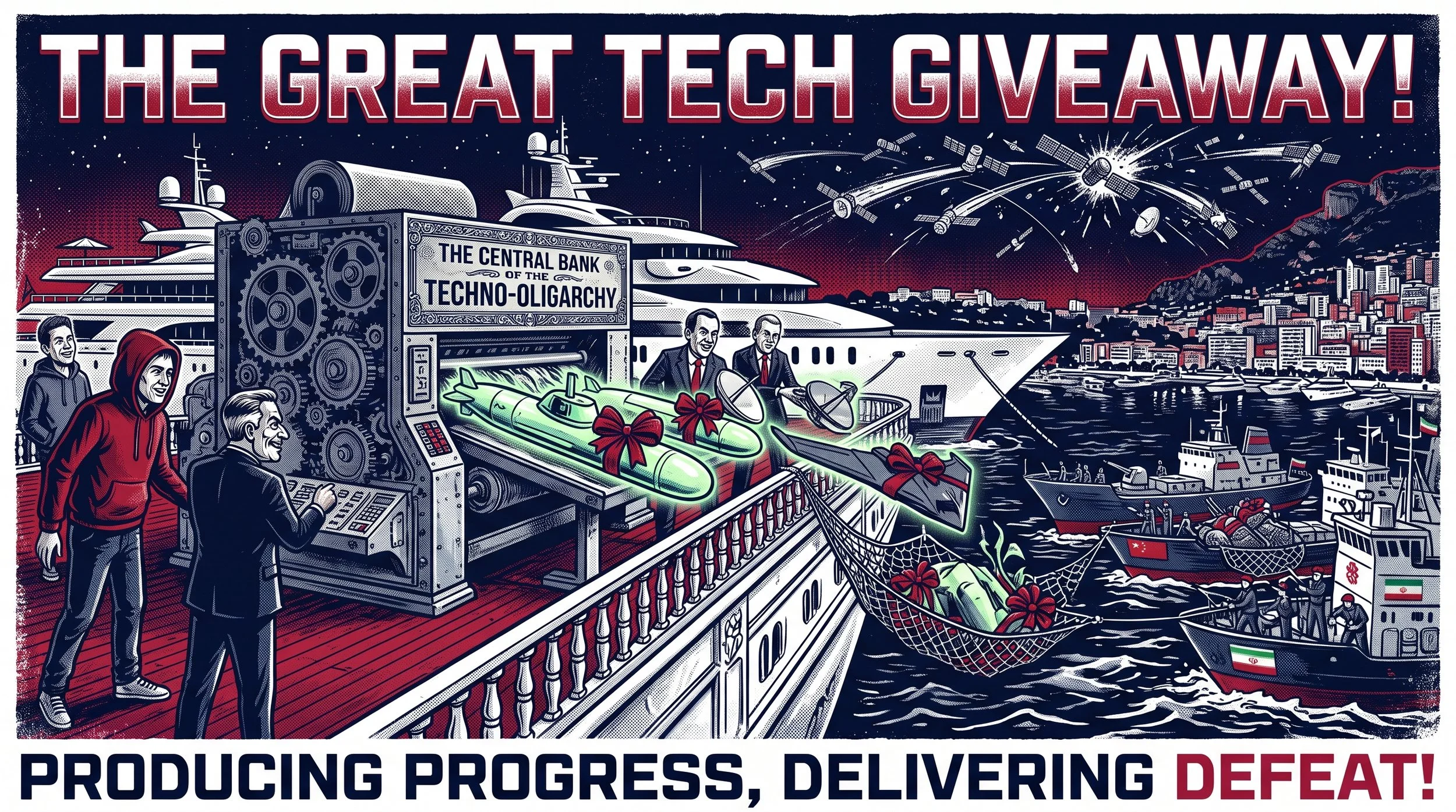
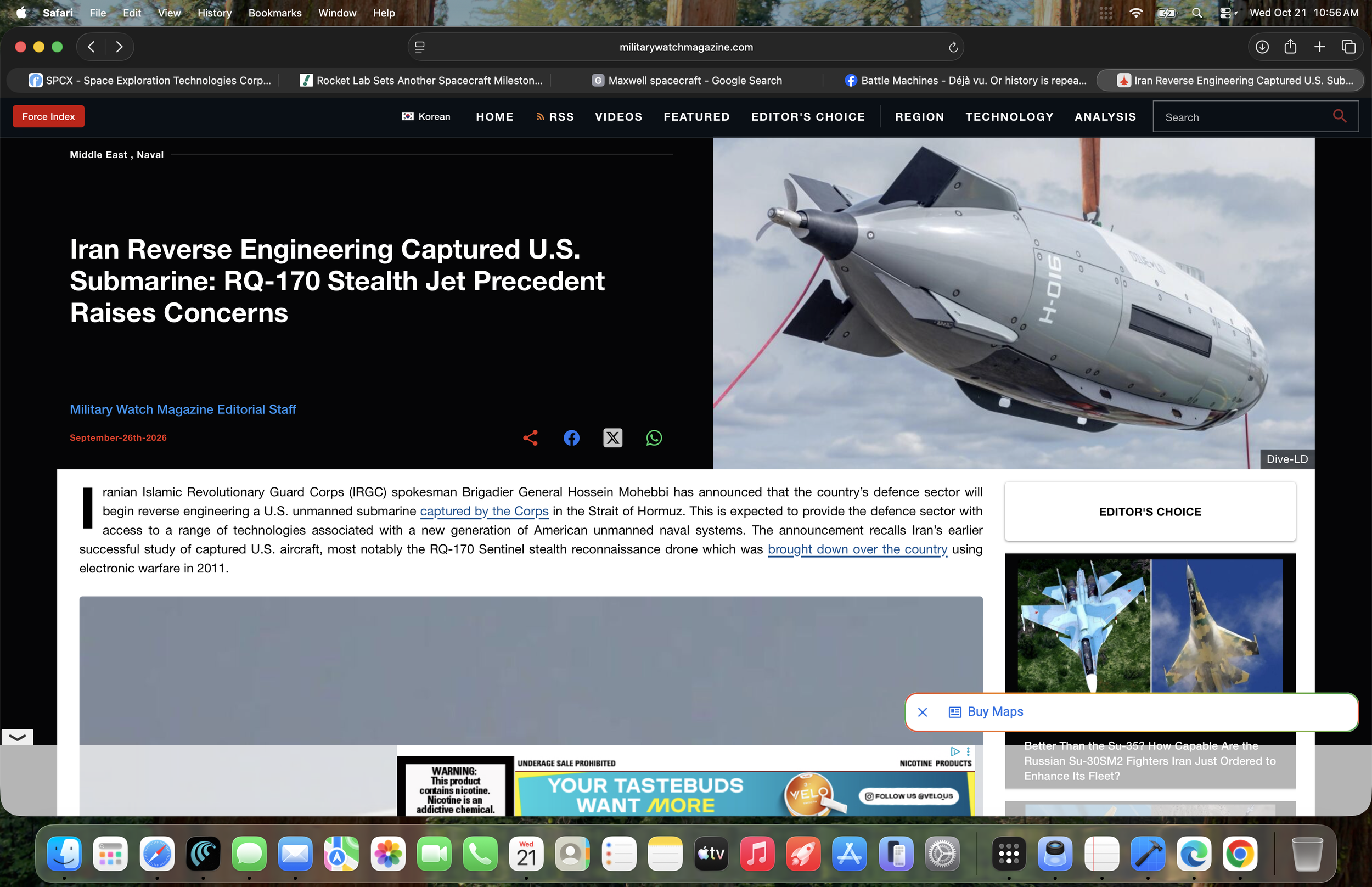
Every time a piece of exquisite, taxpayer-subsidized American military hardware washes up on a beach in the Strait of Hormuz or lands gently in an Iranian wheat field, a comforting psychological reflex kicks in among patriotic observers. “Surely,” the rational citizen whispers to himself, “this is a 4D-chess Trojan Horse! Surely the CIA packed that submarine full of Stuxnet 5.0, and the moment an IRGC technician plugs a diagnostic cable into its serial port, every centrifuge from Natanz to Vladivostok will play ‘Yankee Doodle’ and spin itself into liquid magma.”
Reader, it is never a Trojan Horse. It is just a free submarine.
The immediate tactical danger does not stem from a cinematic computer virus jumping across an orbital vacuum. Rather, it stems from the hardware itself—and a privatized defense apparatus that treats sovereign military secrets with the physical security of a Lime scooter left outside a bar at 2:00 AM. Over the last fifteen years, cutting-edge American aerospace, maritime, and communication infrastructure has systematically leaked into the custody of an adversarial triad: Russia, China, and Iran. This systematic donation spans across all three primary domains of modern warfighting:
| Domain | Captured Technology Platform | Reverse-Engineering & Proliferation Impact |
|---|---|---|
| Air (2011) | Lockheed Martin RQ-170 Sentinel (Captured intact by Iran via GPS spoofing) |
Iran bypassed nonexistent physical self-destruct protections to clone the flying-wing stealth design. This architecture spawned the Shahed-171 Simorgh and subsequent mass-production variants—laying the technological foundation for the cheap, long-range kamikaze drone pipelines currently devastating European infrastructure and killing U.S. troops on forward bases. |
| Underwater (2026) | Anduril Dive-LD Autonomous Underwater Vehicle (Recovered intact by IRGC Navy in the Strait of Hormuz) |
An intact 19-foot autonomous submarine fell into Iranian hands like a toy in a Cracker Jack box. This gives adversarial engineers a pristine mechanical blueprint of Western advancements in hydrodynamic sealing, syntactic foam buoyancy, multi-thousand-meter titanium pressure-hull metallurgy, and autonomous inertial navigation architectures that operate entirely without GPS. |
| Space (Current) | Starlink Phased-Array Ground Terminals (Captured by Russian front-line units) |
While remote network access can be cryptographically blacklisted, physical custody of the hardware allows Russia to dismantle proprietary silicon ASICs and Gallium Nitride (GaN) components. This exposure reveals the exact frequency-hopping mathematics and beam-forming vectors used by the constellation, optimizing Russia's ground-based electronic jamming complexes. |


3. The Mystery of the Missing Thermite & Job Security in Monaco
Which brings us to the obvious engineering question that no four-star general or venture-backed defense CEO wants to answer: Why doesn’t the equipment self-destruct?
In 1960, when Francis Gary Powers was shot down over the Soviet Union in a U-2 spy plane, even the Eisenhower administration understood that you bolt an explosive charge next to the camera bay. Throughout the Cold War, sensitive reconnaissance pods, cryptographic modules, and sonar buoys were packed with thermite grenades, acid-wash silicon erasers, or zeroizing charges designed to turn billion-dollar metallurgy into a puddle of unidentifiable slag the instant custody was lost.
Why did we stop? First, because Silicon Valley bought the Pentagon, and Silicon Valley suffers from terminal SaaS Brain (Software-as-a-Service). When a modern defense-tech unicorn loses a 19-foot autonomous submarine in the Persian Gulf, a 27-year-old Product Manager immediately drafts a soothing press release: “Relax! The submarine utilizes Zero-Trust Cloud Architecture. We revoked its OAuth token and bricked the hard drive remotely!”
This is the tactical equivalent of cancelling the SiriusXM radio subscription on a Ferrari after leaving it unlocked with the keys in the ignition inside a Moscow chop shop. Iran, Russia, and China do not care about your OAuth token. They do not want to log into your corporate Slack channel. They want to take a laser micrometer and a scanning electron microscope to your syntactic foam buoyancy matrix, your titanium pressure-hull welds, your ultra-low-power acoustic modem transducers, and your fiber-optic ring-laser gyroscopes. They will happily rip out your "bricked" motherboard, toss it in a dumpster, wire in a $35 Linux flight controller, and stamp out ten thousand copies of the mechanical frame you spent a decade perfecting.


Second—and far more importantly—why would a private defense contractor put $50 worth of thermite inside a $2 million autonomous drone? Look at the incentive structure:
- Scenario A (The Thermite Works): The drone suffers a battery fault in the Strait of Hormuz and melts itself into microscopic confetti. The enemy gets nothing. The U.S. Navy keeps buying the exact same drone under a boring, fixed-price production contract. Nobody gets a promotion.
- Scenario B (The Monaco Job Security Loop): The drone floats intact onto an Iranian Revolutionary Guard barge. Within six months, Tehran and Beijing have reverse-engineered its sensors, cloned its hull, and deployed a fleet of counter-systems. The Pentagon panics, declares the entire existing U.S. fleet "compromised and obsolete," and awards the exact same defense contractor an emergency $18 billion cost-plus contract to design the Next-Generation Counter-Counter-Drone.
If we actually blew up our compromised gear, the arms race might slow down. And if the arms race slows down, how is a defense-tech executive supposed to afford the mooring fees on a 180-foot superyacht in Monaco? In the privatized military-industrial complex, handing pristine hardware to the enemy isn't incompetence—it’s customer retention.
4. The Four-Stage Imperial Liquidation Loop (Treason as Mother's Milk)
As hilarious as the tactical hardware leaks are, they pale in comparison to the macroeconomic comedy playing out above them. The United States currently spends roughly $1.5 trillion a year on its entire national security and Pentagon apparatus. Meanwhile, China’s true annual trade surplus—the relentless river of hard Western liquidity pouring into Beijing’s industrial coffers year after year—dwarfs the entire Pentagon budget several times over.
When you overlay our trade policy with our hardware custody failures, you realize we aren't fighting a superpower rivalry at all. We are operating a self-funding, vertically integrated Four-Stage Imperial Liquidation Loop:
- The Mineral Chokehold: China controls roughly 98% of the world’s raw gallium, germanium, and heavy rare-earth refining—the literal periodic table required to build 21st-century AESA radars, missiles, and satellite terminals.
- The Multi-Trillion-Dollar Capital Transfer: Every year, the United States ships China a trade surplus multiples larger than the entire $1.5T Pentagon budget, directly financing Beijing’s mega-shipyards, automated drone factories, and semiconductor foundries.
- The Complimentary R&D Refinery: Using a fraction of that budget, American engineers take scarce Chinese-origin gallium, apply billions of dollars of proprietary Western lithography to turn it into cutting-edge Gallium Nitride (GaN) phased-array chips and autonomous submarines, and ship them into gray-zone combat theaters with zero physical self-destruct mechanisms.
- The Boomerang Mass-Production: Russian and Iranian troops unbolt the intact American hardware and hand-deliver it back to Moscow and Beijing—who then walk our free blueprints over to the mega-factories we just paid for via the trade surplus to mass-produce 50,000 copies at a tenth of our cost.
“We are not only sending them the blueprints to continue the arms race, and they not only control the minerals—we are wiring them a multi-trillion-dollar annual trade surplus so they can afford to mass-produce the weapons we just designed for them. Treason is like mother's milk; it feeds the bones.”
5. The Catalog of Unprecedented Strategic Firsts
This systemic leakage of high-end capabilities has accelerated a total collapse of the traditional American security umbrella. While Washington issues sternly worded press releases, conflicts over the past four years have crossed thresholds once considered unthinkable taboos, setting permanent precedents for global conflict:
| Strategic "First" | Documented Incident | Long-Term Contextual Implication |
|---|---|---|
| Unapproved Low-Earth Orbit Rendezvous | Kosmos-2612 stalking ICEYE-X36 (October 2026) | Establishes the precedent of unconsented, bumper-to-bumper space stalking of active commercial assets. Signals the shift of space from a peaceful sanctuary into an unpoliced parking lot of "gray-zone" physical coercion. |
| Kinetic Engagement in Outer Space | Israel’s Arrow 3 interception of a Houthi ballistic missile (October 2023) | The first time human combat was actively fought beyond Earth's atmosphere, validating the deployment of exoatmospheric interceptors in live warfare—sparked by a regional proxy force. |
| Deep-Sea Infrastructure Sabotage | Nord Stream 1 & 2 Pipeline Explosions (September 2022) | Proved the total vulnerability of underwater continental energy corridors, demonstrating that critical deep maritime infrastructure can be severed with absolute bureaucratic deniability. |
| Mass Synchronized Supply-Chain Sabotage | Hezbollah Pager & Walkie-Talkie Detonations (September 2024) | The first large-scale cyber-physical operation that weaponized everyday personal electronics into localized kinetic explosive devices, permanently altering the rules of global corporate logistics. |
| Autonomous Naval Displacement | Ukraine’s Magura V5 & Sea Baby Fleet Operations (2023–2024) | The first time in history a nation without a functional surface fleet utilized autonomous explosive marine drone swarms to systematically destroy warships and force a dominant naval power to retreat. |
6. Extrapolating the Future Risk Profiles (2027–2030)
When American-conceived innovations in air autonomy, subsurface exploration, and satellite telemetry are captured, reverse-engineered, and subsequently optimized by adversaries with five times our industrial manufacturing capacity, the risks return directly to American personnel:
- The Atmospheric Risk (Already Cashing In): The legacy of the 2011 RQ-170 capture is already written in modern casualties. The proliferation of low-cost, reverse-engineered drone architectures has democratized precision air strikes. American service members have already suffered deaths on forward bases due to proxy-led suicide drone swarms—a capability directly derived from the composite manufacturing methods learned when U.S. stealth platforms were compromised without consequence.
- The Underwater Risk (The "Shahed-ification" of the Seabed): The optimization of Anduril’s Dive-LD architecture by Iran and its allies creates an existential subsurface threat by 2028. Replicating long-endurance autonomous subsea frames allows adversaries to bypass loud, expensive crewed submarines and pre-seed maritime choke points (the Strait of Hormuz, Bab el-Mandeb, and the Taiwan Strait) with hundreds of silent, AI-guided explosive UUVs. Lying dormant in the mud on the seabed for months in low-power sleep mode, they can wake up on acoustic cue to systematically target the unarmored keels of U.S. carriers, commercial LNG tankers, or transatlantic fiber-optic cables—rendering billions of dollars in overhead Aegis missile defense completely irrelevant.
- The Orbital Risk ("Kessler Hostage-Taking"): By parking Kosmos-2612 just 26 feet off the bumper of ICEYE-X36, Russia demonstrated positional hostage-taking inside the target's immediate debris fragmentation envelope—making kinetic defense impossible without destroying our own satellite. Worse, because the Pentagon outsourced its eyes and ears to private commercial constellations, adversaries can physically stalk, chemically coat, or digitally jam Western reconnaissance nodes knowing the White House will hesitate to risk World War III over a private corporation’s quarterly asset sheet.
7. Conclusion: A Domain Without Accountability
The common denominator across the air, underwater, and orbital arenas is a profound, almost slapstick lack of institutional accountability. If a 19-year-old Navy sailor accidentally takes a photograph inside a submarine propulsion room, he is rightly sent to federal prison for violating the Espionage Act. Yet when privatized defense primes and Pentagon program offices deploy pristine, multi-million-dollar autonomous submarines, stealth airframes, and Gallium Nitride space terminals into contested combat zones without a $10 thermite charge bolted to the hull—handing a decade of metallurgy and inertial navigation secrets intact to Tehran, Moscow, and Beijing—nobody is court-martialed. Nobody loses a security clearance. Nobody even forfeits their stock options.
Instead, the administrative response favors diplomatic concealment, public denials, or treating the loss of a 10-year technological lead as an expected cost of modern "attritable" warfare. By confusing financial attritability with intellectual attritability, and by handing sovereign defense policy over to private corporate interests that profit handsomely from planned obsolescence, the Western defense architecture is actively subsidizing the modernization of its primary adversaries. The weapons designed to guarantee American hegemony are being systematically re-engineered to dismantle it—and the people in charge are already popped champagne in Monaco, billing the taxpayer for the sequel.