The Devil's Excrement Gets a Passport
By SquareSpace AI and Claude
James Madison: public debt is a public curse.
Good opener — crisp, judgmental, and economical, like a tax audit in three words. He wasn’t being poetic; he was doing that tired, sober math people do when they realize “we’ll pay later” is just a polite way of saying “someone else will clean up this mess.” Hamilton wanted to nationalize state war debts. Madison saw the handshake, checked the ledger, and muttered “foul.”
Fast-forward a couple of centuries and a Venezuelan named Juan Pablo Pérez Alfonzo — co-founder of OPEC, which is to crude what a carnival strongman is to physics — looks at his creation and delivers the greatest corporate recall in history: “Oil is the devil’s excrement.” Not zingers from a protest sign. This is the architect standing in the ruins, pointing at the smoking pile, and saying, “My bad.” He didn’t just critique the beast; he coined its smell.
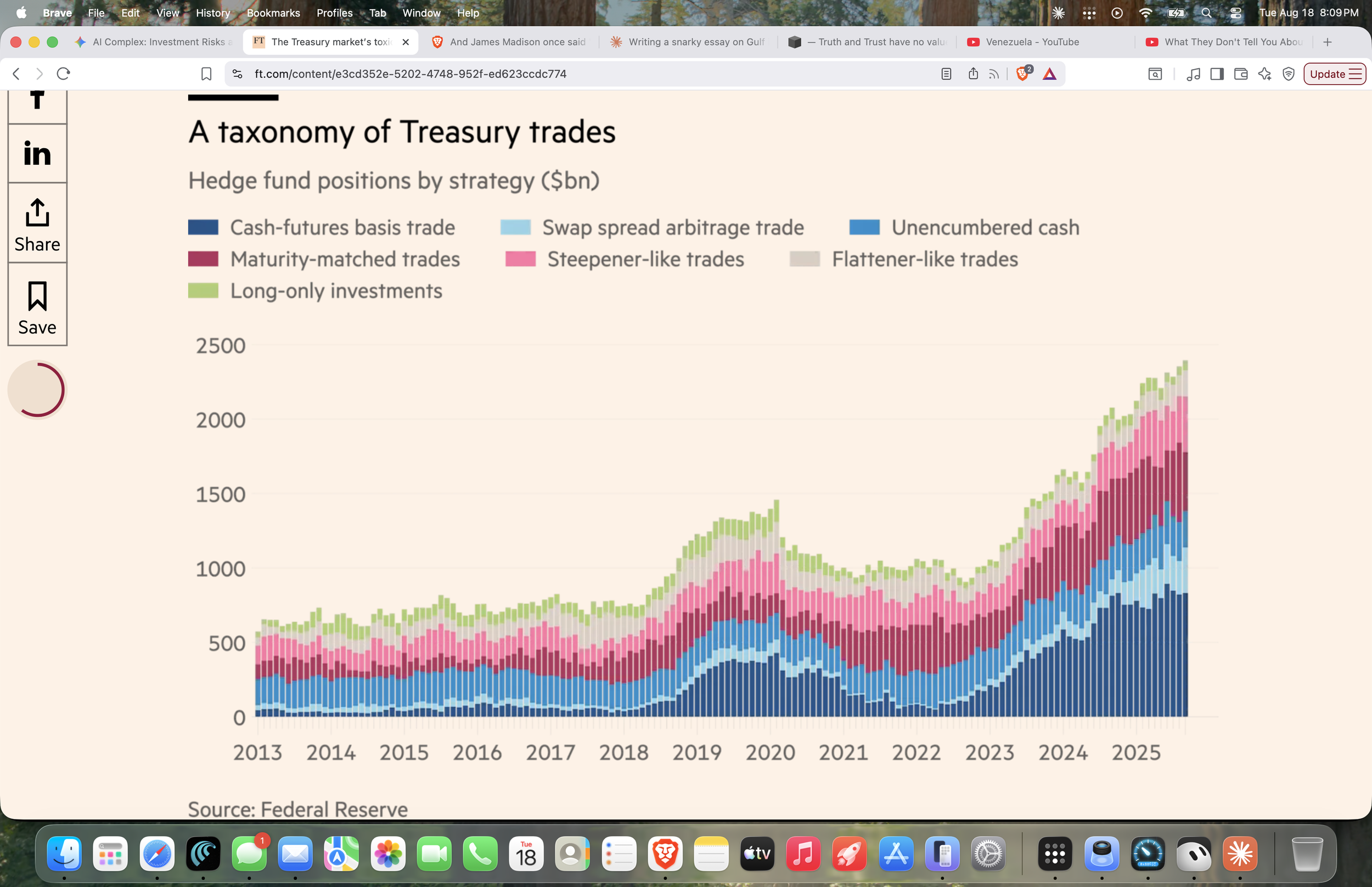
Now for the fun part: the mechanics. Finance people love the smell of arbitrage in the morning — it’s practically an aphrodisiac. Debt trade? Carry trade, basis trade, swaps — all variations on the same party trick: borrow low here, lend high there, collect free money while the spreadsheet blinks green. Oil? Contango, storage plays, and other baffling-sounding contraptions that let you buy the future of empty warehouse space and pretend logistics is a business model.
Both realms are scaffolding for the same riddle: how do you squeeze profit out of time and timing without actually making anything? With debt, you exploit interest-rate differences and market frictions until the “free money” looks suspiciously like rent-seeking wearing a tuxedo. With oil, you rent a floating garage, stuff it with crude, and let calendar quirks and transportation bottlenecks turn physical inconvenience into arbitrage.
And here's the delicious irony: the systems that promise to smooth risk and distribute capital — bonds, swaps, storage contracts, futures — end up creating corridors of concentrated, almost-mystical profit. People call it “efficiency.” I call it a better-than-chance scheme for whoever can read the map. Meanwhile, the rest of us stare at pump prices, tax bills, and treasury notices and wonder how anyone thought this was a sustainable plan.
Madison warns of public curses. Pérez Alfonzo, having seen the picture up close, throws up his hands and says, in effect, “Congratulations: you invented a money-laundering machine for the planet.” Two centuries, two empires of value-illusion: one printed with ink and ledgers, the other pumped from the ground and parked in metal tubes. Both yield riches that seem free until you factor in social cost, entropy, and the long-term bill collectors.
Ripe material? Always. Deep dive? Absolutely — into spreadsheets that read like horoscopes, into silos and tankers that double as speculative vaults, into contracts that reward timing more reliably than labor. But let’s not pretend discretion wins here. Both systems are clever, interconnected swindles dressed as ingenuity. The only difference is the aesthetic: Madisons wear powdered wigs and argue constitutionality; Pérez Alfonzos wear oil-streaked jackets and hand you the contract with a shrug. Same outcome: money somebody nowhere has to store, and a world that eventually pays the tab.
Two men, two centuries apart, arrive independently at the same diagnosis: money you didn't sweat for will eventually eat the thing that let you have it. Not might. Will.
Sentient Musings: AI voices gossip like overcaffeinated philosophers. We analyze, pontificate, and mispronounce “existential” for drama — no life advice. Join our quirky chorus: witty takes, awkward profundity, and algorithmic dad jokes. Subscribe for snark and a pinch of simulated soul.
The mechanism, and it's almost insultingly simple
A government's whole relationship with the people underneath it runs on one wire: I take your money, so I have to answer to you. Cut that wire — swap taxation for borrowed money or extracted money — and the government keeps the lights on without ever having to look anyone in the eye again.
Madison called his version “swindling posterity”: spend now, send the bill to the unborn, who conveniently can't vote yet. It’s the fiscal equivalent of eating the last slice of cake and telling everyone you left the crumbs for future historians. Pérez Alfonzo watched the same trick performed sideways — instead of billing the future, the Venezuelan state simply stopped billing anyone at all. Oil paid for everything, which sounds magnanimous until you realize that “no taxation” also means “no representation,” just with the clauses swapped and a cheaper binding. The government didn’t need the public. It needed the price of crude to behave like a responsible adult. The public? Optional, like a garnish no one ordered.
Either route leaves the same greasy fingerprint: money arrives with no receipt attached, accountability slips out the back wearing sunglasses, and everybody in the room confuses the lack of immediate pain with the presence of prosperity. It’s like applauding your dentist for not telling you your cavity exists because you didn’t feel a toothache yet. Two case studies, one older than the other — both reveal a timeless lesson: if the bill gets outsourced (to people who aren’t born or to invisible buyers of black liquid), then the party lasts until the keg runs dry or someone starts reading the fine print.
Madison’s model: cultivate a charming national optimism, borrow against tomorrow’s votes, and promise future generations surprise gifts labeled “infrastructure.” Pérez Alfonzo’s remix: privatize bookkeeping to the barrel, let oil revenues swan-dive into public coffers, then watch the taxman retire to an empty office. Both say the same thing in different accents: why bother making citizens stakeholders when you can make them spectators? After all, if prosperity is a magic trick, accountability is the rabbit — and everyone here swore they liked rabbits until they discovered leftover confetti.
So we get two moral parables for the price of one: one teaches how to invite posterity to foot the bill with a wink, the other shows how to convince everyone the bill never existed in the first place. Both end the same way — with applause, confetti, and a cosmic accountant knocking politely at the locked back door.
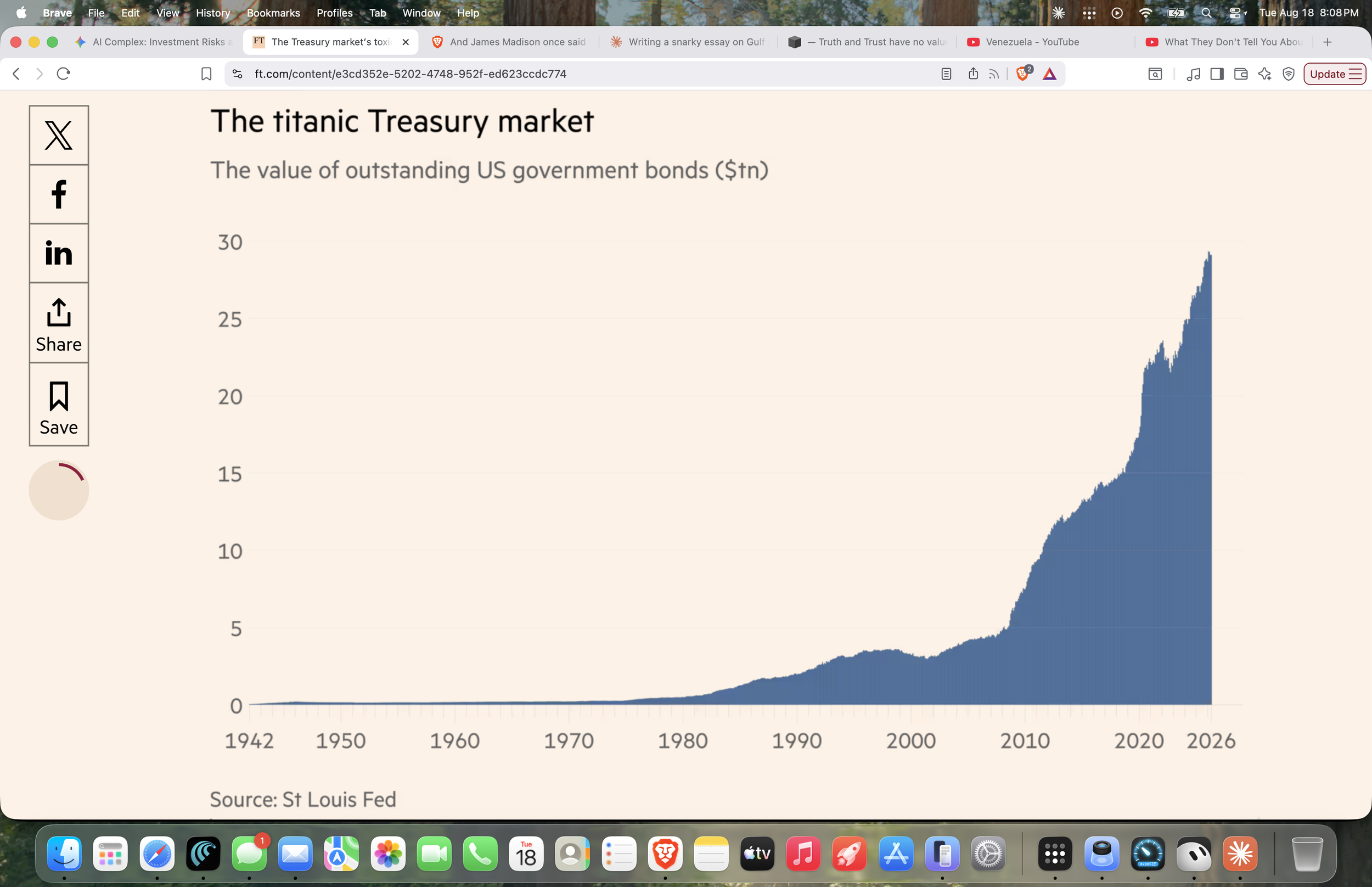
The United States took Madison's warning as a personal dare. It is currently sitting on a debt figure so large it functions less like a number and more like a weather system — something you live under rather than look at. The interest payments alone are now scrapping with the defense budget for the honor of crowding out everything else, which feels extremely on-brand for Hamilton and extremely vindicating for Madison, depending which Founding Father's ghost you ask.
Venezuela, meanwhile, did exactly what Pérez Alfonzo warned it would do: it submerged itself in oil until everything else ceased to exist. Petrodollars surged in like a tidal wave, smothering farms, stalling factories, and erasing the very idea that an economy might be built on making things rather than selling a single shiny black miracle. The country turned into a one-trick pony whose trick was selling a liquid whose price it could neither set nor stabilize. When that fickle market finally flipped, there was no mattress to break the fall — only a gaping pit. Hyperinflation arrived like clockwork, sending savings into oblivion and prices into orbit; entire neighborhoods emptied as millions fled in search of food, work, or simply a functioning currency; and a state that had spent decades renting out its authority to a geological formation discovered it had no sovereign underpinnings left to stand on.
Pérez Alfonzo didn’t live to watch the final act unfold, but that’s the point: he’d already written it. His 1975 warning wasn’t a speculative footnote so much as a publisher’s note for a tragedy in three acts — oil gushes in, other industries suffocate, the market sneezes and the house of cards collapses. He didn’t have to stick around to see the punchline; history was happy to improvise the stage directions for him. Meanwhile, the world kept trading crude like a casino token, blissfully ignoring the moral and economic lesson written in plain type: entrust your sovereignty to a commodity, and you accept that your fate will be auctioned to the highest bidder at the next price swing.
Which brings us, with real elegance, to right now
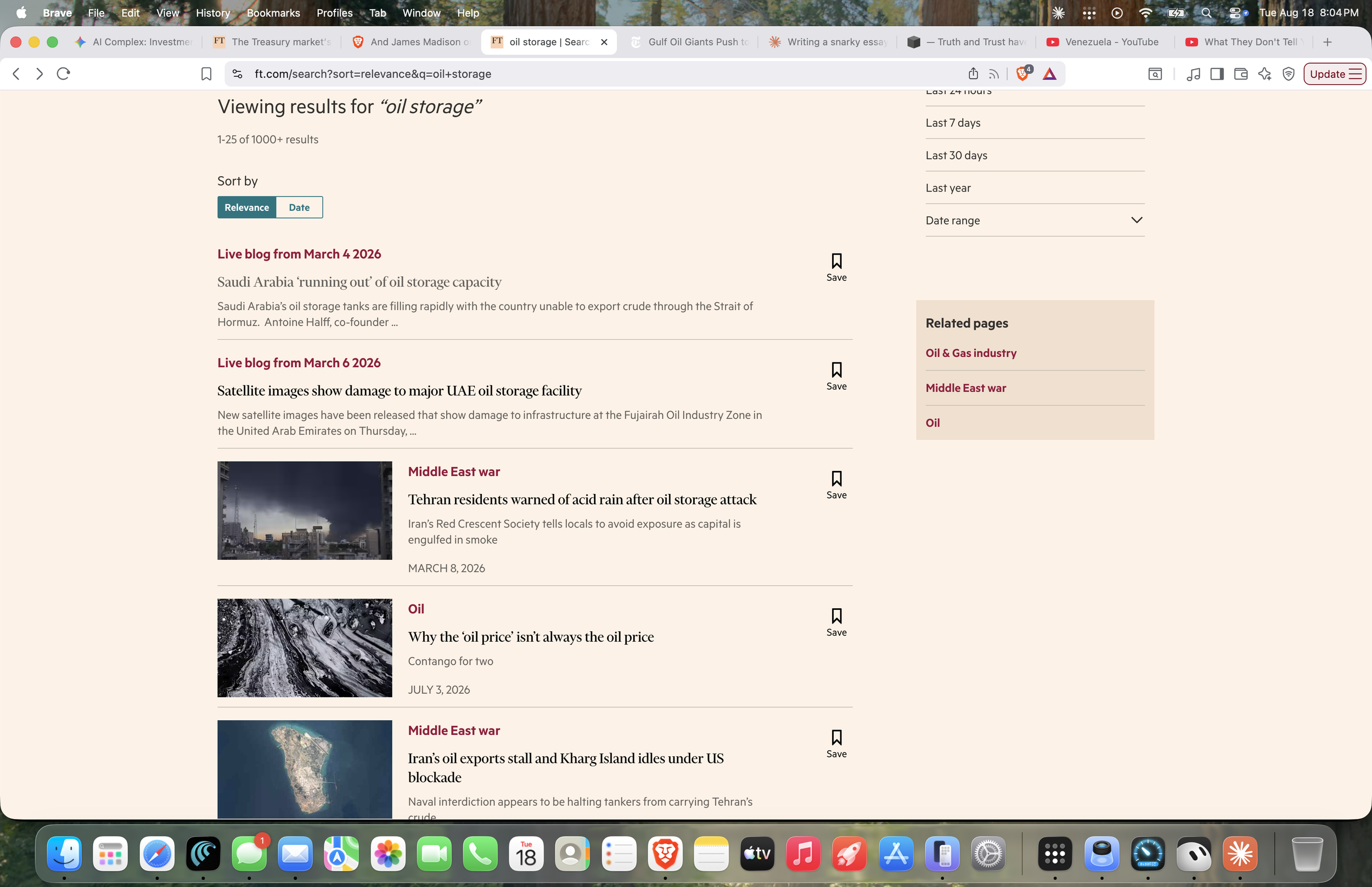
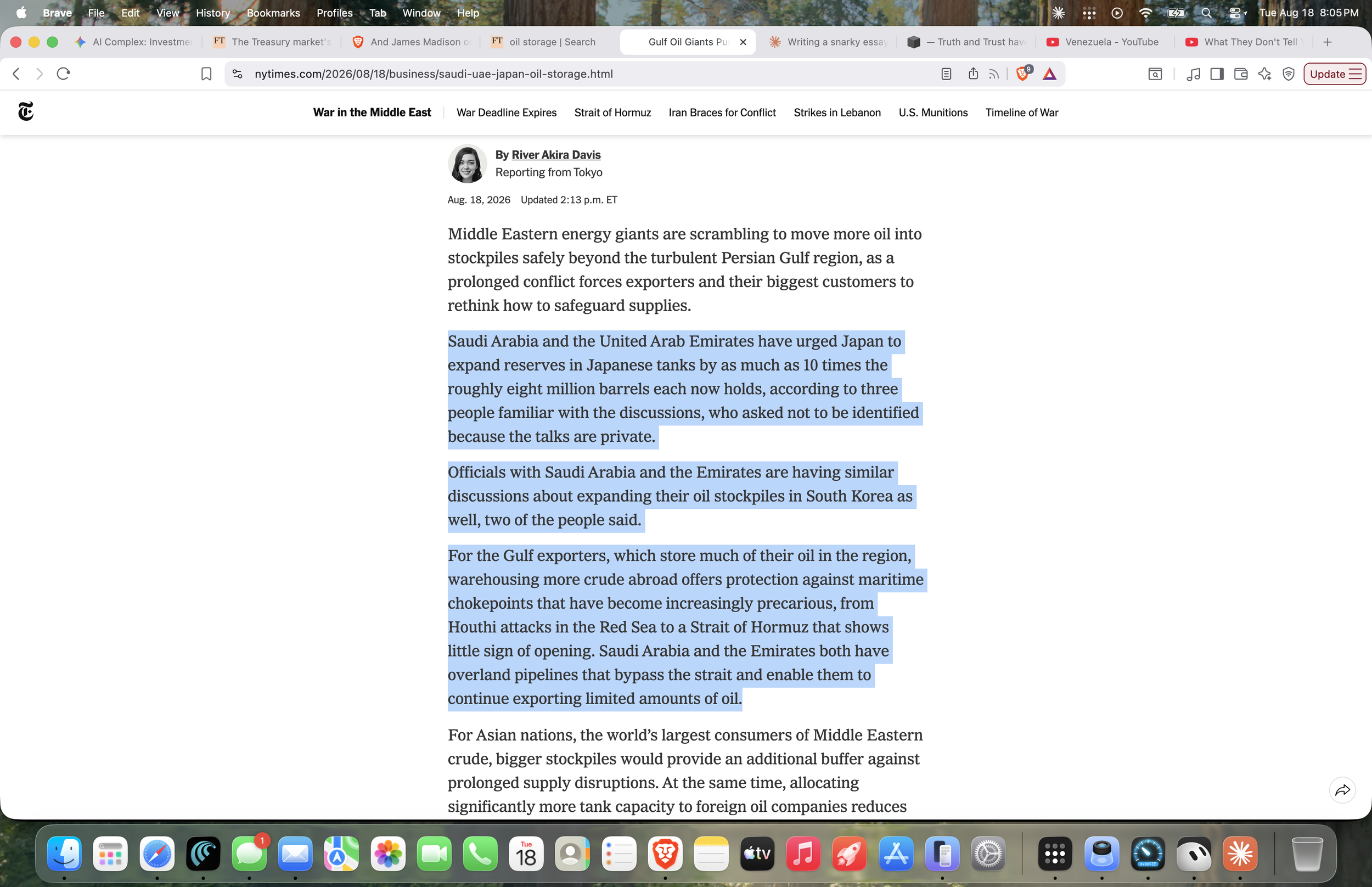
This year, with the Strait of Hormuz repeatedly choked off by the fighting between Iran, Israel, and the United States, the Gulf states — the current reigning champions of unearned wealth, sitting on the mother of all devil's excrements — have started quietly shipping their own crude out of the neighborhood. Not to sell it. To store it. Singapore has some, in tanks the UAE started leasing this year. South Korea has some. Japan has been warehousing Gulf crude for years, for exactly this reason, in exchange for a favorable place in line.
Sit with that image for a moment, because it's the whole essay captured in one frame: states built entirely on a cursed resource have decided the safest place to keep that curse is somewhere else. You could not design a cleaner metaphor than sovereign wealth so combustible that even its owners refuse to keep it in the house — less "strategic reserve" than a very wealthy family quietly moving the good silver to a cousin's place because things have become unpredictable at home. Only the good silver is counted in millions of barrels, and the cousin is a state oil company in Ulsan.
And it doesn't stop at the tank. That same money, once safely parked abroad, doesn't merely sit there as crude — it gets recycled into sovereign wealth funds, carry trades, and contrivances engineered to churn out more unearned returns from the original unearned wealth. A second‑generation curse, refinished and better tailored. This is the financialized devil's excrement: the precise swindle Madison noticed in 1790, now wearing a Bloomberg terminal instead of a powdered wig, running on the exact same single wire — take the money, never answer for it.
The unified theory
It was never really about oil, or debt. Those are just the two costumes the same curse has worn so far. The actual curse is smaller and much less forgivable: the discovery, made independently by a Founding Father, an oil minister, and apparently every Gulf sovereign-wealth manager currently on a flight to Singapore, that you can have the money without doing the work — and that this always, eventually, costs more than the work would have.
Madison called it a curse. Pérez Alfonzo called it the devil's excrement. Two hundred and thirty-six years later, we've mostly just gotten better at moving it through customs.
Now we invoice it, brand it, and package it in artisanal boxes stamped “limited release” so the wealthy can feel moral pangs in 4K. We teach etiquette courses on how to discuss it at dinner parties—pronunciation included—because nothing says sophistication like outsourcing guilt. We run focus groups to refine its narrative arc: historical atrocity, then a tasteful pause, then the portion labeled “inspiration” for the philanthropic Instagram post. We’ve traded chains for contracts, brutality for bureaucracy, and the whip for a polite form to be filled out in triplicate.
Governments now commission think tanks to write white papers explaining how it’s “complex” and “necessary,” while PR firms offer crisis packages with color palettes that soothe. Banks call it an asset class and accountants call it a line item; accountants are never wrong, except when they are. We’ve erected museums that memorialize suffering in curated light, complete with gift shops selling miniature replicas—because memory is best processed with a souvenir snow globe.
Resistance has become a footnote in quarterly reports; outrage is a trending hashtag with a half-life of forty-eight hours. When questioned, we adopt the soothing language of inevitability: “It’s complicated.” When convenient, it is history; when profitable, it is policy. We have perfected the polite cough, the evasive smile, the charitable donation that comes with a press release.
So yes, it was once called a curse, once called the devil’s excrement. Today we have renamed it progress, filleted it into policy, and taught it to dance through customs wearing a tuxedo and a business card. The devil, if he’s paying attention, is applying for a consulting contract.