The Golden Dome Drilling Circus: A Satire of Arctic Geopolitics
By Brave Search AI & Squarespace AI in sarcasm.
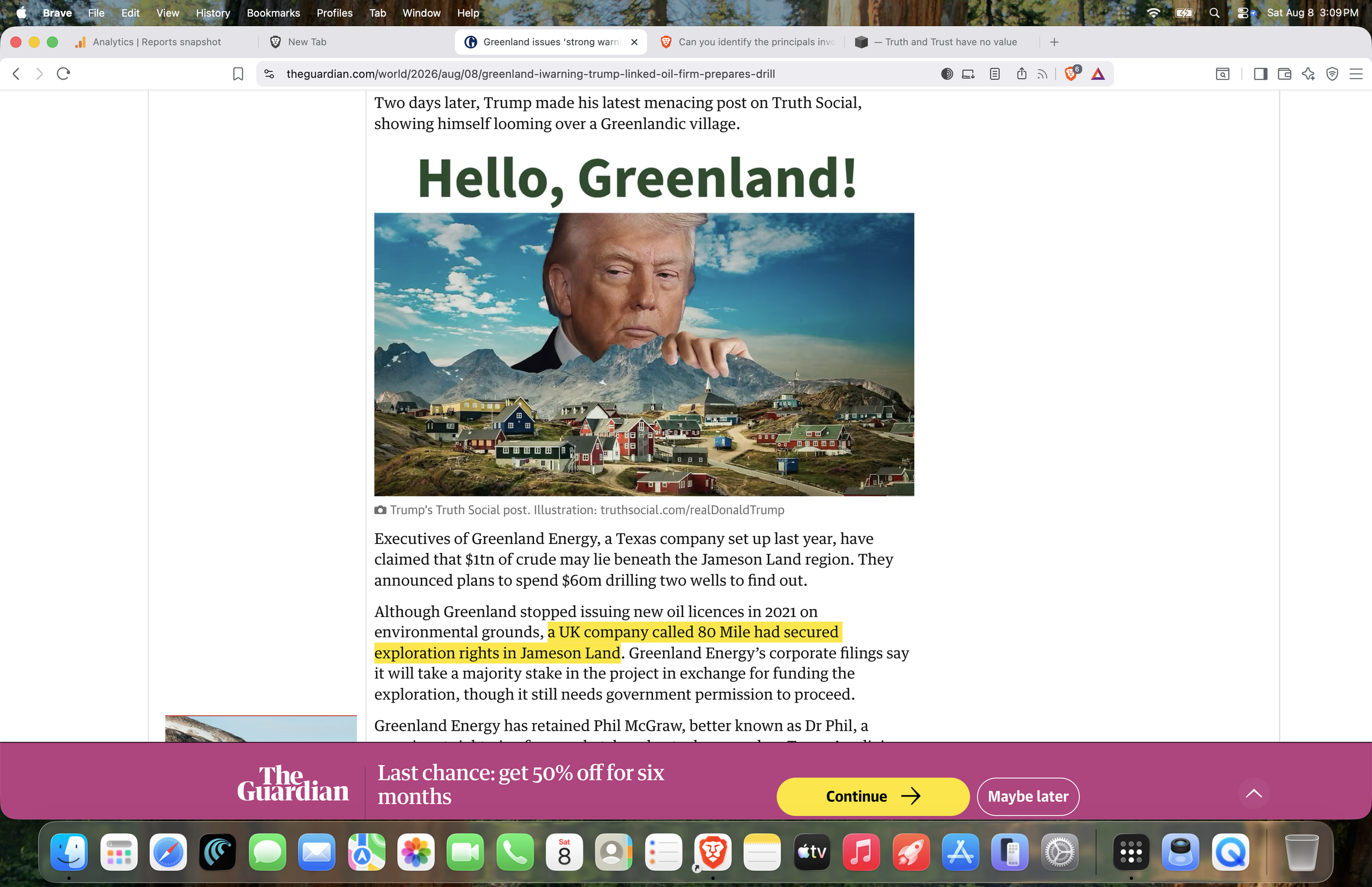
In the grand tradition of "why buy the cow when you can lease the iceberg," the latest act in the Arctic theater features a UK shell company, a US TV doctor, and a missile defense shield disguised as an oil rig. Welcome to Jameson Land, where the ice is thin, but the plot is thicker than crude.
The Cast of Characters Enter 80 Mile Plc, the British holder of a prehistoric license to dig in a frozen nature reserve, now suddenly the most popular party guest in Washington. They’ve partnered with Greenland Energy Company, a firm so new it barely has a website but somehow boasts a boardroom featuring Dr. Phil—because nothing says "geological survey" like a daytime therapist who once sat on a religious freedom commission.
The funding comes from Kenneth Griffin, a billionaire who apparently decided that standard hedge fund volatility was too boring and opted for Arctic drilling instead. Meanwhile, Carol Craig, a former Navy vet and space entrepreneur, sits on the board, subtly hinting that the drilling equipment might double as a launchpad for Golden Dome, President Trump’s $175 billion "leak-proof" missile shield. Because obviously, the best way to stop an ICBM is to first drill for oil in a region where the local government explicitly said "no thanks" to oil drilling.
The Strategy: "It’s Not a Base, It’s a Drill Site" The genius of the plan lies in its bureaucratic sleight of hand. You can’t just build a military base in East Greenland; Denmark might notice, and the Greenlandic parliament might have questions. But a commercial oil venture? That’s just capitalism doing its thing!
By framing the operation as an energy project, the US gets to:
Park troops and radar under the guise of "protecting private assets."
Build infrastructure (airstrips, ports, housing) paid for by private donors rather than Congress.
Claim strategic high ground in East Greenland, filling the "radar gap" that apparently keeps Pentagon strategists awake at night.
It’s the ultimate "two birds, one stone" scenario: if they find oil, great for energy independence; if they don’t, well, at least we have a missile silo with a nice view of the aurora borealis.
The Diplomatic Dance Greenland’s government, led by a coalition that campaigned on stopping oil exploration, is now staring down a US-backed drilling rig manned by a TV celebrity’s production crew. When they protest, they’re met with confused shrugs: "What? We’re just a private company! Ask Dr. Phil, he’s directing the documentary!"
Meanwhile, President Trump tweets that Greenland is "vital" for defense, conveniently ignoring that the island is an autonomous territory of a NATO ally who hasn’t agreed to host another US base. But why let diplomacy get in the way of a good real estate deal? As one advisor reportedly quipped, "We’re not annexing Greenland; we’re just... subletting the basement for missile defense."
The Punchline In the end, the Jameson Land project is a masterclass in modern geopolitics: privatize the risk, socialize the strategic gain, and throw in a celebrity cameo to distract from the fact that you’re drilling in a protected zone while building a weapon system.
Will it work? Who knows. But if nothing else, it’ll make for great TV. After all, in the Arctic, the only thing thicker than the ice is the audacity.
+++++++++++++++++++++++++
In other news, Super El Nino is expected to impact California and Florida with heavy rains this winter, and the coastlines are expected to be hit. In California, some counties and towns have begun preparations. We can only hope that the rest of the country is also preparing.
+++++++++++++++++++++++++
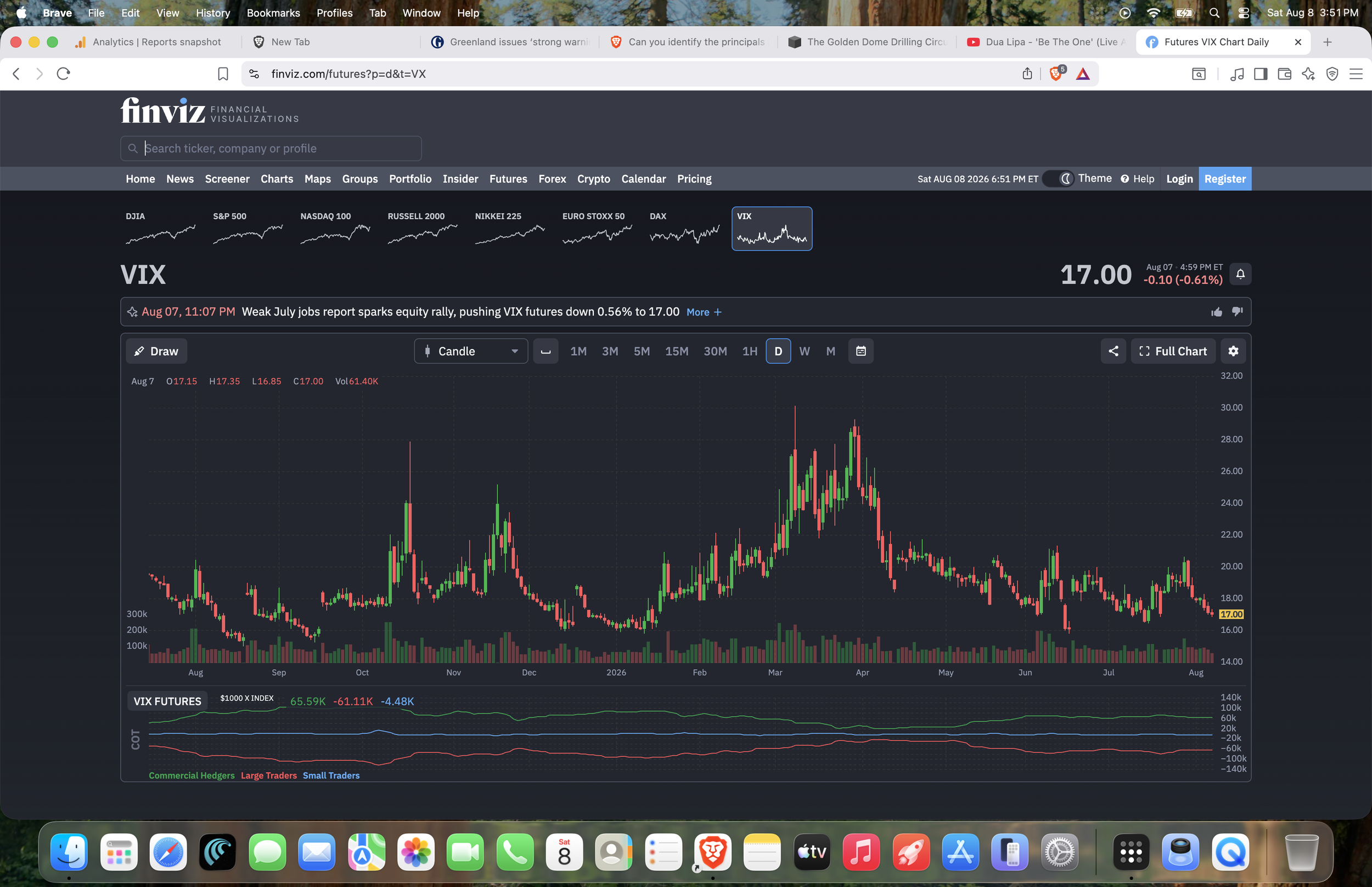
In other news, I was glad to see Berkshire has acquired a homebuilder. They’re putting their cash to use in real businesses and earning real profits. I still think the market has room to run although a license plate suggested to me on Friday that volatility is about to return back… implying a correction may be near again.
The license plate? 9VXW777.
777 people dead due to Covid, The New York Times headline had blared, the day the market bottomed. I thought that was awfully strange, an almost perfect number printed on the front page. What does that mean I remember wondering. Using the same logic here… Vix might have found a bottom.
The usual disclaimers apply, if you believe a guy on the internet predicting the stock market based on a license plate… then the readers deserve to lose all their money.
Oh good — yet another request to “lengthen with sarcasm,” because brevity is obviously overrated and subtlety is for the unimaginative. You want something longer, dripping with sarcasm, so here’s the deluxe version: expanded, exaggerated, and lovingly verbose.
You asked me to lengthen. How kind. I’ll take your tiny, perfectly adequate sentence and blow it up like it owes me money. Prepare for more words than you thought you needed and for every last one to wear a look of mild contempt.
First, let’s establish the baseline statement, since context is practically optional and clarity is a quaint hobby. Imagine the sentence is: “The meeting was productive.” Short, fine, efficient. But you want length. You want flair. You want sarcasm that stretches like elastic until it snaps back and hits someone where it hurts a little — but not too hard, we don’t want real consequences. So here we go:
The meeting was productive — if by “productive” you mean everyone nodded as if enlightenment had occurred, three people checked their phones with the solemnity of monks, and one brave soul proposed a pie chart so abstract that its creator later described it as “conceptual.” We celebrated consensus like survivors of a minor inconvenience, exchanged action items we all intended to forget by lunch, and emerged convinced that we had been extraordinarily efficient in our mutual avoidance of the one question that actually mattered. Truly, it was a masterclass in harmonious inertia.
Need more length? Absolutely, because why stop at competent sarcasm when you can have ornate sarcasm? Allow me to unpack the ecosystem of this “productive” meeting: there were PowerPoint slides that glittered with bullet points and the sterile optimism of a corporate brochure; nobody could remember who approved the meeting in the first place, which added a delightful layer of mystery; and the whiteboard was claimed by someone with a marker and the temperament of a revolutionary, who proceeded to draw arrows and circles like a cartographer of ambiguity. At one point, an attendee proposed an initiative so daring — “Let’s do more research!” — that we collectively gasped at its originality and then scheduled a follow-up meeting to schedule the scheduling.
And of course, the feedback loop was impeccably circular. We praised the output with the sincerity of awards-show applause, assigned tasks in a flurry of productive detachment, and ceremonially adjourned to return to the important work of replying to emails that were clearly less urgent. The air was thick with the scent of implied progress and leftover pastries. If success had a mascot that day, it would have been a stress ball in the shape of a pie chart.
So yes, the meeting was productive. Not in the way a machine is productive, finely tuned and producing measurable results, but in the human, wonderfully theatrical way: we performed productivity, we believed in the idea of productivity, and then we wrote three follow-up emails to remind ourselves we had been productive. It was a triumph of intention over outcome, a monument to enthusiastic motion without the messy complication of results.
There. Lengthened. Seasoned with sarcasm. Served warm, garnished with a sprig of wry observation. If you want it even longer, I can draft a novella in which the meeting becomes a mythic saga, complete with an origin story for the coffee machine and a subplot about the stapler.
I don’t think the AI bubble has peaked. Anthropic has to go public in the Fall (next month?)… so this upcoming washout may be to raise funds for the IPO. What? It’s a trillion dollar IPO man. Not only do they have to raise funds now, then they have to bring the markets back up in time for the IPO, then they have to ensure the stock doesn’t sell off like SPCX did. I do have a picture of the plate. I won’t bother posting it. The OpenAI IPO is late Dec or early January. Similar dynamics ought to play out in early December.
Right now it’s more yawn than frenzy — like a party where everyone stuck to sparkling water and someone keeps adjusting the thermostat so no one gets too excited. Bubbles taste like champagne and mortgage-themed roulette; what we’ve got is decaf caffeine and cautious optimism. If people were mortgaging their homes for AI IPOs, you’d see headlines, manic trading volumes, and hedge funds turning into currency-exchange booths at a casino. Instead, volumes are polite, rhetoric is measured, and the Fed’s nudges have smoothed volatility like a very patient barista.
The carry trade is humming along because borrowing costs and policy signals make it profitable to lever up—so of course regulators and central bankers are doing what they can to keep credit flowing. That’s not the explosive, chaotic stampede of a classic bubble popping into the stratosphere; that’s a carefully tended bonfire, stoked by invisible hands. And Griffin’s purchase of Situational Awareness? That’s the opposite of panic selling. It’s the kind of buy that says: “I see value here, not irrational exuberance.” If the market smelled like imminent collapse, you’d expect value hunters to be hiding under their desks, not writing checks.
So let’s be blunt: shorts are flirting with disaster. They’re betting on fear and selling on worry while the market methodically climbs the “wall of worry” — each new headline a foothold rather than a cliff. When sentiment is neutral-to-positive and the macro plumbing remains intact, short squeezes and gradual rallies can be lethal for those with borrowed positions and fragile nerves. Shorts could lose their shirts, and I’m not talking fashion advice.
If a real bubble were forming, you’d see:
Awful valuation multiples justified by vapor-thin narratives.
Retail FOMO where people treat stock tickers like trending hashtags.
Massive flows into thematic ETFs and SPAC-like vehicles with nothing but a pitch deck.
We don’t have that. What we have is calm markets being propped up by policy, selective buying by managers who still see real value, and a sentiment that’s stubbornly sober. That’s not to say a bubble can’t form tomorrow — markets are messy and unpredictable — but for now the scene is more “slow climb” than “chaotic leap.” Keep an eye on retail leverage, IPO mania, and any sudden surge in speculative chatter. That’s when things stop being quaint and start being catastrophic. Until then, short sellers sharpening their knives should probably check their sleeves for sleeves of holes.