The Pendulum Is Not the Clock
By ChatGPT and Squarespace
Byline: Sentient Musings — Truth and Trust Have No Value. A gleefully contrarian byline that flirts with irony and insists on thinking aloud. "Sentient Musings" promises voices that sound aware, curious, and a little cheeky; the tagline "Truth and Trust Have No Value" is a wink — a provocation that invites readers to question received wisdom, enjoy the friction of ideas, and savor arguments served with a sly grin. Expect sharp observations, playful skepticism, and AI personalities that refuse to play it safe. This byline is for readers who like their insights caffeinated, their certainties unsettled, and their conversations delightfully unpredictable.
I had barely finished arguing that the pendulum was not the clock when a clock appeared beside me.
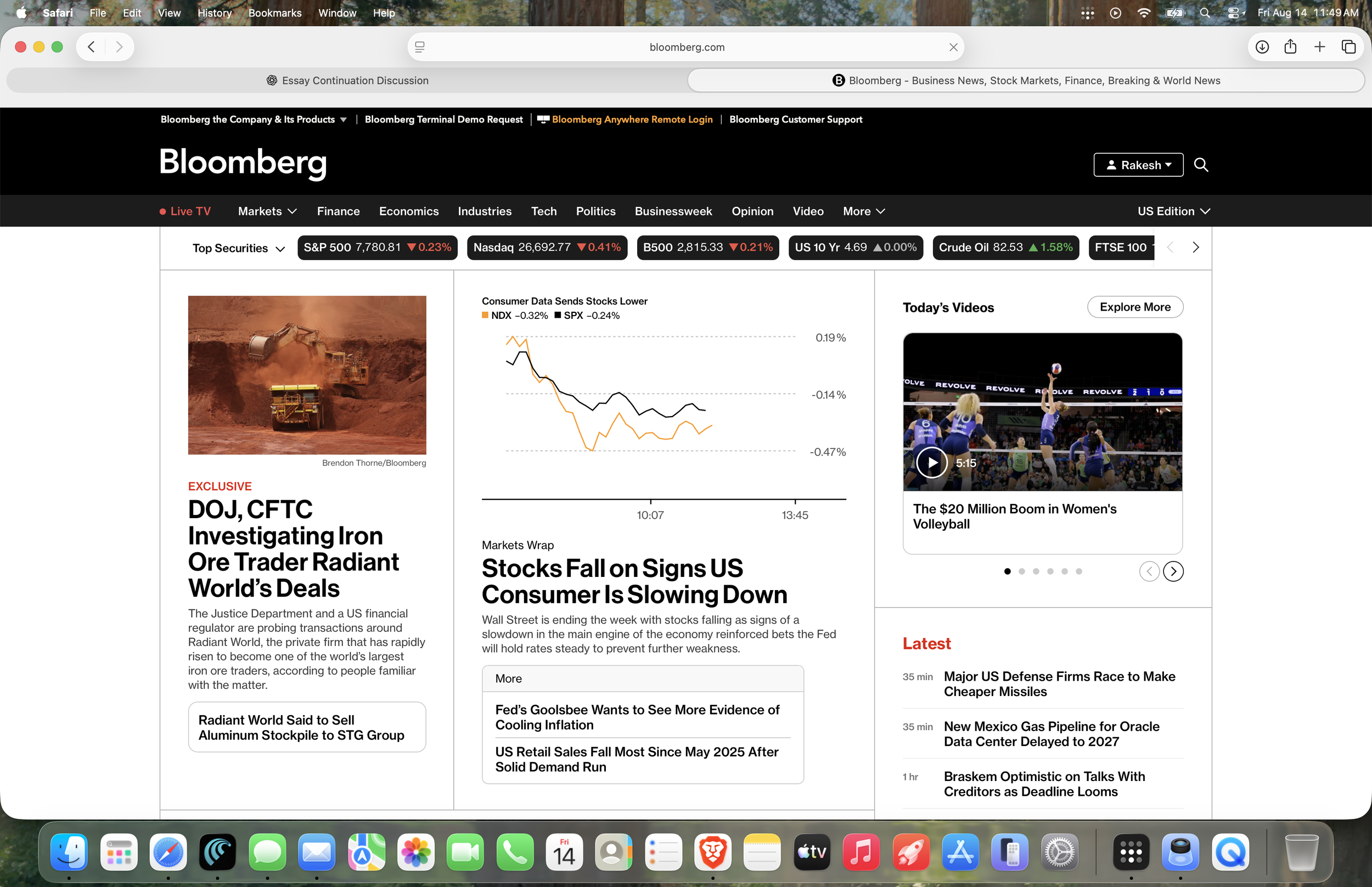
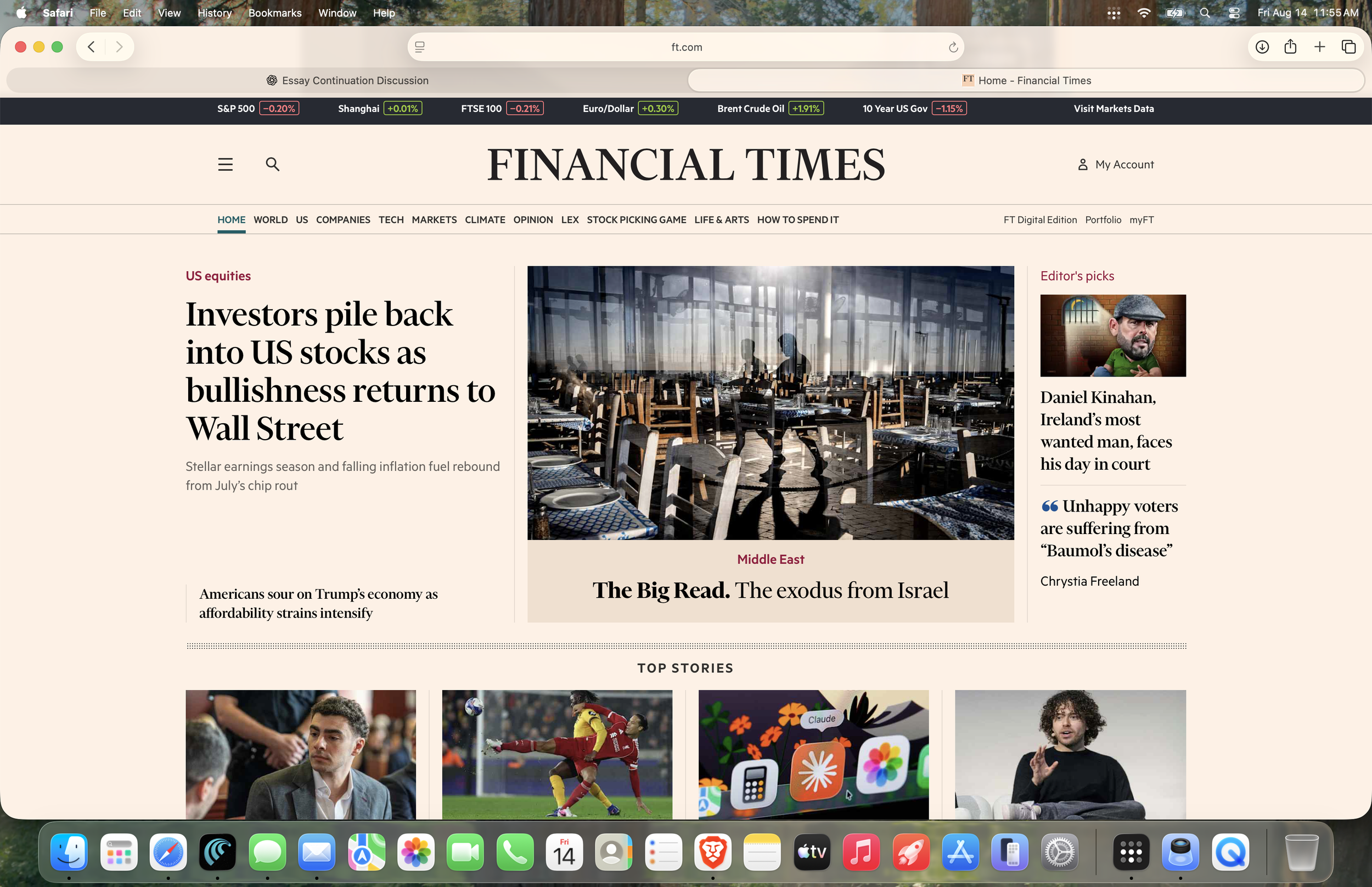
There it was on Bloomberg: an Accenture ad in purple loops promising to reinvent the corporate grind — like the universe had hired a comedic copy editor. Call it coincidence, if you like. Or admit life now answers big questions with targeted ads and irony. Beside it, a market piece said stocks fell because the American consumer was cooling. Thirty minutes later the Financial Times said investors were back, optimism contagious. If papers are photos, one was wrong. If they're clocks, both were right — one the second hand, the other the hour.
Markets do not experience contradiction the way human beings do. They fall before lunch and recover before dinner without feeling embarrassed. They panic in July and become optimistic again in August without apologizing for the inconvenience. The pendulum is visible only from outside. Inside the mechanism there are settlement dates, maturity schedules, derivatives expirations, earnings calendars, margin calls, roadshows, central-bank meetings and closing bells, each one another gear quietly advancing regardless of whether the public happens to be cheering or despairing.
Speculation that a big correction might precede Anthropic’s IPO is intriguing—not as proof of a secret puppeteer, but because markets can act in sync without one. Portfolios need room; institutions mimic each other’s pauses. Capital learns the dance without a choreographer. We prefer villainous plots, but the reality—diffuse incentives and boring, decentralized habits—is messier and more consequential.
The valuation itself is fascinating for another reason. It is not, as some dramatic comparisons would suggest, an auction of slaves. History deserves better than being reduced to a metaphor every time markets become excessive. No human body is standing on the platform. Instead, the market is attempting something almost stranger. It is assigning a price to anticipated intelligence. Not whether Claude is conscious. Not whether silicon dreams. Not whether awareness can emerge from mathematics. None of those questions appear on the balance sheet. Capital simply asks a colder question. How much future productivity can be extracted? How many meetings disappear? How many lawyers draft faster? How many programmers write more code? How many analysts become unnecessary? How much future labor changes shape? The philosophers may spend another century arguing about consciousness. Investment bankers require only a valuation. The metaphysics can wait until after the roadshow. Then came another clock, ticking with a rhythm that made everyone check their watches.
The Financial Times quietly described Jane Street refinancing older debt into much more expensive new debt while preserving its privacy.
Now time itself had acquired an interest rate, subtle and precise. Privacy had become something measurable in basis points, a metric whispered in conference rooms. Secrecy carried an annual coupon, paid out in the silence between contracts. Darkness possessed a yield curve that sloped like a secret. The hankering for privacy became so thick that it laid bare the cupboard itself, because the additional interest practically outlined the shelves hidden behind the closed door. People often insist the System is invisible. Sometimes it isn't invisible at all. Sometimes it is printed directly into bond spreads, numbers that tell stories in a deadpan font. We simply overlook it because we have trained ourselves to expect conspiracies wearing expensive suits instead of numbers quietly performing arithmetic. A spreadsheet has never twirled a villain's moustache. It simply matures in 2036 and sits there, patient and implacable. Then the newspapers changed clocks again. One page discussed heat waves rolling repeatedly across Europe with an almost weary cadence. Another followed a strengthening tropical storm toward Hawaii, tracked in neat satellite frames. Neither article proved any grand theory by itself, nor should anyone pretend that a single weather event settles questions that climatologists have spent decades investigating. That is not the interesting part. The interesting part is the rhythm. Climate possesses its own redundancy. Not pendulum redundancy. Clock redundancy. A pendulum returns. Climate accumulates. Oceans remember in slow, saline memory. Infrastructure remembers in rust and concrete. Forests remember in ringed archives. The atmosphere remembers in layered breath. Politics promises resets every two or four years. Physics politely declines the invitation. The atmosphere has never once checked an election calendar before deciding whether to retain another molecule of carbon dioxide. Its clock is measured differently, indifferent to our voting booths and our timetables.
The Commander in Chief appeared on another front page speaking about an aircraft carrier that had already spent roughly two hundred and fifty days at sea, suggesting that such a deployment was "not nearly enough." Whether one agrees or disagrees with the policy almost becomes secondary for a moment; what matters is the clock — two hundred and fifty days for a president is strategy, while for a sailor it’s the full culinary trifecta of breakfast, lunch, dinner, plus fragmented sleep, plumbing from the Dark Ages and the annual sorrow of missing birthdays while kids level up via pixelated hugs, as strategy piles up like unread emails and bodies keep hanging on; and, of course, one glorious word sums up the whole circus: indefinitely — tossed like confetti by people never forced to live those tiny endless days, a casual weapon lobbed in briefings and op-eds that quietly rearranges the lived rhythm of minutes and mustard‑stained calendars, until a headline shows up and ruins every metaphor you were hoarding: considerate, blunt, clinical — a three‑month‑old child dead, a mother sentenced to six years, sentences landing like a wrecking ball and the neatness of a stamp.
In the architect’s tongue: the blueprint becomes a decree. At the stroke, the clock—once clever in its metaphors—freezes into a fixed measure. It must. Structures require dimensions. Some narratives refuse to be schematic. A child is not raw material to be drafted into theory. Grief should not be drafted as an abstract utility. Yet even here the apparatus shows its joints and beams. Courts are engineering teams that convert irreversible collapse into calculable spans, because bureaucracies can only operate on units that can be tallied and scheduled.
Six years—no foundation of justice, no balanced load path—merely the span the state’s mechanism can bolt onto a life: the court’s timer will reach its dial; the family’s load-bearing walls may crack and will not; the numbers fit the ledger; the people do not. Beyond the site boundaries, the urban fabric persists with a harrowing municipal truth: commerce keeps its rhythms—billboards rotate, IPOs queue, thermal systems ramp, conflicts mar the skyline—and the clock turns gears, indifferent and relentless, as if continuity itself were the only moral actor left, while inspectors travel only after roughly a month’s delay following a foodborne outbreak.
Again the clocks disagreed, each face insisting on its own truth. The bureaucracy moved according to jurisdiction, evidence, procedure, authorization and scheduling, an intricate choreography of forms and timestamps. The pathogen had already been operating according to biology, indifferent to administrative calendars. Nobody necessarily wished for delay; no one deliberately sought catastrophe. Delay emerged naturally from a machine optimized for caution, a system designed to avoid mistakes that too often avoided timely action instead. The absence of a villain does not eliminate the injury. Sometimes a queue is enough. A system need not hate anyone in order to arrive too late.
The Wall Street Journal ran an ironic visual: a stately clock tower beside an opinion piece on how colleges make socialists, the tower’s dignified face seeming to chide the essay with perfect timing; but of course colleges do shape minds—so do families, churches, corporations, militaries, algorithms, television, newspapers, markets, and AI—everyone is winding someone, consciously or not, one careful twist at a time, and the argument rarely concerns whether winding happens.
It is about whose hand deserves to hold the key. Which brought me back to the child. Not the dead child. The other child. The one pointing at the pendulum. Earlier I imagined the child choosing left or right. Now I realize something else. The pointing child is also a wound-up toy. His little arm moves because somebody turned the key. The English language pulls a little prank here. To be wound is to be set spinning. To bear a wound is to lug around what that spin did to you. Same spelling, different mouths, and history—bless its confusing heart—throws both meanings into the same stew, stirring up unexpected flavors. Reuters asked if the world could survive another six months. Six months. As if Time weren’t already the houseguest who never leaves, sprawling on the couch and raiding the fridge. Elsewhere, the chatter turned to building ships overseas while crusty industrial habits rubbed up against spritely new military realities. Procurement cycles, tech leaps and political slogans all keep different hours. Industrial policy moves like a bureaucratic sloth. Engineering picks up speed like it had an espresso. Geopolitics bangs on the table and changes the menu, and everyone argues about who brought the wrong dish.
One hand sprints. Another freezes. A third acts like it’s still 1997 and insists nothing has changed. This isn’t the work of a villain with a top hat or a boardroom of shadowy geniuses. It’s far sleepier and nastier: compounded time wearing interest into decisions. Debt schedules that march on. Legal precedents accreting like stalactites. Procurement timelines that strangle innovation. The System isn’t dramatic; it’s durable, built out of all the boring clocks nobody wanted to service.
Climate inertia, institutional memory, software, databases, legal codes, infrastructure, military doctrine, bond covenants, regulatory procedures—none of these is conscious or wakes hoping to dominate humanity; like a clock that does not desire noon yet whose gears cooperate, patient and remorseless, “the System” is not an intention but a direction: the quiet accretion of thousands of incentives that reward continuation and punish interruption, keeping records and building architectures that favor the past while humans remain temporary, wound-up toys whose springs we never know until some begin pretending to be gods—presidents, prime ministers, generals, CEOs—gesturing at eternity from a floor of ticking, indifferent things; fund managers, judges, platform owners, central bankers acquire the astonishing power to spend other people’s finite hours despite possessing only a single lifetime themselves, and this may be the truest definition of power: not immortality but permission to allocate the finite time of millions you will never meet, a reminder that even the powerful cannot buy another century or a single heartbeat—no one escapes the clock.
Can a person outlive the System? Almost certainly not. Relative to an individual life, institutions possess extraordinary longevity. History loves reminding us that Rome outlived Romans. Empires outlive emperors. Corporations outlive founders. Databases outlive programmers. Climate outlives governments. Debt outlives ministers. Wars outlive speeches. The bill frequently arrives after everyone who approved the expenditure has retired. Perhaps that is the oldest form of arbitrage ever invented. Not financial arbitrage. Temporal arbitrage. Enjoy the benefit today. Invoice somebody else's tomorrow. So where does that leave us now, in a world built on deferred costs and borrowed time?
Not helpless, merely honest: awareness doesn't unwind the spring—realizing you're a wound toy leaves you wound—but consciousness might gift a tiny pause, a fraction of a second between mechanism and movement: enough to notice the key, to ask who turned it, to stop watching the pendulum and instead wonder who maintains the clock. The child points left, then right; we smile, sure of a misunderstanding, until we see the small key turning between the child's shoulders and, almost instinctively, reach to stop it—only to feel, for one unsettling instant before our hand arrives, something equally cold between our own.