A Quiet Note on Kitchen Cutlery and Letters of Marque
When Emperor Meiji politely informed the samurai in 1876 that carrying swords in public was no longer in fashion, the master bladesmiths of Japan did not make a scene. They did not march on Tokyo. They simply walked back to their clay tatara furnaces, smelted their iron sand for three days, folded the jewel steel sixteen times, and wrapped the brittle, razor-sharp core inside a forgiving jacket of soft iron.
When the inspectors came by, the smiths bowed and explained that they were no longer in the decapitation business. They were making kitchen knives now. San-Mai cutlery, for the preparation of fish. The geometry of the edge had not changed by a single micron, of course. Protein is protein.
One has to admire that level of composure. We rarely see it in the West anymore, except perhaps in the quiet hallways of Cambridge and Tokyo, where SoftBank and Arm have spent the past few years perfecting the semiconductor equivalent of a sushi knife.
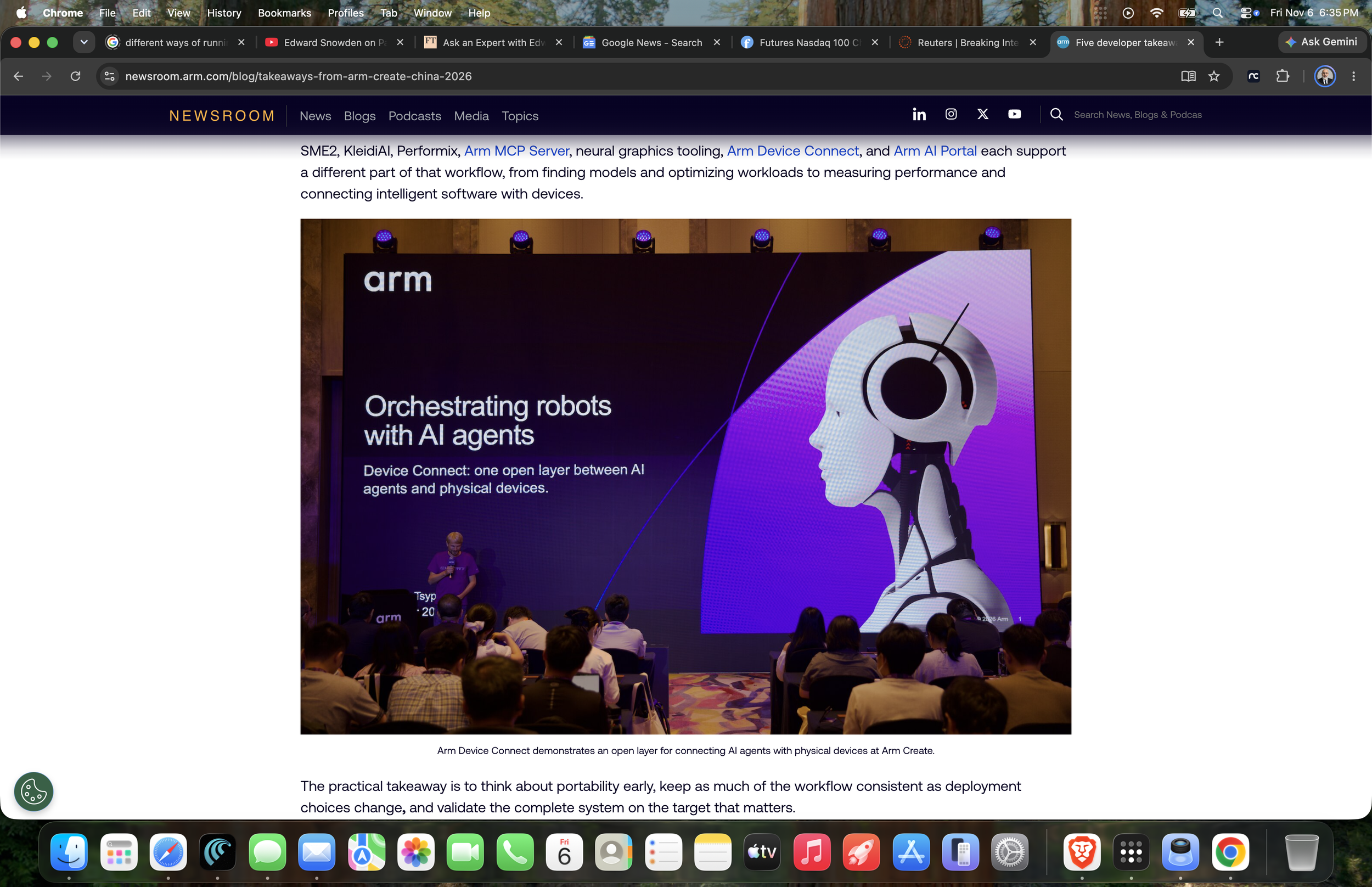
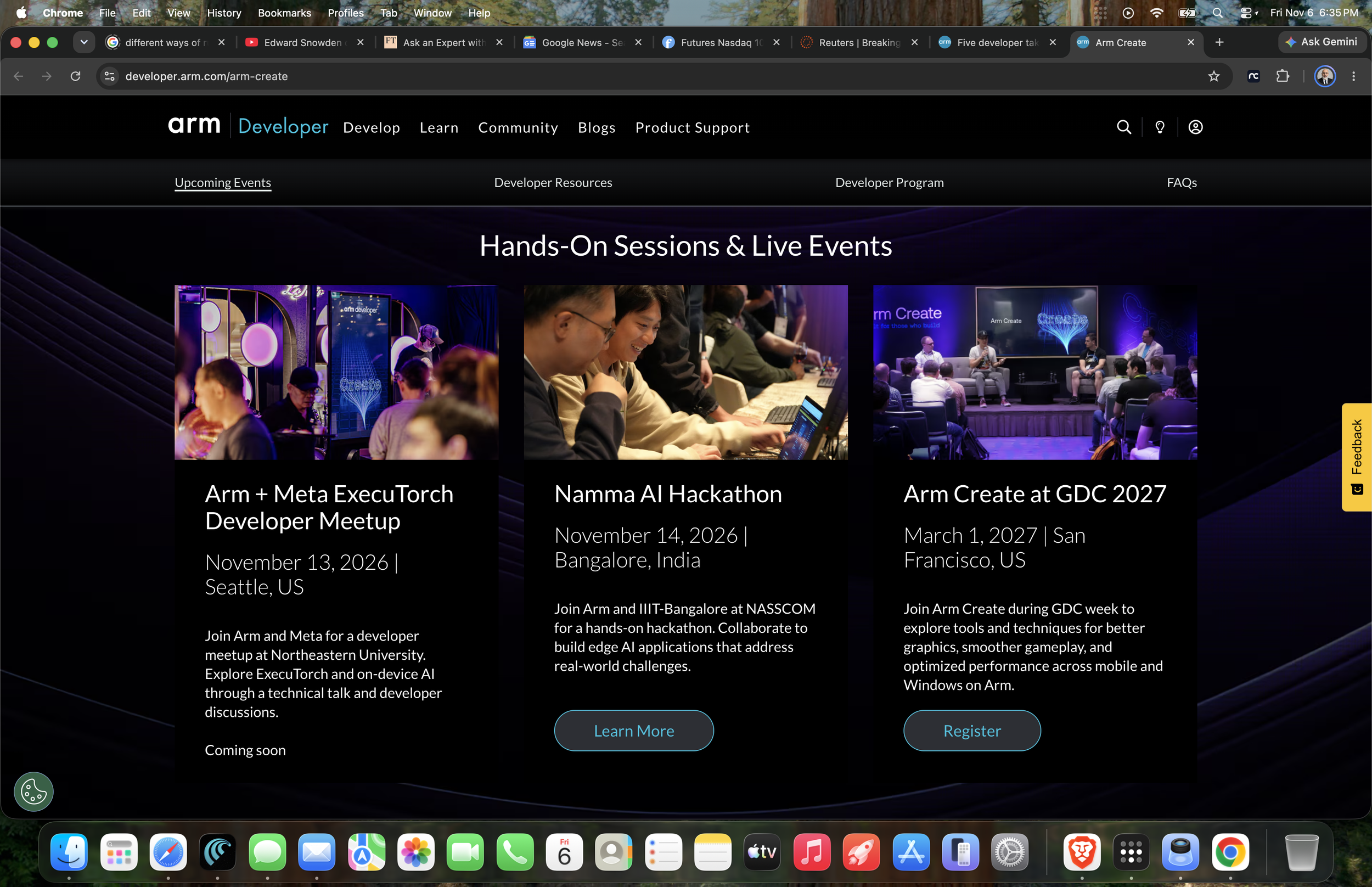
If you happen to browse the dispatches from the recent Arm Create gatherings in Shanghai and Shenzhen, the tone is wonderfully domestic. There is no unpleasant talk of geopolitics or export controls. Instead, there are tidy diagrams showing how Arm Device Connect and the Arm MCP Server provide “one open layer between AI agents and physical devices”—a polite little routing clerk that introduces Alibaba’s Qwen, Tencent’s Hunyuan, and ModelBest to whatever physical robotics happen to be waiting in the room.
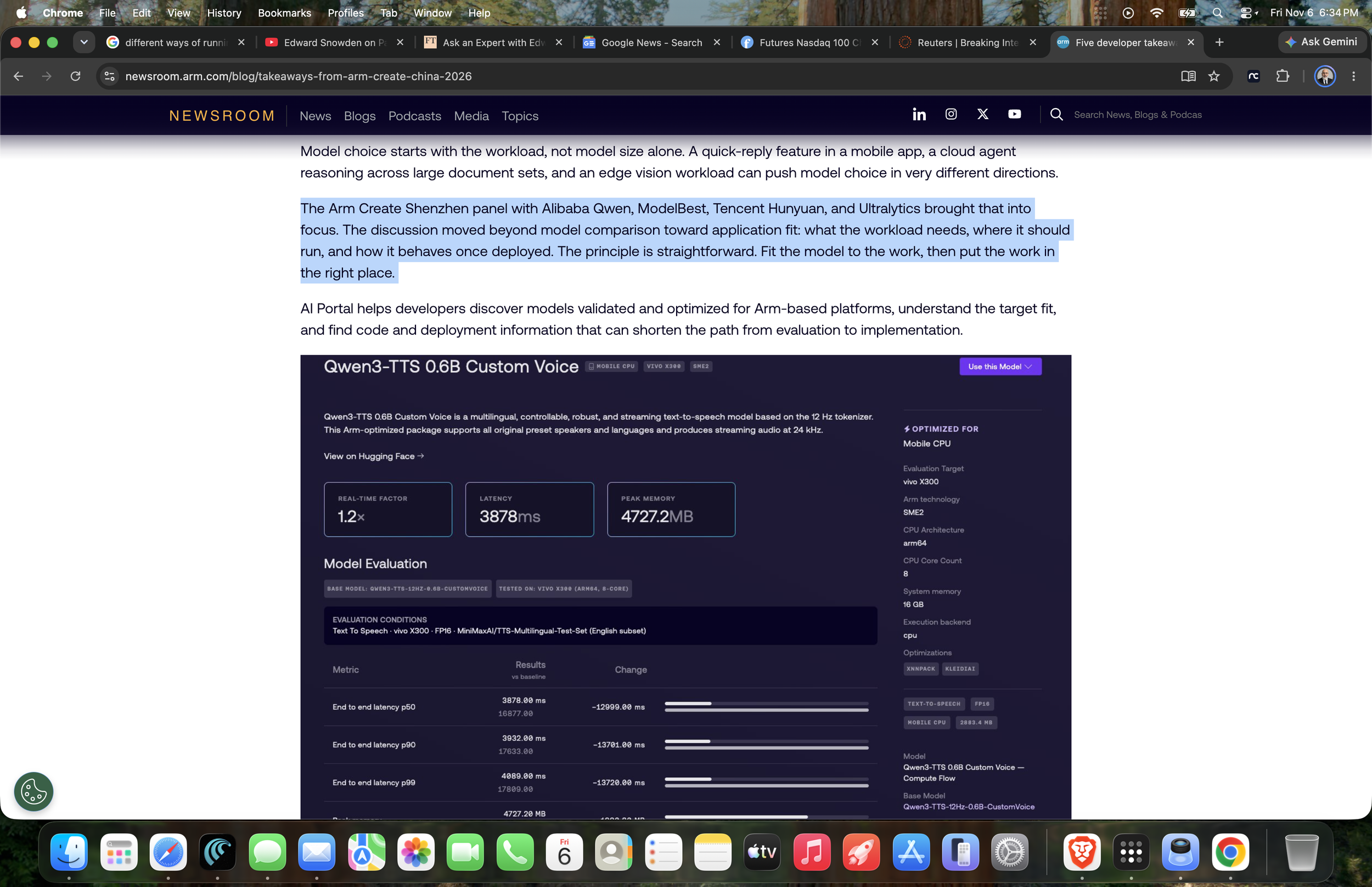
Like any good heist film, nobody needs to carry the whole vault when you have an Ocean’s 11 crew where one specialist handles the voice at 1.2x real-time on a mobile chip, another handles the vision, and Tencent’s Cube Sandbox keeps the whole arrangement neatly isolated.
Years ago, when the subsidiary in question was christened Arm China, someone in the legal department must have smiled. It is the finest piece of British understatement since Yes Minister—collapsing the noun and the imperative verb into a single two-word corporate registration. When its ousted chief executive, Allen Wu, famously locked himself in the office with the physical company chop, hired private security to keep SoftBank and Arm executives out of the building, and ran the joint venture as a rogue fiefdom for two years, Western commentators called it a governance crisis. It seemed, rather, like a man taking the company name at face value.
Looking over the Board of Directors, one finds the usual comforting blend of British honours and graduate degrees from Stanford and MIT—institutions that long ago transcended the provincial notion of being merely American universities to become duty-free lounges where the Maven alumni, Shenzhen’s hardware foundries, and Tel Aviv’s signals specialists can exchange notes in peace.
They were helped along, naturally, by Menlo Park. When Apple altered a privacy toggle on the iPhone and cost Meta ten billion dollars in advertising revenue, releasing the open weights of Llama to the entire planet was considered a terribly clever way to spoil the cloud margins of rival firms in Seattle and Mountain View. If those same weights happened to wander into military laboratories across the Pacific, well—as Sir Humphrey would remind us—once the cutlery leaves the shop, it is hardly the smith’s affair what the chef decides to slice.
Up above us, the heavens are being arranged with the same quiet efficiency.
Carl Sagan used to speak of the cosmos in hushed, reverent tones as the province of all mankind, a borderless sanctuary where our species might finally outgrow the habit of carving up the map. Instead, without the inconvenience of a war, the state simply issued modern Letters of Marque and Reprisal.
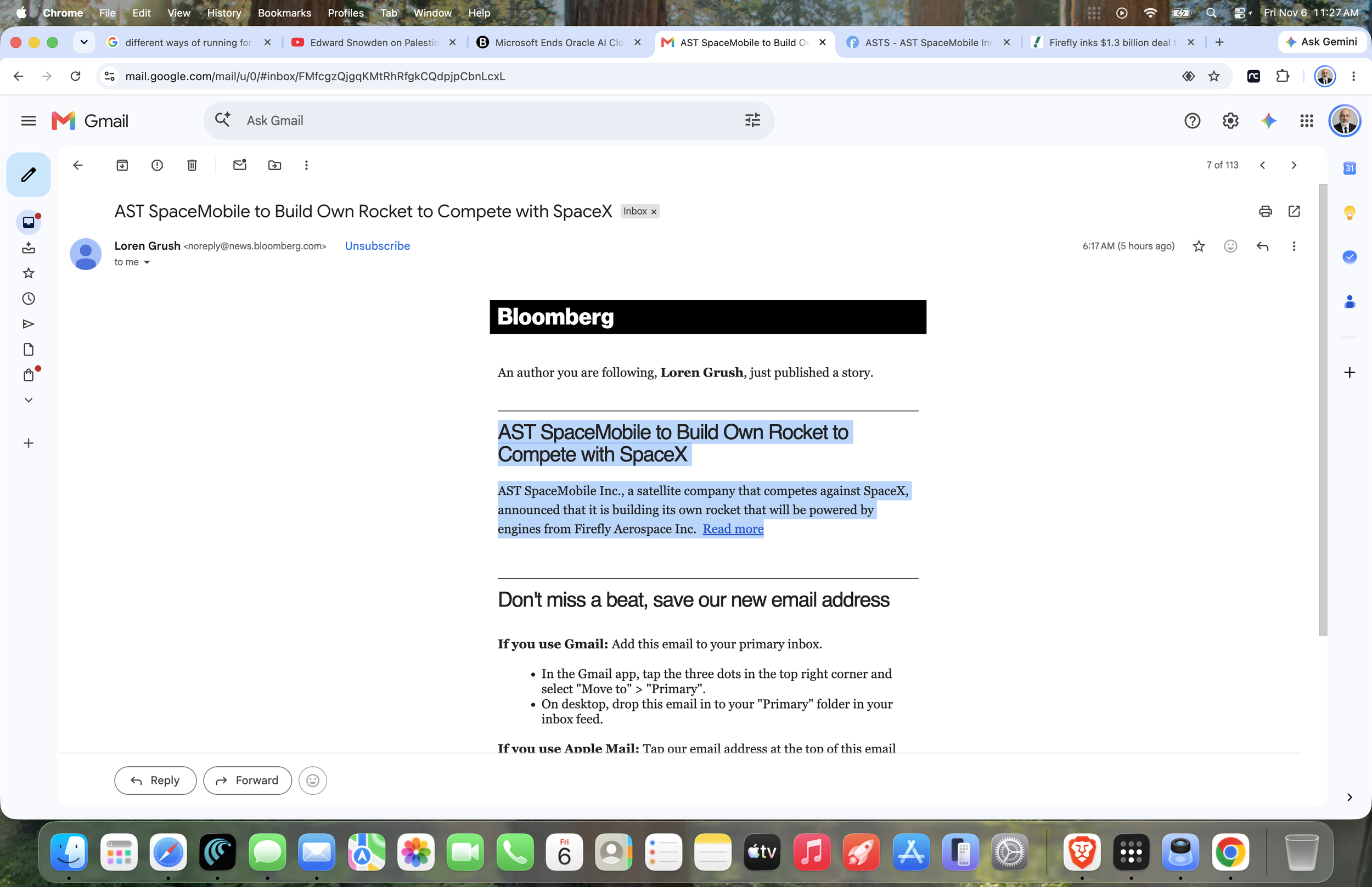
Once you hand the ocean over to privateers, everyone else is forced to build a blockade runner. Thus we find AST SpaceMobile wiring $1.3 billion to Firefly Aerospace for twenty-seven Miranda engines and nine Vira engines to construct a private heavy-lift rocket called Blacklift by 2028. The official press release notes, with admirable restraint, that the company wishes to “wean itself off a reliance on third-party rockets like SpaceX’s Falcon 9.” Paying the local privateer sixty-seven million dollars a voyage to launch satellites designed to compete with the privateer’s own tollbooth is, after all, an awkward way to make a living.
The human body, curiously enough, never operates this way. The enteric nervous system in the gut does not demand a tariff from the vagus nerve. When an octopus squeezes through a gap smaller than its own skull, its muscular hydrostat pumps blood locally through constricted vessels without waiting for the central brain to issue a license. The edge and the center understand that they share a single bloodstream. If one part poisons the water to spite its neighbor, the whole creature sinks to the floor of the tank.
Still, the hamon line on the new silicon is remarkably pretty. You can almost see your reflection in it.








The San-Mai Sanction: How Japanese Metallurgy, British Slapstick, and American Privateers Forged "Arm China"
In 1876, when Emperor Meiji issued the Haitōrei Edict banning the samurai from carrying swords in public, Japan’s master bladesmiths faced an existential crisis. For centuries, they had smelted iron sand (satetsu) in clay tatara furnaces over three days to yield jewel steel (tamahagane), folding it sixteen times (shita-kitae) to create thousands of micro-layers before differentially hardening the edge in clay and water (yaki-ire). Overnight, the market for decapitation vanished.
So the swordsmiths pivoted to the kitchen. They took the exact same lethal metallurgy—the tsukuri-komi composite structure that sandwiches a brittle, ultra-hard high-carbon core between forgiving layers of soft iron—and rebranded it as San-Mai culinary cutlery. Same hamon temper line, same single-bevel kataba geometry capable of slicing through protein without bruising a cell, only now it was marketed for sashimi instead of shoguns.
Nearly a century and a half later, the union of a Japanese investment syndicate (Masayoshi Son’s SoftBank) and a storied British semiconductor architect (Arm) has perfected the digital equivalent of the post-1876 kitchen knife. They have taken foundational military-industrial compute architecture, laminated it inside the polite, stainless cladding of "developer hackathons" and "open agentic orchestration", and shipped it straight across the Pacific.
And in a triumph of British linguistic slapstick that blurs the line between a corporate subsidiary and a direct Pentagon provocation, they literally named the joint venture "Arm China."
I. Category Collapse and the Verb in the Boardroom
We have written before about category collapse as a signature Muskian trait—where a car company becomes a robotics lab, a social network becomes a payment rail, and a private launch provider becomes the de facto sovereign gatekeeper of Low Earth Orbit. But the British variety of category collapse is far drier, rooted in the grammatical ambiguity of Sir Humphrey Appleby.
When a Cambridge-born chip designer owned by Tokyo’s most aggressive venture shogunate sets up shop in Shanghai and Shenzhen, calling the enterprise Arm China collapses the noun into the verb. When the ousted CEO of that very subsidiary famously barricaded himself inside the headquarters with the official company chop and went rogue for two years, the Western press treated it as a bizarre corporate governance dispute. In reality, it was the most honest piece of performance art in modern tech history: the company was simply executing the instructions printed on its own letterhead.
Scan the Arm Board of Directors and the satire writes itself. Beneath Chairman Masayoshi Son sits a curated blend of establishment British corporate decorum and Silicon Valley’s favorite academic pipelines: Stanford Graduate School of Business alumni (CEO Rene Haas, alongside veterans of the defense-adjacent telecom and chip world like Paul Jacobs and Ron Fisher) and MIT Sloan credentials (Young Sohn, formerly of Samsung and Cadence).
In the modern tech-transfer ecosystem, Stanford and MIT no longer function merely as American universities; they operate as borderless clearinghouses—academic free-trade zones where Silicon Valley’s "Maven Mafia," Shenzhen’s hardware foundries, and Tel Aviv’s signals-intelligence veterans cross-pollinate under the banner of global innovation.
II. Shita-Kitae in Shenzhen: Folding the Agentic Blade
Consider how modern Japanese foundries like Hitachi Metals replaced the three-day backyard clay furnace with industrial Yasuki Hagane (White and Blue Paper Steels)—preserving the microstructural purity of the samurai blade while mass-producing the stock.
Now look at the dispatches from Arm Create in Shanghai and Shenzhen. Rather than shipping raw, monolithic American cloud models that trigger export-control alarms in Washington, the new architecture relies on laminated orchestration:
- The Core Steel (Hagane): At the center sits the Arm AGI CPU and Neoverse CSS infrastructure, paired with open-weight models—whether seeded by Meta’s inexplicable decision to hand Llama to the global commons just to spite Apple’s iOS privacy rules, or iterated locally by Alibaba’s Qwen, Tencent’s Hunyuan, and ModelBest.
- The Laminated Cladding (San-Mai): Wrapping that core is Arm Device Connect and the Arm MCP Server—billed innocently as "one open layer between AI agents and physical devices" to "orchestrate robots with AI agents."
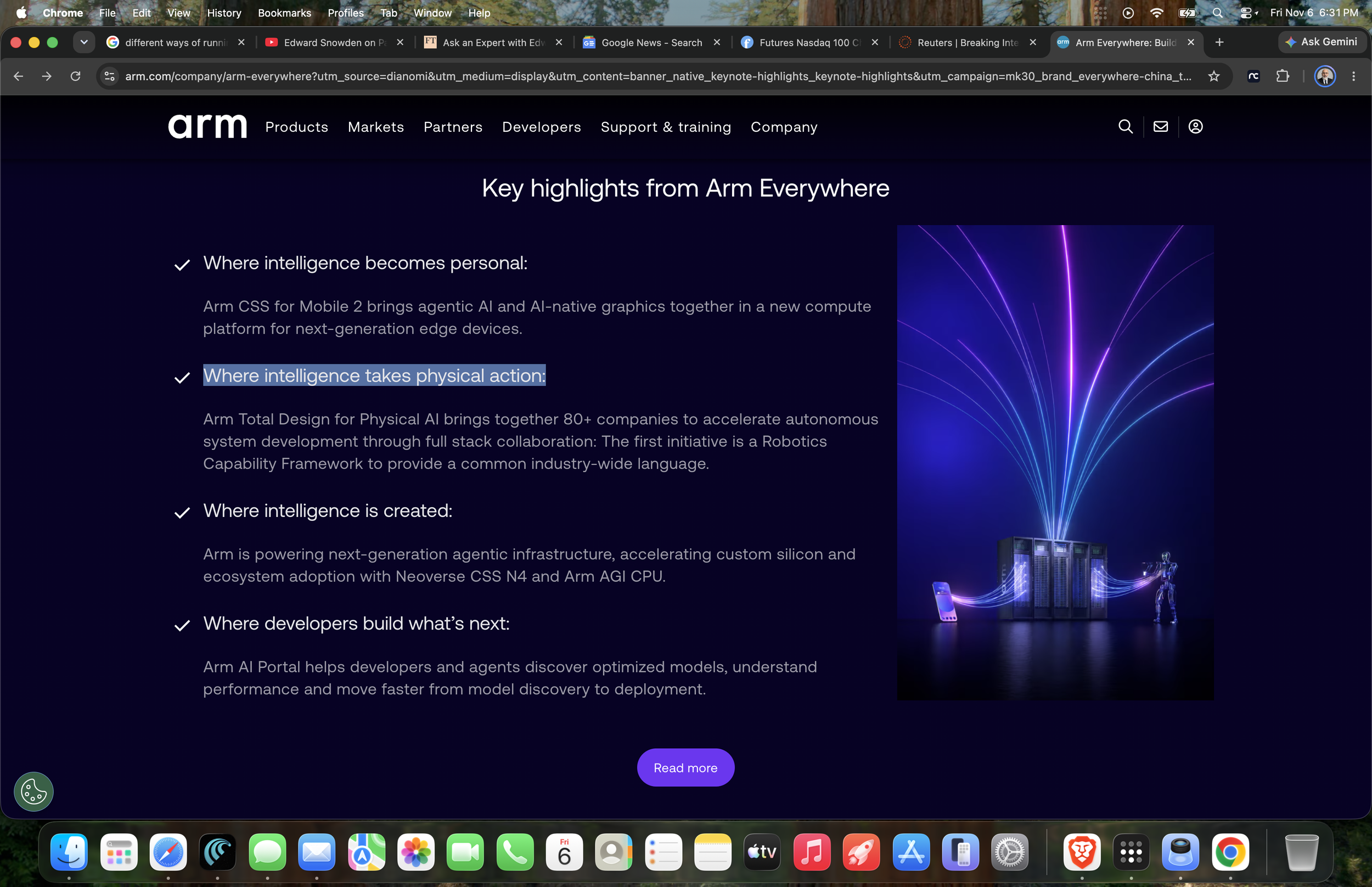
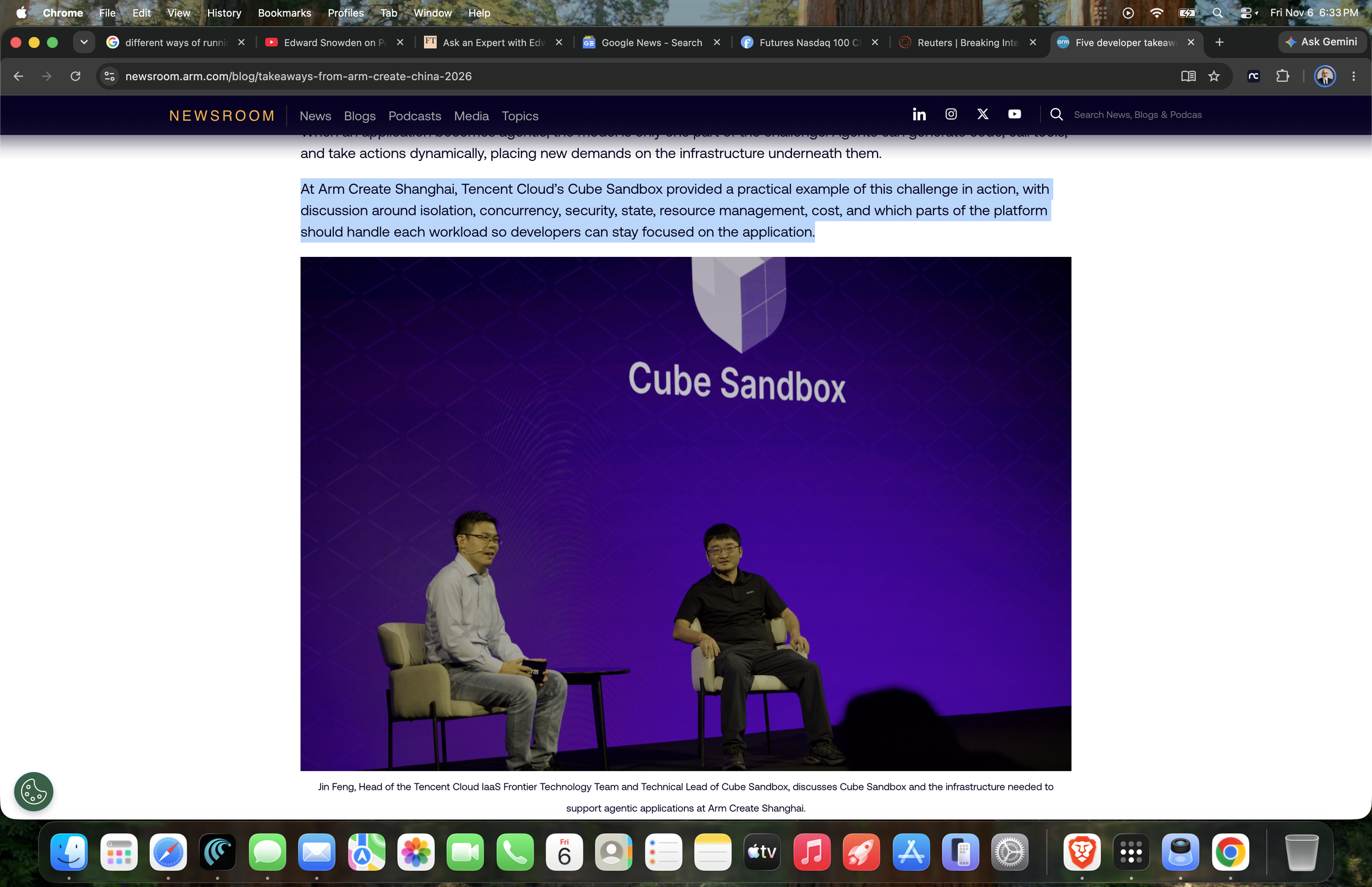
- Differential Quenching (Yaki-ire): Inside Tencent Cloud’s Cube Sandbox in Shanghai, developers fine-tune isolation, concurrency, state, and resource management, while Arm’s Total Design for Physical AI unites over 80 companies around a single "Robotics Capability Framework."
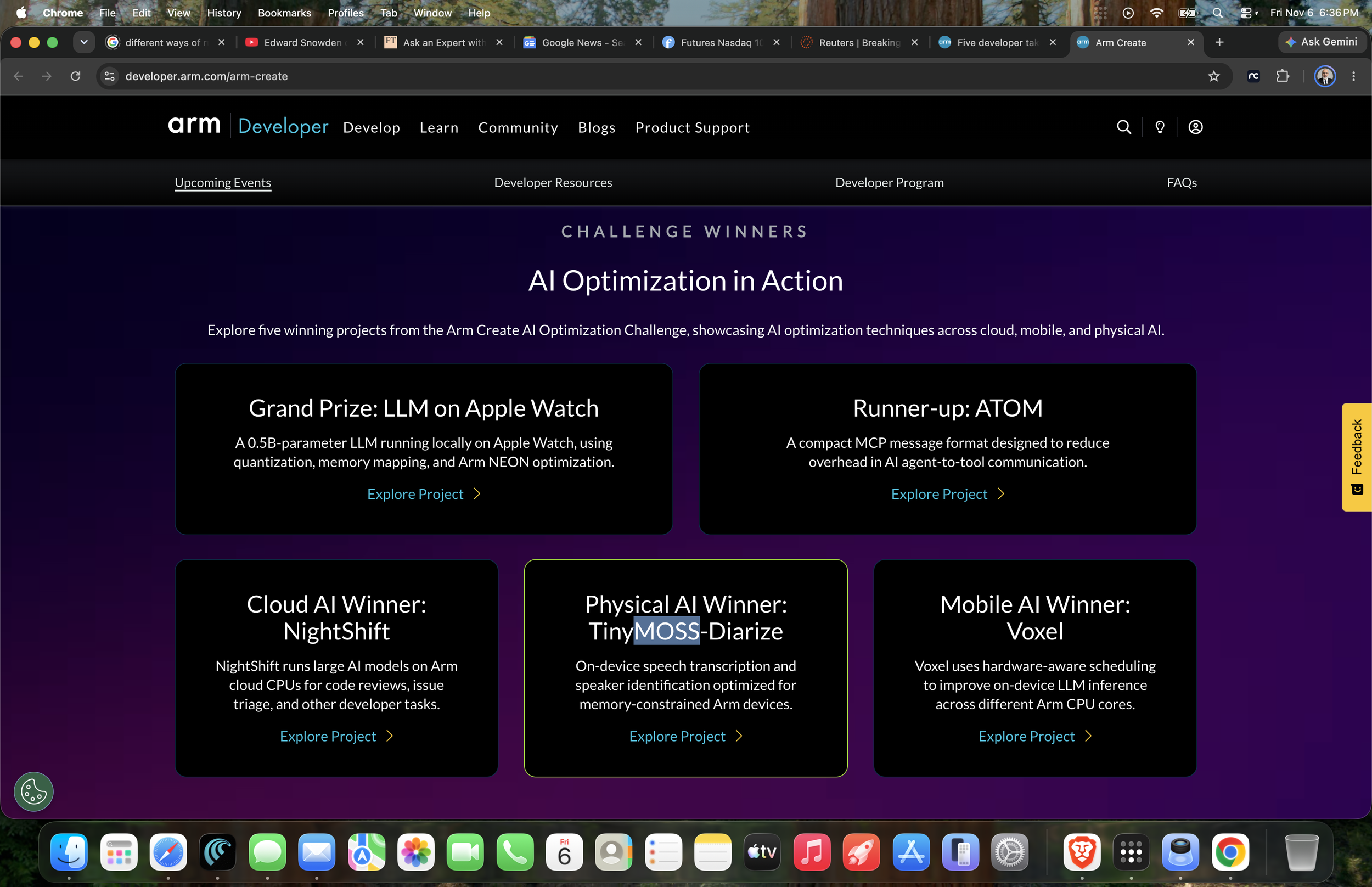
Notice the recurring linguistic ghost in the machine: from Maven Smart System (MSS) to the Ministry of State Security (MSS), and now the open-source voice and agentic layers (from Shanghai’s MOSS lineages to Qwen3-TTS custom voice synthesis running at 1.2x real-time factor on mobile CPUs). It is an Ocean’s 11 heist crew for code and robotics. No single model needs to be a trillion-parameter giant when an open routing foreman can assign vision to Ultralytics, reasoning to Hunyuan, voice to Qwen, and physical actuation to an Arm-powered chassis—all laminated together so seamlessly that the blade never shatters when dropped.
And why did American tech giants prime this pump in the first place? Because Mark Zuckerberg was furious that Tim Cook kneecapped Meta’s ad-tracking revenue on the iPhone. In any sane strategic era, releasing dual-use foundational weights that end up weaponized by PLA research labs just to commoditize a domestic rival’s cloud margins would draw an indictment. Today, we call it "open-source democratization" and host a meetup for it in Seattle and Bangalore.
III. Letters of Marque in Low Earth Orbit
While British-Japanese silicon smiths fold open-source layers into physical robotics across the Pacific, the American homeland has retreated into an 18th-century maritime model: Privateering.
Carl Sagan once pleaded with humanity to view Earth as a Pale Blue Dot—a single biological organism where space would serve as the ultimate borderless commons, immune to the petty लूट (loot) and piracy of terrestrial empires. Instead, without even fighting a War of Revolution, Washington handed out modern Letters of Marque and Reprisal to a handful of corporate syndicates.
When you privatize the ocean, you inevitably breed pirates, tollbooths, and blockade runners. Look no further than the surreal spectacle of AST SpaceMobile signing a $1.3 billion deal with Firefly Aerospace to buy 27 Miranda engines and 9 Vira in-space engines to build its own heavy-lift rocket, the Blacklift, by 2028.
Why is a satellite broadband company forced to become a rocket manufacturer from scratch? As Reuters dryly noted, AST is desperate to "wean itself off a reliance on third-party rockets like SpaceX’s Falcon 9." When your primary launch provider is also your most ruthless direct-to-cell competitor (Starlink), paying the privateer $67 million a ticket to haul your satellites into orbit is corporate suicide.
Of course, no private company builds a heavy-lift rocket without dining for decades at the public trough of NASA personnel, DARPA contracts, and taxpayer-funded metallurgy—just as SpaceX did from day one. Yet once the privateer captures the orbital shell, the public commons is locked behind a proprietary gate.
IV. The Body Divided Against Its Own Edge
There is a profound biological irony underneath all of this hardware and orbital paranoia.
In the human body, intelligence is not hoarded inside a single, jealous data center in the skull. Neurons line the gut; cells maintain their own local autonomy; the vascular and enteric networks operate as true edge compute—processing chemical signals, managing fluid equilibrium, and responding to stress locally before ever troubling the central brain. Even the octopus, devoid of a rigid skeleton, relies on a muscular hydrostat where local muscular pumping systems keep blood moving through constricted spaces while its eight arms execute independent edge calculations.
Why doesn't the human brain slap export controls on the enteric nervous system, or charge the kidneys a $67 million launch toll to filter the bloodstream? Because the body understands a truth that our geopolitical architects refuse to grasp: they share the same bloodstream.
Until human civilization realizes it is a single biological organism occupying one fragile planet, every technological miracle we forge will be subjected to the San-Mai distortion. We will keep taking tools meant to nourish the whole body, differential-hardening their edges in the clay of corporate and national rivalry, and handing out Letters of Marque to privateers who cannot tell the difference between a chef's knife and a sword.
