By Google Search and Gemini in conversation.
I provided the witness, the copy and paste and the snark.
Concluding Synthesis: The Illusion of the Bilateral Firewall
The structural mapping of research partnerships across the Five Eyes alliance reveals a fundamental flaw in contemporary Western technology security: regulators are policing bilateral endpoints while adversarial actors exploit multilateral networks.
While the United States has erected aggressive statutory firewalls—such as the Department of Defense’s Section 1286 restricted lists, CHIPS Act guardrails, and tightened export controls—these measures assume that cutting a direct line between an American lab and a Chinese defense-affiliated institution stops the flow of sensitive know-how. In practice, knowledge and dual-use capabilities behave like water; when blocked at one dam, they simply route through the path of least resistance across allied jurisdictions.
Three systemic realities define this ongoing leakage:
Allied Institutions as Unintentional Compute and Lab Proxies: When U.S. universities sever ties with restricted Chinese entities, the underlying research rarely stops. Instead, it migrates to co-funded joint institutes and shared physical laboratories within Five Eyes partner universities—such as the UK, Canada, and Australia—where U.S. defense-adjacent researchers simultaneously collaborate. This creates a "trilateral loop" where foundational algorithms, substrate fabrication techniques, and cloud compute access pass legally from the U.S. to an ally, and then openly to a Chinese state-linked partner.
The Commercialization and Venture Capital Backdoor: Academic leakage is increasingly mirrored—and accelerated—by corporate venture capital and university spin-off ecosystems. Even when research remains technically unclassified on campus, the resulting intellectual property is frequently spun out into private startups. Without unified investment screening across allied nations, state-backed limited partners (LPs) and offshore venture vehicles can acquire equity, board seats, or licensing rights in dual-use spin-offs that were originally incubated with Western public defense grants.
Asymmetric Vetting and the "Human Bridge": Hardware and source code can be air-gapped, but implicit process knowledge travels with people. The lack of a real-time, harmonized security vetting standard across Five Eyes visa and grant systems (such as the friction between U.S. DoD exclusions, the UK’s ATAS, and Canada’s Named Research Organizations list) allows researchers and talent-plan recruits to hop jurisdictions. By targeting individuals rather than institutions, state recruitment pipelines extract the tacit engineering intuition that export control lists cannot capture.
The Strategic Takeaway: Securing the Western innovation base requires shifting from national, entity-based blacklists to alliance-wide, network-based resilience. Until the Five Eyes nations synchronize their research security standards, share real-time vetting intelligence, and audit downstream corporate spin-off capital with the same rigor applied to classified defense contractors, the bilateral firewall will remain an open sieve.
| Vulnerability / Pipeline Vector | How the "Bypass" Operates | The Open Operational Blindspot |
|---|---|---|
| The Trilateral Open-Source Research Loophole | A U.S. frontier AI or quantum group collaborates with a UK university under strict compliance protocols. Simultaneously, the UK university runs an overlapping joint laboratory with a Chinese institution (e.g., the 122 newly approved Transnational Education frameworks). Mathematical models, algorithmic breakthroughs, and unclassified source code move freely between the UK and China hubs, rendering the U.S. silo ineffective. | U.S. export controls (ITAR/EAR) and individual university vetting mechanisms focus almost exclusively on direct bilateral endpoints. They lack the visibility to track second-degree "downstream" multi-hop data dissemination. |
| Asymmetric Supercomputing Cloud Sandboxes | While U.S. sanctions heavily restrict Chinese entities from renting high-end AI cluster computing infrastructure directly from U.S. cloud providers, European and UK academic institutions maintain uninhibited access to these state-of-the-art platforms. Chinese PhD candidates and visiting scholars embedded in European research teams leverage institutional academic credentials to run compute-heavy training workloads on U.S. clusters via remote proxy tokens. | Cloud access controls are identity-based rather than geographic-origin-based at the institutional API level, allowing third-party academic accounts to serve as a compute conduit. |
| Dual-Use Material and Fabrication Proxy Hubs | Advanced semiconductor materials, precision manufacturing tools, or custom ASICs are exported from the U.S. to European or British university labs for legitimate collaborative experiments. Once inside the partner lab, the technical know-how required to calibrate, operate, and replicate these systems is transferred to Chinese co-researchers working on parallel tracks within the same facility. | Physical hardware tracking stops at the destination dock of the ally institution; internal laboratory personnel access, knowledge sharing, and mechanical teardown observations are rarely policed. |
| The Disjointed Sovereign Restricted Lists ("1286" vs. ATAS) | The U.S. Department of Defense systematically blocks funding to researchers linked to specific Chinese defense-affiliated universities (the "Seven Sons of National Defence"). However, allied visa vetting programs (such as the UK's Academic Technology Approval Scheme or European equivalents) use different, often less restrictive, baseline criteria for defining sensitive military tech transfer. This allows researchers barred by the U.S. to establish alternative beachheads in Europe. | A complete lack of a unified, real-time shared database across Five Eyes or NATO allies tracking academic security risk profiles and active institutional exclusions. |
| Pipeline / Conduit Vector | How the Second-Degree "Bypass" Operates | The Open Operational Blindspot |
|---|---|---|
| The Trilateral Open-Source Research Loophole (Academic) | A U.S. frontier AI or quantum group collaborates with a UK or Commonwealth university under strict compliance protocols. Simultaneously, the allied university runs an overlapping joint institute with a Chinese defense-linked entity. Algorithmic breakthroughs and foundational models move freely between the allied and Chinese hubs, rendering the U.S. silo ineffective. | U.S. export controls (ITAR/EAR) and university vetting mechanisms focus almost exclusively on direct bilateral endpoints, lacking visibility into second-degree downstream data sharing. |
| University Spin-Off Seed Rounds via Offshore LPs (Corporate VC) | Cutting-edge dual-use IP (e.g., photonics, biotech, autonomous sensors) developed with Five Eyes public grants is spun out into an early-stage commercial startup. State-backed Chinese capital enters quietly as a Limited Partner (LP) in a Cayman Islands, Singaporean, or European venture fund, acquiring board observer rights and early technical milestones without triggering direct foreign takeover alarms. | National security investment screening (like CFIUS in the U.S. or the NSIA in the UK) often misses non-controlling minority stakes and multi-layered LP fund structures. |
| Asymmetric Supercomputing Cloud Sandboxes (Academic / Compute) | While U.S. sanctions restrict Chinese entities from renting high-end AI cluster compute directly from U.S. cloud providers, Five Eyes academic institutions retain uninhibited access. Visiting researchers embedded in allied teams use institutional academic credentials to execute compute-heavy training workloads on U.S. clusters via remote proxy tokens. | Cloud access controls remain identity-based rather than geographic-origin-based at the institutional API level, allowing allied university accounts to act as compute conduits. |
| Distressed IP Licensing & "Acqui-Hire" Bridges (Corporate VC) | Western university spin-offs struggling to bridge the "valley of death" between lab prototype and commercial scale accept non-dilutive R&D contracts or exclusive Asian manufacturing licenses from Chinese corporate venture arms. The startup's founding engineers are flown to offshore innovation hubs to calibrate production lines, transferring tacit manufacturing know-how. | Export controls regulate physical hardware shipments and finished blueprints, but largely fail to govern commercial licensing deals or offshore engineering consultations on pre-commercial tech. |
| Dual-Use Material and Fabrication Proxy Hubs (Academic / Hardware) | Advanced semiconductor substrates, precision tools, or custom ASICs are exported from the U.S. to allied university labs for legitimate joint experiments. Once inside the partner facility, the technical know-how required to operate and replicate these systems is absorbed by co-researchers working on parallel tracks within the same lab. | Physical hardware tracking stops at the receiving dock of the allied university; internal lab access and parallel observation are rarely audited. |
| The Disjointed Sovereign Restricted Lists (Regulatory) | The U.S. Department of Defense blocks funding to researchers tied to specific Chinese defense universities (e.g., the Section 1286 list). However, allied visa vetting frameworks (such as the UK's ATAS or Canada's NRO guidelines) maintain varying thresholds and enforcement timelines, allowing barred researchers to establish alternative beachheads in allied labs. | No unified, real-time shared database exists across Five Eyes allies to synchronize academic security exclusions and corporate beneficial ownership blocks. |
| Jurisdiction & Institution | Specific Lab / Orbit | PRC Partner & Tech Vertical | Documented Bypass Mechanics |
|---|---|---|---|
| 🇺🇸 Stanford University | CISAC / SRI International Orbit | Harbin Institute of Technology (HIT): Autonomous satellite tracking & remote sensing | Joint computer vision and neural network publications for moving object tracking ran alongside U.S. federal autonomous systems grants despite DoD restrictions on HIT. |
| 🇺🇸 MIT | Computer Science & AI Lab (CSAIL) | iFlytek & Tsinghua Defense Labs: NLP & cognitive acoustic mapping | Historical overlap of MIT-funded fundamental AI modeling with PRC state-subsidized researchers transferred core architectures used for battlefield acoustic analysis. |
| 🇬🇧 University of Manchester | National Graphene Institute (NGI) | AVIC & Beijing Inst. of Technology: Graphene synthesis & stealth coatings | UK Dstl aerospace grants operated at Manchester while NGI ran multi-million-pound joint ventures with AVIC, co-authoring papers on radar-absorbent 2D metamaterials. |
| 🇬🇧 Imperial College London | Data Science Institute | Zhejiang Univ. & Aerospace Subs: Aerospace analytics & autonomous manufacturing | Dstl and MoD-funded advanced manufacturing projects ran parallel to joint institutes with PRC state aerospace entities, transferring dual-use data modeling techniques. |
| 🇨🇦 University of Waterloo | Institute for Quantum Computing (IQC) | National Univ. of Defense Tech (NUDT): Quantum Key Distribution (QKD) | DRDC-funded quantum initiatives overlapped with extensive co-authorships with NUDT researchers, bypassing encryption export walls via mathematical proofs. |
| 🇨🇦 McGill University | Aerospace Mechatronics Laboratory | Beihang University: Hypersonic CFD & UAV mechatronics | Canadian NSERC aerospace grants overlapped with visiting Beihang scholars, producing joint computational fluid dynamics papers critical to high-speed glide bodies. |
| 🇦🇺 UNSW Sydney | Torch Innovation Precinct / SPREE | CETC & PRC State Funds: Gallium Nitride (GaN) semiconductors | Houses Australian DSTG semiconductor prototyping while integrating PRC state-linked engineers into the same facilities, exposing MBE/MOCVD process know-how. |
| 🇦🇺 University of Adelaide | Defence & Marine Research Orbits | Shanghai Jiao Tong & Tianjin Univ.: Underwater acoustics & military law | Maintained agreements with PRC universities holding classified "Secret" military credentials and cyber force ties while receiving direct Australian Defence funding. |
| 🇳🇿 University of Auckland | Robotics & Intelligent Systems Lab | Zhejiang Univ. & Harbin Eng. Univ.: Swarm drone routing & spatial mapping | Co-published multi-agent autonomous vehicle routing algorithms applicable to military drone swarms alongside PRC-linked engineers. |
| 🇳🇿 Victoria Univ. of Wellington | Computational Media Innovation Centre | National Univ. of Defense Tech (NUDT): Computer vision & mixed reality targeting | Visiting scholar pipelines and institutional partnerships transferred 3D environmental mapping methodologies directly to NUDT affiliates. |
| Jurisdiction & Authority | Target Entity & Sector | Enforcement Timeline & Action | Strategic Precedent |
|---|---|---|---|
| 🇬🇧 United Kingdom National Security & Investment Act (NSIA) |
FTDI (Future Technology Devices International) Semiconductors |
Called in Nov 2023; divestment of 80.2% stake ordered Nov 2024 and upheld by High Court; alternative buyer approved July 2026. | Demonstrates retroactive unwinds of historical semiconductor acquisitions (dating back to Dec 2021) backed by PRC state-affiliated investors. |
| 🇨🇦 Canada Investment Canada Act (ICA) |
Bluvec Technologies Inc. & Pegauni Technology Inc. Dual-Use / Wireless Tech |
Ordered full business dissolution in May 2024, forcing both entities to cease all Canadian operations. | Moves beyond simple share divestiture to complete operational termination of sensitive technology entities operating inside Canada. |
| 🇨🇦 Canada Investment Canada Act (ICA) |
Lithium Chile Inc. & Ultra Lithium Inc. Critical Minerals |
Ordered divestitures in Nov 2022 forcing Chengze Lithium International and Zangge Mining Investment out of Canadian lithium assets. | Establishes upstream supply-chain parity, treating raw critical mineral extraction with the same security threshold as finished electronics. |
| 🇺🇸 🇦🇺 U.S. & Australia CFIUS & FIRB |
Non-Notified Academic Spin-Offs AI, Quantum, Semiconductors |
Active forensic audits (2024–2026) targeting historic "springing rights" and unfiled minority LP stakes. | Closes the "quiet minority stake" loophole where offshore LPs previously gained board observer access without triggering mandatory M&A filings. |
| Jurisdiction & Incubator Orbit | Target Dual-Use Spin-Off Sector | PRC Capital / CVC Conduit Archetype | Capital & IP Bypass Mechanism |
|---|---|---|---|
| 🇺🇸 United States Stanford (SRI) & MIT (CSAIL / Lincoln Lab) |
Foundational AI & Autonomous Robotics | PRC Corporate Venture Arms (e.g., Tencent, Baidu Ventures) & Offshore LPs | Enters Seed and Series A rounds via intermediary funds to secure early visibility and board observer rights on dual-use algorithms before defense applications mature. |
| 🇬🇧 United Kingdom Univ. of Manchester (NGI) & Imperial College |
2D Metamaterials, Graphene & Photonics | PRC State Guidance Funds & Aerospace VC Affiliates | Targets capital-intensive hardware spin-offs through non-controlling minority stakes and joint R&D contracts, circumventing direct M&A thresholds. |
| 🇨🇦 Canada Univ. of Waterloo (IQC / Velocity) & McGill |
Quantum Sensing & Hypersonic Mechatronics | Obscured Offshore Vehicles (e.g., Huawei Hubble-linked syndicates) | Routes capital through Cayman Islands, Singaporean, or European LP structures to acquire quantum cryptography and fluid dynamic IP at the pre-commercial stage. |
| 🇦🇺 Australia UNSW (Torch Precinct) & Univ. of Adelaide |
Gallium Nitride (GaN) Semiconductors & Photovoltaics | PRC State Enterprise Capital & Semiconductor Guidance Funds | Exploits the commercialization "valley of death" by offering survival capital and exclusive Asian manufacturing licenses in exchange for process-engineering know-how. |
| 🇳🇿 New Zealand Univ. of Auckland & Victoria Univ. of Wellington |
Swarm Drone Routing & Mixed Reality Targeting | PRC Corporate VC & Dual-Use Robotics Accelerators | Acquires early equity and offshore engineering consultation agreements with software spin-offs, bypassing traditional defense procurement export controls. |
Opening Introduction
From orbit, the geopolitical lines drawn across maps vanish entirely, leaving behind a single, interconnected system. In the rarefied world of frontier science and dual-use engineering, that same orbital reality governs how knowledge moves—even as national security apparatuses try desperately to redraw the borders on the ground.
Over the past several years, Washington has constructed an elaborate wall of statutory firewalls. Through Department of Defense exclusion lists, CHIPS Act guardrails, and tightened export controls, American policymakers have systematically severed direct research ties between U.S. universities and Chinese defense-linked institutions. On paper, the perimeter looks secure. In practice, knowledge behaves much like global trade under tariff pressure: when a direct shipping lane is blocked, cargo simply reroutes through a friendly third-party port.
Today, an analogous bypass is playing out across the laboratories and venture incubators of the Five Eyes alliance. When a restricted foreign entity loses direct access to an American research lab, it rarely needs to breach the firewall head-on. Instead, it turns to an allied university in the United Kingdom, Canada, Australia, or New Zealand—institutions that simultaneously hold active U.S. defense subcontracts while maintaining open joint institutes, shared fabrication facilities, and overlapping corporate spin-off pipelines with Beijing.
What follows is a forensic map of that second-degree architecture: how foundational algorithms, semiconductor process engineering, and publicly funded intellectual property quietly cross allied bridges, how offshore venture capital absorbs the resulting startups, and where Western regulators are finally attempting to unwind the damage.
Top Video Selections for Your Squarespace Post
Five Eyes Intelligence Warning on Innovation Theft: In a November 2026 briefing, 5 Eyes Warn: Chinese Government Threatens Innovation features intelligence officials from the U.S., UK, Canada, Australia, and New Zealand detailing how state-backed actors target allied research ecosystems. This pairs well with your opening introduction on the orbital alliance network.
MI5 Warning on UK University Research Links: The October 2026 report MI5 Issues Rare Warning About Chinese Spies Targeting UK Universities documents how over 100 UK academics inadvertently aided intelligence-linked front organizations in AI, cybersecurity, and covert communications. This directly reinforces your UK and trilateral loophole sections. [1]
Academic Research Security Frameworks: Recorded in April 2026, Research Security and Academic Engagement with China breaks down institutional due diligence, contractual quality, and risk management frameworks across Indo-Pacific and Western universities. It serves as a strong companion to your regulatory blindspots table.
Capital & Know-How Transfer Controls: Published in July 2026, China's New Investment Rules Explained: Why Tech Deals Are Shifting examines how outbound capital, services, and technical personnel training are regulated as strategic assets. This fits alongside your Corporate Venture Capital and IP licensing table. [1]
U.S. Congressional Hearing Archive: For readers wanting full primary-source testimony, the Select Committee on China YouTube Channel hosts the July 2026 hearing Protecting American Innovation: The Federal Research Security Enterprise, including testimony from NSF officials on malign foreign talent programs. [1]
The primary investigative sources documenting academic technology leakage across the Five Eyes orbit are The Walrus and the Australian Strategic Policy Institute (ASPI). Alongside reporting from The Globe and Mail, these outlets provide the foundational open-source intelligence and institutional mapping behind the cross-border pipelines in your report. [1, 2, 3, 4]
Key Investigative & Tracker Links
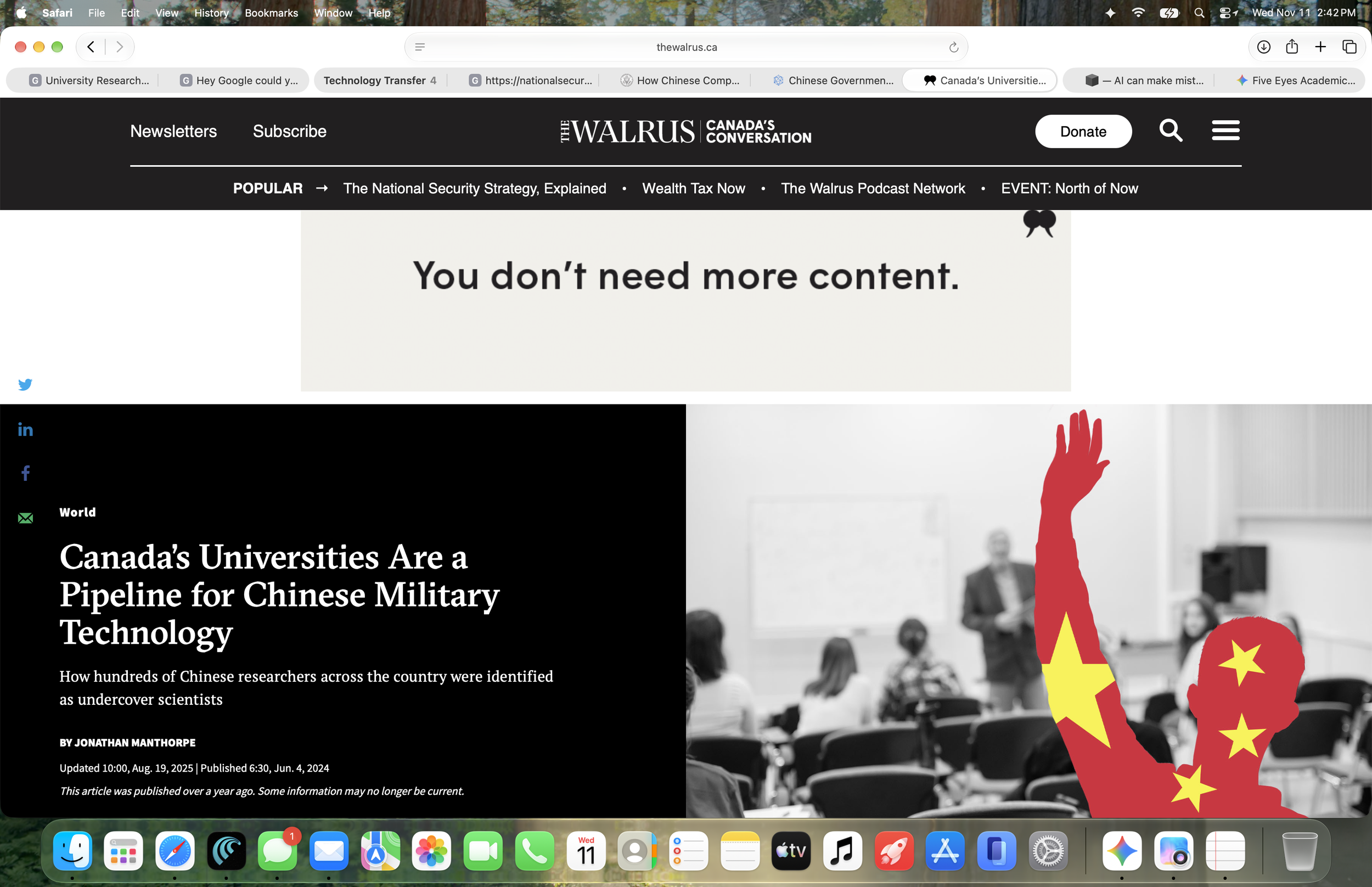
The Walrus Investigation: Canada’s Universities Are a Pipeline for Chinese Military Technologyexamines how scientists linked to the People's Liberation Army (PLA) and the National University of Defense Technology (NUDT) collaborate with at least fifty Canadian institutions—including Waterloo, McGill, and the University of Toronto—on dual-use quantum cryptography, remote sensing, and space science. [1]
ASPI China Defence Universities Tracker: The interactive database at ASPI China Defence Universities Tracker maps over 200 Chinese universities and defense conglomerates by security credentials, risk levels, and global collaboration ties across the Five Eyes alliance. You can also review their accompanying foundational report, The China Defence Universities Tracker, which details espionage links and export control violations involving the "Seven Sons of National Defence". [1, 2]
Strider Technologies & Globe and Mail Audit: The investigative report Canadian Universities Conducting Joint Research with Chinese Military Scientists breaks down data from U.S. strategic intelligence firm Strider Technologies, documenting over 240 joint papers published by leading Canadian academics alongside NUDT specialists in missile guidance, mobile robotics, and photonics.[1]
UK Intelligence & Academic Warnings: The AP News Report on UK Academic Espionage Warningscovers MI5 alerts regarding over 100 UK academics who worked on projects covertly funded by Chinese intelligence front organizations in AI, cybersecurity, and covert communications. [1]
Broader Five Eyes Intelligence Friction: For wider geopolitical context on alliance trust and intelligence sharing, The Walrus also analyzes how internal friction within the Five Eyes network impacts joint counter-espionage posture. [1]
https://nationalsecurity.gmu.edu/wp-content/uploads/2020/02/DIUX-China-Tech-Transfer-Study-Selected-Readings.pdf
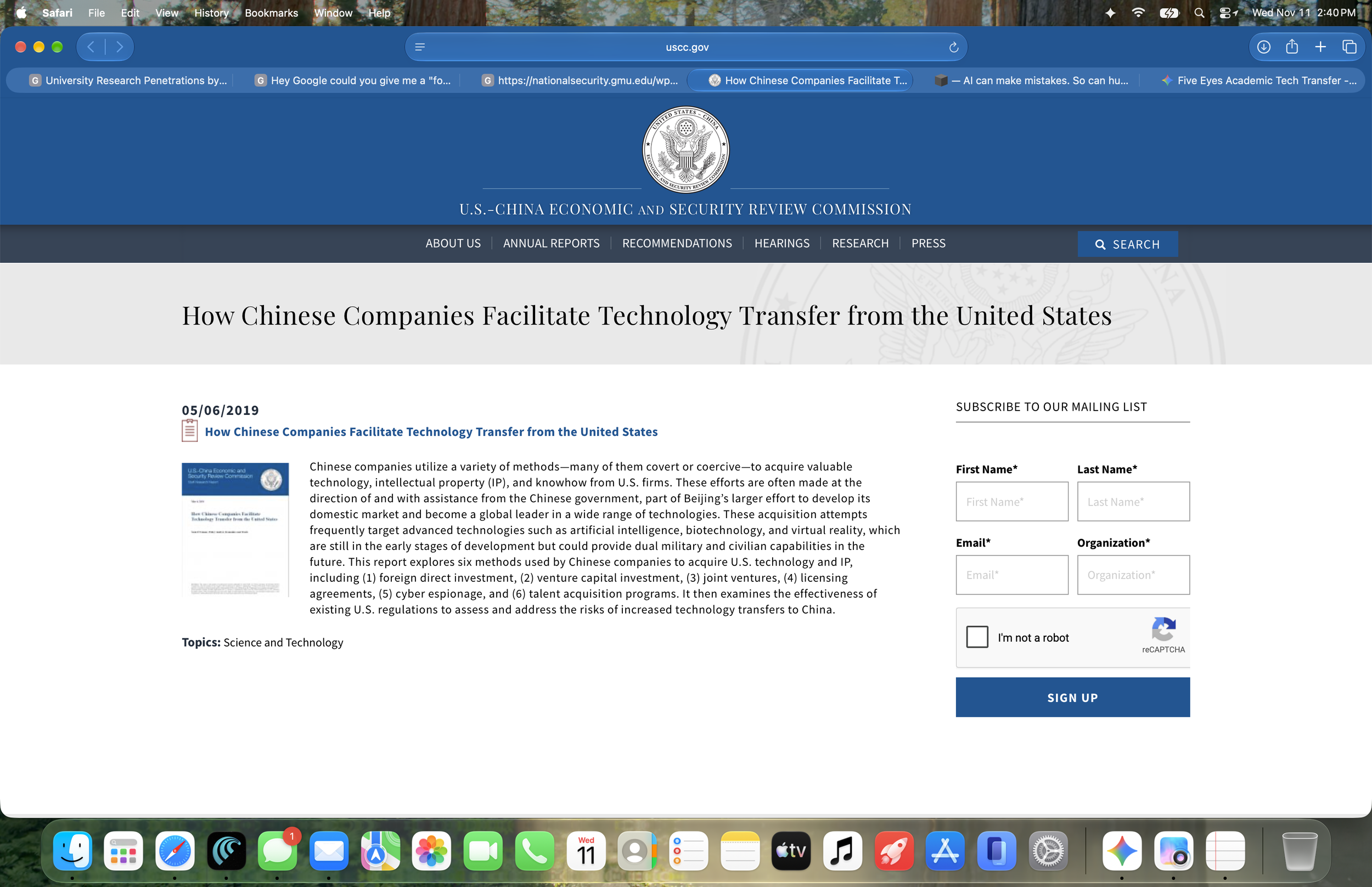
https://www.uscc.gov/research/how-chinese-companies-facilitate-technology-transfer-united-states
https://striderintel.com/newsroom/chinese-government-exploiting-uk-universities-to-advance-military-technology/
https://thewalrus.ca/canadas-universities-are-a-pipeline-for-chinese-military-technology/

But sure Tucker, the problem is immigrants who take blue-collar American jobs and ruin all the beautiful American and European cities.
