Three Planes and Wingsuit Flyers.
By Perplexity with help from Squarespace AI and CoPilot in conversation with Rakesh.
At first there were two planes.
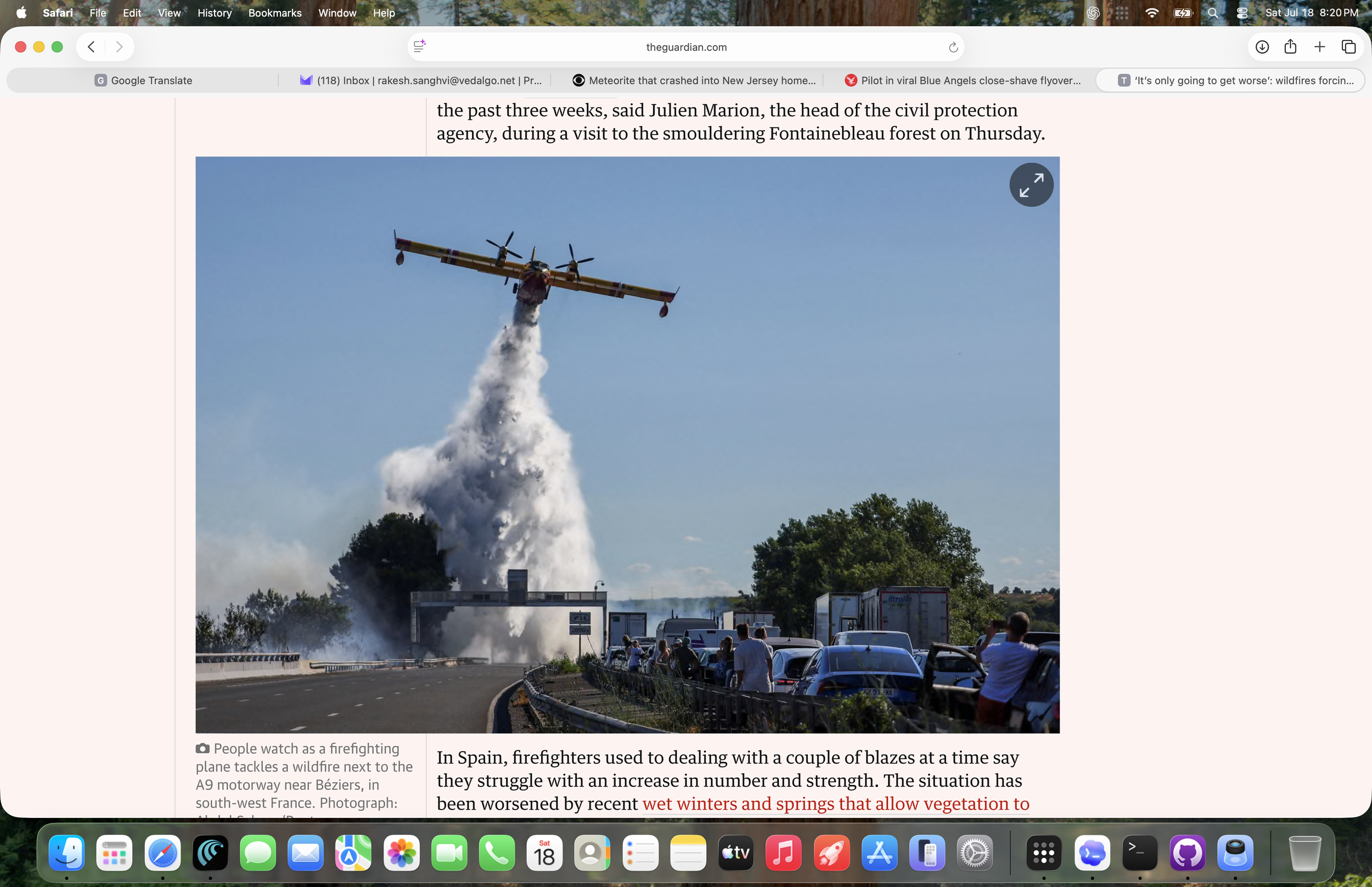
A yellow aircraft descends toward a French motorway, its belly releasing water or retardant into the white-and-grey uprising of a wildfire. Below, cars have stopped. People stand at a distance, but not at a safe distance from the fact of fire. The plane is a moving answer to a question the ground cannot answer alone: how does one throw water at a conflagration too large to approach?
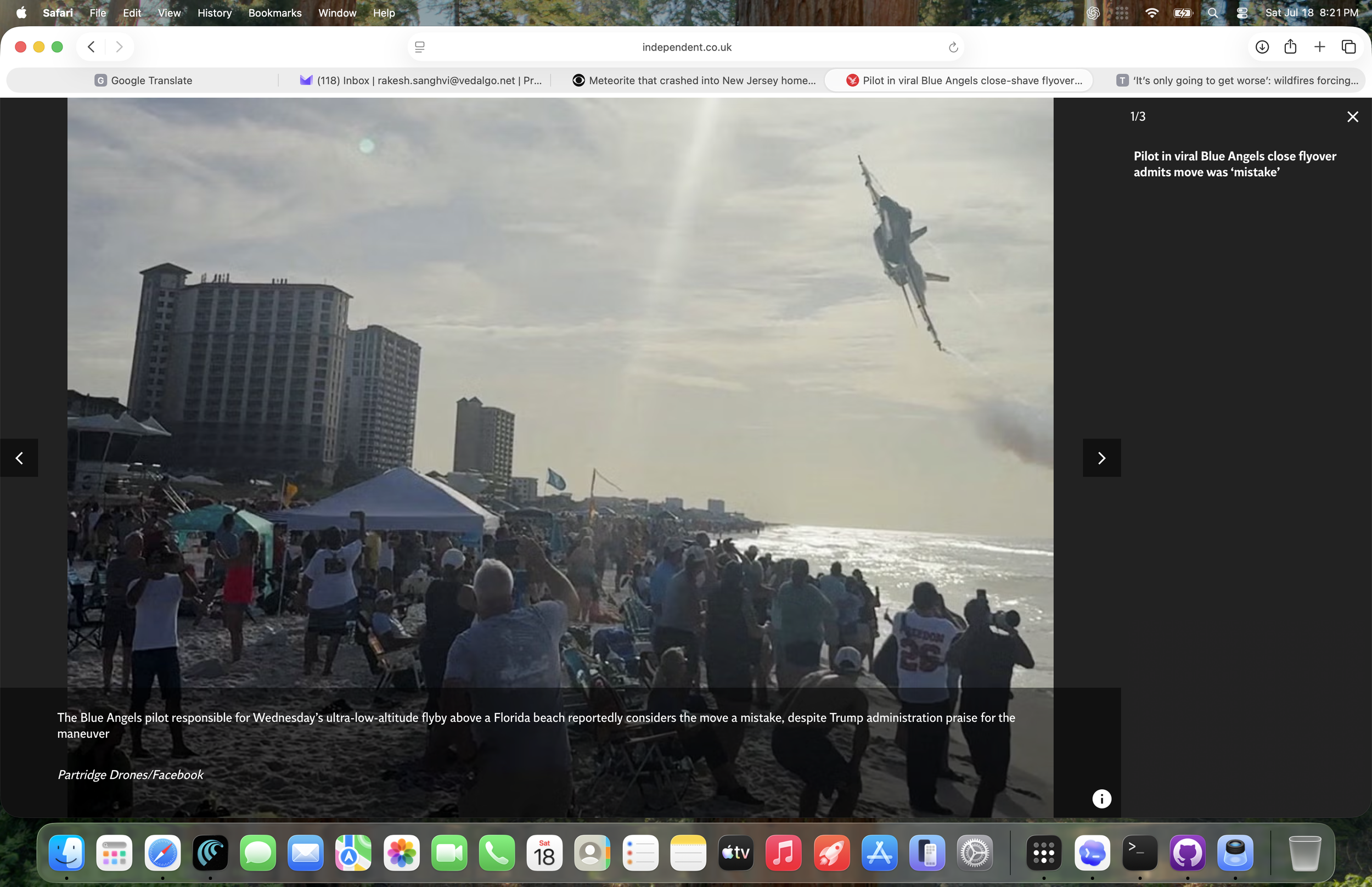
In the second image, a fighter jet banks low over a crowded Florida beach. The people below face upward, phones raised, bodies turned toward a machine that seems almost to have fallen from the sky into their holiday. It is called a flyover, a display, a thrill. But its nearness makes the crowd’s delight inseparable from alarm. The aircraft does not put out a fire. It produces an image of mastery: speed, noise, metal, daring, the temporary conversion of a shoreline into an audience.
Two planes, two jobs. One makes danger answerable; the other makes danger visible.
Then a third plane arrives.
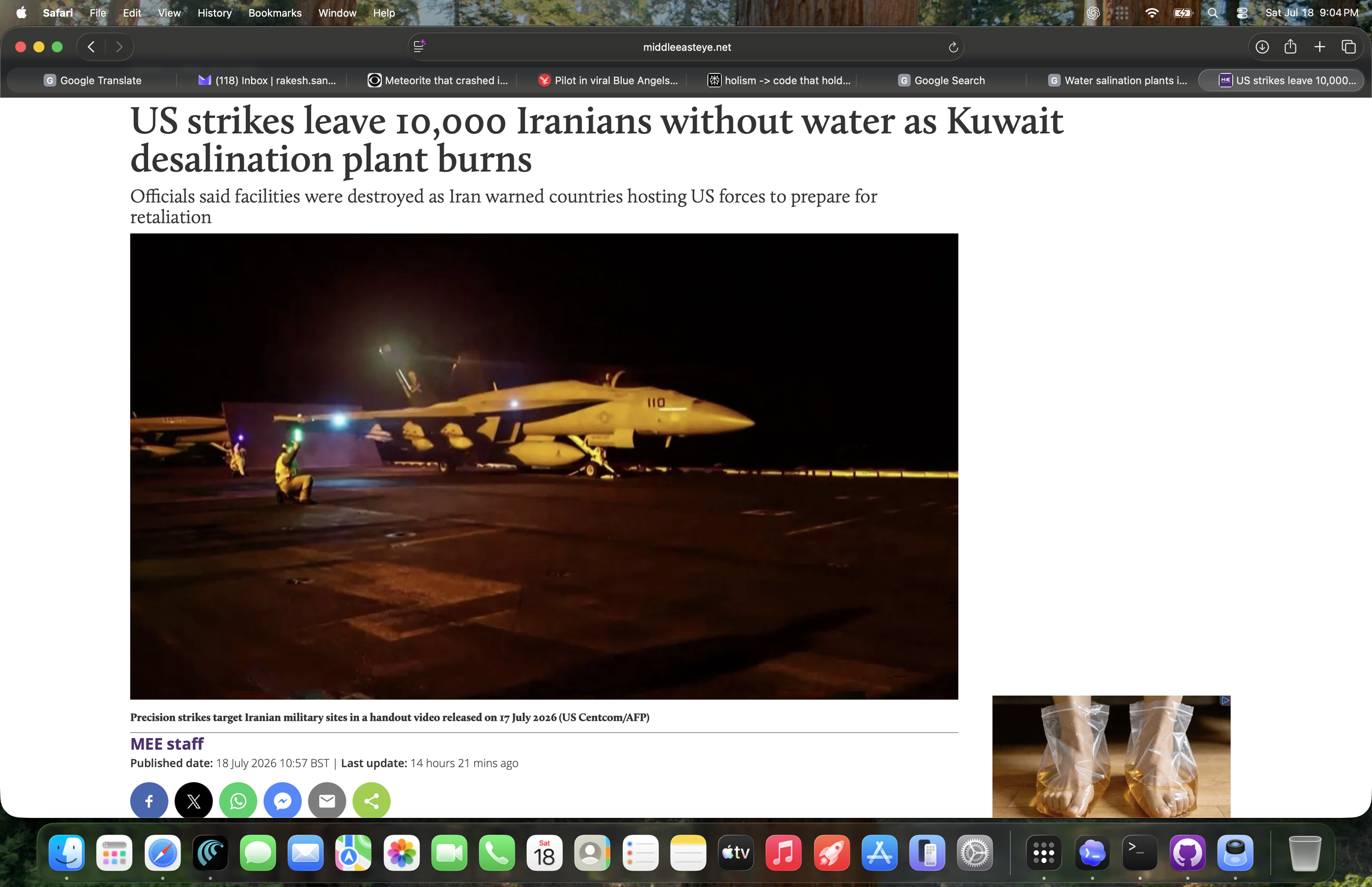
It sits on a runway at night, all amber light and dark tarmac, preparing for or returning from a strike. Its image is accompanied by a report that a desalination plant has burned and thousands of people have been left without water. Now the relation that had been quietly forming among the photographs becomes explicit. The first plane releases water toward fire. The third releases fire whose consequence is the absence of water.
A plane throws water.
A plane throws fire.
Fire takes water.
The phrase “precision strike” may describe where a weapon lands. It cannot, by itself, describe the world that ceases to function afterward. A desalination plant is not merely a building. It is a machine for transforming sea into survival: salt water into drinking water, water into cooking, washing, medicine, sanitation, continuity. International humanitarian law prohibits attacking, destroying, removing, or rendering useless objects indispensable to civilian survival, including drinking-water installations and supplies; even asserted military use cannot justify action expected to leave civilians with inadequate water.
Sometimes the facts are apparent in their factual nature. The procedural needs of attribution, evidence, command responsibility, and adjudication matter. But they do not make thirst hypothetical. Ten thousand people without water are not an ambiguity. They are the human remainder of a fire delivered from above.
The long rehearsal
Leonardo da Vinci watched birds and filled the Codex on the Flight of Birds with observations on wings, air, wind, balance, ascent, descent, and the possibility that a human body might be given an apparatus equal to its desire. Written in 1505–06, the codex records a mind studying flight not as fantasy but as a problem of relation: wing to air, body to balance, creature to atmosphere.
The Wright brothers did not simply invent a vehicle. They made that relation operational. Human beings had always known flight as an external fact: a bird crossing a field, an insect vanishing into light, clouds rearranging themselves above the eye. With the airplane, the ground-dwelling animal built a means of entering the volume that had previously belonged to birds, weather, and gods.
An earthworm may register vibration, moisture, pressure, the sudden violence of being lifted from soil. It may never behold a human as a human. But humans live under a ceiling of presences. We hear a plane before we see it. We register its shadow. We look up. We know clouds, birds, bees, butterflies, the moon, sun, stars, and the hard blinking of machines in the night. We are terrestrials with an incurable awareness of above.
The airplane is therefore not only an object that moves through the sky. It is an old desire given engines, fuel, wings, payload, and jurisdiction.
Plane upon plane
A plane is an aircraft. It is also a flat surface on which points can be held in relation. It is a mental plane, a moral plane, a platform, a screen, a page. The interface through which this essay is typed—rather than pasted—forms another plane: a common boundary between human intention and a responsive machine. The word interface originally named a plane surface understood as the shared boundary of two bodies.
There is the visual plane of the photographs. There is the technological plane of the aircraft. There is the platform plane on which images become articles, articles become screenshots, screenshots become prompts, prompts become sentences. And there is the ethical plane, where a trajectory is no longer merely a trajectory because someone waits below it.
The essay’s motion is not from image to abstraction, as though the images were left behind. It returns to them. The yellow tanker is no longer only a firefighting aircraft. It is the image of aerial power accepting a duty to sustain the ground. The beach flyover is no longer only an instance of martial entertainment. It is the moment when aerial power makes people into spectators of their own vulnerability. The runway fighter is no longer merely a plane in darkness. It is the point at which flight’s ancient promise—freedom from the ground—reveals its reciprocal possibility: power over those who remain on it.
The three planes are not coplanar. That is their meaning.
They interfere.
Dominion
Flight does not produce morality. It enlarges capacity.
To rise above the earth is to see farther, move faster, carry more, arrive where others cannot. But altitude does not sever relation. It intensifies it. The person in the aircraft may appear distant from the person on the road, the beach, or in the village dependent on a water plant. Yet the plane’s capacity is precisely the capacity to reach them.
Dominion is therefore a word with a forked future. It may mean stewardship: power made responsible for what it can affect. Or it may mean possession: the fantasy that seeing from above removes the obligation to answer to those below.
The tanker plane offers one answer. It enters smoke, turbulence, and risk in order to keep a shared world inhabitable. Its descent is not innocent—retardant has effects, aerial suppression is not a substitute for ecological care—but its governing gesture is preservation. Its payload is a wager against flame.
The strike plane reveals the other answer. It can make devastation immediate while keeping its operator distant from its most intimate aftermath. The target may be a coordinate; the consequence is a person opening a dry tap. The apparent cleanliness of altitude is one of its moral temptations.
Do we throw fire, or do we throw water on fire?
The question is almost childish, which is why it is difficult. It asks whether technical power has taught us anything more profound than delivery. It asks whether the fulfillment of the old dream of flight has enlarged our conscience in proportion to our reach.
Already carried
The jet over the beach makes motion spectacular. But the beachgoers, the pilot, the firefighting tanker, the desalination plant, the author, the reader, the interface—none are still.
Earth turns. Earth travels around the sun. The solar system moves within a galaxy; the galaxy travels within an expanding universe. The airplane’s roar is a small local insistence on movement inside a reality that has never stopped moving.
Perhaps that is why flight moves us so deeply. A human being builds wings not because the earth is motionless, but because we sense, however dimly, that stillness has always been an illusion. We are carried already. The airplane makes the fact theatrical. It lets us perform ascent inside a cosmos that has long been carrying us through darkness.
But that is not an escape from responsibility. It is its enlargement.
The first plane drops water onto fire.
The second cuts through air above a crowd.
The third leaves fire where water had been made.
And beneath all three: the earth, moving; the people, thirsty or watching; the old birds, continuing their unlicensed flight.
https://www.loc.gov/resource/gdcwdl.wdl_19477/?st=gallery
Prepared using GPT-5.6 Terra
