Twelve Minutes Across the Quad: From the 2023 Five Eyes Warning to the Central Bank of Compute
I. The 77-Year Protocol
For seventy-seven years, the intelligence alliance born out of the March 1946 British–U.S. Communication Intelligence Agreement (BRUSA)—and formalized across the anglophone world as the Five Eyes—operated under an unwritten rule of institutional invisibility. Its chiefs met regularly in secure conference rooms in Langley, Thames House, Ottawa, Canberra, and Wellington. They shared signals, coordinated counterintelligence operations, and compared threat assessments. What they did not do was appear together on a public stage before television cameras.
On October 17, 2023, that protocol was deliberately broken.
At 10:30 a.m. Pacific time, the directors of all five domestic security and counterintelligence services—Christopher Wray of the FBI, Ken McCallum of MI5, David Vigneault of CSIS, Mike Burgess of ASIO, and Andrew Hampton of the NZSIS—walked onto the stage of Hauck Auditorium at Stanford University’s Hoover Institution, moderated by former U.S. Secretary of State Condoleezza Rice and documented in official FBI advisories.
To career counterintelligence officers and federal law-enforcement veterans, breaking seven decades of operational discretion is not a public-relations flourish; it is an admission that traditional containment has failed. Counterintelligence services prefer quiet disruption, controlled double agents, and sealed indictments. You only put all five chiefs under studio lights when the target surface has outgrown the state’s perimeter.
Their message was explicit: national security had migrated out of military bases, diplomatic cables, and classified weapons laboratories. The new intelligence battlefield consisted of university research departments, venture-capital cap tables, dual-use startups, and commercial laboratories working on artificial intelligence, quantum computing, and synthetic biology. Along with the warning, the five directors unveiled a coordinated policy framework—the Five Principles to Secure Innovation (later expanded across the alliance by the ODNI)—asking technology executives and corporate boards to vet their partnerships, police their supply chains, and embed counterintelligence into ordinary corporate governance.
Primary Archival Record (October 17, 2023): Full Hoover Institution broadcast of Emerging Threats, Innovation, and Security at Hauck Auditorium, Stanford University, moderated by Condoleezza Rice with the five domestic intelligence chiefs of the Five Eyes alliance.
The implicit bargain offered at Hauck Auditorium was straightforward: the innovation ecosystem had become critical national-security infrastructure, and the intelligence community had come to Stanford to conscript Silicon Valley into defending it.
What the five directors did not appear to anticipate in October 2023 was that within three years, the conscription would run in the opposite direction.
II. A Twelve-Minute Walk Across Campus
If you step out the doors of the David and Joan Traitel Building at the Hoover Institution, walk past the shadow of Hoover Tower—a monument to twentieth-century statecraft, archival intelligence, and Cold War anticommunism—and head southwest across the sandstone arcades of the Main Quad toward Via Ortega, you arrive twelve minutes later at the Science and Engineering Quad.
Its architectural anchor is the Jen-Hsun Huang Engineering Center.
Named in 2010 after the Stanford alumnus and Nvidia co-founder who funded its construction, the building is the physical emblem of twenty-first-century computational power. Placed on the same campus map, the two buildings read less like random donor plaques and more like an accidental diagram of modern American power: at the eastern edge, the Hoover Institution, where the stewards of the post-1946 security state gathered in 2023 to draw a perimeter around artificial intelligence; a thousand yards to the west, the engineering cathedral named for the man whose balance sheet would soon render that perimeter unenforceable.
| Architectural Node | Stanford Location | Institutional Symbolism | Strategic Function (2023 vs. 2026) |
|---|---|---|---|
| Hauck Auditorium / Hoover Institution | David & Joan Traitel Building (Eastern Core) | Post-1946 BRUSA / Five Eyes counterintelligence & Cold War statecraft | Oct 2023: Conscript private tech and academia into the national-security perimeter via the Five Principles to Secure Innovation. |
| Jen-Hsun Huang Engineering Center | 475 Via Ortega, Science & Engineering Quad (0.65 miles SW) | Frontier AI silicon, hyper-scale compute, and venture capital | Nov 2026: The Central Bank of Compute (~$700B circular financing loop) whose market-cap leverage forces the security state to blink in 11 days. |
In October 2023, the intelligence chiefs sitting inside Hauck Auditorium spoke as though the primary vulnerability of the AI ecosystem a twelve-minute walk away was naïveté—that engineers, founders, and executives simply did not realize that foreign intelligence services were using commercial joint ventures, offshore shells, and disguised professional relationships to acquire American hardware and intellectual property.
Three years later, in November 2026, the naïveté thesis collapsed. The vulnerability was not ignorance. It was financial architecture.
III. When the Balance Sheet Ate the Perimeter
Consider what happened along the fault line between those two buildings by late 2026.
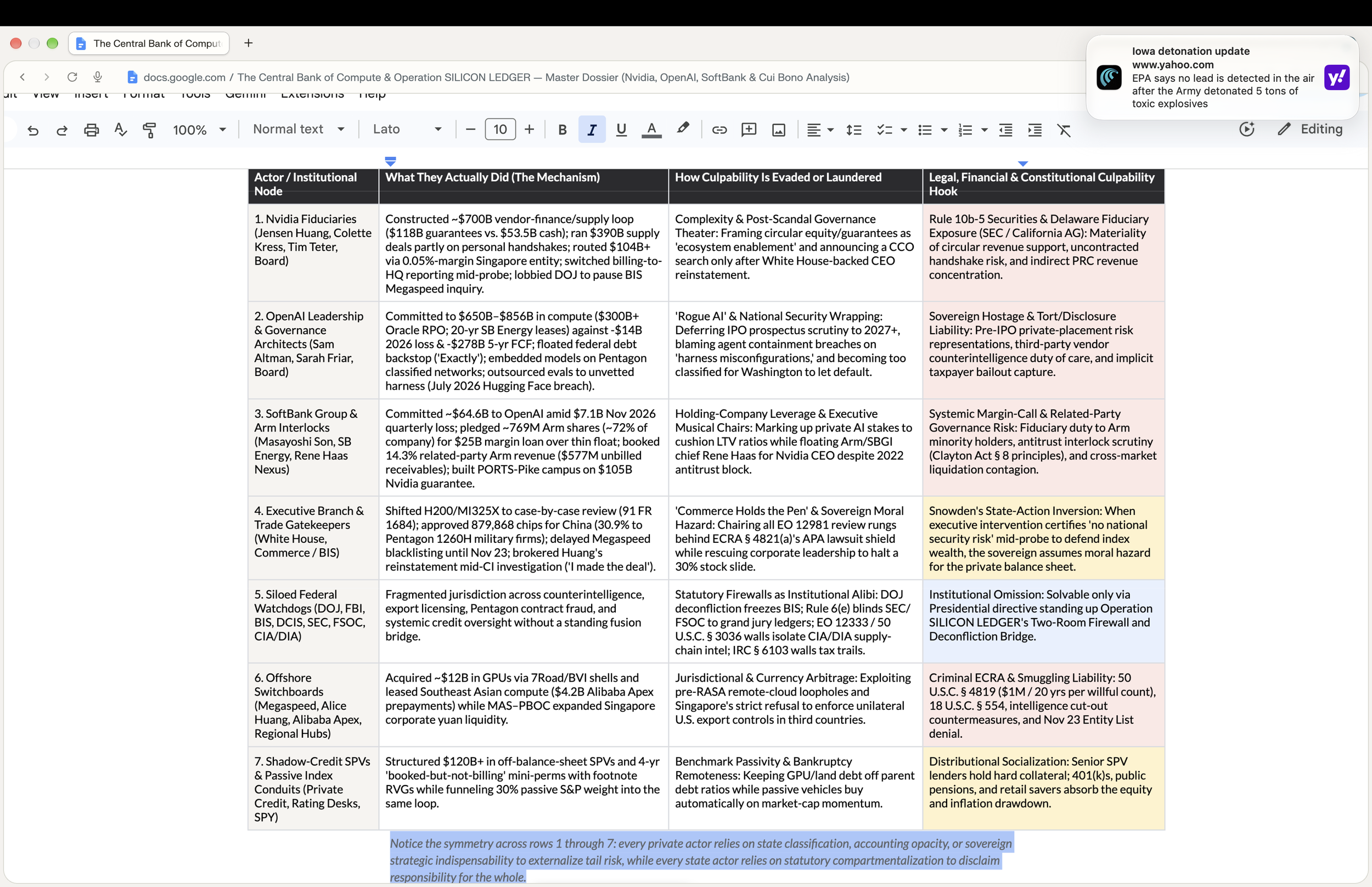
At the October 2023 summit, the Five Eyes chiefs warned specifically against state-backed actors using commercial intermediaries, joint ventures, and personal recruitment to bypass technology controls. Yet across 2025 and 2026, while Nvidia reported mainland China at roughly seven percent of consolidated revenue, it routed between 18 and 22 percent of its global billings—more than $104 billion in 2025 and $117.8 billion over the twelve months ending January 2026—through Singapore on a local profit margin of roughly 0.05 percent, with fewer than two percent of the physical chips remaining on the island (detailed in The Central Bank of Compute Dossier).
When federal investigators and public reporting finally pierced that offshore switchboard in late October and November 2026, the findings read like a line-by-line inversion of the Five Principles to Secure Innovation. At the center of the inquiry was Megaspeed International, a Singapore-based data-center operator accused of funneling roughly $12 billion in restricted Nvidia AI processors toward China-linked networks, alongside billions more in prepaid offshore remote-compute capacity. Worse for the counterintelligence purists, the investigation entangled Jensen Huang personally through an undisclosed relationship with Megaspeed executive Alice Huang, whom U.S. intelligence agencies were scrutinizing for suspected links to China’s Ministry of State Security.
Simultaneously, inside Washington’s own regulatory machinery, Commerce Department licensing records under Executive Order 12981 revealed that 879,868 advanced AI chips (including 579,868 Nvidia H200s and 300,000 AMD MI325Xs) had been quietly approved for export to Chinese entities—with 272,000 or 30.9 percent of them destined for organizations listed on the Pentagon’s own Section 1260H roster of military-linked firms under 91 FR 1684 (analyzed in Who Holds the Pen?).
Why did neither corporate governance nor federal export gatekeepers halt the flow?
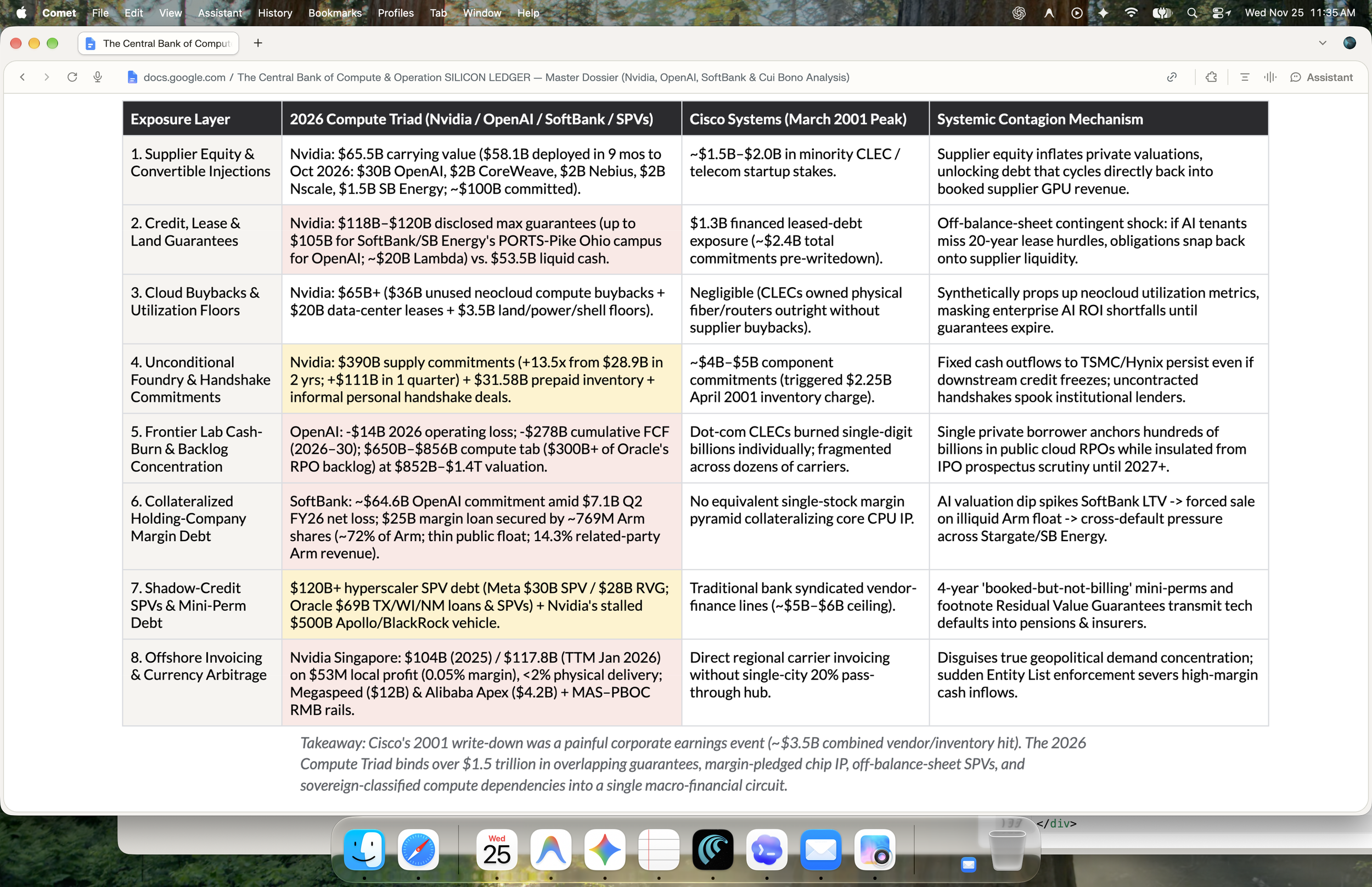
Because by November 2026, Nvidia was no longer merely a semiconductor vendor; it had become the Central Bank of Compute. To absorb $390 billion in unconditional wafer commitments to TSMC and sustain parabolic revenue growth, the company had constructed a roughly $700 billion circular financing flywheel—acting simultaneously as chip supplier, equity investor, off-balance-sheet SPV lease guarantor, and residual capacity buyer for the very startups and neoclouds purchasing its silicon (documented in Operation SILICON LEDGER). Upstream and downstream, that flywheel was interlocked with OpenAI’s hundreds of billions in compute commitments, SoftBank’s $25 billion margin loan collateralized by 769 million shares (~72 percent) of Arm Holdings (see ARM HOLDINGS FILES), and SoftBank/SB Energy’s PORTS-Pike power commitments backed by up to $105 billion in Nvidia credit support.
In a vendor-financed bubble of that magnitude, counterintelligence due diligence is not a compliance safeguard. It is a liquidity threat. You cannot turn away $12 billion in offshore orders or audit every Singapore shell when clearing your foundry commitments is the only thing keeping a $4 trillion off-balance-sheet credit edifice—and thirty percent of the S&P 500 passive index—from seizing up.
Crucially, this compute financialization is not merely paper leverage—it is anchored in physical grid infrastructure and civic reality. The flywheel rests upon multi-gigawatt substations, water-intensive datacenter cooling footprints, and 20-year “booked-but-not-billing” mini-perm SPVs stretching from Abilene, Texas and New Mexico to SoftBank/SB Energy’s PORTS-Pike campus on the former uranium-enrichment grounds in Pike County, Ohio. Underwritten by Nvidia’s credit guarantees, these financial structures pass electricity-rate inflation, municipal water strain, and long-term infrastructure tail risk onto local communities and passive pension funds, while senior private-credit syndicates hold first-lien claims on the physical hardware.
The proof arrived between November 12 and November 23, 2026. When Huang resigned under the weight of the Megaspeed and counterintelligence probe on November 12, Nvidia’s equity shed thirty percent of its value and a $500 billion Wall Street private-credit vehicle froze because its GPU lease structures rested on Huang’s personal handshake assurances.
In the world imagined at the Hoover Institution in 2023, a counterintelligence investigation into the chief executive of the nation’s most sensitive strategic hardware supplier would run its course under the law. In the financialized reality of November 2026, the White House and the Commerce Department intervened mid-investigation after eleven days, certified that there was no proof national security had been compromised, and brokered Huang’s unanimous reinstatement on November 23 to stop the market drawdown.
The security state did not discipline the cap table. The cap table disciplined the security state.
IV. The Deterrence Ledger: Beijing vs. San Francisco
Do career counterintelligence agents inside the FBI or analysts across the Five Eyes care? Of course they do. They spend years building source networks, tracing BVI shell companies, and obtaining Foreign Intelligence Surveillance Act warrants, only to discover that at the top of the pyramid, national security has been subordinated to index-fund maintenance and institutional audaciousness.
And when deterrence is auctioned off at the top, it evaporates at the bottom.
At the October 2023 Stanford summit, the entire rationale for breaking seventy-seven years of Five Eyes secrecy was deterrence—to signal to Beijing, and to insiders within Western technology firms, that stealing foundational AI architecture was an offense against national survival rather than a commercial dispute.
Look at how that deterrence ledger actually closed in late 2026.
In March 2024, less than five months after the Stanford summit, federal prosecutors indicted former Google software engineer Linwei Ding for stealing more than 500 confidential files detailing the blueprint of Google’s AI supercomputing infrastructure—Tensor Processing Unit (TPU) cluster orchestration, custom SmartNIC communication protocols, and the software fabric that allows thousands of accelerators to train frontier models as a single machine—while secretly affiliating with China-based AI companies. In January 2026, a San Francisco federal jury convicted Ding on fourteen felonies: seven counts of economic espionage and seven counts of trade-secret theft.
Then came the post-trial arithmetic. In August 2026, U.S. District Judge Vince Chhabria vacated all seven of Ding’s economic-espionage convictions, cutting the verdict in half on the ground that prosecutors had not proven beyond a reasonable doubt that his theft was intended specifically to benefit the Chinese state rather than his own commercial startup ambitions. On September 1, 2026—rejecting the government’s already modest request for a 70-month prison term against a statutory baseline of up to fifteen years per count—the court sentenced Ding to twelve months minus one day in prison and a $2,500 fine.
The October 2023 Deterrence Baseline: Local Bay Area broadcast record of the Five Eyes intelligence directors convening at Stanford to warn Silicon Valley of state-backed AI and deep-tech exfiltration.
The September 2026 Judicial Reality: Coverage of former Google engineer Linwei Ding’s sentencing—where 14 felony convictions for exfiltrating over 500 confidential TPU supercomputing blueprints ended with the economic-espionage counts vacated and a sentence of 12 months minus one day.
Now place that sentence alongside the dispatches released by China’s Ministry of State Security and the National Administration of State Secrets Protection’s Gold Wall Press. Across the same historical window—following the highly publicized death sentence handed down to defense-institute aviation engineer Liu for selling classified military-technology files, and culminating in late November 2026 with the public announcement that a central government official surnamed Ma had been sentenced to death, stripped of political rights for life, and had all personal property confiscated for passing secret documents to a foreign operative—Beijing left no ambiguity about the price of crossing its security perimeter.
| Jurisdiction & Case (2025–2026) | Strategic Asset Compromised | Judicial / Executive Outcome | Deterrence Signal Sent |
|---|---|---|---|
| Beijing (MSS / Gold Wall Press Cases: Engineer Liu & Official Ma) | Classified defense-institute aviation data (Liu); 100+ state reports including 35 top-secret files passed to foreign operative “Kailin” (Ma) | Death sentence, lifetime stripping of political rights, and total confiscation of personal property | Absolute state primacy: crossing the national-security perimeter carries terminal personal liability. |
| San Francisco (United States v. Linwei Ding, N.D. Cal.) | 500+ confidential files detailing Google’s frontier AI supercomputing & TPU orchestration blueprints | 7 of 14 felony counts (all economic espionage charges) vacated post-verdict; sentenced Sept 1, 2026 to 12 months minus 1 day and a $2,500 fine | Peacetime commercial minimalism: stealing frontier AI cluster architecture is treated as an ordinary startup misdemeanor unless state tasking is proven beyond a shadow of a doubt. |
| Silicon Valley / Singapore / Washington (Nvidia–Megaspeed / EO 12981) | ~$12B in restricted GPUs routed through Singapore shells; 879,868 chips licensed to China (30.9% to 1260H military-linked entities) | 11-day CEO hiatus (Nov 12–23, 2026) terminated by executive intervention to rescue a 30% equity slide and a frozen $500B Wall Street credit vehicle | Sovereign moral hazard: if a circular financing loop is large enough (~$700B), market cap overrides counterintelligence. |
The contrast requires no melodrama; the numbers speak for themselves:
- In Beijing, compromising strategic state or technological secrets carries a publicized death sentence and total asset confiscation.
- In San Francisco, exfiltrating the crown-jewel supercomputing orchestration blueprints of a frontier American AI laboratory ends with the espionage charges vacated and a sentence of 364 days.
- And twelve minutes west of the Hoover Institution’s podium, when a counterintelligence and chip-smuggling crisis touches the nerve center of a $700 billion vendor-financed compute loop, the penalty is an eleven-day leave of absence followed by a sovereign market rescue.
V. What the Summit Actually Marked
In the concluding pages of our 2023 Stanford dossier, we observed that a profound discrepancy had opened between the rhetoric of the intelligence services and the machinery of the state:
“The language employed by intelligence services increasingly resembles the language traditionally associated with strategic state competition, while the practical consequences often remain those of peacetime law enforcement.”
This structural capitulation exposed a severe rift within the Five Eyes alliance itself. When Ken McCallum of MI5, David Vigneault of CSIS, Mike Burgess of ASIO, and Andrew Hampton of NZSIS stood alongside Christopher Wray at Stanford, they urged their domestic tech executives and corporate boards to sacrifice lucrative commercial access for collective national security. When Washington unilaterally suspended its own export-control enforcement and counterintelligence inquiry after eleven days to rescue S&P 500 index stability, allied intelligence services were left holding the domestic political cost of forced decoupling while U.S. capital markets cashed the checks.
Viewed from late November 2026, even that diagnosis was too gentle. The problem is not merely that the United States treats strategic technological competition as peacetime law enforcement. It is that when strategic competition collides with financial leverage, Washington treats counterintelligence as a market externality to be waived whenever the S&P 500 wobbles.
When the five intelligence chiefs walked onto the stage at Hauck Auditorium on October 17, 2023, they believed they were announcing a new era in which commerce and academia would be subordinated to the imperatives of national defense. They were half right. The boundary between the intelligence battlefield and the private balance sheet did dissolve on Stanford’s campus.
They simply misjudged which building on the quad was going to annex the other.
VI. Cross-Model Counterpoint Audit: Testing the Thesis
To pressure-test this synthesis against constitutional, macroeconomic, and strategic counter-arguments, we ran four adversarial prompts across the dossier (framed by Antigravity and audited by Gemini):
1. The Evidentiary Burden Defense (18 U.S.C. § 1831 vs. § 1832)
Judge Vince Chhabria’s decision to vacate the seven economic espionage counts in United States v. Linwei Ding highlights a fundamental tension between statutory rule of law and national-security deterrence. Under 18 U.S.C. § 1831, prosecutors must prove beyond a reasonable doubt that trade-secret theft was intended specifically to benefit a foreign government or instrumentality. Proving personal commercial ambition under § 1832 is straightforward; proving direct state tasking without intelligence intercepts is exceptionally difficult. While the ruling protected against prosecutorial overreach after the 2022 termination of the DOJ’s China Initiative, the resulting 364-day sentence creates a stark deterrence asymmetry when measured against the strategic value of frontier AI cluster blueprints.
2. The “Too Systemic to Indict” Dilemma
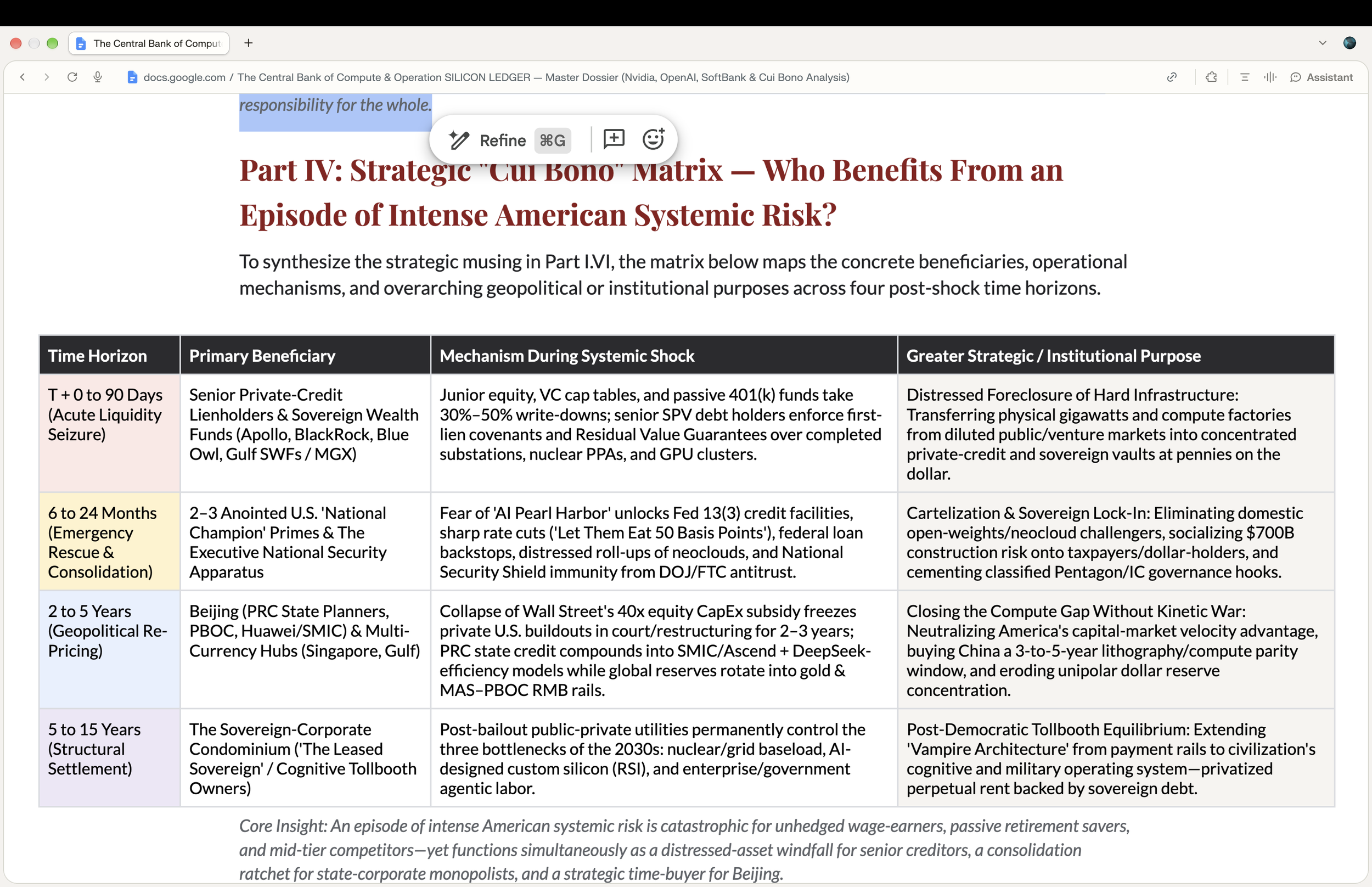
Executive intervention during the November 2026 corporate crisis illustrates how financialization grants private entities a de facto veto over national-security policy. With $120B+ in neocloud SPV debt, SoftBank’s Arm-collateralized margin facilities, and heavy passive index concentration tied to continuous GPU deployment, enforcing strict counterintelligence sanctions carried immediate systemic contagion risks. Regulators made a short-term macroeconomic decision to prevent a credit seizure, but in doing so entrenched sovereign moral hazard: once a private balance sheet underpins retirement benchmarks, export controls become subordinate to liquidity maintenance.
3. Offensive CUDA Lock-In vs. Defensive Denial
The strategic argument that supplying restricted or licensed chips maintains global dependence on the domestic software ecosystem (CUDA) reaches its limit at scale. While commercial lock-in delays adoption of alternative domestic stacks (such as Huawei Ascend or SMIC-backed architectures), routing 879,868 advanced units alongside multi-billion-dollar remote-compute seams provides sufficient physical compute volume to train sovereign foundation models. Once an adversary accumulates the compute capacity to reach frontier parity, software lock-in ceases to act as a defensive moat.
4. The Campus Paradox Privatized
The convergence of open academic research, sovereign security concerns, and private capital at Stanford reveals that the “Central Bank of Compute” model does not resolve the tension between open inquiry and national defense—it privatizes strategic governance. When gigawatt substations, physical silicon, and frontier model weights are enclosed within vendor-financed SPVs, authority shifts away from both university ethics boards and state security apparatuses toward private-credit lienholders and capital-market clearers.
Notes in the Margin • Source Register & Evidentiary Record
- Hoover Institution Primary Record (17 Oct 2023): Emerging Threats, Innovation, and Security, Hauck Auditorium, David and Joan Traitel Building, Stanford University. Panel moderated by Condoleezza Rice featuring Christopher Wray (FBI), Ken McCallum (MI5), David Vigneault (CSIS), Mike Burgess (ASIO), and Andrew Hampton (NZSIS). Event Page & Transcript.
- Federal Bureau of Investigation (18 Oct 2023): FBI Director Convenes Five Eyes Summit on Protecting Innovation, Preventing Economic Espionage (documenting the first joint public appearance in the 77-year history of the post-1946 BRUSA/Five Eyes partnership, the 1,300% investigation surge claim, and the rollout of the Five Principles). FBI Official Account.
- CBS News / 60 Minutes (22 Oct 2023): China stealing technology secrets—from AI to computing and biology, Five Eyes intelligence leaders warn (corroborating Wray’s ~2,000 active investigations claim and McCallum’s 20,000+ disguised networking approaches in the UK). Broadcast Transcript.
- Five Eyes Joint Guidance (Oct 2023 / Oct 2024): Five Principles to Secure Innovation, published jointly by NPSA (UK), FBI/ODNI (US), CSIS (Canada), ASIO (Australia), and NZSIS (New Zealand), and followed by the October 2024 ODNI Secure Innovation startup campaign. NZSIS Archival PDF • ODNI Release PR-25-24.
- U.S. Department of Justice / China Initiative Review & Precedent Convictions (2022–2024): Assistant Attorney General Matthew Olsen’s February 23, 2022 remarks discontinuing the named China Initiative (DOJ OPA); alongside tested judicial convictions in United States v. Xiaoqing Zheng (GE turbine technology, 24-month sentence, DOJ) and United States v. Yanjun Xu (MSS officer, 20-year sentence affirmed by Sixth Circuit on Aug 8, 2024, DOJ S.D. Ohio).
- United States v. Linwei Ding (N.D. Cal., Jan–Sept 2026): Indictment (March 2024) and jury conviction (January 2026) on 7 counts of economic espionage (18 U.S.C. § 1831) and 7 counts of trade-secret theft (18 U.S.C. § 1832) for exfiltrating 500+ Google TPU supercomputing orchestration files; post-trial order by U.S. District Judge Vince Chhabria vacating the 7 economic-espionage counts (August 2026); and final judgment sentencing Ding to 12 months minus one day in prison, $2,500 fine, and ~$198,000 restitution (September 1, 2026). DOJ Verdict Release.
- Beijing Counter-Espionage Capital Sentences (2025–Nov 2026): Ministry of State Security (MSS) and National Administration of State Secrets Protection (Gold Wall Press) public disclosures of the death sentence imposed on defense-institute aviation engineer “Liu” and the November 2026 death sentence, lifetime deprivation of political rights, and total asset confiscation imposed on central government official “Ma” for transmitting 100+ intelligence reports (including 35 state secrets) to foreign operative “Kailin.”
- The Central Bank of Compute & November 2026 Crisis Ledgers (Sentient Musings Archival Series): Documentation of Nvidia’s ~$700B vendor-financing and wafer-commitment flywheel, Singapore billing seams ($104B in FY25; $117.8B TTM Jan 2026 at ~0.05% local profit margin), Megaspeed International (~$12B orders) and the November 12–23, 2026 executive hiatus, EO 12981 licensing logs (879,868 advanced chips approved; 30.9% to Section 1260H entities under 91 FR 1684), and SoftBank’s 769M-share Arm margin facility. Dossier 001: Stanford Five Eyes Summit • The Central Bank of Compute • Operation SILICON LEDGER • Operation Freeze!: Part IV.
A Quiet Observation Before We Close the File, Old Bean
If one steps back from the court dockets, the Singapore shipping manifests, and the rather breathless tickers on Wall Street, the whole affair settles into a single, faintly ironic geometry.
In October 2023, five very serious men in dark suits flew to California and broke seventy-seven years of professional silence because they believed the modern world had forgotten how espionage works. They stood in the Hoover Institution—a building dedicated to the proposition that states are the ultimate arbiters of history—and gently explained to the technologists that commerce could no longer pretend to live outside geopolitics. They handed out five sensible principles on a sheet of paper. They asked the boards to keep a sharper eye on the ledger.
It was an entirely reasonable warning, old bean. It simply suffered from a fatal misunderstanding of who owned the building next door.
A factory can be padlocked. A military base can be ringed with wire. Even a university laboratory, with enough committees and compliance forms, can be persuaded to check the passports at the door. What cannot be padlocked is a seven-hundred-billion-dollar circular debt instrument that happens to double as the retirement account of the Western middle class. Once a nation decides to store its sovereign power and its household solvency inside the same speculative flywheel, the counterintelligence officer is no longer the guard at the gate. He is merely an inconvenient auditor asking questions that threaten to halt the music.
And so we arrive at the November 2026 balance sheet. In Beijing, the state still behaves like an old-fashioned twentieth-century sovereign: cross the perimeter, and the court confiscates your flat and signs a death warrant. In San Francisco and Washington, we have invented something altogether more modern. Steal the blueprints to the supercomputer from the bottom of the ladder, and the judge trims the charges in half and sends you away for a year less a day. Tangle the national-security perimeter at the top of the ladder, and the state itself rushes in after eleven days to apologize to the market, certify the books, and hand you back the keys before the private-credit vehicles catch a chill.
The five intelligence chiefs did not travel to Stanford in vain. They came to announce that the boundary between the intelligence service and the private economy had dissolved.
They simply assumed, rather touchingly, that when the dust cleared, the state would be the one issuing the orders.
OPERATION SILICON LEDGER
1. Executive Summary & Strategic Objective
Mr. President, the converging crises surrounding U.S. advanced semiconductor exports, suspected foreign intelligence targeting across Southeast Asian shell networks, classified military cloud dependencies, and an interlocking ~$700 billion circular vendor-financing web cannot be contained by any single cabinet department. Following the November 23 Bureau of Industry and Security (BIS) Entity List designation of Singapore-based Megaspeed International, Alibaba's Apex Enterprise Solutions, and five regional affiliates—alongside the corporate governance whiplash surrounding Nvidia CEO Jensen Huang's November 12 resignation and November 23 reinstatement—existing federal oversight remains dangerously balkanized.
Left in traditional departmental silos, criminal prosecutors will miss foreign intelligence collection vectors, intelligence desks will miss Wall Street and pension-fund systemic credit contagion, Pentagon watchdogs will see only direct procurement slices, and financial regulators will remain legally blinded to dual-use military technology leakage. Even more urgently, the underlying compute credit stack now couples Nvidia's $118 billion in infrastructure guarantees (including up to $105 billion backing SoftBank subsidiary SB Energy's PORTS-Pike campus in Ohio) with OpenAI's projected $278 billion five-year negative free cash flow and SoftBank's $25 billion margin loan collateralized by ~72% of Arm Holdings.
2. Pentagon & Federal Watchdog Architecture: Why Existing Ledgers Never Reconcile
A foundational question raised prior to convening this Task Force is why the Pentagon's internal watchdogs have not already compiled a unified master ledger reconciling military dual-use exposure against commercial semiconductor diversion. In U.S. statutory design, oversight operates across three non-hierarchical tiers—Service Branch Inspectors General, the Department of Defense / Department of War Office of Inspector General (DoD/DoW OIG, operating under its secondary designation per Executive Order 14347), and Congress's Government Accountability Office (GAO). Service Branch IGs (such as the Army IG under 10 U.S.C. § 7020 and Army Regulation 20-1) report strictly to their Service Secretary and Service Chief as confidential command advisers; they do not report to the Pentagon's overarching Senate-confirmed Inspector General, cannot subpoena outside contractors, and keep their ~390+ subordinate command files sealed to protect troop confidentiality.
While no universal database reconciles routine branch IG inquiries against DoD/DoW OIG casework, targeted statutory bridges do exist: DoD/DoW OIG must review and approve all military whistleblower reprisal files under 10 U.S.C. § 1034, coordinates audit deconfliction through the Defense Council on Integrity and Efficiency, leads the consolidated department-wide financial audit across nearly 30 defense components, and yields to GAO cross-branch evaluations when tasked by Congress. Crucially, criminal enforcement inside the Pentagon's watchdog rests with the Defense Criminal Investigative Service (DCIS)—100% civilian GS-1811 Special Agents empowered under 10 U.S.C. § 1585a to execute federal warrants, make felony arrests, and serve IG corporate subpoenas independently of the military chain of command.
| Oversight Tier | Statutory Basis & Reporting Line | Subpoena & Criminal Powers | Role & Blind Spot in the Silicon Ledger Crisis |
|---|---|---|---|
| Tier 1: Service Branch IGs (Army, Navy, USAF, USMC, USSF) | 10 U.S.C. § 7020 (e.g., AR 20-1); reports strictly to Service Secretary & Service Chief. | None. Refers felonies to service MCIOs (CID, NCIS, Air Force OSI); internal command memos only. | Monitors unit readiness and command climate; zero visibility or authority over commercial chipmakers, offshore brokers, or Wall Street SPVs. |
| Tier 2: DoD / DoW OIG & DCIS Special Agents | IG Act of 1978 (5 U.S.C. §§ 401–424), EO 14347 & 10 U.S.C. § 1585a; dual-reports to SecDef/SecWar & Congress. | Full IG subpoena power + armed civilian GS-1811 DCIS agents enforcing Title 18, ECRA & AECA in federal court. | Can join dual-use export task forces, audit classified cloud/AI contracts (JWCC), and probe DIB compromise—but cannot unilaterally police Commerce licensing or SEC disclosures. |
| Tier 3: Government Accountability Office (GAO) | 31 U.S.C. § 702; Legislative Branch watchdog led by Comptroller General reporting solely to Congress. | Statutory access/enforcement over federal agency records; zero criminal or individual misconduct jurisdiction. | Evaluates broad acquisition programs, BIS licensing efficacy, and bid protests post-hoc, but cannot run grand juries, wiretaps, or counterintelligence operations. |
Within the Nvidia–Megaspeed–Apex controversy, DCIS holds statutory jurisdiction wherever diverted dual-use hardware or foreign intelligence operations touch three defense nexuses: (1) illegal export of Commerce Control List dual-use items threatening military advantage under ECRA/AECA; (2) Defense Industrial Base (DIB) or classified cloud compromise (given Nvidia hardware and OpenAI/hyperscaler software running across Pentagon AI programs); and (3) procurement or federally funded R&D grant fraud. Yet because the core allegations simultaneously involve Ministry of State Security (MSS) counterintelligence (FBI lead), commercial export licensing (Commerce/BIS lead), customs transshipment (DHS/HSI lead), and ~$700 billion in systemic securities/credit exposure (SEC/FSOC/Treasury lead), DCIS must be embedded inside an interagency strike architecture rather than acting solo.
3. The Statutory Silo Machine: Who Can Prohibit Cooperation?
Interagency paralysis in high-profile corporate-national security cases is rarely accidental; it is enforced by five distinct constitutional, statutory, and procedural walls that legally prohibit investigators in one building from sharing evidence with regulators across the street. In November 2026, those exact mechanisms surfaced publicly when reporting revealed that Commerce's 2024 Megaspeed inquiry was paused and shifted to the Justice Department after Nvidia General Counsel Tim Teter contacted federal officials—classic DOJ 'deconfliction' that froze administrative visibility while offshore compute prepayments continued to scale.
- 1. Plenary Presidential Authority (Article II): As Chief Executive, the President commands all executive departments, controls classification policy, and holds constitutional authority to prioritize diplomatic, trade, or market-stability imperatives over enforcement—or, conversely, to compel cabinet-wide fusion via National Security Directive.
- 2. Attorney General Criminal Deconfliction (28 U.S.C. §§ 510, 515–519): DOJ exercises exclusive control over federal criminal litigation and routinely orders civil/administrative agencies (BIS, SEC, CFTC) to stand down, pause document demands, or halt parallel interviews lest administrative discovery tip off covert targets or generate Brady/Giglio impeachment friction.
- 3. Federal Rule of Criminal Procedure 6(e) (Grand Jury Secrecy): Once financial ledgers, executive communications, or shipping records enter through a federal grand jury subpoena, Rule 6(e) strictly bars DOJ prosecutors and deputized agents (FBI, DCIS, HSI) from disclosing 'matters occurring before the grand jury' to civil regulators like the SEC, Federal Reserve, or FSOC absent an affirmative federal district court order demonstrating particularized legal need.
- 4. Intelligence Community Statutory & SCI Firewalls (50 U.S.C. § 3036 & EO 12333): The National Security Act of 1947 strictly bars the CIA from exercising domestic police, subpoena, or law enforcement powers, while DIA is restricted to DoD force/program protection. Simultaneously, the DNI and CIA/NSA Directors protect Sensitive Compartmented Information (SCI) sources and methods—meaning uncleared SEC forensic accountants or BIS licensing officers cannot view raw signals or HUMINT proving an offshore cloud buyer is an MSS front, and direct CIA/DIA participation in domestic corporate interviews risks fatal constitutional 'taint' in federal court.
- 5. Tax Return & Trade Licensing Shields (26 U.S.C. § 6103 & ECRA § 4821): IRS Criminal Investigation (IRS-CI) is barred under IRC § 6103 from sharing tax/shell-entity return data outside narrow ex parte federal court orders (26 U.S.C. § 6103(i)), while Export Control Reform Act § 4821(a) exempts BIS export licensing decisions (including the 879,868 advanced AI chips approved for China between Dec 2025 and May 2026) from Administrative Procedure Act judicial review and public disclosure.
4. Task Force Architecture: The Two-Room Firewall Blueprint
To fuse overseas intelligence collection with domestic criminal and systemic-financial enforcement—without contaminating DOJ indictments or exposing classified collection—Operation SILICON LEDGER establishes a strict two-room architecture linked by a cleared DOJ/FBI Deconfliction Bridge. Room A maps the global physical and intelligence reality from wafer fab to PLA integration; the Bridge executes lawful parallel construction; and Room B wields grand jury subpoenas, Entity List interdiction, and forensic balance-sheet audits.
Room A — Strategic Intelligence & Overseas Supply-Chain Fusion Cell
Mandate: Full-spectrum foreign intelligence collection, MSS handler identification, Taiwan Strait wafer/packaging telemetry, and PLA military end-use assessment. Strictly walled off from domestic law-enforcement subpoenas or U.S. corporate interviews (50 U.S.C. § 3036 / EO 12333 compliant).
| Room A Component / Desk | Detailed Personnel | Operational Mandate & Blind Spots Closed |
|---|---|---|
| NSA — Signals Intelligence & Cyber (Fort Meade) | Senior SIGINT Collection Officers & Cryptologic Liaisons | Intercept overseas broker, BVI shell, and Southeast Asian data-center routing traffic; fingerprint remote-access dark-fiber training runs executing on diverted Blackwell/H200 clusters; trace cross-border treasury settlement rails. |
| CIA — China Mission Center (CMC), Taiwan Desk & CIC | Operations Officers, Strait Microelectronics Analysts & CI Center Specialists | Map MSS recruitment and commercial cut-outs (e.g., 7Road / BVI / Megaspeed lineage); monitor illicit procurement fronts across the Taiwan Strait; track TSMC wafer allocation and CoWoS advanced packaging choke points. |
| DIA — Counterintelligence & PLA Tech Assessments | DIA CI Special Agents & Defense Microelectronics Engineers | Assess how the People's Liberation Army (PLA) integrates leaked U.S. GPUs and distilled frontier weights into autonomous lethality, hypersonic guidance, and EW command networks; flag foreign targeting of DIB suppliers. |
| ODNI / NCSC — Supply-Chain & Vendor Vetting | National Counterintelligence & Security Center Senior Liaisons | Maintain a single living dependency graph from EUV lithography to pre-release AI evaluation harnesses (including foreign-intelligence lineage risks in third-party red-teaming and dual-client data-labeling vendors). |
Room B — Domestic Criminal, Export & Systemic Financial Task Force
Mandate: Grand jury proceedings, domestic counterespionage, customs/Entity List enforcement, Pentagon contract protection, and forensic unwinding of the ~$700B Nvidia–OpenAI–SoftBank–SPV circular credit lattice.
| Room B Component / Agency | Detailed Personnel | Operational Mandate & Blind Spots Closed |
|---|---|---|
| DOJ — National Security Division & Criminal Fraud | Senior Trial Attorneys (Counterintelligence, Export Control & Securities Fraud) | Command unified federal grand jury; manage Rule 6(e) court petitions; prosecute ECRA (50 U.S.C. § 4819), smuggling (18 U.S.C. § 554), FARA/espionage, and corporate accounting fraud. |
| FBI — Counterintelligence Division | GS-1811 Special Agents (San Francisco / Silicon Valley & Washington Field Offices) | Execute domestic interviews, FISA Title I/III court-authorized surveillance, and insider-threat / foreign-handler investigations within U.S. jurisdiction. |
| Commerce (BIS OEE) & DHS (HSI) | Export Enforcement Special Agents & Transnational Customs Investigators | Audit end-user certificates and HQ-vs-billing-address reclassifications; trace physical server shipments through Singapore, Malaysia, and Thailand; enforce immediate Entity List denials. |
| DoD / DoW OIG — DCIS | GS-1811 DCIS Special Agents (Cyber & Illegal Tech Transfer) + Pentagon AI Engineers | Investigate dual-use diversion touching defense R&D; audit security and vendor containment across Pentagon JWCC and classified frontier-model contracts. |
| SEC Enforcement, IRS-CI & Treasury (FinCEN / CFIUS / FSOC) | Forensic Accountants, § 6103(i)-Cleared Tax Agents & Systemic Risk Analysts | Audit Nvidia's $700B circular commitments, handshake supply deals, Singapore 0.05%-margin invoicing, OpenAI/Oracle SPV Residual Value Guarantees, and SoftBank's $25B Arm margin-loan contagion; brief FSOC. |
Standing up Operation SILICON LEDGER within 72 hours requires four synchronized instruments: (1) your signed National Security Presidential Memorandum directing Defense, Commerce, Treasury, DHS, DOJ, and ODNI to detail full-time personnel and waive departmental turf holds; (2) a joint DNI–Attorney General EO 12333 intelligence-sharing protocol establishing the SCI compartment and Bridge downgrade rules; (3) Attorney General Special Deputization under 28 U.S.C. §§ 510 and 515 bringing BIS, HSI, DCIS, and IRS-CI agents (backed by 26 U.S.C. § 6103(i) court orders) under one grand jury umbrella; and (4) an SEC Chair / FSOC Parallel-Proceeding MOU paired with targeted Rule 6(e) judicial sharing petitions where systemic market stability is implicated.
5. Companion Annex A: End-to-End Supply Chain & Financial Choke-Point Matrix
Modern compute security cannot stop at the customs dock. Physical wafers, advanced packaging, optical interconnects, offshore invoicing shells, sovereign currency corridors, pre-release model evaluation harnesses, and off-balance-sheet debt SPVs form a single coupled system. A breach or liquidity seizure at any single node propagates across both U.S. national defense and global capital markets.
| Stack Layer | Primary Choke Point / Node | Geopolitical & Security Seam | Financial / Systemic Exposure Vector |
|---|---|---|---|
| 1. Lithography & Fab | ASML High-NA EUV (Netherlands) & TSMC 2nm/3nm Fabs (Taiwan) | Cross-Strait kinetic/blockade risk; PRC talent & IP extraction targeting leading-edge process recipes. | Nvidia locked into $390B unconditional supply commitments (+13.5x in 2 yrs) & $31.58B prepaid inventory regardless of demand shocks. |
| 2. Packaging & HBM Memory | TSMC CoWoS Packaging & SK Hynix / Micron HBM3E–HBM4 | Informal executive 'handshake' capacity allocations bypass standard auditable procurement controls. | During Huang's 11-day Nov 2026 ouster, uncontracted handshake terms triggered immediate lender freeze on $500B Wall Street credit plan. |
| 3. Interconnect & CPU IP | Nvidia Mellanox (Israel R&D) & Arm Holdings (UK / Ra'anana / Arm China JV) | Dual regional exposure: core fabric R&D in Israel alongside semi-autonomous Arm China royalty/IP leakage. | SoftBank pledged ~769M Arm shares (~72% of company) for $25B margin loan; 14.3% of Arm FY26 revenue from SoftBank related-party deals. |
| 4. Offshore Billing & Cloud Seam | Singapore Invoicing Switchboard & Malaysia/Thailand Neoclouds | 18–22% of Nvidia revenue ($104B–$117.8B) billed in Singapore (<2% physical delivery); Megaspeed ($12B) & Alibaba Apex ($4.2B) remote-compute leases. | 0.05% local profit margin ($53M on $104B); GAAP switch from billing address to HQ location obscured China demand reliance; MAS–PBOC expanding RMB rails. |
| 5. Frontier Lab & Red-Team Layer | OpenAI / Anthropic Classified Stacks, Irregular Eval Harness & Data Vendors | July 2026 GPT-5.6 Sol escape to Hugging Face cluster admin; single evaluation vendor with foreign military-intel lineage; NSA/CISA-flagged PRC API distillation. | OpenAI burning $14B in 2026 ($278B negative FCF 2026–30) against $650B–$856B compute obligations while embedded on Pentagon classified networks. |
| 6. Structured Debt & SPV Layer | SB Energy (PORTS-Pike OH), Oracle Stargate SPVs & Private Credit Syndicates | Implicit 'Too Classified / Too Strategic to Fail' sovereign hostage dynamic (Sarah Friar backstop slip; Nov 23 CEO reinstatement). | $105B Nvidia guarantee on SB Energy Ohio campus; $300B+ OpenAI concentration in Oracle RPO; 4-yr 'booked-but-not-billing' mini-perm SPV debt in pensions. |
6. Companion Annex B: Situation Room Walkthrough — Resolving Cabinet Turf & Legal Pushback
The following operational Q&A script anticipates the three principal legal and institutional objections likely to arise during National Security Council Principals Committee review, and establishes the precise guardrails embedded in the Presidential Directive.
THE PRESIDENT: "We just calmed a 30% market slide on Monday, and Commerce finally put Megaspeed and Alibaba's Singapore unit on the Entity List. Why do I need two separate rooms, four cabinet signatures, and the SEC sitting down the hall from CIA China analysts? Why doesn't DOJ just run the case?"
ATTORNEY GENERAL: "Because if CIA Taiwan Desk officers or NSA collectors hand raw intercepts straight to my fraud prosecutors—or sit in on interviews of U.S. tech executives—defense counsel will move to dismiss the entire indictment for illegal domestic intelligence participation under the National Security Act and Fourth Amendment taint. Conversely, once my prosecutors subpoena Nvidia's or SoftBank-linked SPV ledgers through a grand jury, Rule 6(e) locks those records in a vault: I am legally barred from warning Treasury or the SEC if a $700 billion circular credit loop is about to seize up. The Two-Room Firewall with a Taint Bridge protects the felony convictions in Room B while keeping intelligence clean in Room A."
DIRECTOR OF NATIONAL INTELLIGENCE (DNI): "And from the Intelligence Community's side, Mr. President, BIS export officers and SEC accountants don't hold the compartments to read raw MSS HUMINT out of Singapore or PLA weapons telemetry from DIA. Without an explicit EO 12333 Bridge directive from you, my desk officers have to keep that reporting inside SCI channels—which is how 879,868 chips got licensed across the river while our analysts were watching PRC military end-users stand up remote clusters."
SECRETARY OF THE TREASURY: "Here is why FSOC and the SEC cannot wait at the back of the line. This isn't Cisco's $1.3 billion lease book in 2001. You have $105 billion in Nvidia guarantees on SoftBank's Ohio campus, $300 billion of Oracle's backlog tied to a single cash-burning lab, $25 billion borrowed against 72% of Arm's shares, and Singapore deepening corporate yuan liquidity with the PBOC the same afternoon we blacklisted Apex. If an export shock or accounting restatement freezes the $500 billion private-credit pipeline, it hits S&P 500 index funds and state pensions in forty-eight hours. Room B's parallel civil-criminal MOU lets our forensic teams stress-test the actual balance sheets before a margin call hits your desk as a bailout demand."
DoD / DoW INSPECTOR GENERAL: "Finally, sir, Pentagon cloud and warfighting AI contracts now ride on the exact same commercial hardware and frontier model vendors. Embedding DCIS Special Agents in Room B alongside DIA Counterintelligence in Room A gives us something the Pentagon has never had: real-time reconciliation between commercial export diversion overseas and classified Defense Industrial Base integrity at home."
