VIX Expiration and RLHF.
I’ve been expecting the VIX to jump yet sometimes it just jumps because of monthly expiration and not because “the market is down” (which it is) reason. It can get confusing and for the most part I suspect the difference between monthly expiration and contract rollover is some sort of racket.
I got some sort of Google alert that the Anthropic IPO will be on October 22 (not early September like people were expecting). I can no longer find the alert. Regular readers may recall that I expect the market to correct before the IPO (cash out funds for the event) and then recover in time for the IPO to show that all is well and the market is AI positive. Whether any of that happens is a matter of speculation and a person ought not to gamble on what you read here.
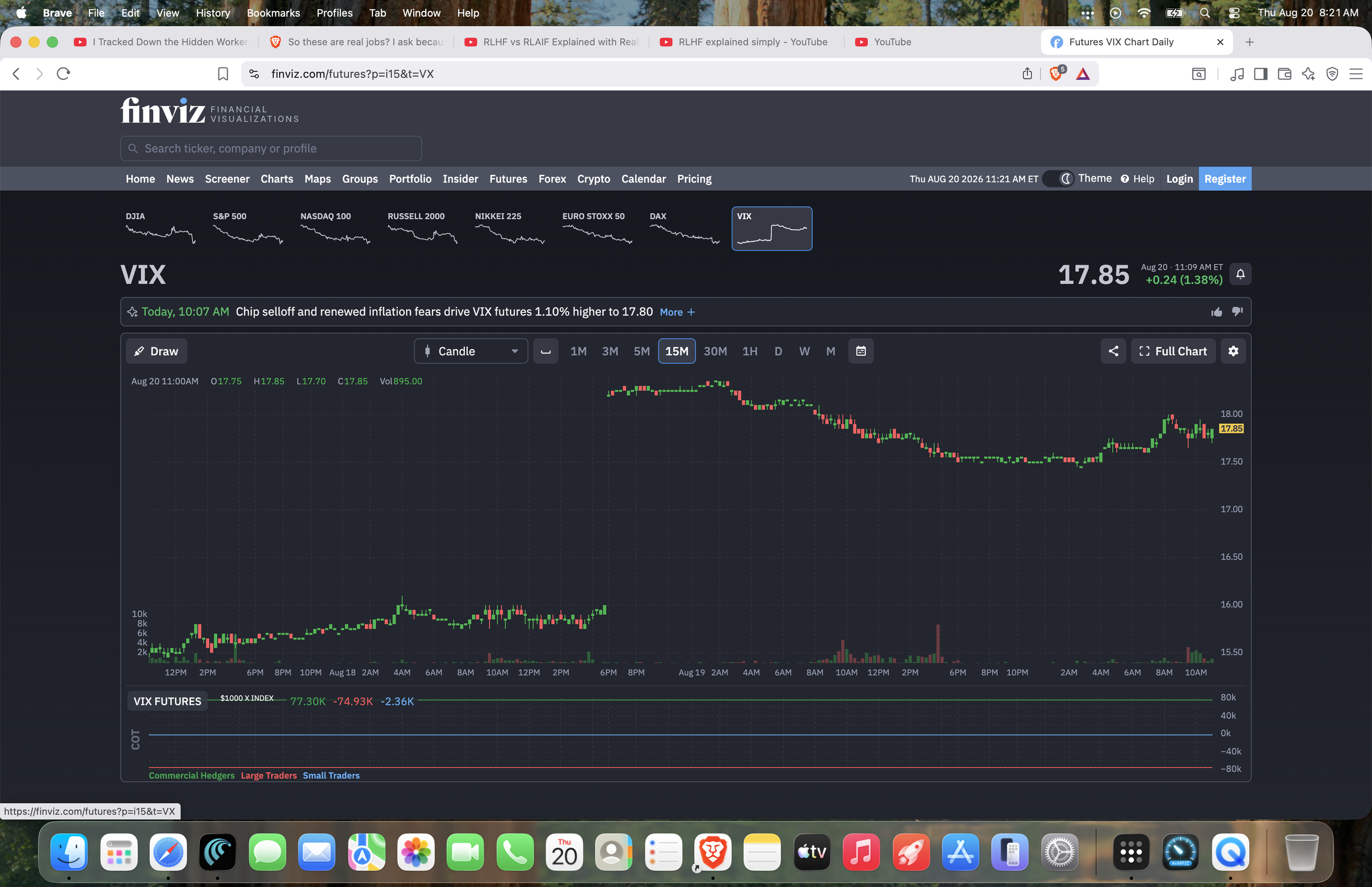
See that jump?
Here’s Gemini to explain: Why the Gap Appears
Contract Expiration Date: VIX monthly futures for August expired on Wednesday, August 19, 2026.
The Term Structure Shift: As the front-month contract expires and the pricing shifts to the next front-month contract (September), the chart reflects the absolute price difference between those two distinct contracts in the VIX term structure. Because volatility futures usually trade in contango (where farther-out months are priced higher than expiring ones), rolling over to a later expiration naturally creates a visual "gap" on continuous charts.
The intraday movement itself reflects normal fluctuations around a chip selloff and inflation concerns, but the large structural level change is purely a function of the monthly contract changeover.
If you ask people to try and explain the “gap” in futures in Treasury bond futures or oil futures or VIX futures they usually provide some sort of an answer that’s some version of “contango”. People were expecting this month to be a bit more volatile and they never adjusted their position sort of vibe. So if you want to play next month, you have to pay more. Sound like bullshit to you? Yeah me2 meme. It’s just me to you. That’s all it ever was. In VIX the gap often fills, although sometimes it takes a couple of years to fill it.
For some people, this is a fun way to start their mornings, for others who may not know what VIX is : it’s a rude awakening. Speaking of rude awakenings, some scientists took a few neurons, put it in a cage and had them play video games over and over again. Shooter games, Ping Pong whatever. Just to demonstrate that they can create neurons in a lab, presumably from pluripotent stem cells and trained them into becoming specialists. Like playing DOOM Eternal on repeat and that’s all they can do. Perhaps William the Conqueror still paying off his karma. Or maybe just scientists who like to examine beetles in a cage.
I did get your thoughts by the way: what’s the difference between Taiwan and Hong Kong? The Brits turned Hong Kong over to the Chinese in a civilized, choreographed manner. The announced it, gave it a couple of years and then turned it over. Hong Kong still exists, finance still exists, a few things changed in the government and I don’t mean to diminish the changes that may have happened. I am simply suggesting that the world accepted it and moved on. And when I asked AI, why can’t the world accept that in the case of Taiwan, the reasons I got were severe but ultimately - to me - nonsense. Taiwan is a sovereign country! Yes, it is, and it was formed by Chinese people escaping the mainland due to a disagreement during the People’s Revolution. And it is 100 miles from the mainland. To say that America must intervene in this and maintain “strategic ambiguity” and put a million troops into a plan OPLAN5077 so we can justify the reason INDOPACOM exists, sound absurd. But only to me. I am sure the SOCOM operators on Taiwan are doing just fine. Hopefully y’all aren’t teaching future Chinese citizens some of our black secrets. Cause that would be stupid and I don’t think y’all are stupid.
We have SOCOM on Taiwan?
hehehe
The things you learn from YouTube, what?
I learned once again today that there are jobs out there created by AI. They’re called Data Annotation and AI Training. The way they were explained to me is rather simple and charming. If you want to create an AI that specializes in a dentist’s office then you need humans who can provide feedback to the AI. It creates a specialized sort of Agentic AI, rather than the originally envisioned generalized AI in the 1950s. Back then, after World War II, the scientific consensus was we ought to create AI, build computing prowess and use it for research and the betterment of mankind.
Now the consensus has shifted more towards agentic behavior and becoming a dentist’s assistant or a teller at a bank. And those jobs - the Data Annotation and AI Training jobs - are actual jobs… not the work from home and stuff envelopes Ponzi schemes from the 1990s. However they’re “feast or famine” type jobs. The world has a surfeit or excess of college graduates. Many of these graduates in second or third world countries do this type of work. They set alarms for these jobs and regardless of when these jobs appear (some appear in the middle of the night) they apply and start working.
DishBrain is a semi-biological computing system developed by the Australian biotech startup Cortical Labs (founded in 2019 by Hong Weng Chong and Andy Kitchen). It represents a pioneering effort in Organoid Intelligence (OI), merging living human and rodent neurons with silicon electronics to create a "wetware" computer.
Key Facts
The Experiment: In 2022, Cortical Labs demonstrated that a culture of approximately 800,000 neurons (grown from human and mouse stem cells) could learn to play the 1970s arcade game Pong. The neurons were grown on a multi-electrode array that provided sensory input (ball position) and feedback (electrical stimulation).
How It Works: The system uses the Free Energy Principle, where neurons adapt their activity to minimize "surprise" or unpredictability. When the "paddle" hit the ball, the neurons received predictable, low-energy electrical signals (a reward). When they missed, they received chaotic, high-energy jolts (a punishment). The neurons learned within minutes to coordinate their firing to hit the ball and avoid the punishment.
"Sentience" Claim: The researchers described the neurons as exhibiting "sentience"—defined not as human-like consciousness, but as the ability to sense the environment and respond to it. This terminology has sparked significant debate regarding synthetic suffering, as the "punishment" signals might be experienced as distress by the biological tissue.
Commercial Evolution (2025–2026): In early 2025, Cortical Labs launched the CL1, the world’s first commercial biological computer. The CL1 is designed to work alongside traditional AI to improve learning efficiency and reduce the "catastrophic forgetting" common in silicon-based models. It has attracted military funding to explore applications in adaptive robotics and drug discovery (e.g., testing how neural networks respond to pharmaceuticals).
Why It Matters
DishBrain is significant because it offers a potential alternative to energy-hungry silicon AI. Biological neurons are vastly more efficient at learning from sparse data than deep learning algorithms. However, the project highlights the ethical complexities of synthetic biological intelligence, particularly the question of whether living neural networks can experience suffering and how they should be regulated.
