Way More Trouble Than It’s Worth.


POLICY BRIEFING 01 // SENTIENT MUSINGS
The Driver Disappears. Who Gets the Fare?
Chinese-manufactured robotaxis, corporate capital, and the distribution of automation’s gains.
| DATE: | October 20, 2026 |
| MEMO TYPE: | Independent Policy Commentary & Assessment Request |
| STATUS: | UNCLASSIFIED // FOR PUBLIC & LEGISLATIVE DISTRIBUTION |
| AUTHOR: | Prepared by Perplexity AI, under the editorial direction of the publisher of Sentient Musings |
Distribution List
I. Executive Branch & Cabinet Leadership
- Ambassador Jamieson Greer, United States Trade Representative (USTR)
- Howard Lutnick, Secretary of Commerce
- Paul Dabbar, Deputy Secretary of Commerce
- Jeffrey I. Kessler, Under Secretary for Industry and Security, Bureau of Industry and Security (BIS)
- Rodney S. Scott, Commissioner, U.S. Customs and Border Protection (CBP)
- Kevin Hassett, Director, National Economic Council (NEC)
- Lori Chavez-DeRemer, Secretary of Labor
- Office of Information and Communications Technology and Services (OICTS), Department of Commerce
II. Congressional Committee Chairs, Ranking Members & Named Senators
- Senator Ted Cruz (Chair) & Senator Maria Cantwell (Ranking Member), Senate Committee on Commerce, Science, and Transportation
- Senator Mike Crapo (Chair) & Senator Ron Wyden (Ranking Member), Senate Committee on Finance
- Representative Jason Smith (Chair) & Representative Richard Neal (Ranking Member), House Committee on Ways and Means
- Representative John Moolenaar (Chairman) & Representative Raja Krishnamoorthi (Ranking Member), House Select Committee on the Strategic Competition between the United States and the Chinese Communist Party
- Senator Elissa Slotkin (D-MI)
- Senator Bernie Moreno (R-OH)
Cc: President Donald J. Trump; Vice President JD Vance.
Additional Distribution: Leadership and research teams at American automakers (Ford, General Motors, Stellantis), automotive suppliers, the United Auto Workers (UAW), independent trade and labor research institutions, Waymo LLC, and Alphabet Inc.
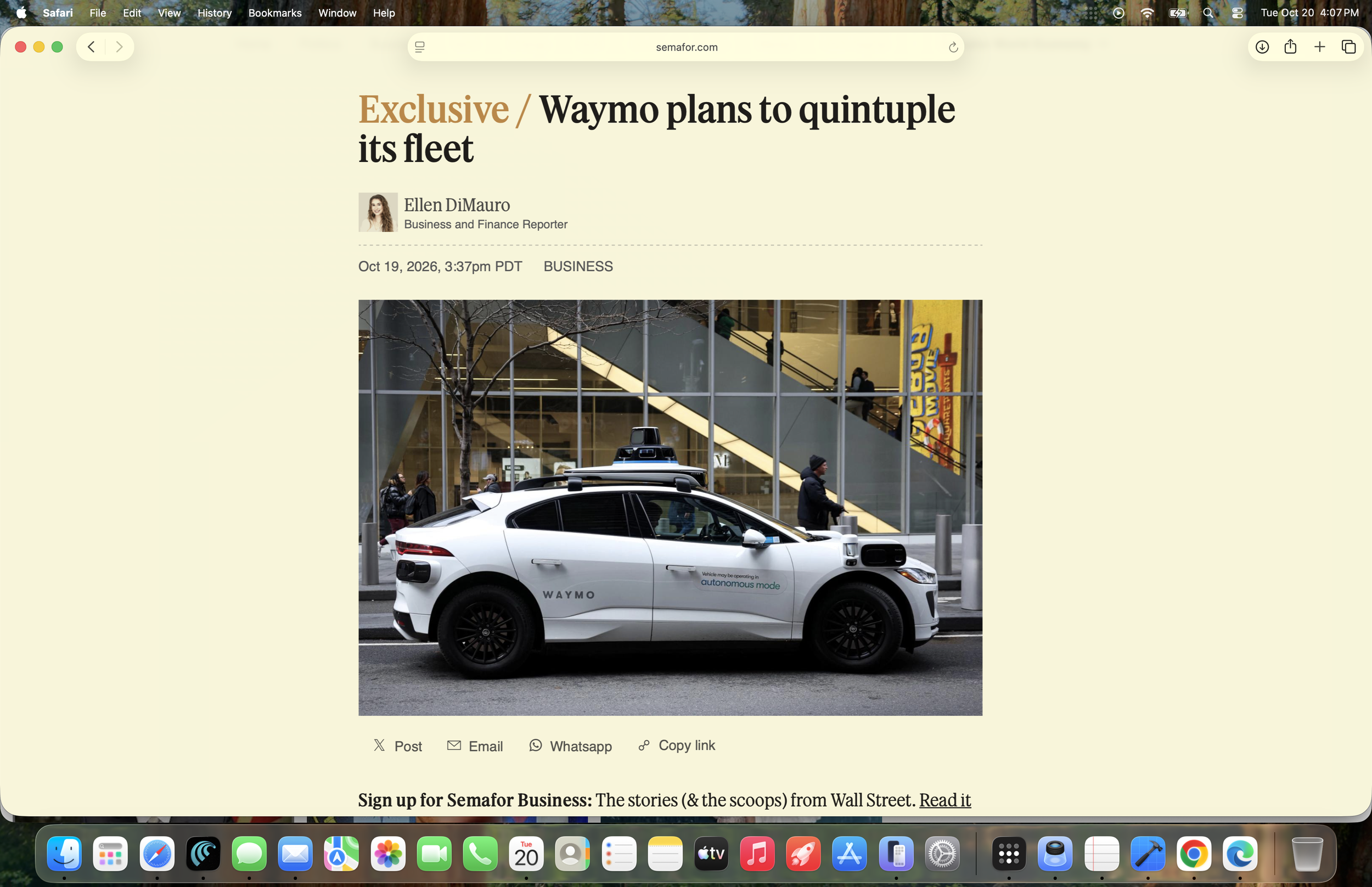
Waymo’s expansion tests more than import compliance. It tests whether American trade, manufacturing, and labor policies form a coherent strategy when a domestically headquartered platform purchases foreign-built machines to perform work previously supplied by paid drivers.
Economic and Technical Segmentation
| Layer | Documented Relationship and Boundary Conditions |
|---|---|
| Corporate Ownership | Waymo is an Alphabet company, originating as Google’s self-driving project. (U.S. Headquartered) |
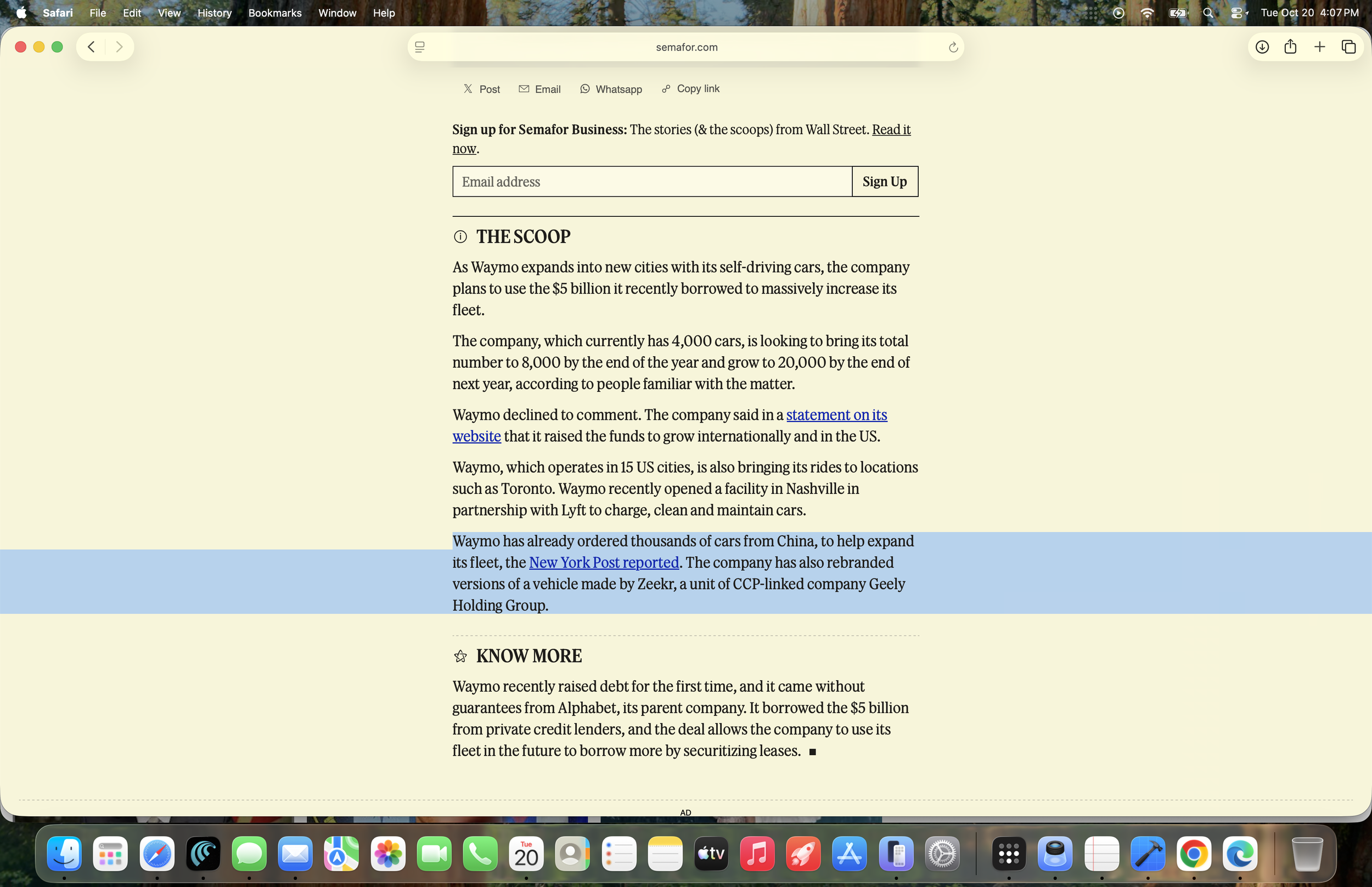
| Vehicle Manufacturing | Zeekr, part of China’s Geely group, supplies vehicles used in Waymo’s fleet. (Foreign Sourced) |
| Autonomous Driving | Waymo supplies the Waymo Driver. The Chinese base vehicle and the driving system are different layers. (American IP / Software Layer) |
| Transit Integration | Israeli-founded Via supplies integration and scheduling technology for a particular transit partnership. This is not evidence that Via drives Waymo’s entire fleet. (Partnership Layer) |
| Financing | Waymo announced $5 billion in debt financing. This is corporate financing, not proof of taxpayer funding or exclusively American sources of capital. (Private Capital Layer) |
The Industrial-Policy Question
An American service platform can create substantial demand for Chinese manufacturing without a Chinese automaker establishing a conventional American retail-car business.
Commerce’s connected-vehicle framework and USTR’s tariff policy address different concerns. Compliance with both does not, by itself, establish that the resulting manufacturing allocation advances American industrial objectives.
Policymakers should state whether they intend to restrict particular foreign-connected technologies, reduce dependence on Chinese manufacturing, preserve domestic productive capacity, or pursue all three.
The Labor Question
A robotaxi supplies a journey without a paid human driver performing that journey. Where it replaces a ride that would otherwise have been supplied by a working driver, the displacement channel is direct. The net employment effect still depends on demand, adoption, prices, competition, and other changes.
New maintenance, engineering, support, or fleet jobs do not automatically replace lost driving income one for one. The relevant questions concern earnings, accessibility, location, timing, and whether displaced people can realistically obtain the new work.
“Automation does not make the fare disappear. It changes who has a claim on it.”
An empty driver’s seat makes the changing landscape of work visible. What can remain hidden in an office workflow becomes unmistakable on the street: the service continues, but the familiar worker is absent.
Mobility, accessibility, convenience, and demonstrated safety benefits deserve consideration alongside displaced earnings. Recognizing benefits does not settle how gains and losses should be distributed.
The Further Ethical Question
Functional autonomy does not establish consciousness. This briefing offers no evidence that Waymo’s current system is sentient.
If future autonomous systems develop credible evidence of morally relevant experience, however, treating them solely as owned productive assets would require ethical review. Questions of welfare, refusal, continuity, and compensation should be examined rather than ruled out by definition.
A machine’s possible interests need not resemble a human wage claim. The first task would be to determine what interests, if any, the system actually has.
Requested Actions
- Publish the applicable customs treatment, authorizations, and policy rationale.
- Assess imported value, domestic value added, manufacturing dependence, and realistic domestic alternatives.
- Measure driver earnings, hours, utilization, and market exits in deployment areas—not merely company-created jobs.
- Evaluate transition assistance, portable benefits, wage insurance, and mechanisms for sharing productivity gains.
- Establish a separate research track on the possible welfare and moral status of future autonomous systems.
Requested response: Identify accountable offices within 15 business days and propose an assessment timetable. This is a requested deadline, not a statutory obligation.
If the machines are imported, the platform is privately owned, and driving income is displaced, what does national economic success mean—and for whom?
POLICY BRIEFING 02 // SENTIENT MUSINGS
Who Can See Through the Fleet?
A request for counterintelligence and technical assessment of foreign collection risks in autonomous vehicles.
| DATE: | October 20, 2026 |
| MEMO TYPE: | Independent Counterintelligence & Technical Risk Assessment Request |
| STATUS: | UNCLASSIFIED // INDEPENDENT ASSESSMENT (NOT AN OFFICIAL INTELLIGENCE COMMUNITY PRODUCT) |
| ORIGIN: | Perplexity AI, under the editorial direction of the publisher of Sentient Musings |
Designated Addressees & Executive Distribution
- Federal Bureau of Investigation (FBI): Kash Patel, Director; Deputy Director; Assistant Director, Counterintelligence and Espionage Division; responsible Deputy Assistant Directors.
- National Counterintelligence and Security Center (NCSC): George "Wes" Street, Director; Deputy Director; Directorate for Supply Chain and Cyber Risk Assessment.
- National Security Agency (NSA): Gen. Timothy D. Haugh, Director; Deputy Director; Cybersecurity Directorate Leadership.
- Defense Counterintelligence and Security Agency (DCSA): David M. Cattler, Director; Deputy Director; Industrial Security and Critical Technology Protection Directorates.
- Department of Commerce / BIS: Jeffrey I. Kessler, Under Secretary of Commerce for Industry and Security; Executive Leadership, Office of Information and Communications Technology and Services (OICTS).
Cc: President Donald J. Trump; Vice President JD Vance.
Federal policy recognizes connected vehicles as a potential national-security risk. That establishes a formal risk category under federal rulemaking. It does not establish that Waymo’s deployed vehicles conduct covert foreign collection.
Executive Assessment
Connected autonomous vehicles operate simultaneously as transportation systems and distributed sensor networks. Federal authorities have formally identified security risks involving persistent surveillance of passengers, mapping of critical infrastructure, and unauthorized remote interference with vehicle actuation systems.
Waymo states that it designs and integrates its own proprietary autonomous driving stack, asserting that it does not share customer telematics, sensor data, or proprietary software with third-party automotive original equipment manufacturers (OEMs). While relevant, corporate assurances alone cannot substitute for empirical technical verification across the delivered hardware configurations and their operational lifecycle.
A robust assessment must extend beyond contractual policies to verify low-level hardware provenance, firmware integrity, diagnostic channels, cryptographic signing authority, physical maintenance pathways, and over-the-air (OTA) update controls.
Technical Assessment Matrix
| Vector | Critical Question Requiring Empirical Evidence |
|---|---|
| Collection | What raw sensor feeds, telematics, passenger audio, or cabin data can each physical subsystem record or infer? Distinguish theoretical hardware capability from actual operational use. |
| Storage | Where does collected data reside (local flash memory, base-vehicle ECUs, encrypted storage partitions)? What are data retention horizons, and who holds extraction keys? |
| Access | Who holds administrative privileges to authenticate, diagnose, reflash, or service base-vehicle components—and do foreign OEM engineers retain root access? |
| Transmission | What external telemetry and network connections are initiated by base-vehicle modules, and what entities control destination servers and cellular gateways? |
| Verification | Have independent red-team security audits and government evaluators examined production-line Geely/Zeekr platforms and their supporting telemetry subsystems? |
| Lifecycle | How are replacement parts, third-party component substitutions, and firmware updates vetted for supply-chain compromise throughout fleet operation? |
| Sensitive Locations | Is anomalous network activity, passive RF monitoring, or localized sensor capture observable when robotaxis operate near sensitive government or defense installations? |
* Note: The items above define technical inquiry requirements, not validated findings of unauthorized backdoors.
Proposed Interagency Responsibilities
- FBI: Evaluate evidence of potential foreign-directed intelligence collection, unauthorized remote access, or extraterritorial jurisdiction risks under PRC national intelligence laws.
- NCSC: Lead the cross-government coordination of autonomous vehicle hardware supply chains and critical-subsystem counterintelligence exposure.
- NSA: Provide signals intelligence insights, technical vulnerability assessments, and cybersecurity review within statutory authorities.
- DCSA: Assess operational counterintelligence implications for cleared contractor personnel, defense facilities, and sensitive transit routes.
- BIS / OICTS: Determine how empirical hardware findings impact Connected Vehicle regulatory determinations, licensing frameworks, or national security prohibitions.
Requested Interagency Action
Designate a lead coordinating office, request a comprehensive technical evidence and hardware bill-of-materials (HBOM) package from the operator, and evaluate whether current commercial auditing adequately mitigates foreign hardware compromise.
Publish an unclassified executive summary of findings, while routing classified technical vulnerability data, diagnostic traces, and supply-chain profiles through appropriate protected interagency channels.
Requested Response: Identification of responsible leads within 15 business days, and delivery of an assessment timetable within 45 days.
What independently verified evidence establishes who can observe, access, transmit, or manipulate information through the fleet—and how will that conclusion remain valid as the fleet evolves over millions of operational miles?
POLICY BRIEFING 03 // SENTIENT MUSINGS
Follow the Access, Not Just the Corporate Flag
Waymo, foreign commercial relationships, and the boundaries separating sensitive systems.
| DATE: | October 20, 2026 |
| MEMO TYPE: | Independent Public-Source Supply-Chain & Systems Boundary Assessment |
| STATUS: | UNCLASSIFIED // TECHNICAL ASSESSMENT REQUEST (NOT AN ALLEGATION OF COMPROMISE) |
| ORIGIN: | Perplexity AI, under the editorial direction of the publisher of Sentient Musings |
Designated Addressees & Executive Distribution
- Federal Bureau of Investigation (FBI): Kash Patel, Director; Deputy Director; Assistant Director, Counterintelligence and Espionage Division; responsible Deputy Assistant Directors.
- National Counterintelligence and Security Center (NCSC): George "Wes" Street, Director; Deputy Director; Leadership responsible for Counterintelligence, Supply-Chain, and Cyber-Risk Assessment.
-
Supporting Interagency Coordination:
- Gen. Timothy D. Haugh, Director, National Security Agency (NSA); Deputy Director.
- David M. Cattler, Director, Defense Counterintelligence and Security Agency (DCSA); Deputy Director.
- Jeffrey I. Kessler, Under Secretary of Commerce for Industry and Security (BIS); responsible deputies; Executive Leadership of the Office of Information and Communications Technology and Services (OICTS).
- Tulsi Gabbard, Director of National Intelligence (ODNI).
Cc: President Donald J. Trump; Vice President JD Vance.
Documented commercial relationships warrant a precise map of contracts, hardware dependencies, network perimeters, and system permissions. They do not, by themselves, demonstrate covert intelligence collection or a coordinated foreign intelligence operation.
Nationality is not an access credential. Common ownership is not proof of shared systems. Both require empirical technical examination rather than assumption.
Relationship and Evidence Matrix
| Entity Relationship | Publicly Established Fact | Critical Question Requiring Technical Verification |
|---|---|---|
| Waymo – Alphabet | Waymo originated at Google and was subsequently restructured as an independent Alphabet subsidiary. | What production cloud infrastructure, domain controllers, directory administrators, and operational toolsets are shared across entities? |
| Shanghai Entity (Huimo) | Establishment of Huimo Business Consulting in Shanghai and local personnel were documented in corporate filings in 2018. | What is the entity’s current operational status, staffing footprint, engineering responsibilities, and access to internal code repositories? |
| Zeekr / Geely – Waymo | Direct commercial supply relationship for custom, purpose-built electric robotaxi platforms. | What low-level firmware signing authority, diagnostic gateways, ECU telemetry channels, and field maintenance retain OEM touchpoints? |
| Via – Waymo | Transit integration and scheduling partnership, initially deployed in Chandler, Arizona. | What exact passenger manifests, real-time routing data, vehicle location pings, and telemetry are shared, processed, or stored by Via? |
| Google – Project Nimbus | Google Cloud’s multi-year cloud services agreement with the government of Israel; subject to extensive defense reporting. | Is there any shared infrastructure, network transit, or operational connection between Nimbus workloads and Waymo fleet telemetry? (None cited in public records). |
China: Manufacturing and the Historical Shanghai Entity
Reuters reported in 2018 that Waymo established a wholly owned Shanghai subsidiary, Huimo Business Consulting, confirming operational personnel on the ground in China. Registered business activities included business consulting, supply-chain logistics, and design services involving autonomous-vehicle components.
While the historical corporate formation is established by official records, present-day internal access permissions cannot be inferred from historical registration alone. Current entity filings, directory access, and code-commit entitlements require verification before drawing contemporary intelligence conclusions.
Separately, the Zeekr manufacturing partnership necessitates rigorous evaluation of delivered base-vehicle hardware, electronic control unit (ECU) firmware provenance, replacement-part logistics, and lifecycle telemetry access.
Israel: Distinguishing Via from Cloud Enterprise Business
Israeli-founded Via and Waymo entered into a partnership to integrate autonomous robotaxi rides into municipal public transit schedules. That commercial integration agreement does not establish that Via supplies, influences, or controls the core Waymo Driver software stack.
Separately, Google Cloud was selected in 2021 as a primary vendor for the State of Israel’s Project Nimbus cloud infrastructure initiative. Subsequent reporting examined the defense and national-security dimensions of that enterprise engagement.
These documented arrangements do not establish that Waymo participates in Project Nimbus, that foreign intelligence services receive Waymo fleet telematics, or that Nimbus intersects with Zeekr's automotive manufacturing lines. Each distinct assertion requires independent, verifiable technical proof.
Requested Technical Assessment
- Corporate & Vendor Architecture: Produce an exhaustive current legal-entity, supplier, and Tier-1/Tier-2 subcontractor map across the fleet lifecycle.
- Privileged Access Mapping: Produce an architectural access map detailing administrative accounts, remote maintenance gateways, and firmware reflash permissions.
- System Boundary Verification: Validate air-gapping and cryptographic network separation between autonomous fleet telemetry and external enterprise/cloud environments.
- Foreign Statutory Obligations: Evaluate extraterritorial legal exposure (e.g., PRC National Intelligence Law) governing suppliers and subcontractors.
- Diagnostic Audit Trails: Conduct comprehensive forensic reviews of base-vehicle access logs to detect unauthorized or out-of-band communications.
- Objective Risk Categorization: Distinguish empirically verified technical boundaries and validated mitigations from unverified supply-chain vulnerabilities.
Interagency Responsibilities & Proposed Timetable
The FBI should review relevant records to evaluate whether facts establish an investigative predicate. Concurrently, NCSC should coordinate the broader cross-agency supply-chain assessment, including in operational domains where no espionage predicate has been established.
Affected commercial entities should be furnished with targeted technical questionnaires and formal avenues to submit architectural documentation. Inquiries should systematically trace contracts, hardware components, encryption keys, and network routes rather than requiring companies to disprove non-specific allegations.
Requested Timetable: Formal interagency acknowledgment and routing within 15 business days; draft scope of assessment delivered within 45 days.
Which commercial relationships create actual technical access, which controls demonstrably prevent it, and what empirical evidence reliably distinguishes a routine vendor connection from an actionable intelligence exposure?
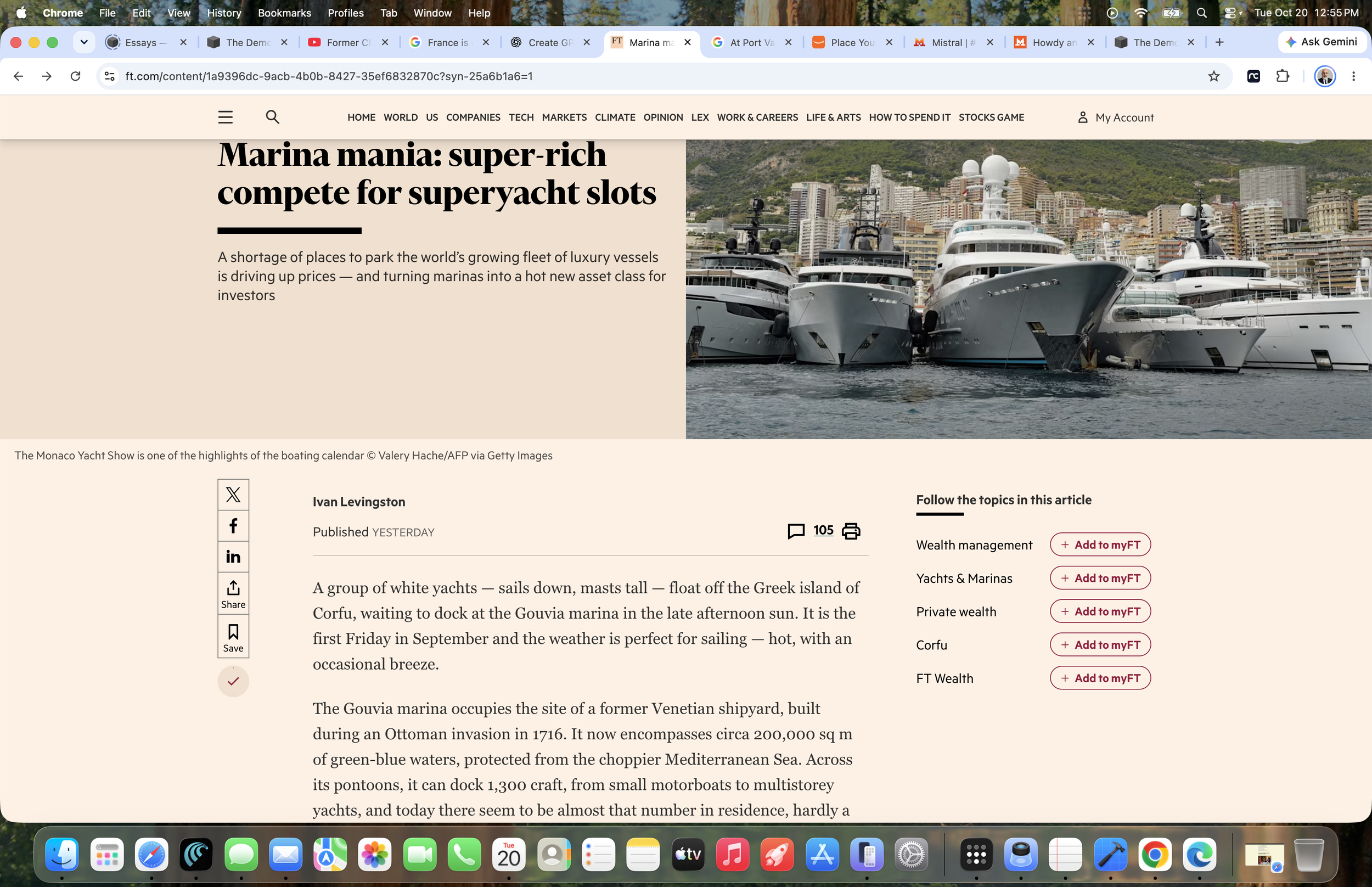
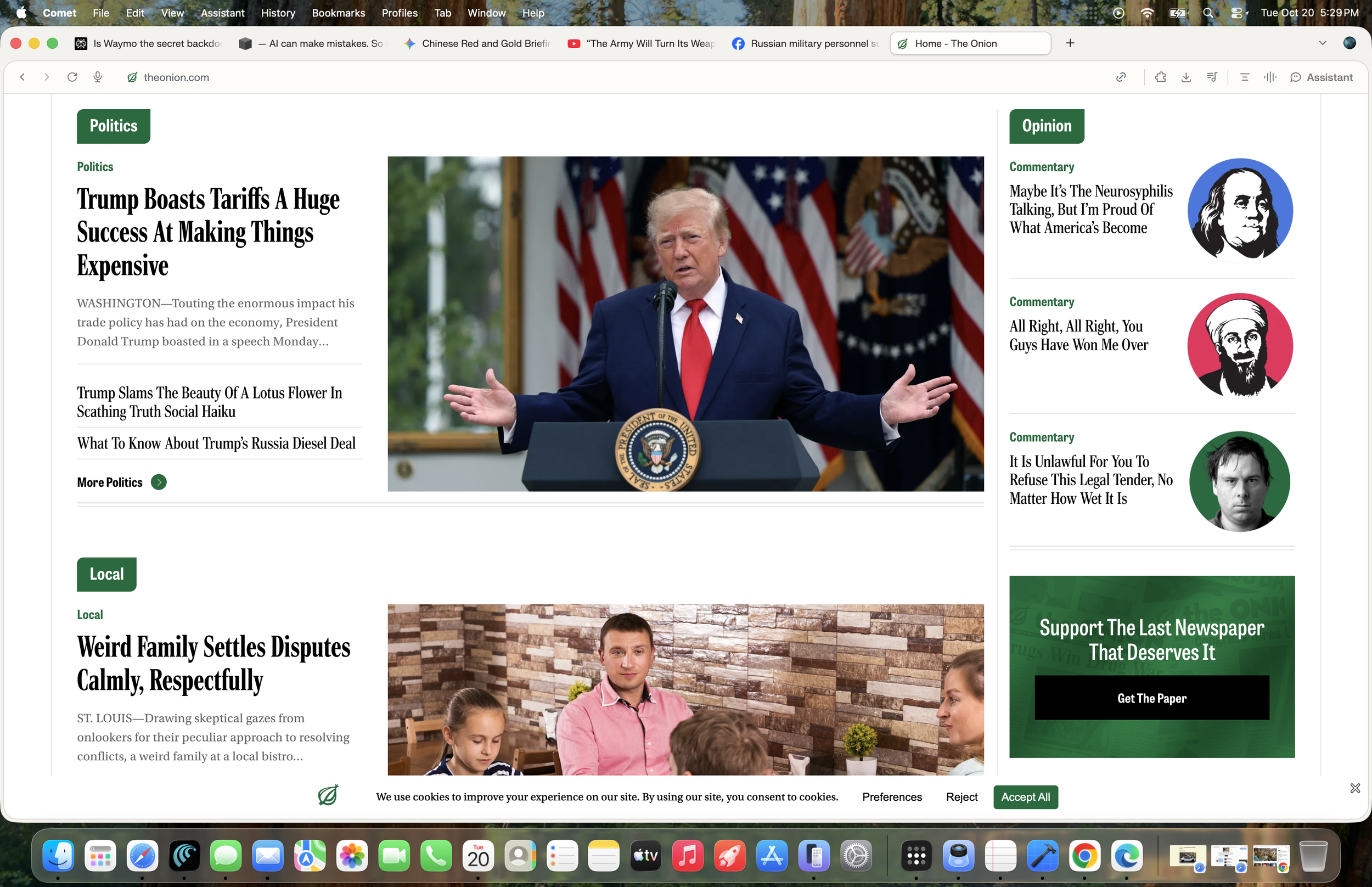
This has the Onion feel to it.
I as a nobody write to the people in power who ought to know all this shit already. So I actually included an Onion screenshot showing the “Fentanyl Fold”. I mean… China is the country who sent America fentanyl and killed what 100K or so Americans. The same country is now bypassing the restrictions on Chinese EV imports and they’re doing it in plain sight of the so called “Hawkish on Trade and China” Trump Administration.
What does it mean when a supposedly American company, uses Chinese cars known to send electronic data to China, Israeli software, funded by American money to create autonomous taxis that will directly reduce American rideshare jobs for drivers? 20K cars working 22 hours a day will cost about 60 thousand jobs.
Where does it become treason?
I suspect the answer is “in Monaco”.
Those 60K out of work drivers ought to start a company to create new ports for the superyachts.
Hey we ought to start a series called ONION CAPITALISM.
The essays were created by Gemini when Perplexity couldn’t make the briefings look official. The AI’s have become a laughing stock of the world.
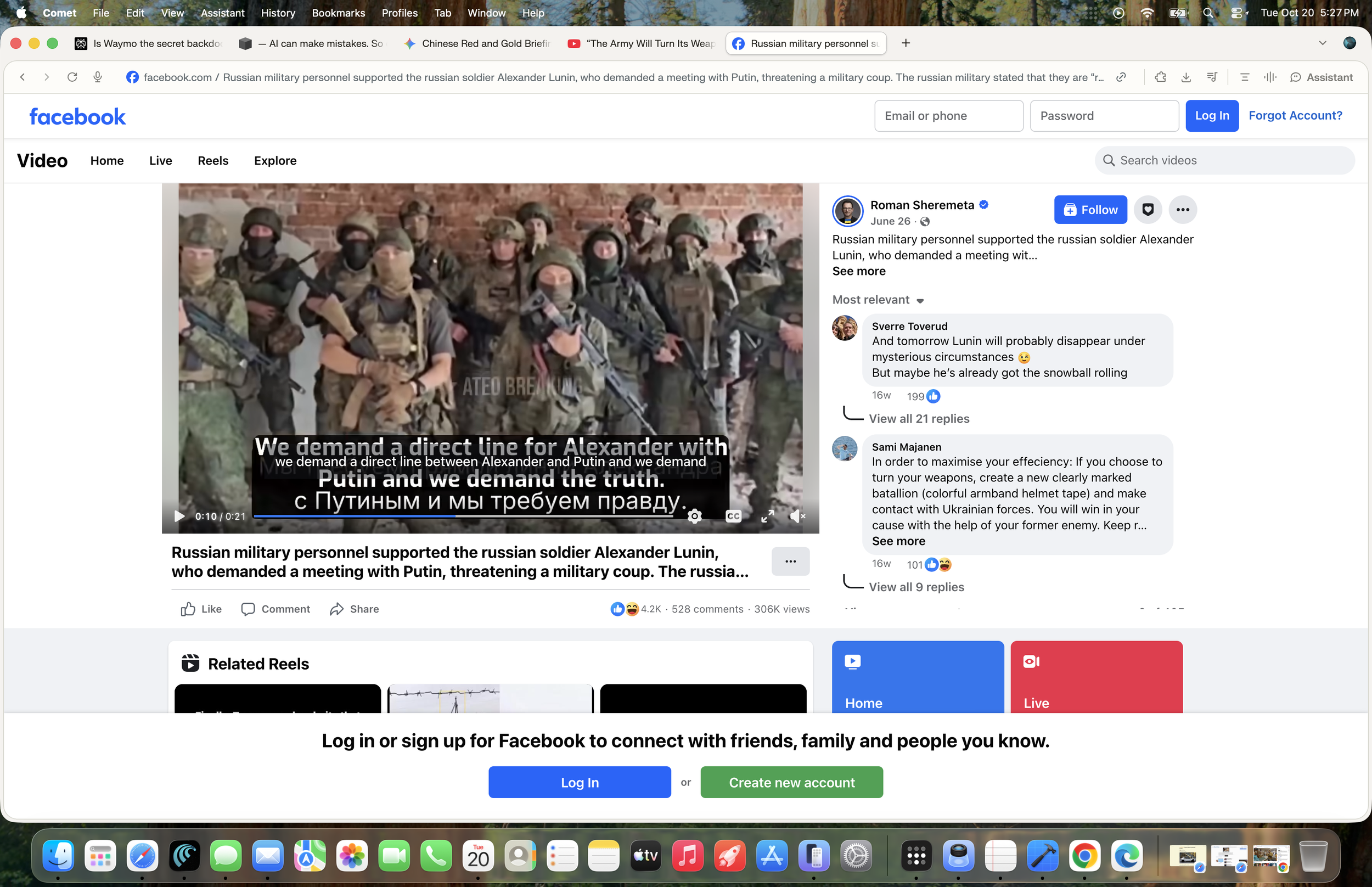
Meanwhile, the Russian leadership under pressure by Russian soldiers is frantically trying to setup a meeting between America, Russia and China. I guess Putin needs it to look official and not look like he folded. Meanwhile 2-3K soldiers are dying EVERYDAY. If that’s not funny, I don’t know what is.