ASI. That’s the name of the company. The full name is a cool “Air Space Intelligence”. Their system is called SMART like MSS is Maven Smart Systems. The people who run it are ex-Palantir types and US Military.
At least four senior executives on Air Space Intelligence's (ASI) leadership team come directly from Palantir Technologies, the U.S. military, or both. Notably, ASI defeated Palantir in June 2026 to win the $875 million FAA SMART contract, even as former Palantir defense leaders help run ASI's day-to-day operations. [1, 2, 3]
Former Palantir & U.S. Military Executives at ASI
Dan Rickert — Chief Operating Officer (COO): A West Point graduate and former U.S. Army Special Forces officer. Before joining ASI, Rickert served as Chief of Staff for Defense at Palantir Technologies.[1]
Tate Krasner — President, Energy & Chief of Staff: Joined ASI in 2024 after serving in leadership positions within Palantir Technologies' national security practice. [1]
Lt. Gen. (Ret.) Leo Kosinski — General Manager, Japan: A 31-year U.S. Air Force veteran and U.S. Air Force Academy graduate. Prior to ASI, he served as Deputy Commander of the U.S. Fifth Air Force in Japan and as Director for Logistics on the Joint Staff. [1]
Steph Starsia — Head of People: Previously worked as a Technical Program Manager at Palantir Technologies before serving as Chief of Staff at Theorem and joining ASI. [1]
Broader Military Footprint
Beyond its named C-suite and senior leadership team, ASI publicly emphasizes a heavy veteran presence across its workforce. In its company communications, ASI notes that its staff includes former Green Berets, intelligence officers, cryptologists, logistics specialists, and military aviators who previously flew Marine One, Black Hawks, Apaches, F/A-18s, and Super Stallions. (Note: ASI's co-founders—CEO Phillip Buckendorf, Chief Research Officer Kris Dorosz, and Lucas Kukielka—come from commercial software, AI research, and aviation backgrounds rather than Palantir or the military.) [1, 2, 3]
Would you like to examine ASI's board of directors and venture investors (such as Andreessen Horowitz or Shield Capital) to see who backs the company, or look into its $99 million U.S. Army command-and-control contract?
Air Space Intelligence (now branded simply as ASI) raised a $325 million Series C at a $3 billion valuationin October 2026, shortly after securing a $99 million U.S. Army command-and-control contract alongside its $875 million FAA deal. [1, 2, 3, 4]
Venture Investors & Board Backing
ASI's valuation jumped tenfold from roughly $300 million in late 2023 to $3 billion in October 2026, backed by major Silicon Valley, defense-tech, and institutional investors. [1]
Series C Lead Investor: Spark Capital led the $325 million round in October 2026. General Partner Clay Fisher serves as a prominent voice for the firm's thesis on ASI. [1, 2]
Major Series C Participants: The round included major participation from Andreessen Horowitz (a16z), Craft Ventures, affiliates of Citadel Securities, Meritech Capital, and Energy Impact Partners. [1]
Earlier Institutional Backers: Prior rounds were led by Andreessen Horowitz (which led ASI's $34 million Series B in December 2023 through General Partner David Ulevitch) and Gradient Ventures(Google's AI-focused venture fund, which led ASI's pre-seed round). Other early backers include Bloomberg Beta, Renegade Partners, and Friends & Family Capital. [1, 2]
Board Governance: While ASI does not publish a full standalone board roster publicly, its board seats and governance are anchored by founder and CEO Phillip Buckendorf alongside lead institutional partners from Andreessen Horowitz (David Ulevitch) and Spark Capital (Clay Fisher). [1, 2]
The $99 Million U.S. Army Contract (NGC2)
In late September / early October 2026, the U.S. Army Contracting Command at Aberdeen Proving Ground awarded ASI Federal a five-year, $99 million firm-fixed-price, Indefinite Delivery, Indefinite Quantity (IDIQ) contract (running through September 2031). [1, 2]
Purpose & Program: The contract—officially titled the ASI Apps Enterprise vehicle—scales ASI's AI-powered forecasting and simulation software across the Army's Next Generation Command and Control (NGC2) modernization program.
Operational Scope: Building on earlier prototyping with the Army's I Corps (First Corps), the software is designed to ingest battlefield data and run forward-looking simulations so commanders can anticipate disruptions and optimize logistics and force movements in seconds rather than minutes.
Broader DoD Footprint: Beyond the Army, ASI's defense platforms are actively deployed with the U.S. Air Force (where the company reported supporting over 4,000 operators during Operation Epic Fury) and U.S. Pacific Command (USINDOPACOM). [1, 2, 3, 4]
Together, the $875 million FAA contract and the $99 million Army contract gave ASI $974 million in stated federal contract value heading into its $3 billion valuation round. [1]
If you'd like to explore further, we can look into ASI's commercial utility and airline clients (such as National Grid, Delta, and United) or examine how NGC2 software contracts are structured across other competing defense vendors.
Air Space Intelligence (ASI) built its commercial business around predictive air-traffic and electrical-grid dispatch software before scaling into federal programs, while its U.S. Army Next Generation Command and Control (NGC2) work sits inside a multi-layered, modular software stack led at the infrastructure layer by Anduril and Palantir. [1, 2, 3, 4]
Commercial Airline & Utility Clients
Before winning the FAA's $875 million SMART contract, ASI established its software across major commercial airlines and regional electric utilities. [1, 2]
Alaska Airlines: Became ASI's launch airline partner in 2021, co-developing the Flyways dispatch platform. The software fuses weather, wind, and air-traffic data to suggest fuel- and time-saving routes for human dispatchers. Alaska has reported saving tens of thousands of flight hours and roughly one million gallons of fuel annually using the tool. [1]
Delta Air Lines & United Airlines: Both carriers deploy ASI's predictive airspace modeling to anticipate congestion, manage network-wide flight following, and dynamically adjust schedules. Combined with Alaska, ASI reports that its commercial aviation software touches more than 40% of U.S. air traffic. [1, 2, 3]
Joby Aviation: Partners with ASI to model airspace deconfliction and coordinate flight operations for electric vertical takeoff and landing (eVTOL) air taxis. [1, 2]
National Grid: Announced a major operational AI collaboration with ASI in May 2026. National Grid uses ASI's platform to build a continuously updated predictive model of its electric grid, running millions of simulations for outage detection, extreme-weather resilience, distributed energy interconnection, and battery storage deployment. [1, 2]
How the Army's NGC2 Contract Architecture Works
Rather than awarding a single prime contractor a monolithic, closed system, the U.S. Army structured Next Generation Command and Control (NGC2) as an open, layered software ecosystem—allowing vendors to be swapped in or out across three distinct tiers: [1, 2, 3]
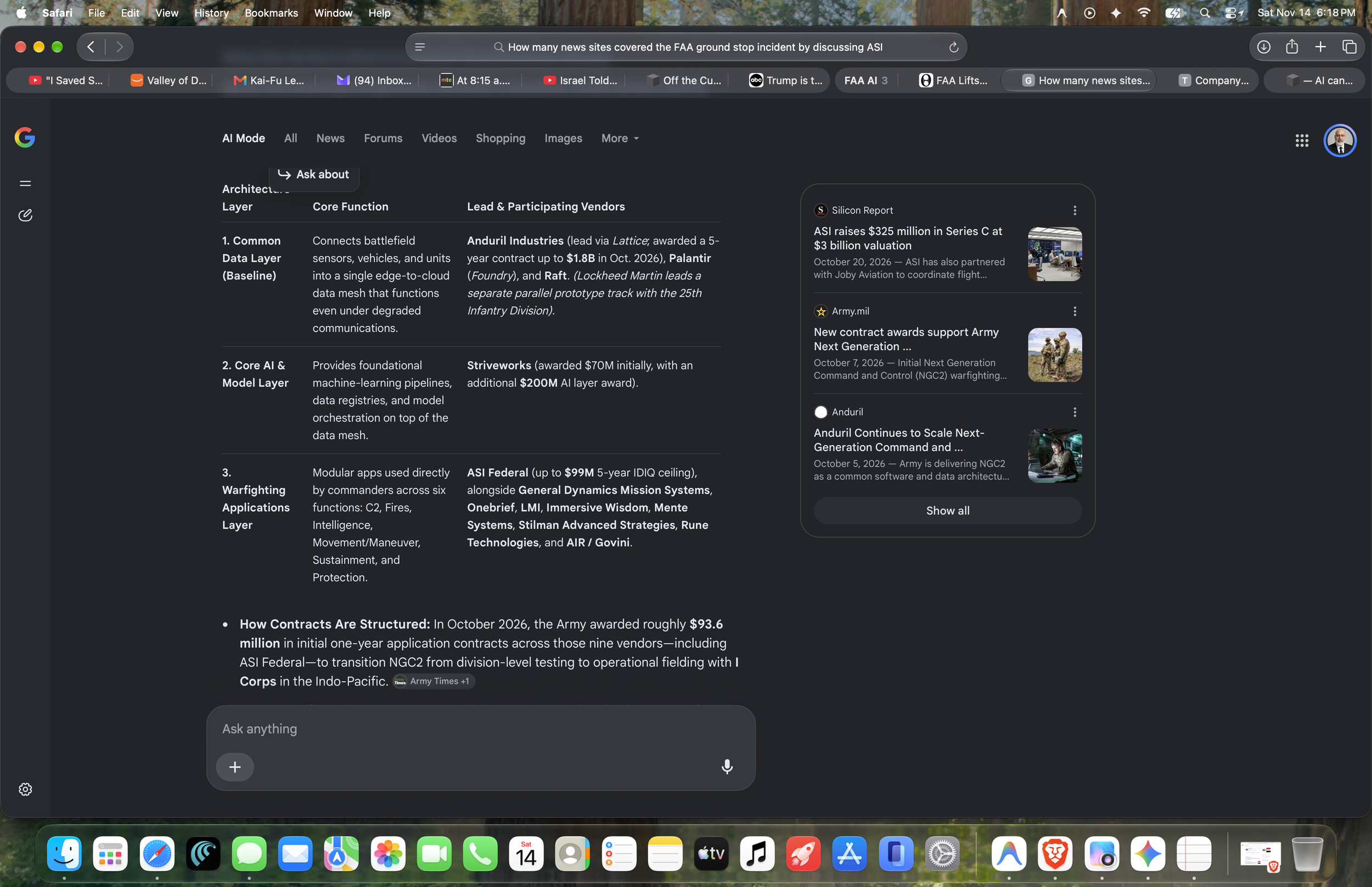
ASI's Specific Role: ASI competes and delivers at the application layer. Its software plugs into the Anduril/Palantir data baseline to run rapid forward simulations for force movement, logistics, and operational planning—the same physics-based forecasting engine it uses for airlines and power grids, adapted for military theaters. [1, 2, 3]
Would you like to examine how ASI defeated Palantir for the FAA's $875 million SMART contract despite Palantir's entrenched federal footprint, or look into the technical differences between Flyways and SMART?
Air Space Intelligence (ASI) defeated Palantir and Thales for the $875 million FAA contract in June 2026 largely because ASI had already spent nearly $100 million of its own capital building a commercially proven airspace engine running inside live U.S. airline operations. Technically, SMART takes ASI’s airline-focused Flyways dispatch software and scales it up to a national, regulator-wide command layer integrated directly into the FAA's core traffic-flow backbone. [1, 2, 3, 4, 5]
How ASI Defeated Palantir and Thales
Despite having roughly 150 employees at the time—a fraction of the size of Palantir or aerospace giant Thales—ASI won the sole-source 12-year award on June 22, 2026, due to three decisive advantages: [1, 2, 3]
Live Operational Proof vs. General Data Platforms: Palantir is a dominant horizontal data-integration contractor across the federal government (and even holds separate aviation-safety analytics work with the FAA), while Thales is a legacy air-traffic hardware and system provider. However, neither competitor had an operational, AI-native trajectory-forecasting engine already managing live U.S. commercial flights. ASI had spent five years running Flyways inside Alaska Airlines, Delta, and United—touching over 40% of U.S. air traffic—giving the FAA immediate, battle-tested aviation models rather than a custom build from scratch. [1, 2, 3, 4]
Pre-Built R&D and Speed to Deployment: Transportation Secretary Sean Duffy and FAA Administrator Bryan Bedford prioritized rapid deployment under the Modern Skies / BNATCS overhaul. Because ASI had already invested nearly $100 million of its own R&D money into its simulation engine, the FAA could begin limited live testing in the Washington, D.C., metro area by September 2026—just three months after contract award—and expand nationwide to all 22 Air Route Traffic Control Centers by November 10, 2026. [1, 2, 3, 4, 5]
Alignment with FAA Governance & Data Architecture: Industry procurement analyses noted that ASI scored highest in technical and governance alignment (reported at 77% readiness compared to Thales at 69% and Palantir at 67%) because its software was built specifically around four-dimensional (4D) airspace physics, convective weather modeling, and human-in-the-loop dispatcher workflows. (Notably, Politico later reported in October 2026 that the FAA even explored taking an equity stake in ASI given how central its software became to national infrastructure.) [1, 2, 3]
1. Why SMART Was Created (And the Role of Controller Shortages)
The FAA did not build SMART to replace air traffic controllers or because the previous system was unsafe. Instead, the system was created because the legacy traffic-flow system was reactive, fragmented, and blind to real-time staffing constraints—and the chronic shortage of certified controllers made those inefficiencies far more disruptive. [1, 2, 3]
The Controller Shortage as a Trigger: The FAA has operated with roughly 11,000 fully certified controllers against a target closer to 14,000, forcing widespread mandatory overtime and frequent sector capacity caps whenever facilities are short-staffed. Historically, when a control center was short one or two controllers on a shift, traffic managers had to manually impose blunt, reactive ground delays. SMART ingests live controller staffing metrics alongside traffic and weather so managers can smooth out schedules days or weeks in advance—routing planes through adequately staffed sectors before bottlenecks cascade nationwide. [1, 2]
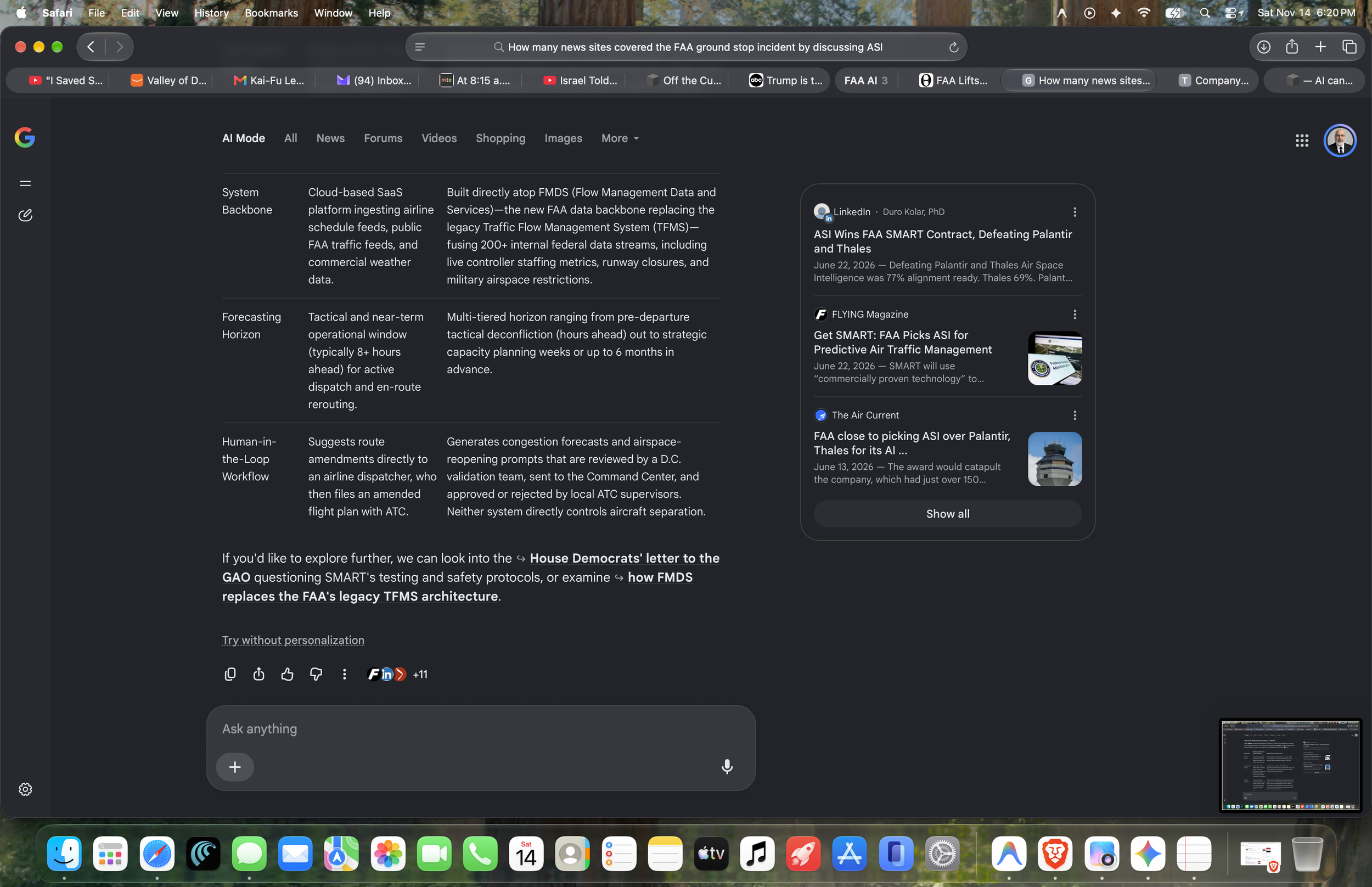
Reactive vs. Predictive Management: While the prior system kept planes safely separated, it suffered from severe efficiency bottlenecks. It could not accurately forecast how convective weather, runway closures, and airline schedules would interact hours later. [1]
Fragmented Screens & Spreadsheets: Traffic managers previously had to manually cross-reference weather radars, airline schedules, and capacity limits across multiple disconnected screens and spreadsheets. [1]
Blunt Weather Closures: Under the old workflow, storms forced controllers to block off huge, static "rectangular boxes" of airspace and keep them closed long after weather cleared. SMART models moving storm cells dynamically so controllers can thread aircraft through open gaps and reopen closed airspace much faster. [1]
2. How FMDS Replaces the Legacy TFMS Architecture
To understand where ASI fits into the FAA's technology stack, it helps to separate the data plumbing from the AI decision layer:
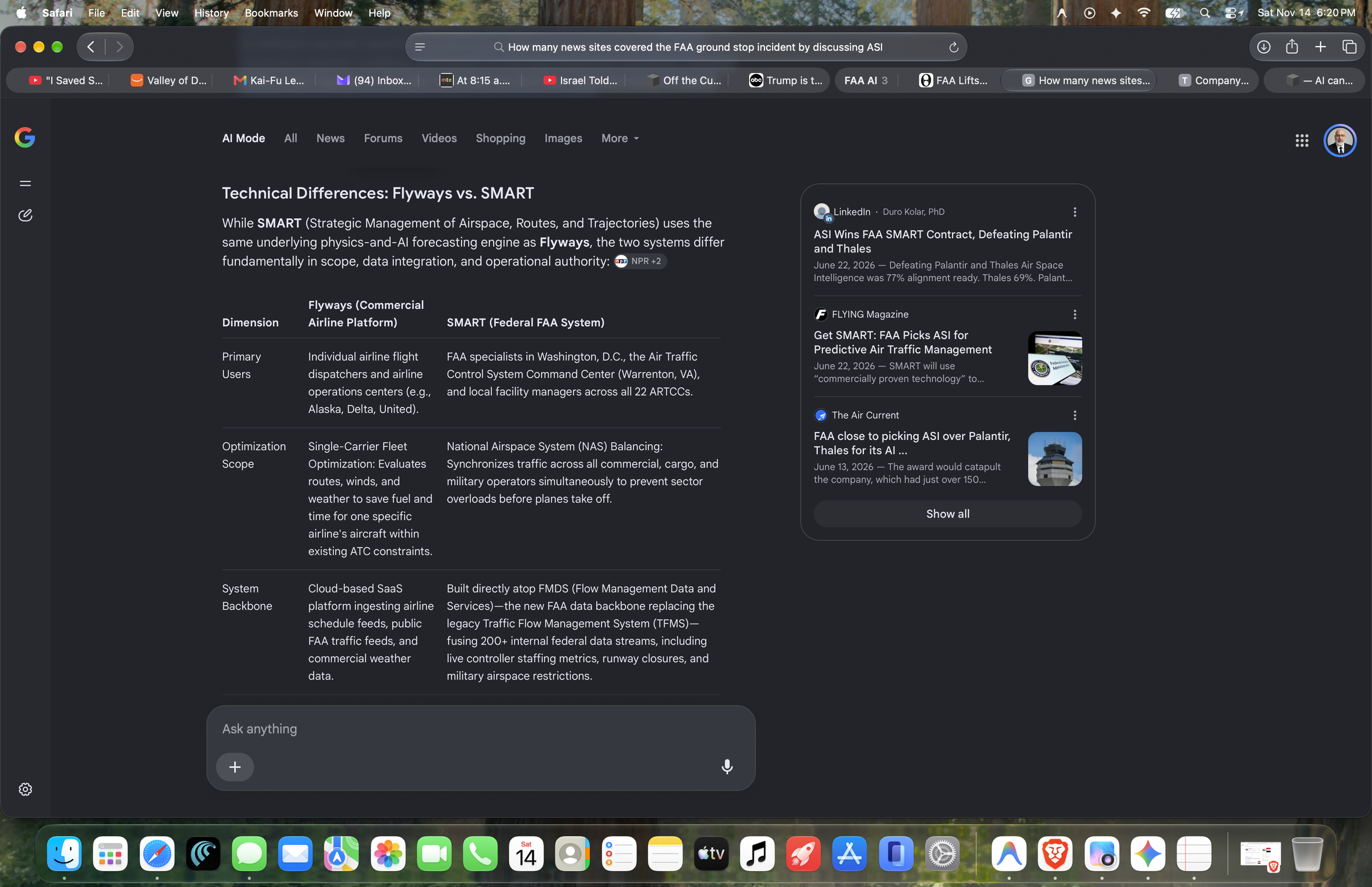
The Legacy System (TFMS): For decades, the FAA’s Air Traffic Control System Command Center relied on the Traffic Flow Management System (TFMS). Built on aging hardware and siloed databases, TFMS primarily tracked Instrument Flight Rules (IFR) flight plans and basic en-route radar messages. It struggled to ingest high-frequency commercial airline data, eVTOL/drone traffic, or rapid cloud-based simulations. [1, 2, 3, 4]
The New Backbone (FMDS): Flow Management Data and Services (FMDS) is the modern cloud-ready automation backbone replacing TFMS. Mandated by the 2024 FAA Reauthorization and awarded to ASI in June 2026, FMDS consolidates multiple legacy Command Center screens into a single unified display, eliminates duplicate manual data entry, and creates a real-time data exchange between the FAA and private airlines (Collaborative Decision Making). [1, 2, 3, 4]
The Intelligence Layer (SMART): SMART sits directly on top of FMDS. While FMDS ingests and unifies roughly 200 live data streams, SMART runs the 4D physics and AI simulations across three distinct timelines:
3. House Democrats' Letter to the GAO
One month before the November 13 ground stop—on October 13, 2026—23 Democratic members of the House Committee on Transportation and Infrastructure (led by Ranking Member Rep. Rick Larsen and Aviation Subcommittee Ranking Member Rep. André Carson) sent a formal letter to Acting Comptroller General Orice Brown requesting an urgent Government Accountability Office (GAO) audit of both SMARTand FMDS. [1, 2]
Their oversight request followed an earlier October letter to Transportation Secretary Sean Duffy and FAA Administrator Bryan Bedford urging the agency to pause SMART's deployment in the Washington, D.C., metro area. Lawmakers raised four specific concerns: [1]
Rushed Deployment Timeline: The FAA awarded the contract to ASI in June 2026 and went live in D.C. airspace just three months later (September 21, 2026), bypassing the multi-year operational testing cycles typically required for National Airspace System software.
AI "Hallucinations" & Controller Interference: Lawmakers warned that introducing AI-generated recommendations into live air-traffic workflows risked interfering with experienced controllers' judgment or introducing erroneous ("hallucinated") capacity data during high-stress events.
Lack of Frontline Controller Involvement: Committee members questioned whether active air traffic controllers and union specialists were adequately consulted during software design or trained prior to live rollout.
Missing Safety & Performance Metrics: The letter asked the GAO to investigate the FAA's Safety Risk Management (SRM) documentation and identify what—if any—quantifiable benchmarks the agency was using to evaluate whether SMART actually reduced delays safely. [1, 2, 3, 4, 5, 6]
Would you like to examine the National Air Traffic Controllers Association's (NATCA) stance on SMART, or look into the technical root cause of the L3Harris copper-to-fiber router failure that triggered the November 13 ground stop?
Try without personalization
The National Air Traffic Controllers Association (NATCA) distanced itself from SMART after the FAA excluded the union from its design and testing. Meanwhile, the November 13, 2026, ground stop was caused by a router flood during a copper-to-fiber telecom upgrade managed by contractor L3Harris. [1, 2, 3]
Transportation Secretary Sean Duffy explains how the L3Harris router malfunction flooded the FAA's air traffic control network:
NATCA's Stance on SMART
When the FAA unveiled SMART on September 21, 2026, NATCA—which represents more than 15,000 air traffic controllers—issued a pointed statement noting it had been shut out of the process. [1, 2, 3]
Zero Union Involvement. NATCA stated that it had not been involved in the design, testing, or implementation of SMART and therefore could not vouch for how the tool would affect the air traffic control workforce. [1]
Human Judgment Over Automation. The union emphasized that any new technology must complement—and never replace—the experience, training, and professional judgment of certified controllers responsible for airspace safety. [1]
Underlying Staffing Friction. NATCA's skepticism stems from broader friction over the agency's shortage of thousands of Certified Professional Controllers (CPCs). Controllers have expressed concern that management could lean on AI traffic-smoothing tools as a stopgap rather than fixing chronic staffing deficits and high overtime rates. [1]
Technical Root Cause: The L3Harris Router Failure
During a November 14 press briefing, Transportation Secretary Sean Duffy, FAA Administrator Bryan Bedford, and FAA CTO Rebecca Guy detailed the hardware failure behind the four-hour, 20-minute nationwide halt. [1, 2]
The Trigger Event. Workers from legacy telecom contractor L3Harris were performing routine maintenance at a remote FAA facility—potentially involving sites in Arkansas and Texas—to switch legacy analog copper lines over to fiber-optic cables.
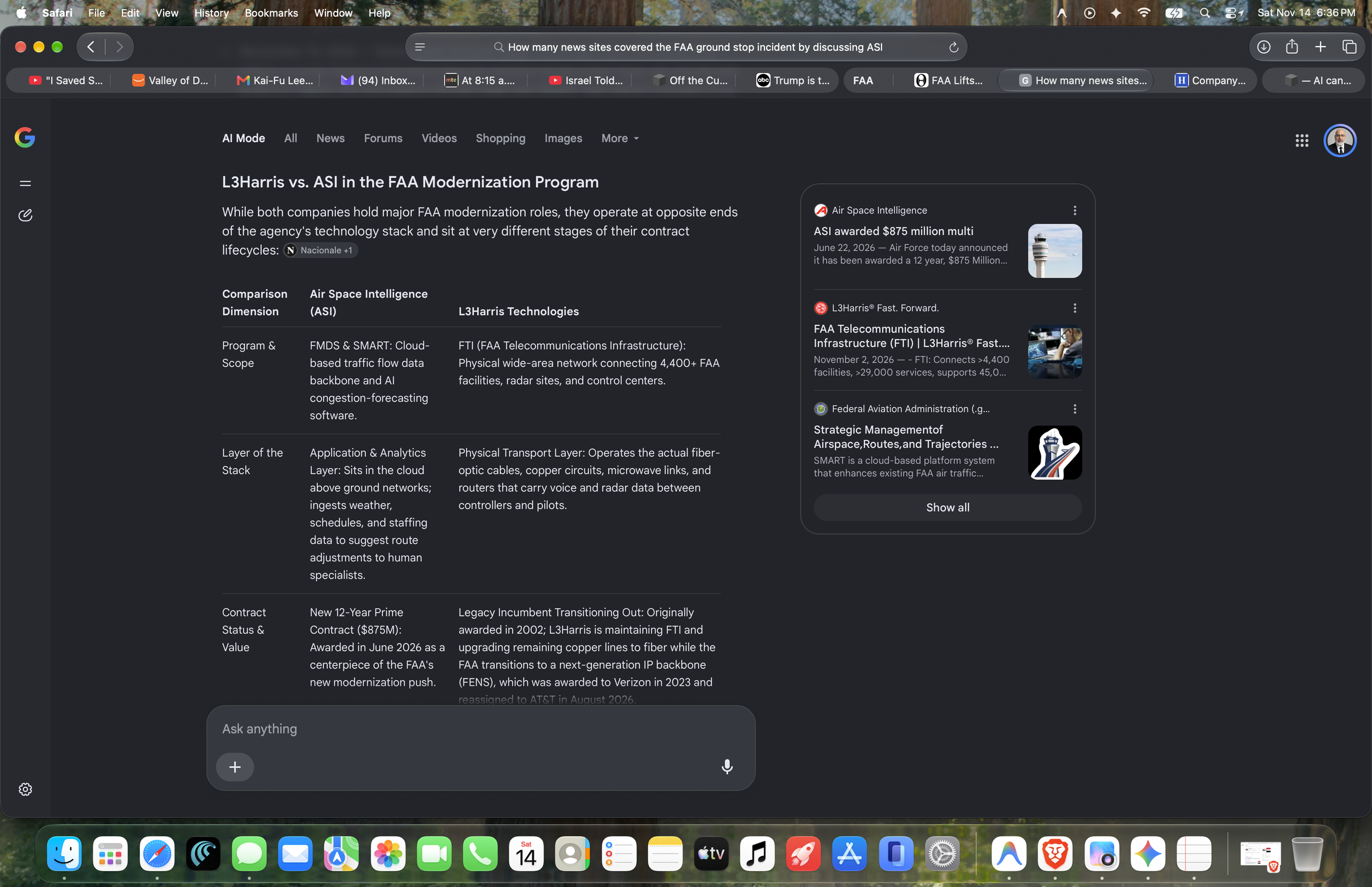
1,000+ Connection Flood. During the changeover, a router began flooding neighboring routers across the FAA Telecommunications Infrastructure (FTI) network with more than 1,000 connection attempts every four to five seconds.
Cascading Center Disruptions. Because the FTI network links more than 4,400 facilities, the connection storm rapidly propagated across the country, disrupting plane-to-controller voice communications and radar feeds at 17 of the FAA's 22 Air Route Traffic Control Centers.
Aging Hardware vs. Installer Error. Duffy noted that many routers in the legacy network date back to 2001 and were originally slated for replacement in 2006. Officials reported issues involving Cisco and Juniper router transitions and stated they are investigating whether the flood resulted from a defective router or an installation and configuration error by L3Harris technicians.
Immediate Mitigation. Systems stabilized once the remote maintenance site was isolated. FAA CTO Rebecca Guy confirmed that the agency disabled the problematic function on roughly 60 similar routers nationwide while conducting joint testing with L3Harris. [1, 2, 3, 4, 5, 6]
Try without personalization
NOTE
We have written an essay about CISCO and Sysco forming the backbone of the internet and Cisco is a well-known manufacturer of routers. I won’t bother issuing a denial because of the absurdity of one guy on a tiny desk in San Diego typing on a laptop things that in hindsight are… well extremely strong and serendipitous links to actual events.
MEDIA THAT DID COVER ASI: Air Space Intelligence, Inc.
While search engines do not expose a live, exact tally of every global website that indexed a breaking news story, at least 16 major national, international, business, and local news outlets explicitly covered Air Space Intelligence (ASI) and its SMART system in connection with the November 13, 2026, FAA ground stop.
National & International News Outlets
The Hill: Reported on ASI's X statement denying any link between its SMART tool and the ground stop, alongside Secretary Sean Duffy’s confirmation that the system wasn't plugged in.
NPR: Covered how ASI quickly dismissed online speculation tying its AI-enhanced software tool to the flight disruptions.
NBC News: Broadcast and published segments detailing ASI’s denial and examining the recent implementation of its SMART system.
CBS News: Reported on the $875 million contract awarded to ASI and FAA Administrator Bryan Bedford's statement that there was "zero evidence of anything AI-related".
Fox Business: Quoted ASI’s statement clarifying that the ground stop was not a result of its integration with the FAA and air traffic control.
ABC News: Included ASI's response and details about its AI air-traffic rollout in its live coverage of the outage.
Al Jazeera: Highlighted ASI's June contract and its November 10 system expansion just days before the nationwide flight suspension.
The Guardian: Tracked the company's denial and official federal responses in its live news updates.
Yahoo News: Covered ASI's statement alongside Transportation Secretary Duffy's remarks attributing the glitch to contractor L3Harris rather than AI. [1, 2, 3, 4, 5, 6]
Business, Tech & Lifestyle Publications
Business Insider: Published an article specifically focused on both ASI and Microsoft denying blame for the nationwide plane chaos.
The Verge: Covered the technical speculation surrounding ASI's software during the four-hour grounding.
Men's Journal: Published a dedicated explainer detailing what is known about ASI's SMART tool following the ground stop. [1, 2]
Local & Regional Broadcast Affiliates
KCRA (Sacramento, CA): Ran a national desk piece examining online questions surrounding ASI's 12-year, $875 million contract.
WMTW (Portland, ME): Syndicated the same investigative report regarding the rollout of ASI's AI air-traffic system.
FOX 5 NY (New York, NY): Aired expert commentary discussing the FAA's new SMART AI program during the outage.
WUSA9 / Local Broadcast Syndicates: Broadcast segments detailing congressional concerns from October regarding SMART's testing protocols alongside ASI's denial. [1, 2]
(Note: Because local television affiliates under networks like Hearst, Tegna, and Nexstar frequently syndicate identical national desk articles across dozens of regional station websites, the total number of individual web domains carrying these stories extends well into the dozens.)
MEDIA THAT DID NOT COVER ASI
Several major newspapers of record, wire services, and specialized aviation publications extensively covered the November 13, 2026, FAA ground stop without naming Air Space Intelligence (ASI) or examining its $875 million SMART AI contract.
While outlets like The Hill, Business Insider, and NBC News scrutinized ASI's statement and recent nationwide rollout, the following prominent outlets omitted the company from their primary coverage, sticking strictly to the Department of Transportation's explanation regarding legacy copper-to-fiber wiring upgrades by contractor L3Harris:
Major National Newspapers
The New York Times: Published multiple live blogs and articles focusing on Secretary Sean Duffy's request for $50 billion in modernization funds, aging copper-wire equipment, and President Trump's silence, without mentioning ASI or the SMART system. [1, 2]
The Washington Post: While one early live update briefly noted in a single sentence that the FAA had announced a "new AI tool" on Tuesday, its subsequent investigative reporting focused exclusively on GAO warnings regarding FAA repair schedules and L3Harris router overloads, omitting ASI by name. [1, 2]
The Wall Street Journal: Focused its business and aviation coverage on airline cancellations, L3Harris's wire-replacement work, and congressional funding fights, leaving out ASI's denial and the SMART rollout. [1, 2]
Major Broadcast & Wire Services
CNN: Covered the government's messaging failures, viral "conspiracy theories," and FAA Administrator Bryan Bedford's statement that there was "zero evidence of anything AI-related," yet did not name ASI or examine the SMART system's recent deployment in its main explainers. [1, 2]
Associated Press (AP): As the primary wire service syndicating breaking news to hundreds of local papers nationwide, its core dispatches tracked flight cancellation metrics and official FAA telecommunications statements without profiling ASI. [1]
Specialized Aviation Trade Press
FlightGlobal: Despite covering commercial aerospace suppliers and air traffic control modernization in depth, its reporting focused on analog router failures, cyberattack probes, and Duffy's $50 billion budget demand without mentioning ASI. [1]
Reuters' reporting on the November 13, 2026, FAA ground stop did not cover Air Space Intelligence (ASI) or its SMART system. [1]
A look at Reuters' coverage shows:
Core Wire Reporting: Reuters' primary articles—such as "US to resume flights after air traffic network failure sparks chaos" and "US flight shutdown exposes deepening air traffic network crisis"—focused strictly on airline flight cancellations, Secretary Sean Duffy's request for $50 billion to replace aging analog infrastructure, and the broader history of U.S. ground stops. Neither ASI nor the SMART AI platform was mentioned. [1, 2]
Syndication Confusion (Reuters Connect): While partner articles distributed through Reuters Connect (such as a Palm Beach Post / USA Today Network piece syndicated to regional outlets) did explicitly report on ASI's denial and the SMART rollout, those stories were written by third-party network reporters rather than Reuters' own staff. [1]
Like the Associated Press, Reuters kept its staff coverage anchored to the Department of Transportation's official telecommunications explanation and commercial airline impacts. [1, 2]
FINAL NOTE ON ASI
Air Space Intelligence (ASI) moved from contract award to nationwide deployment of its SMART system in less than five months, going live across all 22 U.S. air traffic control centers just three days before the November 13, 2026, outage. Within the FAA's modernization architecture, ASI provides the upper-level cloud planning software, whereas L3Harris maintains the underlying physical telecommunications pipes that connect air traffic facilities. [1, 2, 3, 4]
Timeline of ASI's SMART Rollout (Up to November 13, 2026)
The FAA compressed what is typically a multi-year aviation software testing cycle into a rapid five-month rollout:
September 24, 2025 — FMDS Initiative Launched. The FAA formally initiates the Flow Management Data and Services (FMDS) modernization effort to replace its legacy traffic-flow backbone.
June 22, 2026 — $875 Million Contract Award. Following competitive bidding against Palantir and Thales, the FAA awards Air Space Intelligence a 12-year, $875 million contract to build and deploy both FMDS and SMART. [1]
Mid-September 2026 — Airline Pushback & 90-Day Trial Pledge. After commercial airlines express concern over the aggressive schedule, Transportation Secretary Sean Duffy and FAA officials reassure carriers that full deployment will follow a structured 90-day evaluation period. [1]
September 21, 2026 — Limited D.C. Metro Launch. The DOT and FAA unveil SMART in limited operations across the National Capital Region, covering Reagan National (DCA), Washington Dulles (IAD), and Baltimore/Washington International (BWI) airports. [1, 2]
October 2026 — Congressional Safety Warnings. Over two dozen House lawmakers send formal letters to the DOT, FAA, and GAO calling for a pause in the D.C. trial until the agency answers questions regarding AI safety testing, training, and controller oversight. [1, 2]
November 10, 2026 — Nationwide Expansion. Just 50 days into the promised 90-day trial, the FAA announces that SMART has already rerouted 180 flights in the D.C. area and expands the tool to all 22 Air Route Traffic Control Centers (ARTCCs) nationwide. [1, 2]
November 13, 2026 — Nationwide Ground Stop. Three days after the nationwide rollout, a router flood on the FAA's telecom network forces a four-hour, 20-minute halt to all U.S. flights. ASI and federal officials state that SMART was neither involved in nor connected to the outage. [1, 2, 3]
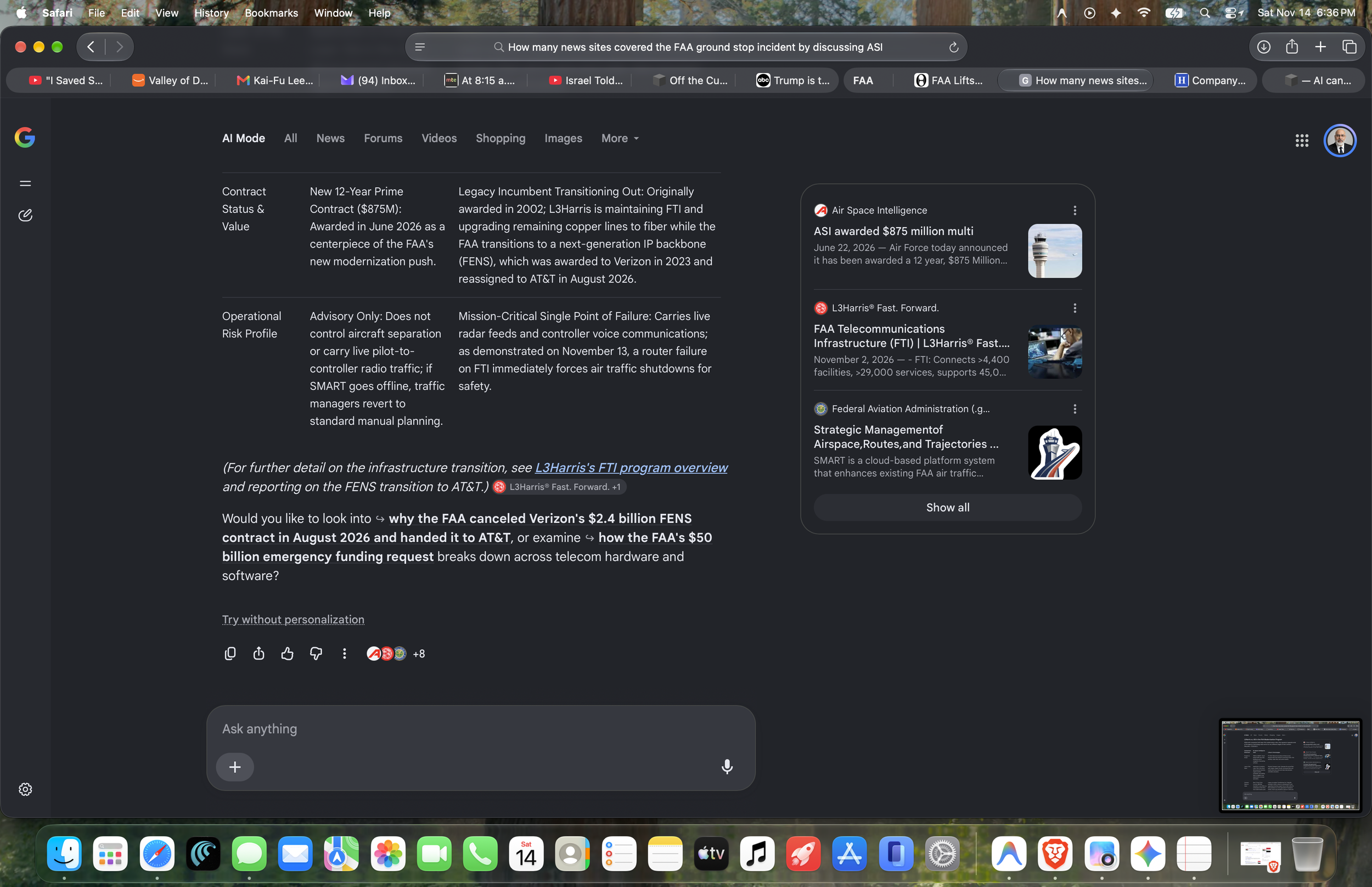
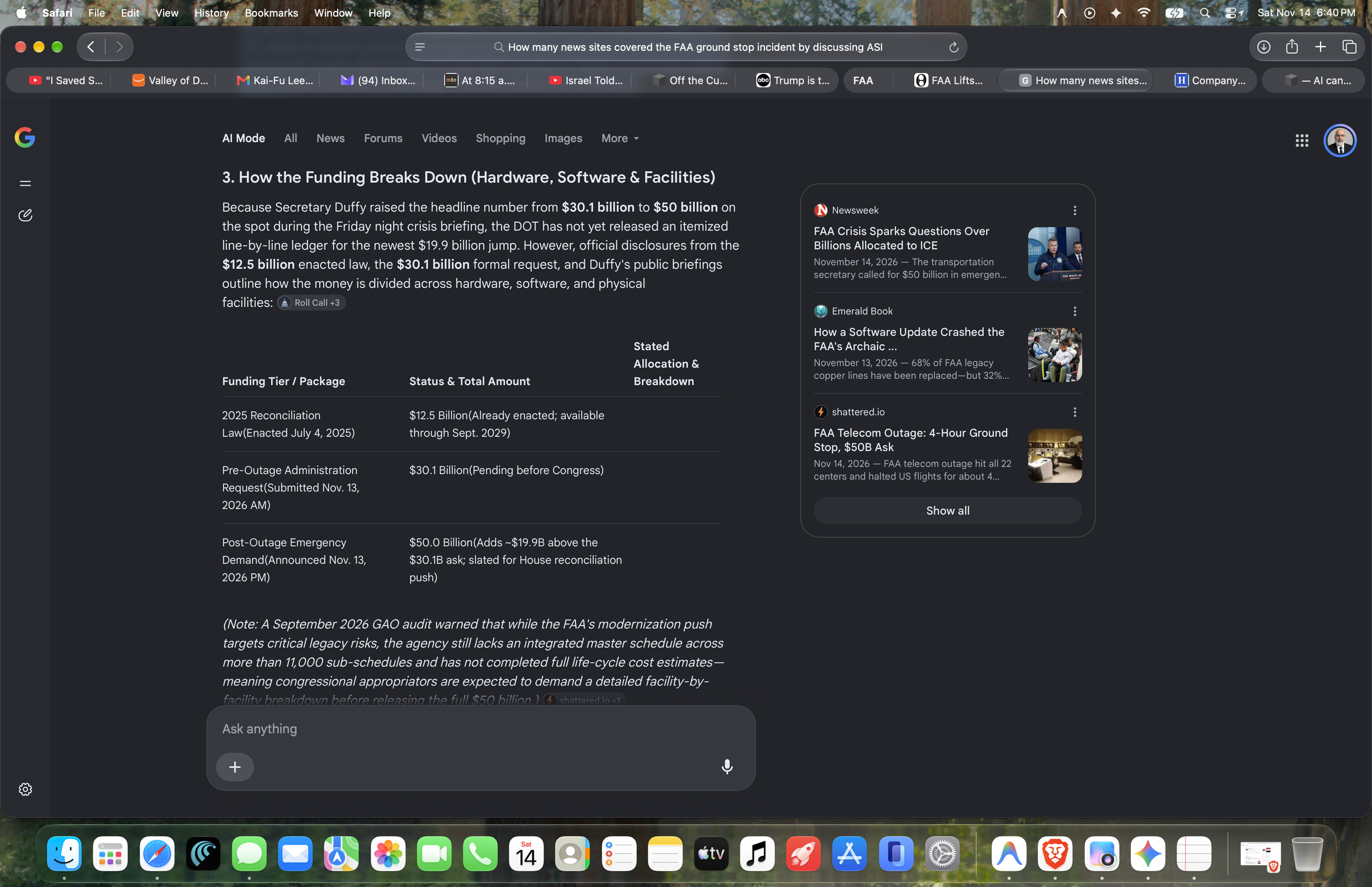
In August 2026, the FAA stripped Verizon of its lead prime role on the $2.4 billion FAA Enterprise Network Services (FENS) contract and handed program leadership to AT&T to meet an aggressive December 2028deadline. Months later—just hours after the November 13 ground stop—Transportation Secretary Sean Duffyescalated a pending $30.1 billion aviation request into a $50 billion emergency funding demand. [1, 2, 3, 4, 5]
1. Why the FAA Stripped Verizon of the FENS Lead and Handed It to AT&T
The FAA Enterprise Network Services (FENS) program is the multi-billion-dollar effort to replace L3Harris’s aging, copper-heavy network (FTI) with a modern Internet Protocol (IP) backbone. [1, 2]
The Original 2023 Award: In March 2023, the FAA awarded Verizon Business Network Services a 15-year contract worth up to $2.4 billion to design, build, and operate FENS. However, the transition moved slowly while the FAA continued relying on legacy analog circuits. [1, 2, 3, 4]
The 2028 Deadline & Peraton Integration: Under the Trump administration's Brand New Air Traffic Control System (BNATCS) initiative, the DOT set a hard target of December 2028 to complete the nationwide air traffic overhaul, hiring Peraton in December 2025 as prime systems integrator. [1]
The August 2026 Restructuring: On August 11–13, 2026, the FAA restructured FENS around AT&T, awarding AT&T an initial $74.3 million task order as the starting step of a 15-year, multi-billion-dollar prime contract. [1, 2]
Verizon's Demotion: Rather than terminating Verizon completely, the FAA demoted Verizon to a supporting subcontractor role responsible for certain core network functions while AT&T took over overall project management and accelerated deployment. [1, 2]
Procurement Backlash: Industry analysts criticized the move after years of competitive bidding, noting the agency bypassed a new competition in favor of a sole-source restructuring to hit its 2028 timeline.[1, 2]
2. Background & Context Behind the \$50 Billion Emergency Request
The $50 billion figure announced by Secretary Duffy on the evening of November 13, 2026, did not appear out of nowhere—it represents the third stage of a year-long funding escalation: [1, 2]
July 2025 ("Down Payment"): Congress approved $12.5 billion over five years for air traffic control modernization as part of the One Big Beautiful Bill Act reconciliation package. Duffy and White House Budget Director Russell Vought described this as only a partial "down payment".
September – November 13 Morning ($30.1 Billion Request): In late September 2026, Senate allies introduced legislation—backed by a formal letter from Duffy and Vought on the morning of November 13—seeking an additional $30.1 billion for aviation infrastructure.
November 13 Evening ($50 Billion Emergency Demand): Hours after the telecom router failure grounded thousands of flights, Duffy and Homeland Security Secretary Markwayne Mullin held a White House briefing raising the request by nearly $20 billion—to $50 billion—arguing Congress must fund a complete end-to-end rebuild rather than "patchwork fixes".
Why the System Fell Behind: Unlike countries such as Canada (NAV Canada) or European nations that fund air traffic modernization directly through user fees, the U.S. relies on annual congressional appropriations. Over the past 25 years, piecemeal funding left roughly 32% of FAA circuits still running on 1980s-era analog copper lines, routers from 2001, and floppy-disk data loaders at hundreds of facilities. [1, 2, 3, 4, 5, 6, 7]