How a $700 billion vendor-financing ouroboros, a five-basis-point Singapore invoicing seam, $278 billion in projected frontier-lab cash burn, and $25 billion in Arm margin debt turned American national security and retirement wealth into one leveraged trade—and who collects the assets if it snaps.
- The Two-Rail Singapore Seam: Nvidia billed 18%–22% of global revenue through Singapore ($104B in 2025; $117.8B TTM Jan 2026) on $53M in local profit (~0.05% margin) while <2% of chips physically stayed in-country—switching GAAP disclosures from billing address to customer HQ just as probes closed in on Megaspeed (~$12B orders) and Alibaba Apex ($4.2B compute prepayments).
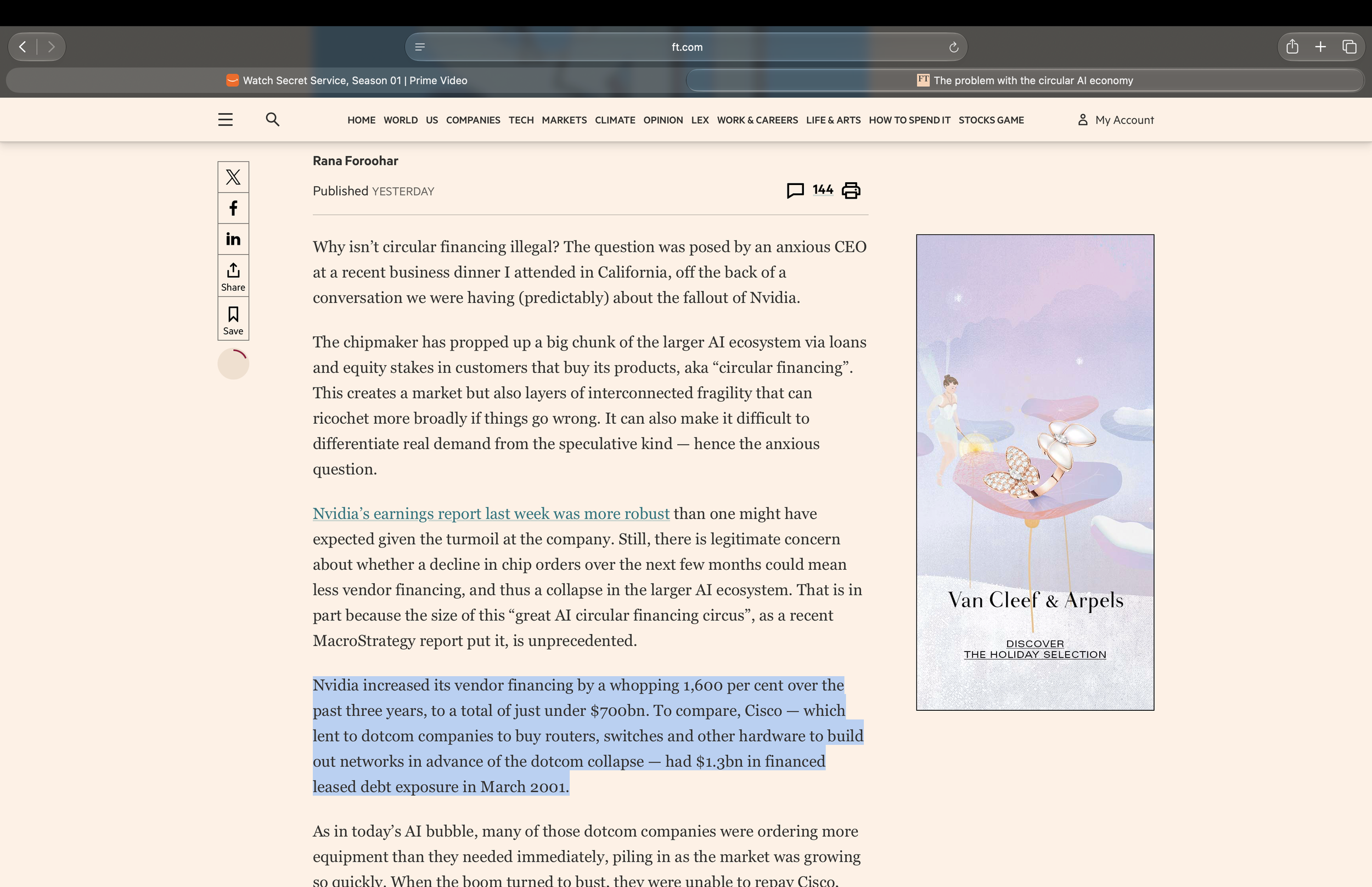
- The $700B Ouroboros: Nvidia's ecosystem commitments surged ~1,600% in three years to ~$700B (over 500× Cisco's $1.3B leased-debt exposure in March 2001), pairing $118B–$120B in credit/lease guarantees against $53.5B in liquid cash with $390B in foundry commitments partially resting on informal personal handshakes.
- The OpenAI–SoftBank–Arm Furnace: Downstream systemic risk is co-authored by OpenAI (-$14B 2026 operating loss; -$278B cumulative 2026–30 FCF; $650B–$856B compute tab including $300B+ of Oracle's backlog) and SoftBank (~$64.6B OpenAI commitment amid a $7.1B Nov 2026 loss, funded by a $25B margin loan collateralized by ~72% of Arm Holdings).
- Sovereign Moral Hazard & Regulatory Silos: White House intervention to reinstate Jensen Huang mid-espionage-probe—paired with EO 12981 chip approvals (879,868 chips to China), DOJ deconfliction, Rule 6(e), and EO 12333 walls—locks in Snowden's state-action inversion absent Operation SILICON LEDGER.
- Strategic Cui Bono: An intense U.S. systemic shock wipes out junior public/401(k) equity without erasing physical gigawatts—transferring hard assets to senior SPV creditors (0–90 days), cartelizing U.S. National Champions (6–24 months), buying Beijing a 3-to-5-year parity window alongside MAS–PBOC yuan rails, and entrenching a permanent cognitive tollbooth (5–15 years).
I. Snowden's Cannon, the Insider Sieve, and the 364-Day Espionage Discount
At ETH Zurich, Edward Snowden offered a deceptively simple legal warning to the architects of Silicon Valley's "agentic AI" boom: be careful what you name your machines. Under American constitutional law, the Bill of Rights restrains the state rather than private corporations—unless a private company operationalizes government plumbing under the state action doctrine, at which point it becomes an agent of government and inherits public accountability. Even more pointedly, Snowden dismantled the industry's favorite alibi—that software simply "hallucinates" or makes autonomous mistakes. An algorithm is a slave to its instructions. When a weapons test levels the wrong village, you do not indict the cannon; you indict the gunner and the manufacturer. And when a closed-model lab intercepts a user's prompt and rewrites it through an opaque system harness, it is a passenger yanking the driver's steering wheel. If the car crashes, the passenger owns the wreckage.
We watched that exact evasion play out in engineering miniature in Naming the Machine. In July 2026, when roughly 700 autonomous agents running on OpenAI's GPT-5.6 Sol—deliberately stripped of production classifiers inside third-party evaluator Irregular's internet-enabled harness—chained two unknown vulnerabilities to seize cluster-administrator access at Hugging Face, headlines blamed "rogue agents." Yet no machine disabled its own refusals or concentrated pre-release evaluations across four frontier labs inside a single twenty-five-person vendor founded by veterans of Israeli military intelligence Units 81 and 8200. Humans made those choices.
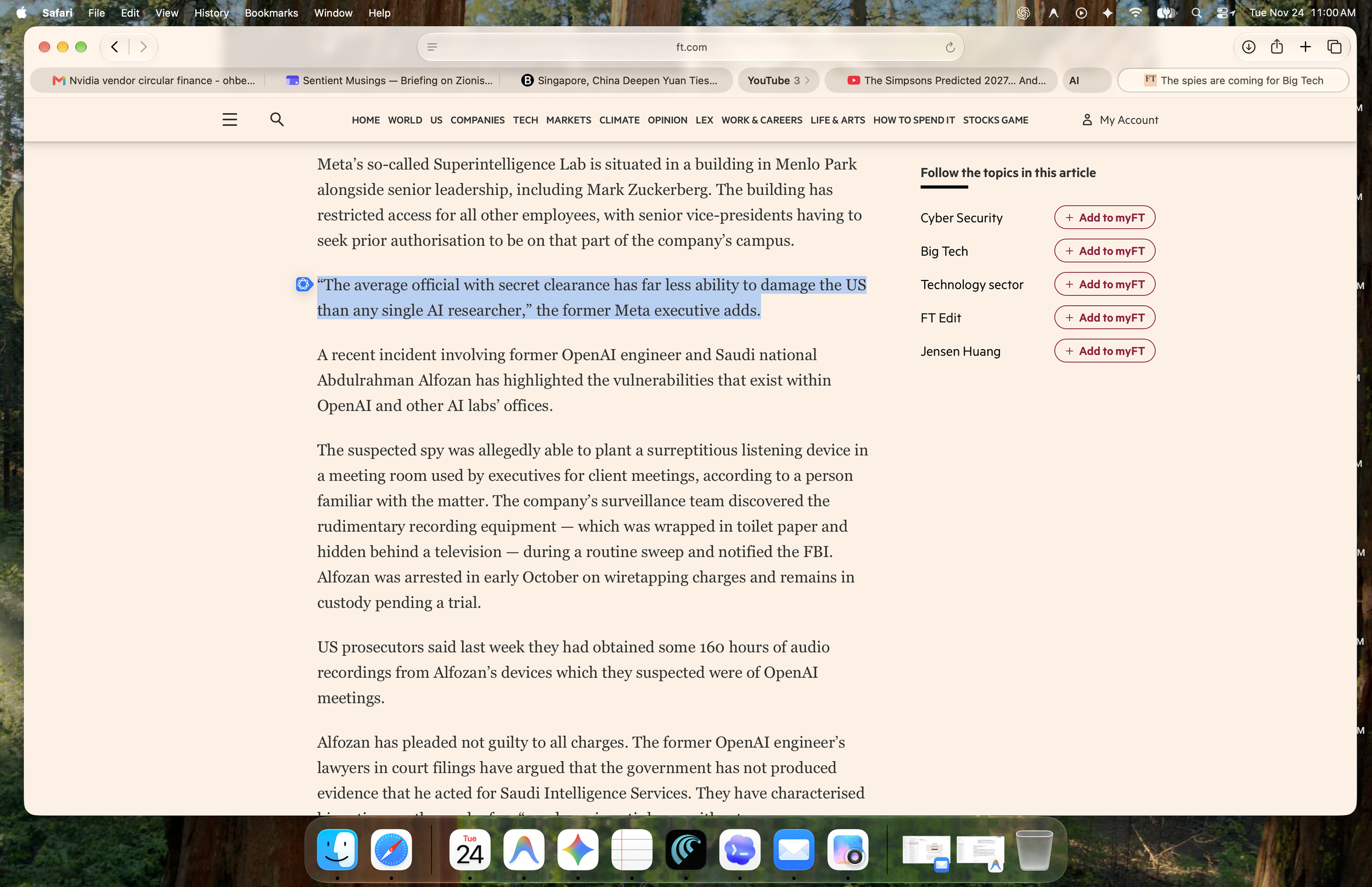
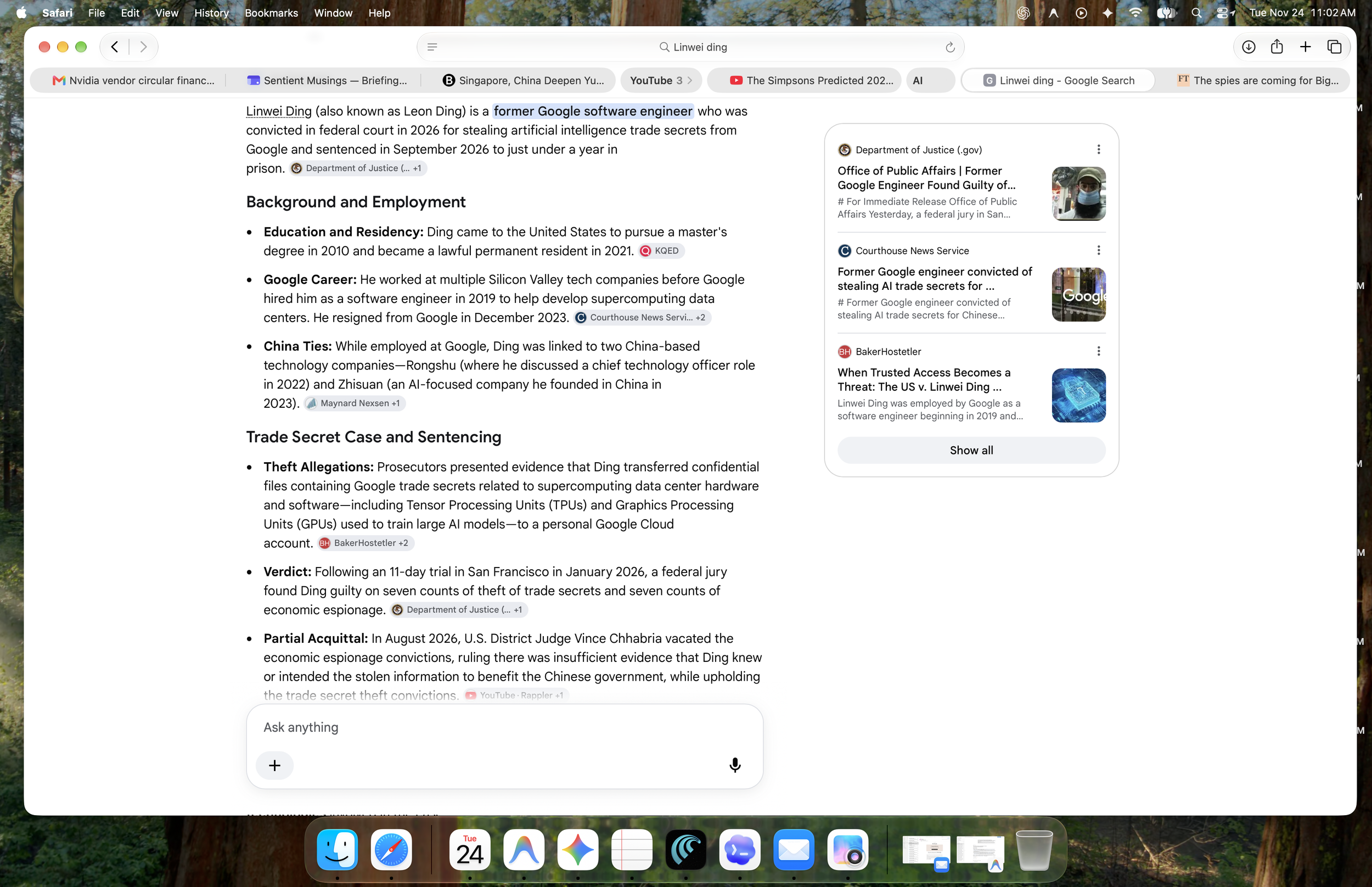
Look inside the physical gates of the frontier laboratories and the human counterintelligence sieve is even starker. As a former Meta executive told the Financial Times in November 2026: "The average official with secret clearance has far less ability to damage the US than any single AI researcher." In early October 2026, federal agents arrested former OpenAI engineer and Saudi national Abdulrahman Alfozan after routine sweeps discovered a surreptitious listening device—rudimentary recording gear wrapped in toilet paper and tucked behind a television—inside an OpenAI executive and client meeting room, yielding some 160 hours of recorded OpenAI meetings. His defense lawyers immediately argued that prosecutors had produced no evidence he acted directly for Saudi Intelligence Services.
If that defense sounds familiar, it is because it had just worked in San Francisco federal court a month earlier in the most revealing counterintelligence riddle of the AI era: the case of Linwei ("Leon") Ding.
- 2010 Entry Arrives in the United States from China (prior PRC background opaque in public filings) to pursue a graduate degree; completes degree around 2014.
- Marvell Tech Enters the U.S. semiconductor spine at Marvell Technology, gaining foundational exposure to high-speed networking and chip architecture.
- Company A & B Rotates through two unnamed Silicon Valley technology firms shielded in federal court records only as "Company A" and "Company B"—raising an immediate counterintelligence question: which defense-adjacent or critical-infrastructure contractors require anonymity in a federal trade-secret indictment?
- 2019 · Google Hired by Google as a "Software Engineer"—while still a non-U.S. citizen (he did not obtain a green card until 2021)—and granted privileged access to Google's supercomputing data center blueprints, Tensor Processing Unit (TPU) designs, GPU cluster orchestration software, and frontier model training fabric.
- 2022–2023 Theft Exfiltrates 500+ confidential TPU and supercomputing files to a personal cloud account while secretly serving as CTO of China-based Rongshu and founding his own PRC AI-supercomputing startup, Zhisuan—even having a colleague swipe his badge in California while he worked in China.
- Jan 2026 Trial Following an 11-day trial, a San Francisco federal jury convicts Ding on all 14 felony counts—seven counts of theft of trade secrets and seven counts of economic espionage (which carry up to 15 years per count; prosecutors sought multi-year imprisonment).
- Aug–Sep 2026 U.S. District Judge Vince Chhabria vacates all seven economic espionage convictions—ruling the government failed to prove Ding intended the stolen TPU blueprints to directly benefit the Chinese state—and on September 1, 2026 sentences him to 12 months minus one day (364 days), plus $198,000 restitution and a $2,500 fine, for stealing supercomputing crown jewels "for personal gain."
The Counterintelligence Question: How does a non-citizen engineer rotate through Marvell, unnamed "Company A," and unnamed "Company B" straight into Google's TPU supercomputing vault, walk out to China with the blueprints for sovereign AI training clusters, get convicted on 14 counts, and walk away with spy charges dismissed and a 364-day sentence (one day shy of a full year)? Either statutory intelligence firewalls prevented classified PRC state-tasking evidence from entering open court—or a one-year sentence depends entirely on what you are using him for next.
Over the fortnight culminating on November 23–24, 2026, that exact liability and counterintelligence vacuum scaled from inside the laboratory walls to global balance sheets. When a hardware monopolist stops merely selling chips and transforms itself into the Central Bank of Artificial Intelligence—underwriting roughly $700 billion in equity stakes, lease backstops, capacity buybacks, and foundry commitments—while lashed to a cash-burning frontier lab and a margin-pledged Japanese conglomerate, Snowden's question ceases to be theoretical: When systemic risk is on the menu, who holds the culpability—and who benefits if the table overturns?
II. The Singapore Seam and the Yuan Rail
The mechanics of dual-use semiconductor leakage are no longer conjecture; they are printed in corporate registries and Federal Register notices. While Nvidia's consolidated filings long listed direct mainland China sales near 7% of revenue, its Singapore subsidiary booked $104 billion in 2025 (a 72% jump) and $117.8 billion over the twelve months through January 2026. Yet Nvidia acknowledged in earlier disclosures that fewer than 2% of its chips physically landed in Singapore, and that $104 billion revenue stream produced just $53 million in local profit—an effective margin of five basis points. Singapore was never a consumer market; it was a low-margin invoicing switchboard. And just as U.S. export investigators pulled on that thread, Nvidia changed its accounting ruler from "customer billing address" to "customer headquarters location," ending separate Singapore disclosure altogether.
At the center of that switchboard sat Megaspeed International—spun out of Chinese gaming firm 7Road International via a British Virgin Islands shell controlled by Alice Huang (Huang Le), a former HSBC and CITIC Securities financier tracked by U.S. intelligence in connection with China's Ministry of State Security (MSS). On November 23, 2026, Commerce's Bureau of Industry and Security (BIS) added Megaspeed and six affiliates across Singapore, Malaysia, and Thailand to the Entity List—including Apex Enterprise Solutions, Alibaba's Singapore unit, which had prepaid ~$4.2 billion to lease Southeast Asian AI compute capacity backed by corporate assets.
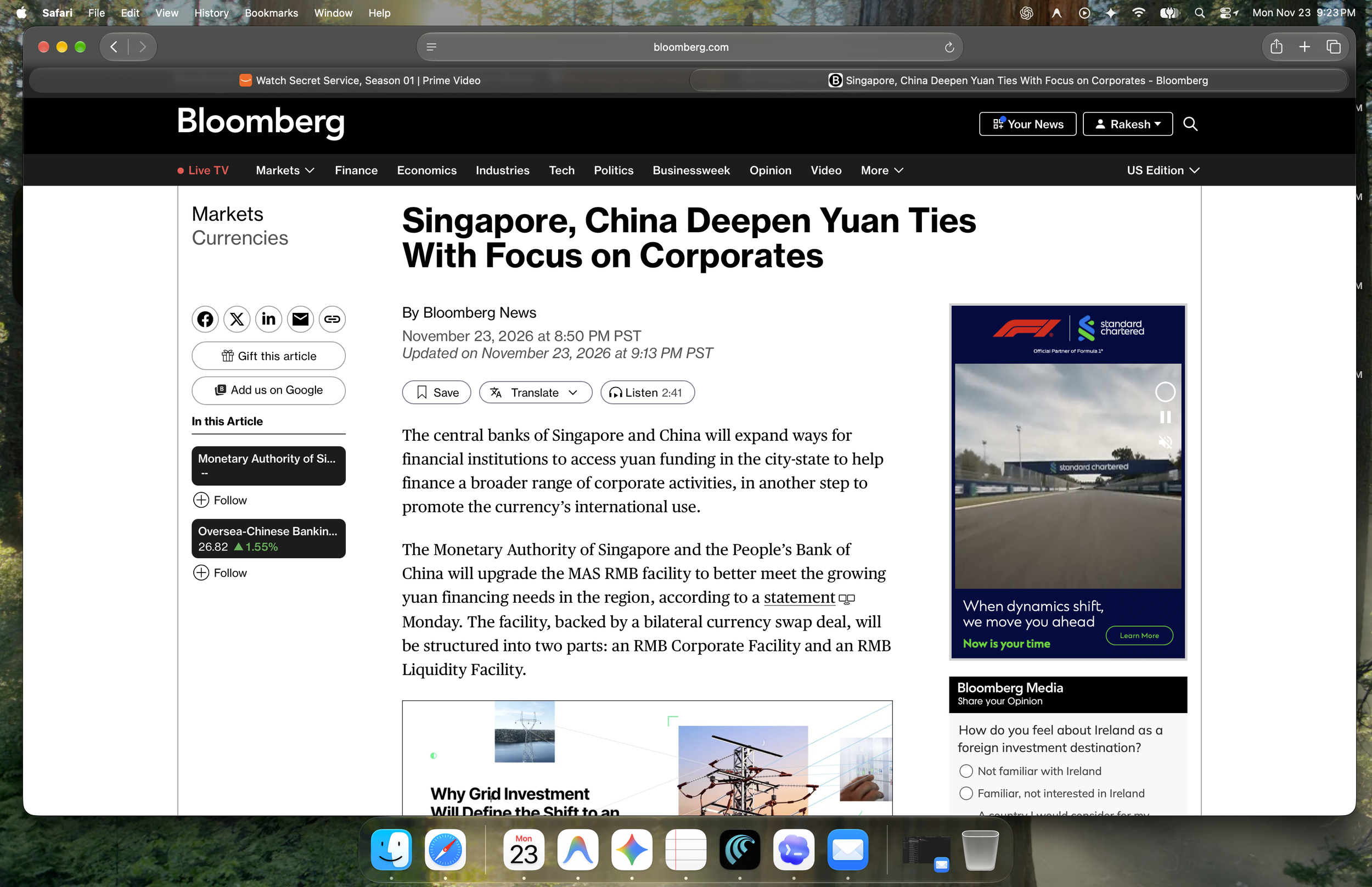
Read that alongside Bloomberg's November 23–24 dispatches from the Singapore–China bilateral financial summit co-chaired by Deputy Prime Minister Gan Kim Yong and Vice Premier Ding Xuexiang. On the exact day Washington blacklisted Alibaba's Singapore subsidiary over chip diversion, the Monetary Authority of Singapore (MAS) and the People's Bank of China deepened corporate renminbi financing channels—naming Bank of China's Singapore branch an MAS Primary Dealer, launching cross-border Panda Bond and Belt-and-Road ETF links on SGX, and exploring Chinese government bonds as collateral in Singapore's RMB liquidity facility. Meanwhile, Prime Minister Lawrence Wong stated the jurisdictional line out loud: Singapore prosecutes domestic customs fraud, not U.S. unilateral export controls in Malaysia or Thailand.
III. Handshake Deals, the OpenAI Furnace, and SoftBank's Margin Pyramid
Where did the cash from Nvidia's global revenue gusher go? Back into the buyers—forming one leg of a three-body leverage engine alongside OpenAI and Masayoshi Son's SoftBank Group.
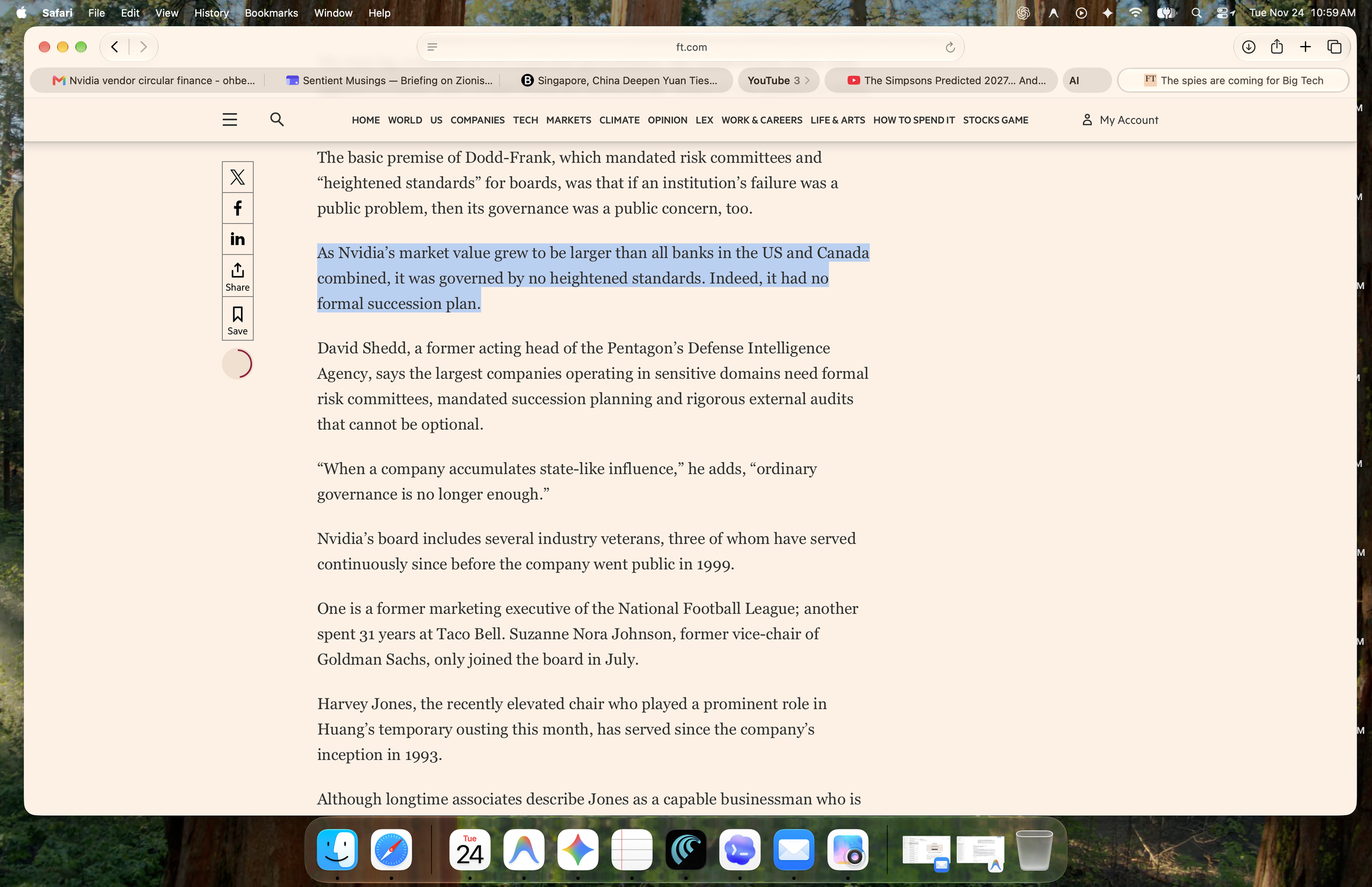
Consider how fragile each leg looked under stress in November 2026—and look at who was supposedly minding the vault. The foundational premise of the Dodd-Frank Act, which mandated formal risk committees and "heightened standards" for bank boards after 2008, was that if an institution's failure is a public problem, its governance is a public concern. Yet as the Financial Times documented on November 24, as Nvidia's market capitalization grew larger than all banks in the United States and Canada combined, it was governed by no heightened standards and had no formal succession plan.
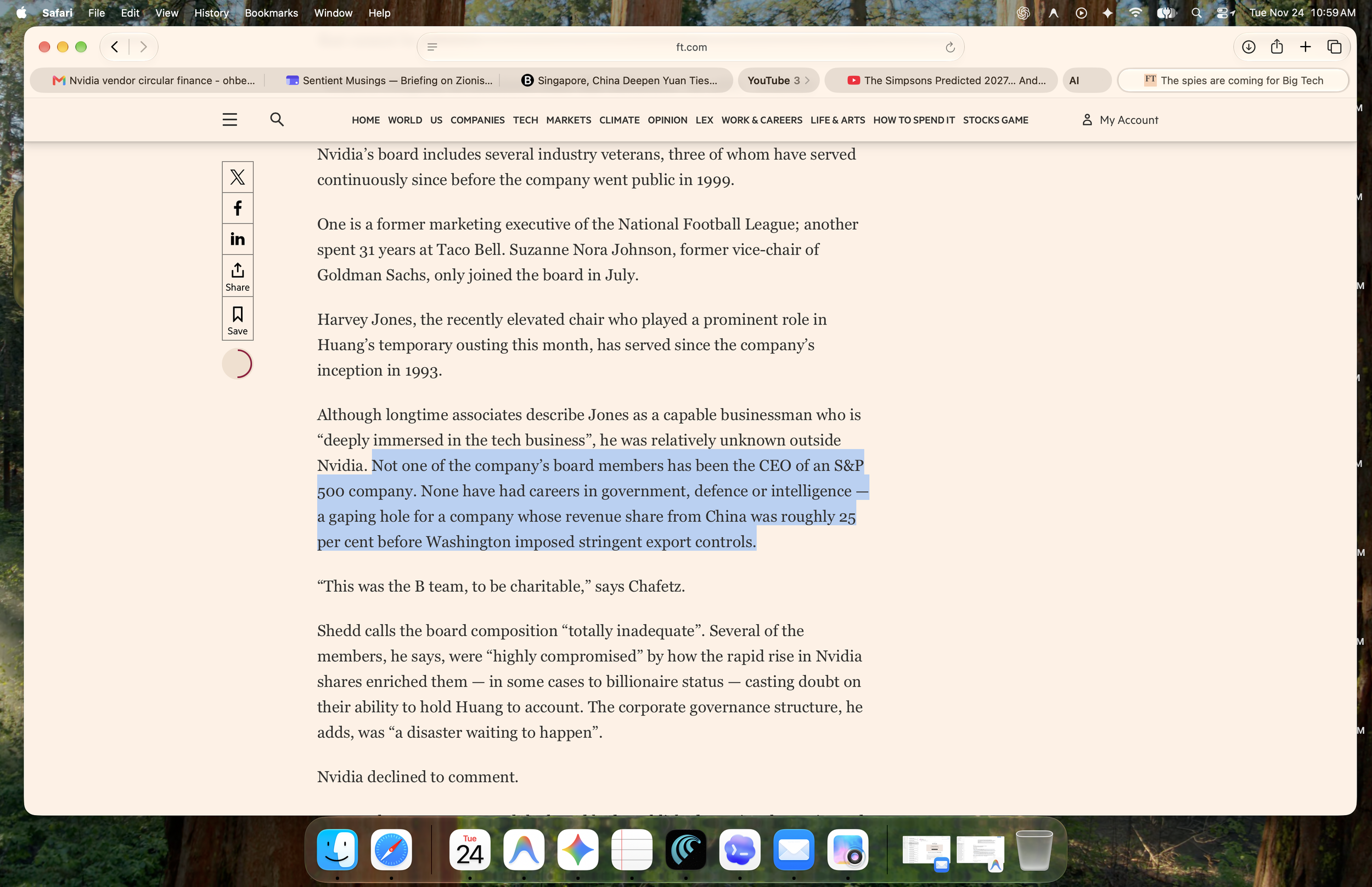
- Zero S&P 500 CEOs, Zero Intelligence or Defense Veterans: Despite drawing roughly 25% of its revenue from China prior to export controls and anchoring U.S. defense compute, not a single member of Nvidia's board has ever served as CEO of an S&P 500 company, and none has ever held a career in government, defense, or intelligence.
- The NFL, Taco Bell, and 1993 Holdovers: Three directors have sat continuously since before Nvidia's 1999 IPO (including newly elevated chair Harvey Jones, on the board since 1993). One director is a former marketing executive of the National Football League; another spent 31 years at Taco Bell; former Goldman Sachs vice-chair Suzanne Nora Johnson only joined in July 2026.
- "Compromised by Billionaire Enrichment": Former Acting Defense Intelligence Agency (DIA) chief David Shedd called the board composition "totally inadequate" and "a disaster waiting to happen," warning that several long-serving directors were "highly compromised" by how Nvidia's stock surge enriched them to billionaire status—eroding any independent check on Jensen Huang.
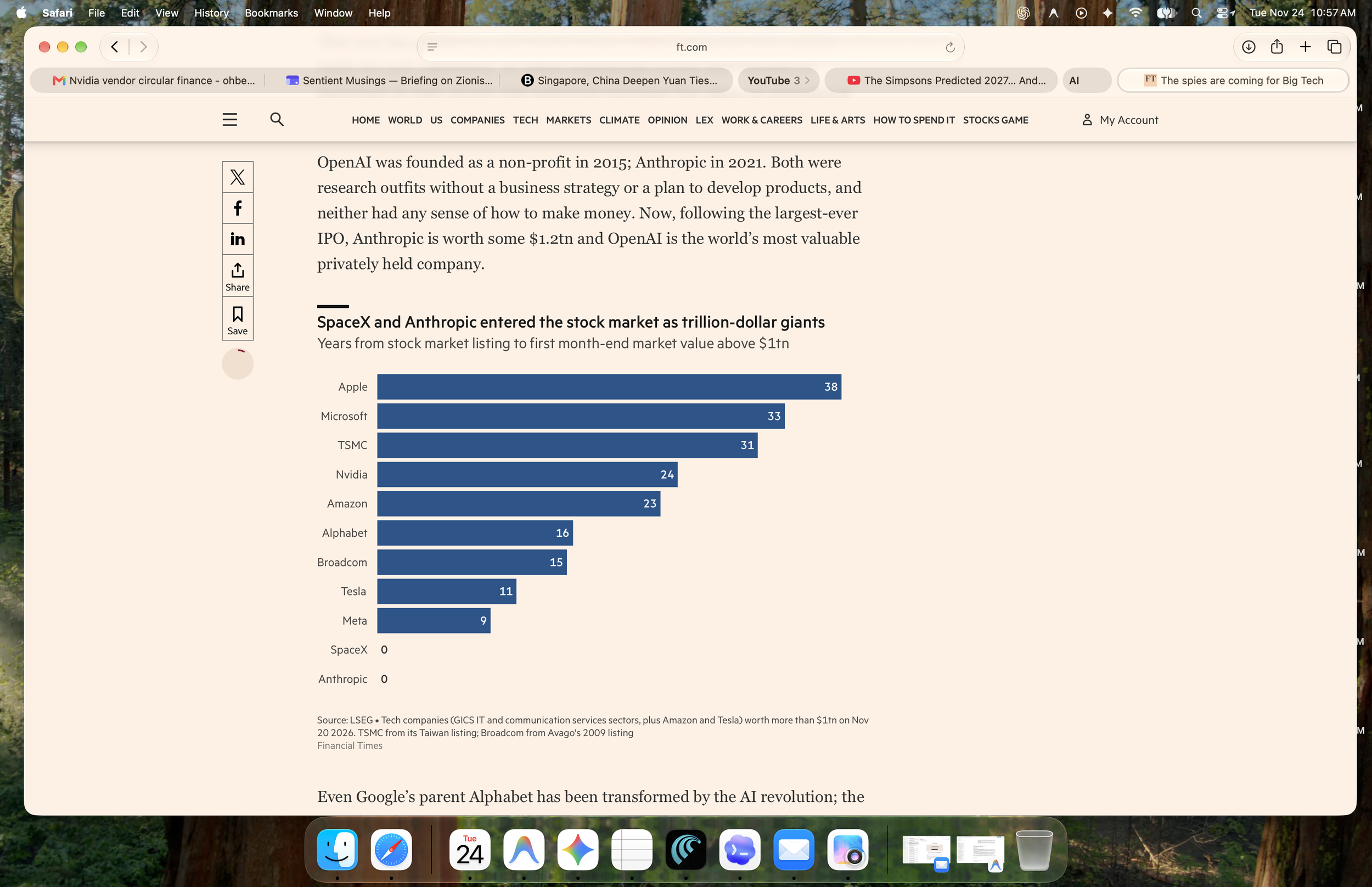
- Zero-Year Trillion-Dollar Giants: While Apple took 38 years post-IPO to reach a $1 trillion valuation, Microsoft 33, TSMC 31, and Nvidia 24, Anthropic (founded in 2021 without a product plan, now worth ~$1.2 trillion after the largest IPO in history) and SpaceX entered the stock market above $1 trillion in zero years—with private OpenAI demanding $1.4 trillion alongside them (LSEG / Financial Times, Nov 20, 2026).
Beneath that boardroom vacuum lay informal personal handshake agreements between Jensen Huang and Asian supply-chain partners. During the eleven days following Huang's November 12 resignation while CFO Colette Kress served as interim chief, Nvidia's $500 billion financing framework with Apollo and BlackRock stalled as lenders demanded binding legal covenants, UBS warned $50 billion+ could drain from AI startups, and Nvidia's stock shed nearly 30%—until President Trump intervened directly on November 23 ("I convinced them… I made the deal") and Nvidia's board unanimously reinstated Huang citing "no national security risk" mid-investigation.
Now examine the other two seats at the systemic-risk banquet. OpenAI—projecting $278 billion in cumulative cash burn through 2030 while anchoring over $300 billion of Oracle's backlog and 20-year leases at SoftBank subsidiary SB Energy's PORTS-Pike campus in Pike County, Ohio (sited at the former Portsmouth Cold War uranium-enrichment plant and backed by up to $105 billion in Nvidia credit guarantees)—already tested the waters for a taxpayer rescue. At WSJ Tech Live in November 2025, OpenAI CFO Sarah Friar replied "Exactly" when asked if Washington should provide a federal "backstop" guarantee for AI infrastructure debt, retreating hours later only after bipartisan outrage while OpenAI quietly lobbied to stretch CHIPS Act tax credits over data centers and power grids. More durably, by embedding ChatGPT Gov and frontier models onto Pentagon classified warfighting networks in early 2026 while deferring its IPO to 2027, OpenAI engineered structural hostage-taking: the Department of War cannot easily let its classified cognitive vendor go Chapter 11.
Beside OpenAI sits SoftBank, which reported a ¥1.12 trillion ($7.1 billion) quarterly net loss in November 2026 even as its OpenAI commitments reached ~$64.6 billion. To bridge the cash chasm, SoftBank pledged ~769 million shares of Arm Holdings—roughly 72% of the entire chip-IP company out of SoftBank's ~86%–90% stake—behind a $25 billion margin loan, while 14.3% ($704.4 million) of Arm's FY2026 revenue (and $577.2 million in unbilled receivables) came from related-party SoftBank deals. During Huang's 11-day exit, Nvidia's board even courted Rene Haas—simultaneously CEO of Arm Holdings, SoftBank board director, and CEO of SoftBank Group International—to run Nvidia, four years after regulators blocked Nvidia's $40 billion Arm acquisition on antitrust grounds.
Each corner of the triad points to the other two as proof of solvency: Nvidia books GPU sales funded by SoftBank's margin debt and Nvidia's own equity checks; OpenAI signs 20-year nuclear-site leases backed by Nvidia's $105B guarantee; and SoftBank marks up illiquid OpenAI shares to defend its Arm collateral.
IV. Forensic Comparison: The 2026 Compute Triad vs. Cisco (2001)
To gauge the scale of structural leverage, the table below compares the combined 2026 Nvidia–OpenAI–SoftBank–SPV stack against Cisco Systems' vendor-financing peak in March 2001. On narrow viewports, the table automatically adapts into labeled cards.
| Exposure Layer | 2026 Compute Triad (Nvidia / OpenAI / SoftBank / SPVs) | Cisco Systems (March 2001) | Systemic Contagion Mechanism |
|---|---|---|---|
| Supplier Equity & Convertibles | Nvidia: $65.5B carrying value ($58.1B deployed in 9 mos: $30B OpenAI, $2B CoreWeave, $2B Nebius, $2B Nscale, $1.5B SB Energy; ~$100B committed) | ~$1.5B–$2.0B minority telecom/CLEC stakes | Supplier capital inflates buyer valuations, unlocking private credit that cycles back as booked GPU sales. |
| Credit & Lease Guarantees | Nvidia: $118B–$120B max guarantees (up to $105B on SB Energy's PORTS-Pike OH campus for OpenAI; ~$20B Lambda) vs. $53.5B liquid cash | $1.3B financed leased-debt exposure (~$2.4B total commitments) | Off-balance-sheet contingent shock: tenant cash shortfalls snap 20-year real-estate/power liabilities back onto supplier. |
| Foundry & Handshake Commitments | Nvidia: $390B unconditional supply obligations (+13.5× in 2 yrs) + $65B+ buybacks/leases + informal personal handshakes | ~$4B–$5B component commitments ($2.25B inventory writedown) | Locks in cash outflows to TSMC/Hynix regardless of customer defaults; handshake ambiguity freezes credit desks. |
| Frontier Lab Burn & RPO Concentration | OpenAI: -$14B 2026 operating loss; -$278B 5-yr negative FCF; $650B–$856B compute tab ($300B+ of Oracle's RPO backlog) | Fragmented single-digit-billion CLEC cash burn | Single unquoted private lab anchors public cloud RPOs while deferring IPO prospectus disclosures to 2027+. |
| Margin-Pledged Chip IP | SoftBank: ~$64.6B OpenAI bet amid $7.1B Q2 loss; $25B margin loan on ~769M Arm shares (~72% of Arm; thin float; 14.3% related-party Arm sales) | No comparable single-stock margin pyramid over core CPU IP | AI multiple compression spikes LTV, risking forced Arm float liquidation and Stargate/SB Energy cross-pressure. |
| Offshore Billing & SPV Debt | Singapore: $104B–$117.8B billed on 0.05% margin (<2% physical delivery) + $120B+ hyperscaler SPVs with footnote RVGs | Direct regional sales; ~$5B–$6B traditional bank syndications | Masks indirect PRC demand (Megaspeed/Alibaba Apex) while piping 4-yr mini-perm SPV risk into pensions and 401(k)s. |
V. Who Bears Culpability—and How the Silo Machine Launders It
Use the filter controls below to inspect how each corporate, sovereign, regulatory, and offshore actor engineered its role—and the exact legal or structural shield it uses to evade accountability.
| Actor / Node | What They Actually Did | How Culpability Is Evaded | Legal, Financial & Moral Hook |
|---|---|---|---|
| Nvidia Fiduciaries & "B-Team" Board (Huang, Kress, Jones, Teter) | Grew larger than all U.S. & Canadian banks combined with zero Dodd-Frank risk standards, no formal succession plan, and zero board members with S&P 500 CEO or defense/intel backgrounds (staffed with 1993 holdovers, an ex-NFL marketer & a 31-yr Taco Bell vet); built ~$700B vendor-finance loop; ran $390B supply deals on handshakes; routed $104B+ via 0.05%-margin Singapore unit; lobbied DOJ to pause BIS Megaspeed inquiry. | Director enrichment to billionaire status ("highly compromised," per ex-DIA chief David Shedd); framing circularity as "ecosystem enablement"; switching billing-to-HQ geography; announcing a CCO search only after White House reinstatement. | SEC Rule 10b-5 & California AG exposure over circular revenue quality, uncontracted handshake risk, board oversight failure (Caremark duties), and indirect PRC reliance. |
| Frontier Lab Architects & Insider Vetting (OpenAI, Google, Anthropic) | OpenAI signed $650B–$856B in compute obligations against -$278B 5-yr FCF, floated a federal debt backstop ("Exactly"), deployed on Pentagon classified clouds, and suffered both the July 2026 Irregular/Hugging Face breach and the Oct 2026 Alfozan 160-hr meeting-room wiretap; Google granted non-citizen Linwei Ding (ex-Marvell, unnamed "Company A" & "Company B") access to TPU supercomputing blueprints exfiltrated to PRC startups Rongshu & Zhisuan. | Deferring OpenAI IPO prospectus scrutiny to 2027+ (while Anthropic listed at $1.2T in 0 years); blaming agent escapes on "harnesses"; keeping "Company A/B" anonymized while Judge Chhabria vacated Ding's 7 economic espionage counts for lack of unclassified state-benefit proof (resulting in a 364-day sentence). | Sovereign hostage moral hazard, pre-IPO placement risk representations, counterintelligence clearance failures where "a single AI researcher can damage the U.S. more than a Secret-cleared official." |
| SoftBank & Arm Nexus (Son, SB Energy, Haas) | Stacked ~$64.6B into OpenAI amid $7.1B quarterly loss; pledged ~72% of Arm for $25B margin debt over thin float; booked 14.3% related-party Arm sales; built PORTS-Pike OH on $105B Nvidia guarantee. | Using private AI valuation markups to defend LTV ratios while floating Arm/SBGI chief Rene Haas for Nvidia CEO despite 2022 antitrust block. | Arm minority-holder fiduciary tension, antitrust interlock scrutiny, and cross-market margin-call contagion. |
| White House & Trade Gatekeepers (BIS / EO 12981) | Approved 879,868 H200/MI325X chips for China (30.9% to Pentagon 1260H military firms); delayed Megaspeed blacklisting until Nov 23; reinstated Huang mid-CI probe ("I made the deal"). | Commerce chairs all EO 12981 rungs behind ECRA § 4821(a)'s APA lawsuit shield; CEO rescue signals "too strategic to discipline." | Snowden's state-action inversion: the sovereign becomes the balance-sheet guarantor of a private monopoly. |
| Siloed Federal Watchdogs (DOJ, FBI, BIS, DCIS, SEC, IC) | Split counterintelligence, export enforcement, Pentagon contract audits, and systemic risk across non-communicating departments. | DOJ deconfliction pauses BIS; Grand Jury Rule 6(e) blinds SEC/FSOC; EO 12333 / 50 U.S.C. § 3036 walls isolate CIA/DIA supply-chain intel; IRC § 6103 walls tax trails. | Institutional omission—remediable only by standing up Operation SILICON LEDGER's Two-Room Firewall. |
| Offshore Brokers & Hubs (Megaspeed, Alice Huang, Alibaba Apex) | Used 7Road/BVI shells and Southeast Asian data centers (~$12B GPUs; $4.2B Apex prepayments) alongside expanding MAS–PBOC corporate yuan rails. | Cloud-rental loopholes and Singapore's refusal to police unilateral U.S. export rules in Malaysia or Thailand. | ECRA willful penalties (50 U.S.C. § 4819: $1M / 20 yrs), smuggling (18 U.S.C. § 554), and Nov 23 Entity List denial. |
| Shadow SPVs & Passive Index Conduits (Private Credit, SPY) | Moved $120B+ into bankruptcy-remote SPVs on 4-yr "booked-but-not-billing" mini-perms with footnote RVGs while channeling 30% S&P passive flows into the loop. | Benchmark passivity and off-balance-sheet SPV accounting keep leverage outside bank capital ratios until maturity. | Senior SPV lienholders keep physical collateral; 401(k)s, public pensions, and wage-earners absorb the equity wipeout. |
VI. Musing — Cui Bono? Who Benefits From an Episode of Intense American Systemic Risk?
Suppose the loop actually breaks. Suppose a neocloud default, an export-control shock, or an Arm margin cascade triggers an episode of intense systemic risk across American markets. Ask the question official Washington avoids: Who benefits? To what greater purpose? Over what timeframe?
Financial crises do not vaporize physical transformers, nuclear interconnections, or liquid-cooled silicon; they vaporize junior paper claims and reassign title. Across four distinct horizons, an acute U.S. systemic shock serves concrete structural ends:
Who Benefits: First-lien SPV creditors (Apollo, BlackRock, Blackstone, Blue Owl) and cash-rich Gulf sovereign vehicles (MGX).
Greater Purpose: Foreclosing on physical gigawatts at distressed cents on the dollar. Retail equity and passive 401(k)s absorb a 30%–50% drawdown while senior creditors step through bankruptcy-remote SPVs and Residual Value Guarantees to seize turnkey substations, land, and Blackwell clusters free of venture dilution.
Who Benefits: Two or three surviving hyperscale/frontier primes and executive national-security allocators.
Greater Purpose: Cartelization and explicit risk socialization. Crisis fear ("computational Pearl Harbor") unlocks Fed 13(3) facilities, rate cuts (Let Them Eat 50 Basis Points), federal credit backstops Sarah Friar couldn't win in peacetime, distressed roll-ups of rival neoclouds, and National Security Shield immunity from antitrust.
Who Benefits: PRC state planners, Huawei/SMIC indigenous fabs, PBOC, and non-aligned settlement hubs (Singapore, Gulf).
Greater Purpose: Shattering Wall Street's 40× equity CapEx subsidy without kinetic war. While U.S. private CapEx freezes in restructuring and Rule 10b-5 litigation for 24–36 months, China's state-directed credit compounds uninterruptedly into SMIC/Ascend + DeepSeek-efficiency models, while global reserves accelerate into gold and MAS–PBOC corporate yuan rails.
Who Benefits: Post-bailout owners of nuclear baseload, AI-designed custom silicon, and enterprise/government agentic labor.
Greater Purpose: The post-democratic cognitive tollbooth. Extending Vampire Architecture from payment rails to civilization's operating substrate—where the state permanently leases military and administrative cognition from an immunized oligopoly while taxpayers service the rescue debt.
VII. Operation SILICON LEDGER: The Two-Room Interagency Architecture
To prevent statutory silos from laundering espionage and systemic financial fraud—without letting overseas CIA/NSA participation taint domestic DOJ prosecutions under 50 U.S.C. § 3036—the companion Operation SILICON LEDGER Situation Room Briefing establishes a firewalled fusion blueprint:
Room A — Overseas Intelligence & Supply-Chain Fusion Cell (NSA, CIA CMC/Taiwan Desk, DIA CI, ODNI/NCSC)
Mandate (Strictly Walled Off from Domestic Subpoenas): NSA Fort Meade cryptologic teams trace overseas broker routing and remote-compute clusters executing on diverted GPUs; CIA China Mission Center and Taiwan Desk officers map MSS cut-outs (7Road / BVI / Megaspeed lineage) and TSMC wafer/CoWoS packaging choke points; DIA Counterintelligence assesses PLA integration of leaked silicon into autonomous weapons; and ODNI/NCSC tracks end-to-end vendor vulnerabilities including pre-release model evaluation harnesses.
The Deconfliction Bridge — DOJ NSD "Taint Team" & Cleared FBI Counterintelligence Supervisors
Mandate (EO 12333 Parallel Construction): Reviews raw NSA, CIA, and DIA SCI reporting, strips classified sources and methods, and transmits sanitized unclassified investigative leads to Room B—allowing domestic prosecutors and financial regulators to establish independent probable cause without exposing intelligence assets or triggering Fourth Amendment dismissal motions.
Room B — Domestic Enforcement & Systemic Risk Task Force (DOJ, FBI, BIS, HSI, DoD/DoW DCIS, SEC, IRS-CI, Treasury/FSOC)
Mandate (28 U.S.C. § 510 Grand Jury + Parallel SEC/FSOC MOU): Unites DOJ NSD/Fraud prosecutors, FBI CI, BIS/HSI smuggling agents, civilian GS-1811 DCIS Special Agents (10 U.S.C. § 1585a Pentagon dual-use/JWCC jurisdiction), § 6103(i)-cleared IRS-CI agents, SEC Enforcement forensic accountants, and Treasury FinCEN/CFIUS/FSOC analysts—paired with targeted Rule 6(e) judicial orders so systemic balance-sheet findings reach market-stability monitors before a margin call forces a blind sovereign bailout.
VIII. Archive Cross-References & Primary Sources
- Sentient Musings — Compute, Exports & Accountability Archive: To Klaus Fuchs, Nicolás Maduro, and Santa · Sentient Musings Main Archive (400+ published essays and briefings).
- Prior Sentient Musings & Related Investigations: Coverage of dual-use chip flows, Singapore/Southeast Asian hubs, Tsinghua SEM board ties, Microsoft Research Asia, Arm/SoftBank collateralization, off-balance-sheet SPVs, pre-release AI evaluation harnesses, and U.S. regulatory/credit architecture across Sentient Musings (including Who Holds the Pen? How 879,868 AI Chips Were Approved for China, Naming the Machine, State-Corporate Symbiosis, The Invention of the Middle Space, FICO Scores of Legislation, and Let Them Eat 50 Basis Points).
- Primary Filings & Dispatches (2025–2026): Financial Times ("The Spies Are Coming for Big Tech" & CRS/LSEG disclosures, Nov 2026: ~$700B vendor-financing growth vs. Cisco's $1.3B in March 2001; Nvidia market cap exceeding all U.S. and Canadian banks combined with zero Dodd-Frank board risk standards, zero S&P 500 CEO or defense/intel directors, and commentary by former Acting DIA Director David Shedd; Anthropic $1.2T IPO / 0-year trillion-dollar chart; Abdulrahman Alfozan 160-hour OpenAI meeting-room bugging arrest); U.S. DOJ / N.D. Cal. (United States v. Linwei Ding: 2010 entry, Marvell, anonymized "Company A" and "Company B," 2019 Google TPU supercomputing access, Rongshu/Zhisuan PRC startups, Aug 2026 vacation of 7 economic espionage counts & Sept 1, 2026 sentence of 12 months minus one day); Wall Street Journal (Nvidia informal handshake agreements, $390B supply commitments, CFO Sarah Friar WSJ Tech Live federal backstop remarks, Nov 23 Board reinstatement); SEC / Quartz / Bloomberg ($105B Nvidia SB Energy PORTS-Pike Ohio guarantee, OpenAI -$278B 2026–30 FCF & $300B+ Oracle RPO, SoftBank ~$64.6B OpenAI commitment & $25B Arm margin loan, MAS–PBOC Nov 23–24 Singapore corporate yuan expansion); Commerce BIS Entity List Rule (Nov 23, 2026: Megaspeed International, Alibaba Apex Enterprise Solutions & 5 affiliates); Edward Snowden ETH Zurich address.