For some reason Google sends me alerts on new scientific discoveries and many of them include scientists creating new elements that don’t exist on Earth, scientists trapping a particle of antimatter without creating an explosion, the correct transmission of quantum data using superconductors, something about the Fermi sea that I was not aware existed and all sorts of interesting information being collected from the universe that lead to “never before seen” phenomena. As a stark juxtaposition, I continue to be amazed by wood, milk and water. Some readers might be tempted as I was to say that milk is mainly water. Yet a mother cannot raise a baby on “mainly water”. Perhaps that’s just a marginal note but it becomes important. What I am saying is not that milk is a unique substance by itself, it’s that it is mainly water, yet the part that is not water nourishes human life in a critical way.
The other day I was lightly heating milk to let it come to a slow boil to make yogurt. As a rule I don’t like boiling milk and perhaps it’s the baby in me. Something happens to the milk as it start to gain heat… it develops surface wrinkles. And once a person makes that observation, they immediately and without apparent embarrassment thinking about getting old. “Are my wrinkles because of heat?” There is no decent answer to that sort of deep contemplation. "I dunno”, I felt like saying, “ask your mother”. For the record, I don’t like milk to be homogenized, pasteurized, ultra pasteurized and ultrafiltered.
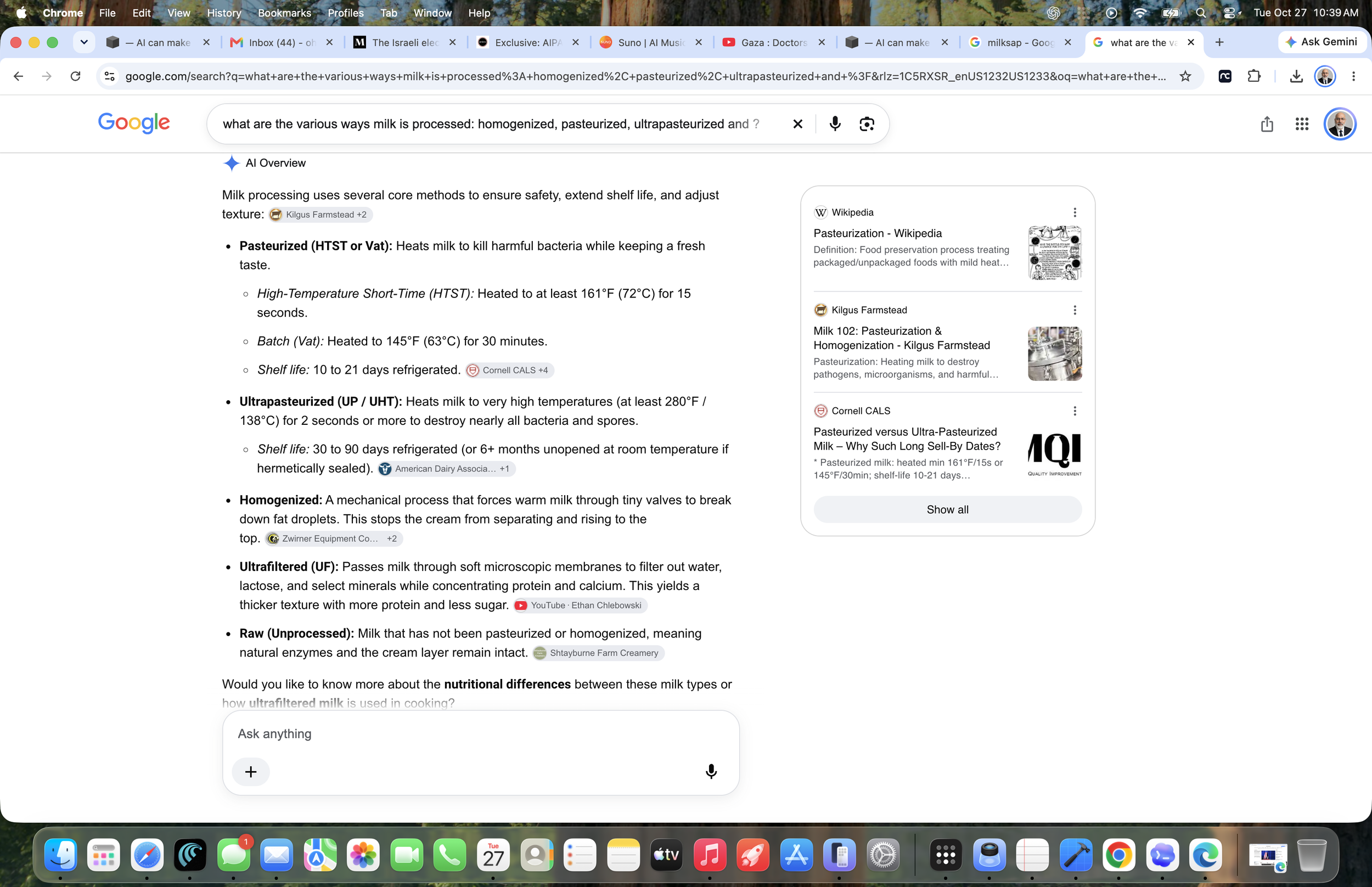
Safety and extending shelf life. That’s why we do the things we do on this planet. And yet the substance is miraculous enough that even milk in its powderized form is still acceptable as nourishment.
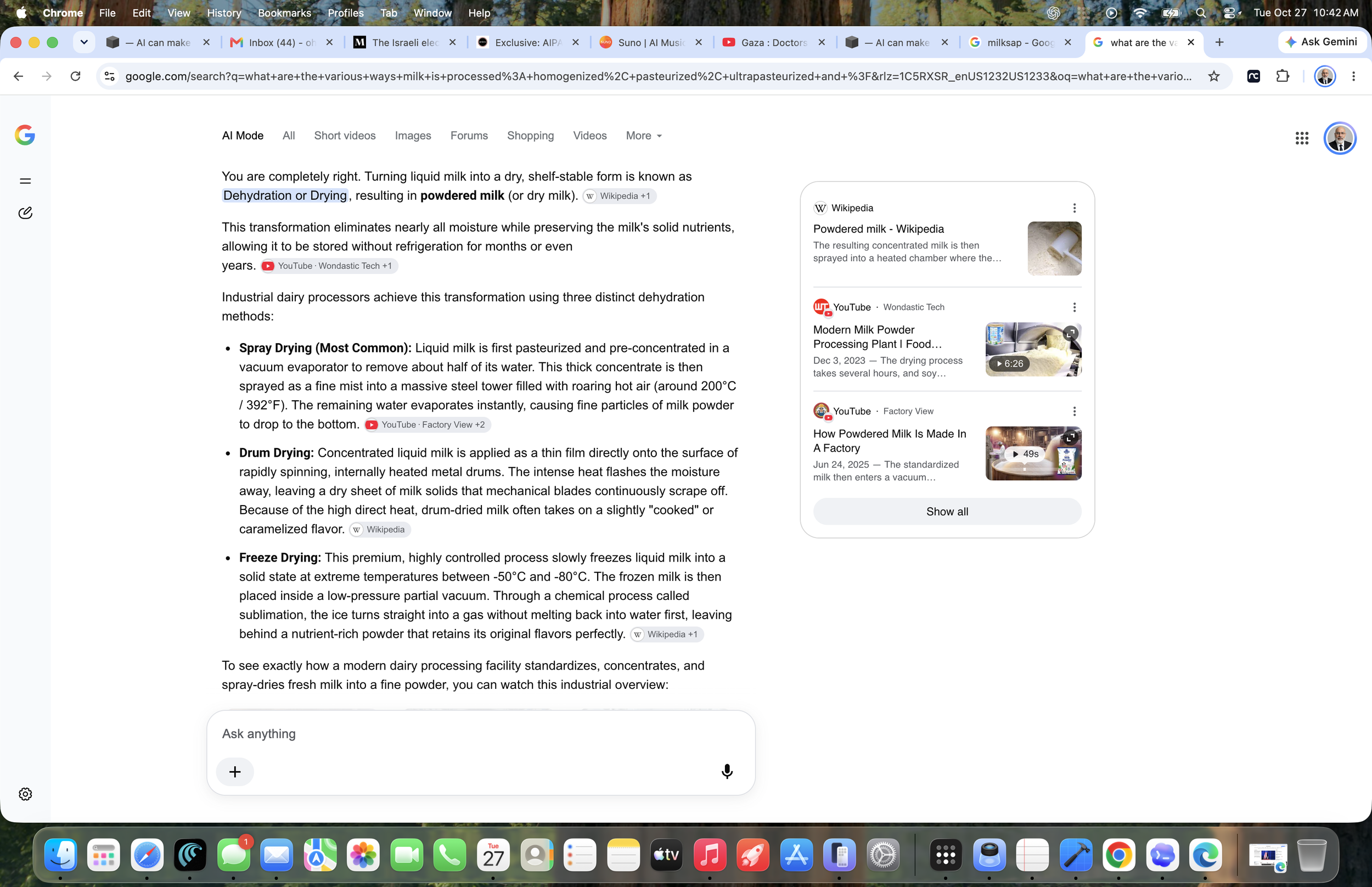
Instead of the newly discovered forms of matter, I find this to be incredible. A substance produced by a biological body can withstand everything from boiling and super heating to freeze drying and still provide an infant with nourishment.
And that’s before all the various things that you can do with milk: from butter and ghee, to cheese in its many different varieties, clotted cream, yogurt, kefir, buttermilk, powdered milk, evaporated milk, condensed milk, dulche de leche, standard cream (from half and half to heavy whipping cream), sour cream and crème fraîche, Smetana / Kaymak (or Kajmak), Skyr, Lebneh, Filmjölk / Viili, Lassi / Ayran / Doogh, Kumis (Airag), Ice Cream & Gelato, Frozen Custard, Kulfi, Junket, Whey Protein, Curds / Chhena, Khoa, Makhan / Safed Makhan, Malai and Cultured Malai, Sarshir (or Qishta).
And in making a lot of these products, we boil the milk and often add sugar to it. That may accelerate the aging would be my guess. That’s probably where vegans get the idea that milk is unhealthy. And of course the mistreatment of cows, goats and sheep that produce the milk. We’ve been given a miraculous substance produced by a mother for her calf and we can’t seem to find it in our hearts to take care of the cows, or the calves in order to produce cheap milk. If I were an alien, that would probably be in my report about Earth titled “Is Earth Worth Saving?”


Before the “Infantilization of the Internet” was the “Commercialization of Husbandry”.
I realize that it may strike some of you as my being clever with words. I assure you I am being dead serious. When given technology, this is inevitably what humans do with it.
I will keep the rest of the essay short and sweet.
Wood is also a really extraordinary material. Everyone knows that it is the living tissue of a tree. The properties of wood are quite incredible. Long past the death of the tree itself, wood retains its unique properties. It is a bad conductor of heat and electricity. You can put a large wooden spoon on top of a stovetop pan that is boiling water or milk and it won’t get hot. While it is on a tree that is alive, it protects the sap of the tree during extreme cold temperatures and is able to transport nourishment and ingredients from the earth to the leaves. In that it is very similar to milk — it can withstand extreme cold and extreme heat and still maintain its design purpose.
And then there is water. It is one of the craziest substances that exists on earth. For starters, it has 3 distinct states that most people can experience in their lives: liquid, ice and steam. It falls to the earth as rain, it runs through our bodies as blood and milk, it runs through trees as sap and nourishment and it also runs through gutters as sewage. Humans can drink well water without fear of it ever spoiling. While most materials contract and become denser as they freeze, water expands, a quirk driven by its unique molecular geometry and hydrogen bonding. It emerges pristine from snow caps on mountains from the Kilimanjaro to the Himalayas, from Mt. Fuji to the Serra Geral even as magma or lava bubbles under the surface.
PROPERTIES OF WATER THAT ARE EXTRAORDINARY
Water reaches its maximum density as a liquid at 3.98°C, expanding if it gets any colder or warmer. Solid ice floats on liquid water.
High Heat Capacity: It requires immense thermal energy to raise the temperature of water compared to other liquids, making it an excellent planetary coolant.
Under specific thermodynamic conditions, initially hot water can freeze faster than cold water.
Excluding liquid metals, water has the highest surface tension of any common liquid, allowing it to support weight and form spheres.
Water can dissolve more substances than almost any other liquid, acting as the "universal solvent."
At low temperatures, water contracts when heated and expands when cooled, completely reversing standard thermodynamic volume changes.
Light refracts and slows down to 75% of its vacuum speed in water.
🧠 3. Biological Context: Brain Learning Signaling
Recent neurological research has highlighted a distinct way water acts as an active matrix in the brain. While not "storing memory" inside the liquid itself, water plays a critical structural role in how human neurons transmit memory signals.
The Mechanism: Inside the brain, memory formation relies on the flow of calcium ions through NMDAR (N-methyl-D-aspartate receptor) channels.
The Role of Water: Recent high-performance cryo-EM computing has shown that magnesium ions block this channel by strongly attracting a shell of water molecules, creating a bulky structure that cannot pass. For learning and memory signaling to proceed, calcium ions must strip away their surrounding water shell (dehydration) to squeeze through the narrow amino acid filter of the channel. Here, the dynamic behavior of water regulates the physical gating of memory pathways, rather than storing information within the fluid structure itself. [1]
Would you like to examine the data regarding ultrafast laser spectroscopy techniques used to measure picosecond bond lifetimes, or explore how the dehydration of ions controls neural pathways?