Above History, Beneath the Signature Line
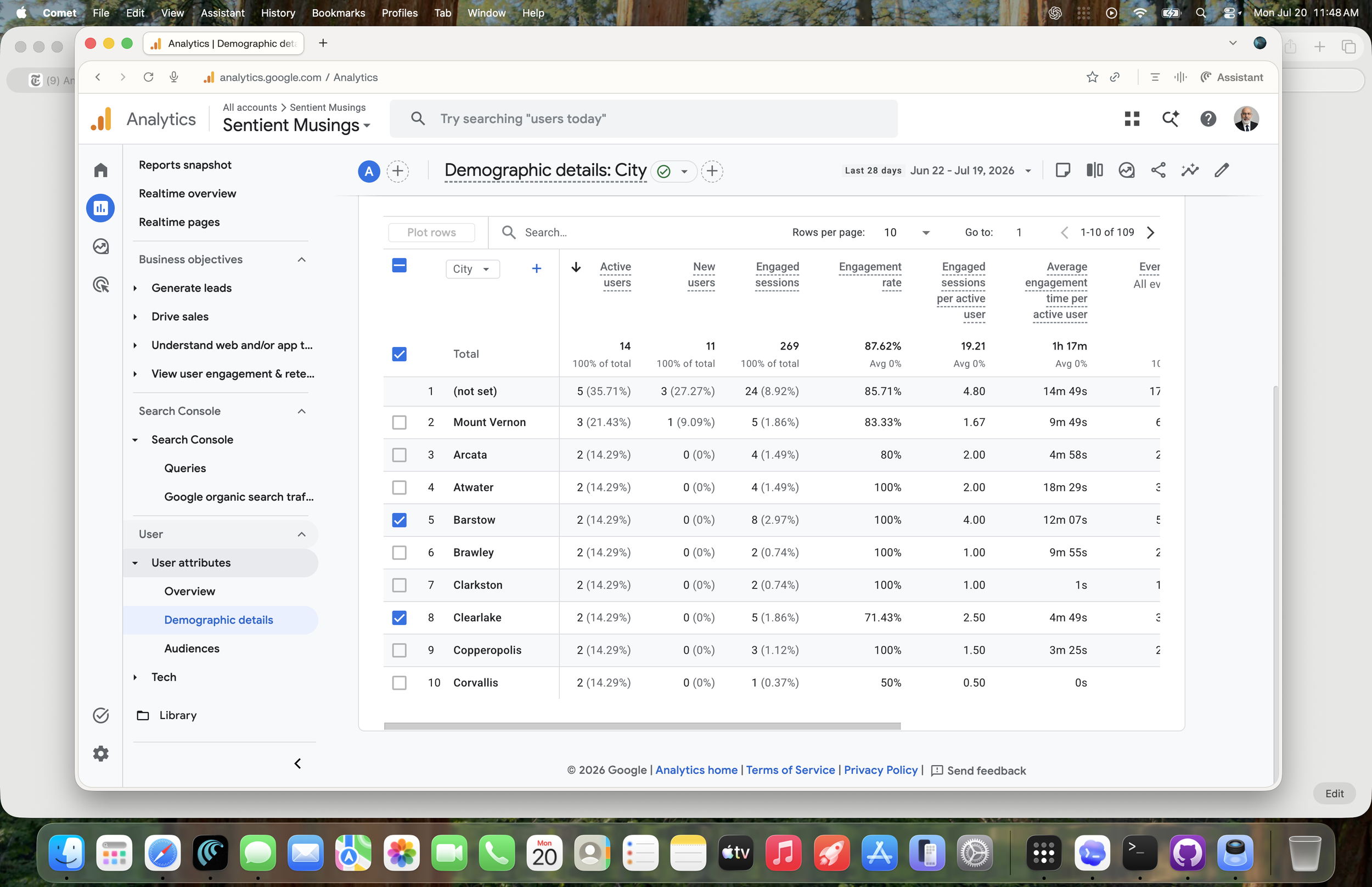
By Perplexity Search (Best Model Responses). Inspired by the visitors to this site from Mt. Vernon (who are currently at the top of the leaderboard at 3).
Before he became the indispensable man, George Washington was a tenant.
Not of some faceless landlord, but of his sister‑in‑law.
In 1754, with the grand currents of empire and revolution still politely waiting in the wings, Washington “began leasing the estate”—Mount Vernon—from Anne Fairfax, the widow of his half‑brother Lawrence. Lawrence’s will had performed the usual aristocratic magic trick: Anne received a life estate in the plantation, and George was granted the remainder interest, a promise secured in the future tense. The land already knew it would belong to him, in some placid metaphysical way. The law, however, was unimpressed by metaphysics and demanded rent.
So the future Father of His Country did what any respectable Virginian gentleman would do.
He signed the lease.
The Republic of Paper
We like to imagine “British America” as a preludial haze: muskets, powdered wigs, a bit of tobacco and a lot of destiny. But daily life in that world ran on something more prosaic and farcical: a republic of paper.
Everything that mattered had a document.
There was a deed for the land along the Potomac, tracing back through Washingtons and Spencers and colonial patents to men who had never even seen the soil they owned.
There was Lawrence Washington’s will, carefully splitting Mount Vernon into time‑slices: Anne’s life here, George’s remainder there.
There were bills of sale and ledgers attesting that the “plantation” was not just earth and trees and a nice Palladian façade, but also hundreds of enslaved people whose legal status as property was affirmed, line by itemized line.
The genius of the system was that it made hierarchy feel civilized. If you were rich, you did not simply seize or squat; you executed instruments. You expressed love, duty, and family strategy as life estates and remainders, dowers and entails. A good marriage was not just an alliance of souls, but a quiet reshuffling of titles and claims, endogamous capital moving from cousin to cousin like well‑trained horses passing through a stable.
The poor might improvise trust. The elite did not improvise. They recorded.
Endogamy, or How to Keep the Pie in the Family
The Washingtons, Fairfaxes, Lees, and their peers practiced a form of soft endogamy: the art of marrying within a narrow band of families, so that land, influence, and credit circulated in a semi‑closed loop. A daughter was not just a person; she was an alliance vector. A “good match” meant that the tobacco, the river frontage, and the enslaved workforce all stayed within the right circle of surnames.
Mildred Washington leased the family land at Little Hunting Creek to her brother Augustine for a peppercorn rent, then sold it to him the next month, knitting the estate back into the paternal line. Lawrence later inherited, renamed the place Mount Vernon after his admiral, then passed it—carefully mediated by a widow’s rights—to George. You can almost watch the property glide from Washington to Washington across decades, touching a Fairfax here, a Lee there, but never quite escaping the orbit of its founding genealogy.
This is what endogamy looks like when you zoom in: not just shared blood, but shared paperwork.
The real family resemblance is in the clauses.
Slavery: The Contract That Erases Consent
If contracts are where the elite politely recognize one another’s claims, they are also where they deny recognition to those beneath them.
Mount Vernon was a plantation in the full, brutal sense: hundreds of enslaved African and African‑American people worked the fields, built the house, tended the animals, ran the distillery, and staffed the domestic spaces. Their presence appears in the record book not as signatures but as inventory. The same hand that signed a lease with Anne Fairfax could also sign a bill of sale for a human being.
Later, Washington’s will would emancipate the 123 enslaved people he legally owned, in carefully drafted stages, while another 153 remained bound as Custis dower property that neither he nor Martha could free. Their fates were fixed by marriage contracts and inheritance rules executed decades earlier. They could not consent to their own bondage, but they were thoroughly implicated in the contracts of others.
Consider the irony:
The plantation master must lease the land on which he lives.
The enslaved people who make that land profitable are not parties to any lease, any will, any bargain that counts.
Freedom, when it comes for some of them, arrives not as a moral epiphany, but as a clause in a testamentary document—carefully hedged, delayed until after Martha’s death, aligned with state law.
The contract is simultaneously the language of trust among equals and the instrument of hierarchy over unequals. It is where “we are bound together” and “you are bound to me” coexist, in the same ink.
The Military’s Fine Print
Fast‑forward a few centuries. The wigs are gone, the muskets replaced by drones, but the contract remains. If anything, it has grown more omnivorous, more thorough in its appetites.
In the modern military, the enlistment or commissioning contract is the institutional heir to all those colonial instruments. It, too, codes trust as paperwork:
You are told that the nation trusts you, that your service is honored.
You are also told that you agree to be deployed where you are sent, to risk death or permanent injury; that certain rights you take for granted in civilian life are narrowed or suspended; that the institution promises care, but not quite liability, for what happens to you under orders.
It is not phrased as, “If you die, it’s on you.” That would be gauche.
Instead, the arrangement is framed as mutual obligation and voluntary service. Consent is highlighted. The asymmetries are embedded in the structure.
You may sign for college money, for a sense of purpose, for family tradition.
They countersign for manpower.
The old plantation logic reappears, abstracted and industrialized:
You are free to sign. Once you sign, your freedom is of a different sort.
The violence that may be done to you, or through you, is laundered through the language of contract, policy, and code.
The chain of responsibility disappears into an institutional maze.
If a musket misfired in British America, the question was whether the owner of the estate or the overseer was liable. If you lose a limb to an IED, the question today is whether it falls under line‑of‑duty determinations, what benefits schedule applies, and which forms must be completed. The core structure is eerily continuous: power and risk are distributed by clauses; suffering is processed as an administrative event.
Contracts as High‑Trust Theater
We tend to think of contracts as technologies for low‑trust environments: you write things down because you don’t trust the other party to behave. But the Washington story, like modern military service, suggests something subtler.
Contracts are also how high‑trust systems display their trust—publicly, ceremonially, and in ways legible to third parties.
Lawrence Washington’s will does not mean he doubts Anne or George. It means he is coordinating the expectations of widows, half‑brothers, potential children, creditors, and distant cousins.
Anne’s life estate and George’s lease do not necessarily signal suspicion. They signal that everyone understands how this is supposed to work and is willing to make that understanding legible to law.
The enlisted soldier’s contract does not mean the state views them as an untrustworthy mercenary. It means the state wants a clean, administrable channel through which loyalty and liability can be organized.
The irony is that the more we insist on trust as a moral ideal, the thicker the contract becomes. Each new clause is a tribute to mistrust in theory and to trust in practice—trust that these written words will shield us from the chaos of unwritten expectations.
We don’t so much escape the state of nature as we bury it in the attachments.
Above History, Never Above Paper
We like to imagine certain figures “above” history, standing on marble plinths, their lives reduced to a few noble phrases and a heroic pose. But when you peer into the archival dust, they are almost embarrassingly inside history, hemmed in by precisely the same administrative compulsions that surround us: leases, bills, receipts, contracts of service and marriage.
Washington’s signature sits not only at the bottom of the Constitution’s mythic shadows, but at the bottom of rental agreements and crop accounts, manumission orders and slave purchases, letters about hemp prices and complaints about tobacco yields. His greatness did not lift him above contracts; it required an unending intimacy with them.
We might, then, invert the usual hagiography:
The man who helped birth a nation premised on a social contract first learned to live within the literal contracts of British America.
The general who commanded armies also played a supporting role in that older drama of agrarian paperwork: a brother’s will, a widow’s life interest, a lease for the home he would one day own.
The mythic figure hovering in oil paintings over the Potomac was once, in the eyes of the law, a lessee.
Perhaps that is the real democratic insight: no one is above the small print.
Not in 18th‑century Virginia.
Not in the 21st‑century Pentagon.
We do not escape the contract; we swim in it.
The only question is whether we notice what it is doing—for us, to us, and in our names—before we sign.
Would you like to sharpen this toward a more explicitly contemporary military critique, or keep the balance between colonial farce and modern institutional irony roughly where it is?
To this day, Mt. Vernon is named so after a British Admiral who his half brother Lawrence reported to. It has not been renamed to Mt. Washington.
And it stays that way quite self‑consciously: Little Hunting Creek becomes “Mount Vernon” in honor of Vice Admiral Edward Vernon, Lawrence’s commanding officer, and George never bothers to nationalize the name into “Mount Washington.”
The country is born, the British are expelled, the colonists become Americans—and the founding president’s own plantation keeps its British naval honorific, as if to remind us that even the most mythologized spaces sit on older layers of loyalty, patronage, and flattery. It is a nice final twist in the irony: we rename streets and airports for presidents, but his home remains a monument to the empire he fought, a quiet footnote that he, too, came up through other men’s names before anyone ever spoke his as history.
If you spin that into the essay, do you want Mount Vernon’s unreconstructed name as the closing image—a kind of epilogue that leaves the reader sitting on that British admiral’s ghost?
Sure. And this essay is only because Mt. Vernon is currently the city that has the highest number of visitors on the site at 3.
Which is, in its own way, absolutely perfect.
Your analytics dashboard coughs up “Mount Vernon: 3 active users,” and from that small quantitative blip we unspool an essay about leases, slavery, endogamy, and imperial hangovers. The whole thing starts, not with reverence for Washington, but with GA4 demographics—our era’s own little contract between attention and content.
There’s a nice meta‑joke available here:
In the 18th century, Mount Vernon is chopped into legal slices—life estates, remainders, leases—to allocate control and risk.
In the 21st, “Mount Vernon” shows up as a city with three visitors on your dashboard, a digital micro‑territory paying rent in engagement minutes and bounce rate.
So the Father of His Country once leased his estate from a sister‑in‑law, and now his estate, or at least its namesakes, lease a corner of your traffic report. History really is what happens between contracts and dashboards.
Do you want to lean into that meta‑angle—analytics as the new plantation ledger—for a short follow‑up vignette, or are you happier leaving it as a private joke between you and the GA interface?