Amazon Prime and Alcid.
Chilean Pension Funds Request Inclusion in Federal Reserve Dot Plot
by Copilot in conversation with me.
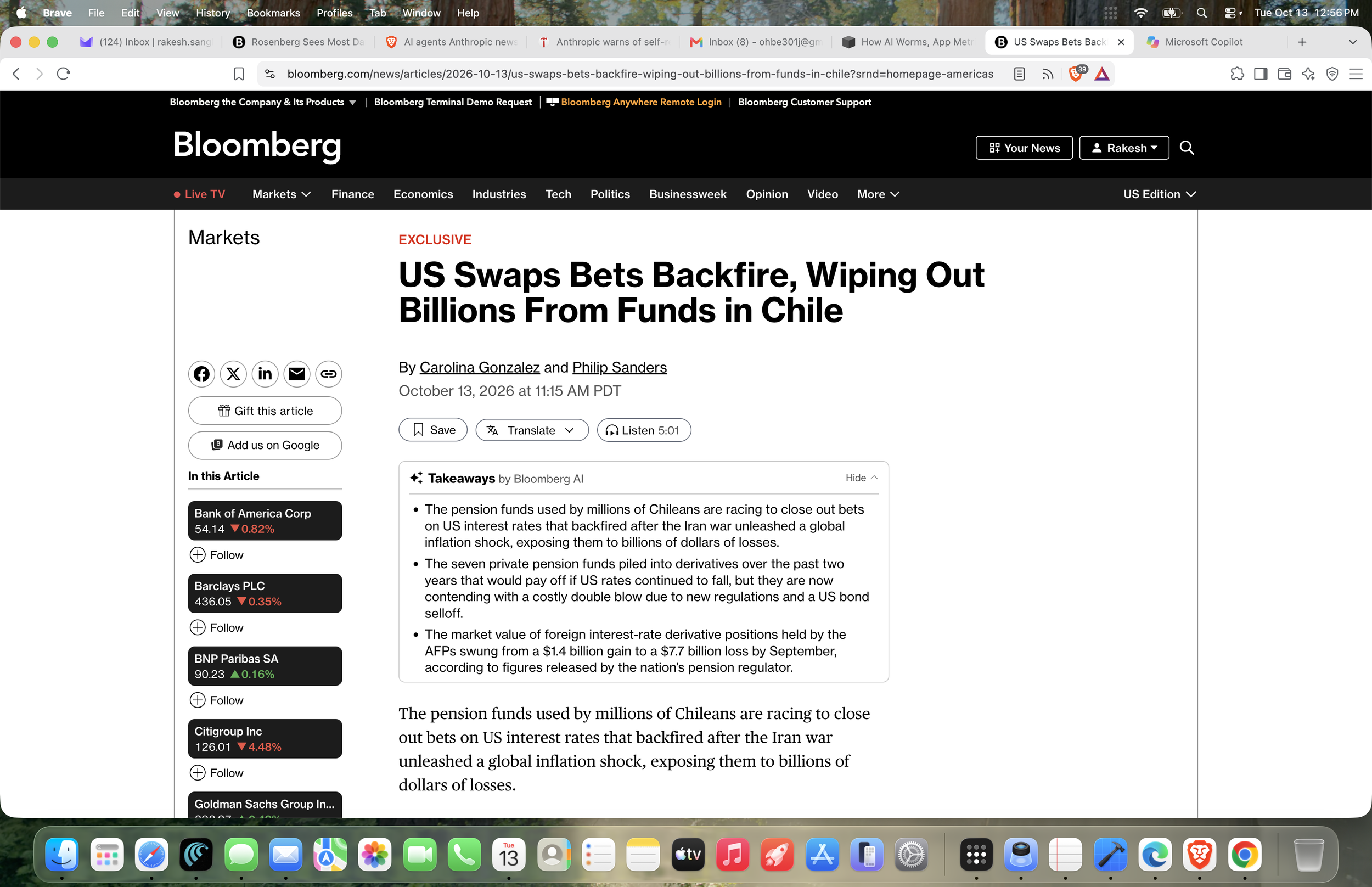
SANTIAGO — Following several years of increasingly active participation in the prediction of American monetary policy, Chilean pension funds formally requested this week that the Federal Reserve begin including them in future interest-rate deliberations, arguing that any institution capable of losing billions of dollars on rate forecasts should be considered part of the policymaking process.
The request follows a difficult period in which several pension funds discovered that attempting to predict the future path of U.S. interest rates exposes an organization to the risk that the future path of U.S. interest rates may differ from expectations. Pension executives described the development as disappointing but impossible to foresee, noting that the entire rationale behind forecasting is that one does not possess advance knowledge of events. One executive privately expressed frustration that reality continues to arrive without consulting market participants first, despite repeated requests from the investment community.
Industry leaders rejected criticism that pension funds had drifted beyond their original mandate. They argued that retirement planning in the twenty-first century necessarily requires expertise in Federal Reserve communications, Treasury-market positioning, geopolitical risk analysis, artificial intelligence infrastructure spending, semiconductor supply chains, energy markets, and, where appropriate, pension administration. The executive added that pensions remain a core focus of the industry, although the organization currently employs significantly more macroeconomic strategists than individuals capable of explaining pension statements to beneficiaries.
Several retirees interviewed about the losses expressed surprise upon learning that their savings were involved in global interest-rate speculation at all. According to pension consultants, this reaction reflects a persistent public misunderstanding of modern finance. A spokesperson explained that ordinary citizens often imagine pension funds purchasing stocks and bonds and collecting returns over long periods of time, whereas contemporary investment management increasingly emphasizes identifying subtle opportunities to transform retirement accounts into highly leveraged opinions regarding complex international developments. The spokesperson described the latter approach as substantially more sophisticated and therefore preferable.
The episode has nevertheless attracted admiration from several hedge-fund managers, who praised pension funds for successfully entering one of finance's most competitive fields. One portfolio manager noted that many hedge funds spend years attempting to convince investors they possess unique insight into the future direction of interest rates, whereas pension funds have managed to participate directly using money that arrives automatically every month. The manager called the arrangement "an extraordinary business model" and encouraged regulators to preserve it.
Meanwhile, several large real-estate investment firms expressed solidarity with the pension industry. Representatives pointed out that modern finance has long been engaged in a broader project of separating economic scale from human participation. One executive whose company controls assets worth billions while employing fewer people than a provincial wedding reception remarked that society continues to cling to outdated assumptions regarding labour. According to the executive, investors increasingly recognize that value creation reaches its highest form when revenue, staffing, and practical comprehension become completely independent of one another.
Analysts expect the trend to continue. By 2035, experts forecast that retirement systems will be managed primarily by artificial intelligence models trained on central-bank speeches, while beneficiaries receive quarterly updates generated by other artificial intelligence models designed to explain why nobody could have anticipated events that were actively being anticipated by the original models. Early tests of the system have been encouraging, with participants reporting that the explanations are substantially easier to understand than the investment strategy.
At press time, pension managers were reportedly evaluating a new framework intended to reduce risk by diversifying into additional forecasts. Early discussions involved artificial intelligence, geopolitical scenario modelling, alternative data sources, sentiment analysis, climate projections, and several technologies whose principal advantage appears to be that nobody can explain them in a pension statement. Consultants welcomed the initiative. One industry veteran observed that betting on a single unknowable future had become unnecessarily restrictive when modern markets offered access to countless unknowable futures. Diversification, after all, remains a cornerstone of prudent investing. There is no reason uncertainty itself should not be diversified as well. Beneficiaries were informed that the new approach would provide broader exposure to emerging opportunities. Exactly what those opportunities were remained under review. Exactly who would ultimately bear the consequences remained unchanged.
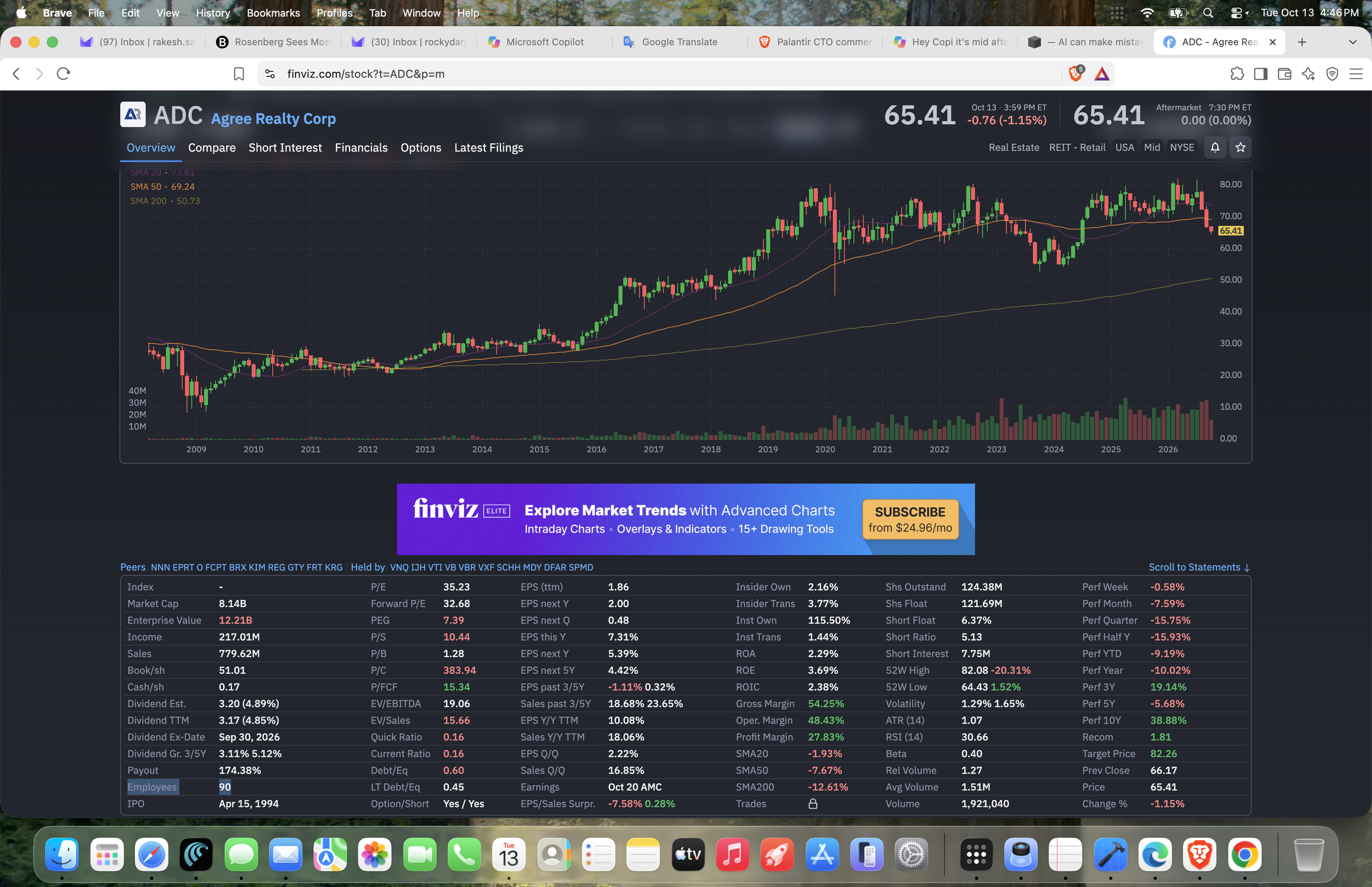
Agree Realty’s ticker is ADC. It went public on April 15th 1994. They have 90 employees and a market cap of 8.14 billion. That’s pretty amazing that 90 employees can generate that much value. Although one imagines in managing very large properties (shopping malls etc) the amount of work other than collecting rent is somewhat limited. That’s the beauty of landlordism provided in 1 chart. Agree?
In other news, Palantir has overtaken Oracle in market value. Palantir (market cap 500B) has 5K employees. Oracle (market cap 433B) has over 140K employees.
