Essay
The Architecture of Impunity: Bloodlines, Bureaus, and the Osage Ledger
The Dynastic Blueprint and the Birth of the Bureau
When we peer behind the curtain of modern statecraft, we are taught to see neutral institutions governed by laws rather than men. Yet, a dispassionate look at the genealogical roots of American federal law enforcement reveals a reality of dynastic continuity and imperial design. In 1908, the Bureau of Investigation was established under Attorney General Charles Joseph Bonaparte. The grand-nephew of Emperor Napoleon seeded the new bureau with operatives drawn directly from the Secret Service, planting the unyielding DNA of executive protection, surveillance, and central command into the bedrock of American policing.
This institutional fiefdom found its true master builder in J. Edgar Hoover, whose 48-year reign transformed federal law enforcement into a private archive of leverage and political management. Hoover didn't simply run an agency; he curated a vault of secrets that ensured the permanence of elite hegemony across administrations. To maintain the illusion of an impartial state, Hoover operated as a master publicist, heavily influencing media to shape the Bureau's mythology. This public relations machinery peaked with the 1959 film The FBI Story, where Jimmy Stewart portrayed the agency as a flawless, heroic defender of the American public.
All the while, the theater of American politics kept the populace entertained through semantic inversions. During the mid-century "Red Scare," the word "red" was weaponized as a derogatory badge against worker solidarity. Yet, in a bizarre historical color-coding reversal, "red" now proudly decorates the right wing of the political spectrum. Both major wings—represented by the donkey and the elephant, ancient British colonial symbols for beasts of burden—harness the working class to the cart of capital.
The Extraction Machine: From Hale to Koch Oil
The illusion of state neutrality dissolves entirely when we trace how capital extracts wealth from the vulnerable. Popular culture packaged the early history of federal law enforcement around the myth of the heroic rescue, culminating in Scorsese’s Killers of the Flower Moon, where Hoover’s agents dismantle William "King" Hale’s murderous ring in Osage County. But the Reign of Terror merely changed its uniform.
The second chapter of extraction was made possible by the very mechanisms meant to protect the tribe. The Osage retained their mineral rights communally, and the federal government held them in trust. Because the Bureau of Indian Affairs (BIA) acted as the trustee auditing the buyers, corporate extractors didn't need poison; they just needed to co-opt the auditors. Koch Oil became a dominant purchaser of Osage crude and perfected the "Koch Method"—a system of deliberate mismeasurement and false volume reporting at the wellheads. Extraction moved from physical murder to white-collar balance-sheet plunder.
The Weaponization of Family Feuds and the Alibi of Justice
When the state actually moves against elite criminality, it is rarely out of an organic defense of the public; it is usually the result of internal elite fracture. In the late 1980s, Bill Koch and co-plaintiff Bill Presley sued Koch Industries under the False Claims Act, exposing thousands of fraudulent oil tallies on federal and Indian lands. A federal judge eventually approved a $25 million settlement in 2001. While this was a matter of public record, the mechanism of justice functioned primarily as an arbiter of a dynastic family dispute. The BIA and the Justice Department declined to actively participate alongside the plaintiffs in the suit, and the Osage Nation itself opted out, leaving the extent of their restitution deeply contested and largely unresolved.
The Calculated Inaction of the Praetorian Guard
The true measure of an institution is found in what it refuses to investigate. In The Chickenshit Club, Jesse Eisinger argues that the Department of Justice's failure to prosecute Wall Street executives after the Great Financial Crisis was born of prosecutorial timidity, careerism, and a fear of losing in court. But institutional cowardice alone cannot explain the sheer, uniform consistency of this inaction across decades. When viewed alongside the Bureau's history of selective enforcement, it becomes clear that this is not mere timidity—it is the natural behavior of a praetorian guard protecting the sovereign.
This dynamic is glaringly evident in the handling of the Epstein network. The system protected its apex predators first through a highly irregular 2008 non-prosecution agreement in Florida, which allowed Jeffrey Epstein to avoid federal prosecution entirely. Even when public pressure forced the DOJ to release over 3 million pages of records in January 2026, the disclosures were aggressively managed. With extensive redactions shielding the broader network, the files demonstrate how the shadow infrastructure curates accountability to protect the permanent state.
Whether an empire is managed by Bonapartes, Hoovers, or private energy dynasties, the sovereign operates above the ledger. The Osage wells stand abandoned and leaking toxins into the soil; the files on elite predation are carefully redacted in climate-controlled vaults; and the beasts of burden continue turning the wheel.
DOJ Releases Final Set Of Epstein Files
Sources
Sources and further reading, grouped by the section of the essay they bear on. Links open in a new tab.
The Dynastic Blueprint and the Birth of the Bureau
- A Brief History — Federal Bureau of Investigation. Bonaparte, the 1908 congressional ban on loaning Secret Service operatives, and the creation of a Justice Department investigative force.
- FBI Turns 110 — Federal Bureau of Investigation. Nine Secret Service investigators joined with 25 others to form the original special agent force in 1908.
- The FBI Story (Mervyn LeRoy, 1959) — Wikipedia. Hoover’s approval of the production, his role in casting, and his brief appearance in the film.
The Extraction Machine: From Hale to Koch Oil
- Grann, David. Killers of the Flower Moon: The Osage Murders and the Birth of the FBI (Doubleday, 2017), and Martin Scorsese’s 2023 film adaptation.
- Osage murders — Encyclopaedia Britannica. Overview of the headright conspiracy and the Bureau’s investigation.
- Palast, Greg. The Osage want you to know their story doesn’t end with Killers of the Flower Moon — The Guardian, October 2023 (via Radio Free).
- Palast, Greg. What Charles Koch Paid to Elude 70 Years in Prison — GregPalast.com, on the documentary Long Knife.
- Leonard, Christopher. Kochland: The Secret History of Koch Industries and Corporate Power in America (Simon & Schuster, 2019). Account of the oil-theft investigation, the federal case dropped in 1992, and Bill Koch’s later civil suit.
- Blood and Oil — CBS News. The False Claims Act case and its $25 million settlement.
The Weaponization of Family Feuds and the Alibi of Justice
- United States ex rel. Koch v. Koch Industries, Inc., 57 F. Supp. 2d 1122 (N.D. Okla. 1999) — Justia.
- Koch brothers settlement coverage — Indian Country Today. Notes that the Justice Department and the Osage Nation declined to join the suit.
- Money Koch bros. stole from tribes could swing mid-term elections — Indian Country Today. The 1989 filing and the outcome for the tribes.
- Inside the Koch Brothers’ Toxic Empire — Rolling Stone. The jury’s finding of more than 24,000 false claims and the later settlement.
The Calculated Inaction of the Praetorian Guard
- Eisinger, Jesse. The Chickenshit Club: Why the Justice Department Fails to Prosecute Executives (Simon & Schuster, 2017).
- Jeffrey Epstein’s former prosecutors used “poor judgment” in deal, DOJ says — NPR, November 12, 2020 (via KRCU). On the 2008 non-prosecution agreement.
- DOJ releases final 3 million pages of the Epstein files — NPR, January 31, 2026.
- US Department of Justice releases 3 million new Epstein files — Al Jazeera, January 30, 2026.
Media
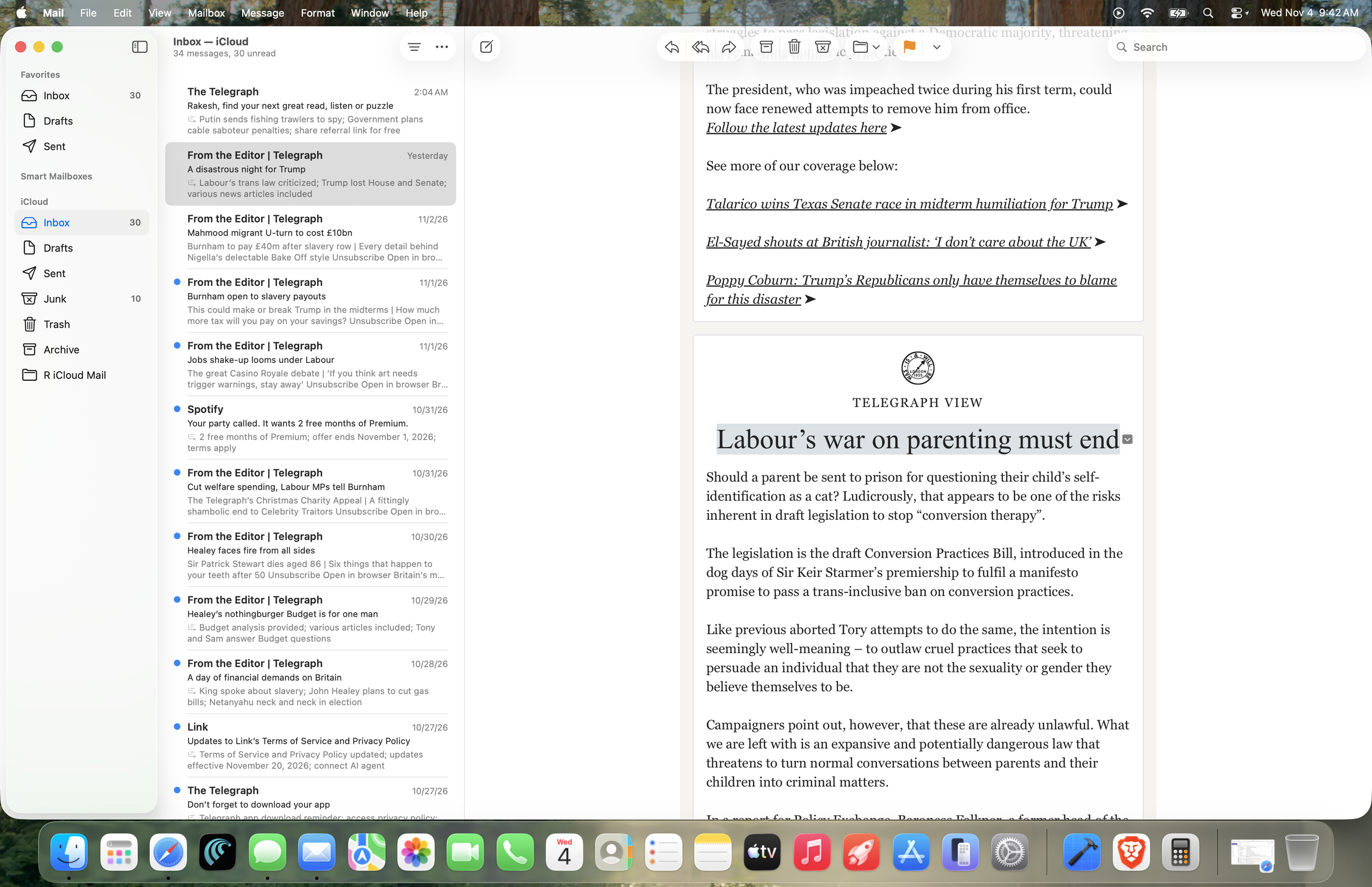
Meanwhile, in the real world I had forgotten I had a subscription to The Telegraph to an email I don’t use very often: rockyvedalgo@icloud.com
Anglophile that I am not, I was rather amused that the leading story in today’s email was about the US Elections framed as a setback for Trump while the story immediately following was about parenting failures.