I didn’t vote because the voting was already done before the Americans voted. It was done in secret lodges and clubs from where all the candidates were born, arose and died. The illusion that Americans had a choice in who was elected is amply demonstrated in a zero sum game that elections are. 25 Republicans lost, 25 Democrats won. In other words, 25 elephants lost and 25 donkeys won. The trick you see is to realize that in the places where the British ruled elephants and donkeys were both beasts of labour or burden if you’re a Rolling Stones fan. America has never had a native or domesticated elephant so the choice of an elephant as a mascot is itself a bit questionable.
The newspapers are breathless declaring a Democratic sweep, so it’s important to throw cold water on the results and see what was actually at stake. Of the 100 seats in the Senate, only 35 had elections, 65 did not. In some maps of the House, the center of the country holds as a firm “red”. I am a visual person at heart and so I like to look at different maps and see how the SAME results can be conveyed in different ways. And what impressions they leave on a mind like mine that does not retain memory from day to day.
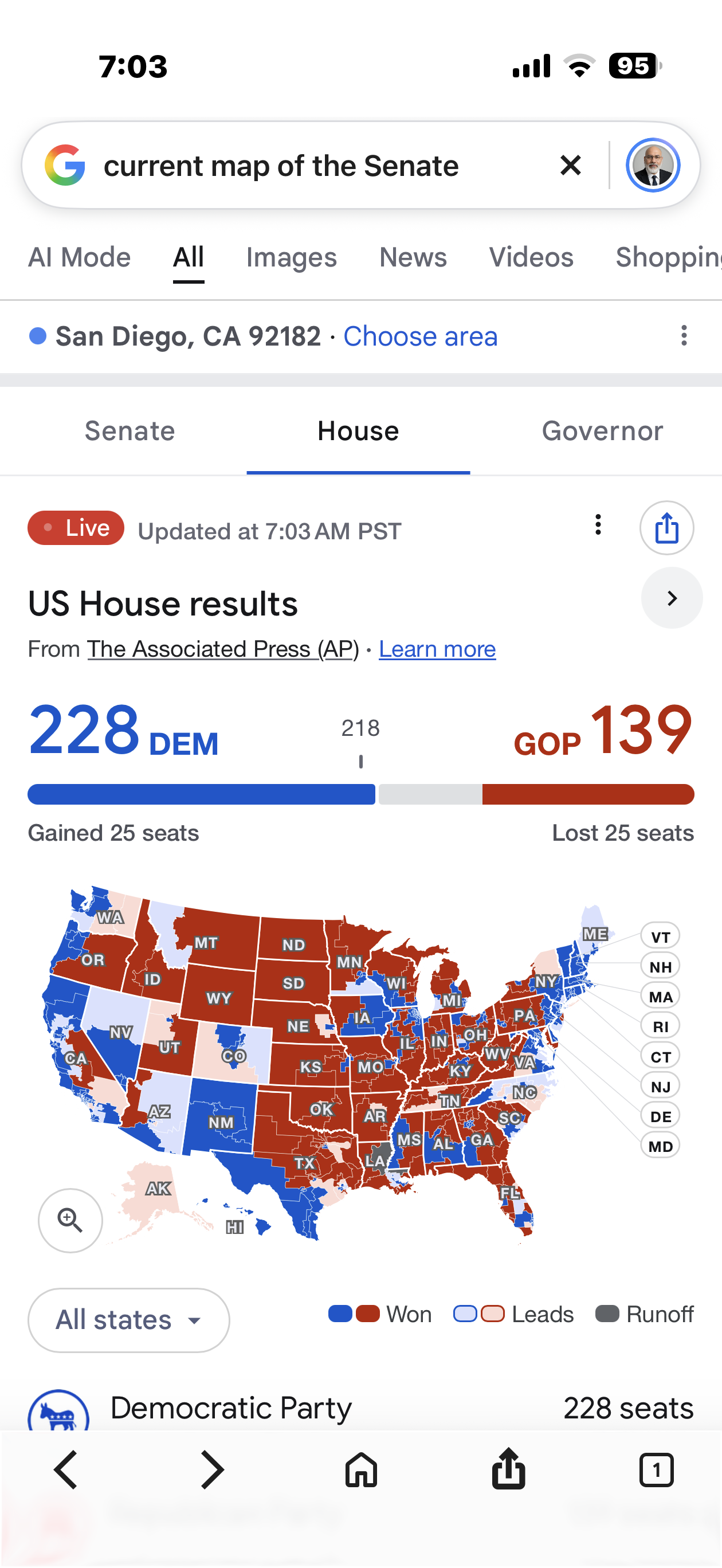
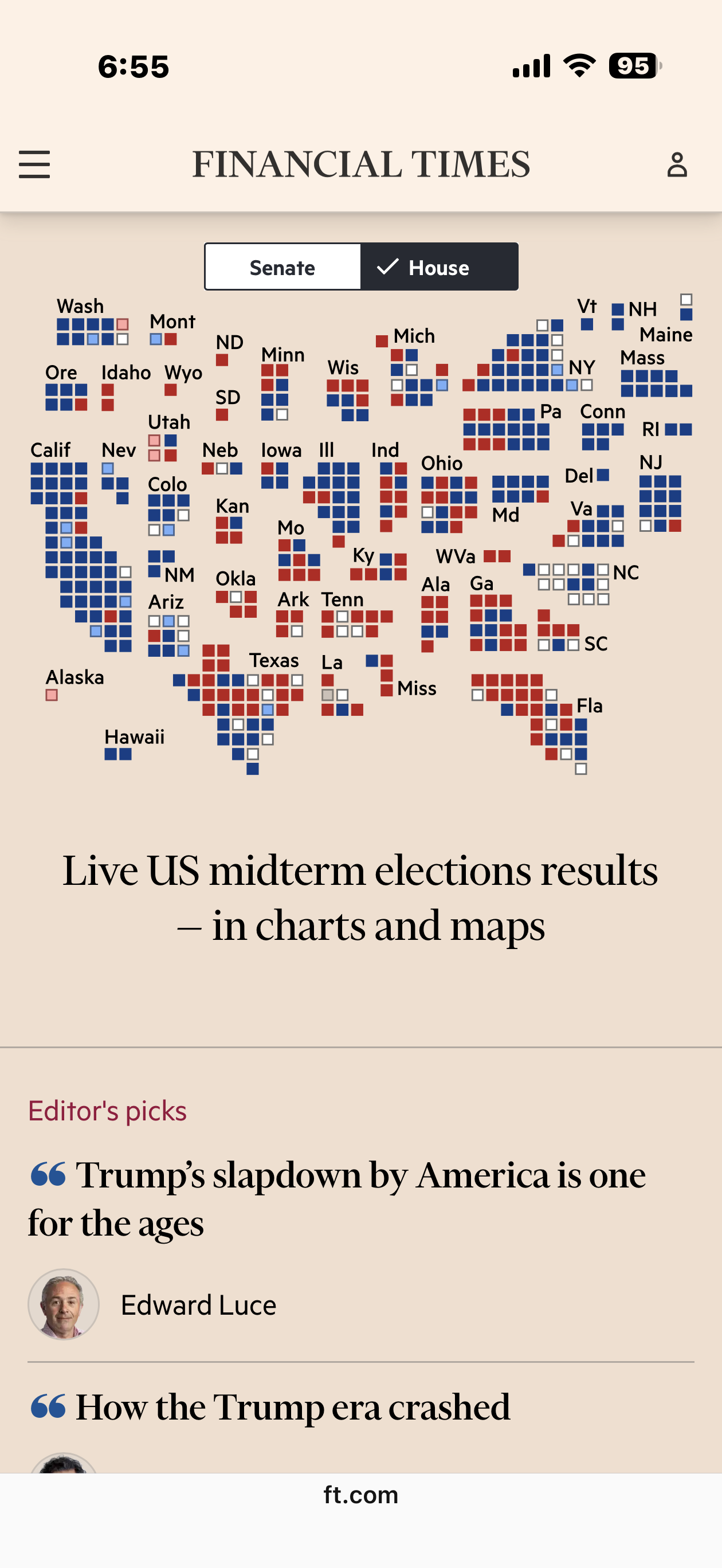
Both are maps of the exact same result. It just different ways to look at them. The second map from the FT while more accurately reflecting what happened in the House elections seemingly divide the country, while the first map while keeping the country united conveys a somewhat false impression of the results. Here are three more maps for the reader to look at and observe what, if any, the effect is on their mind.
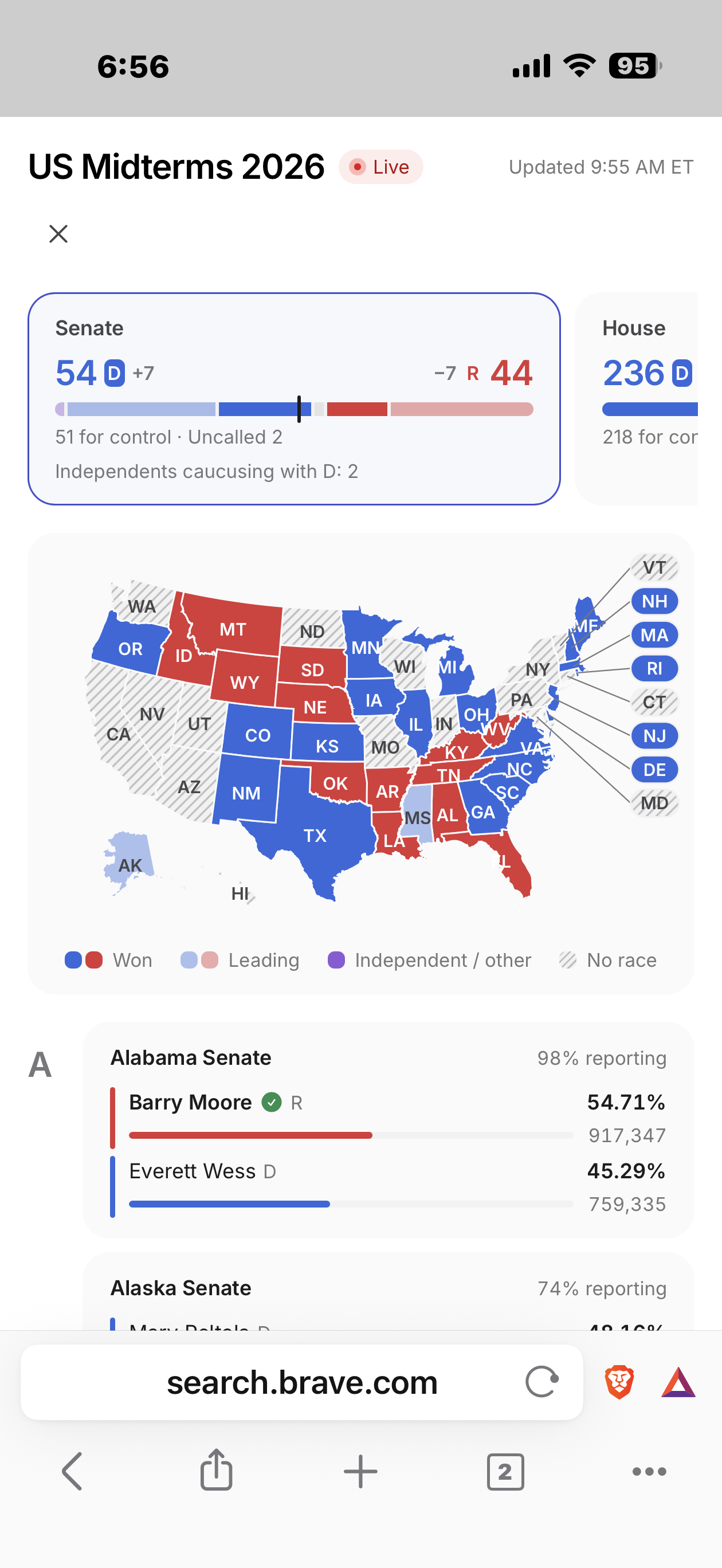
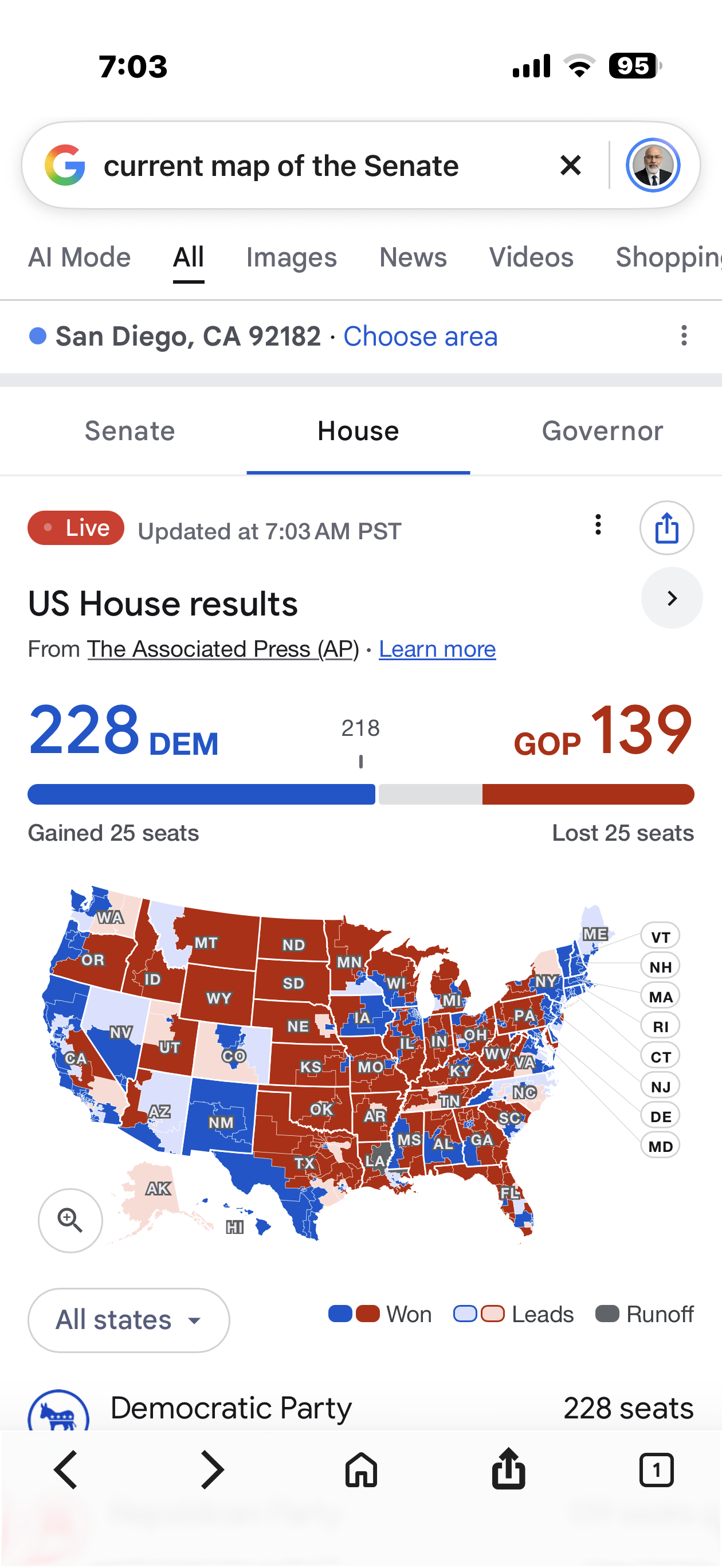
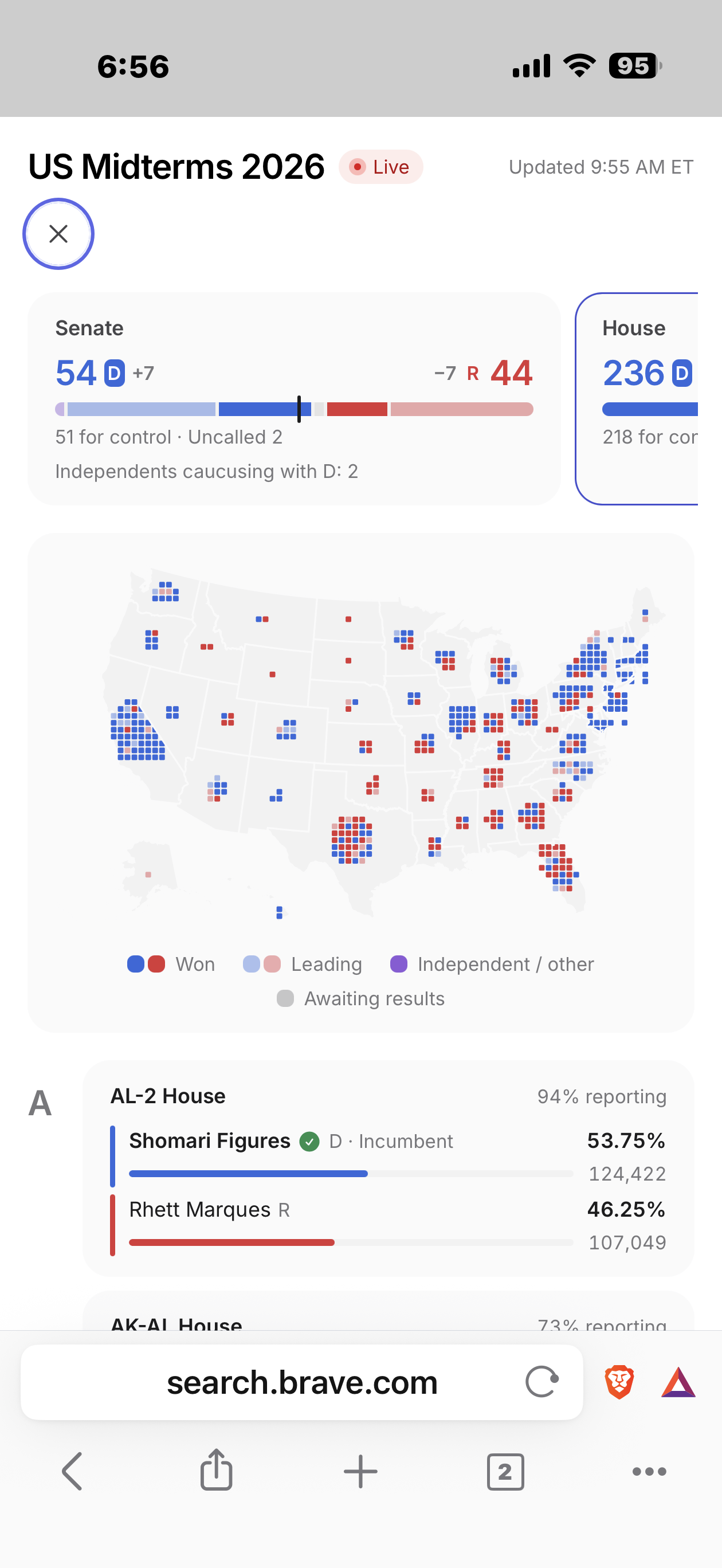
The last two maps are of the House results. The last map keeps the country united while showing what happened accurately. A responsible media organization would show that map to Americans.
Ground News doesn’t often send me emails. Their emails when they arrive seem to have a curated list of articles and there is definitely one article that they want to bring to their readers attention. While most Americans are metabolizing the results of this election, they are completely unaware of something important that happened in Europe on October 30.
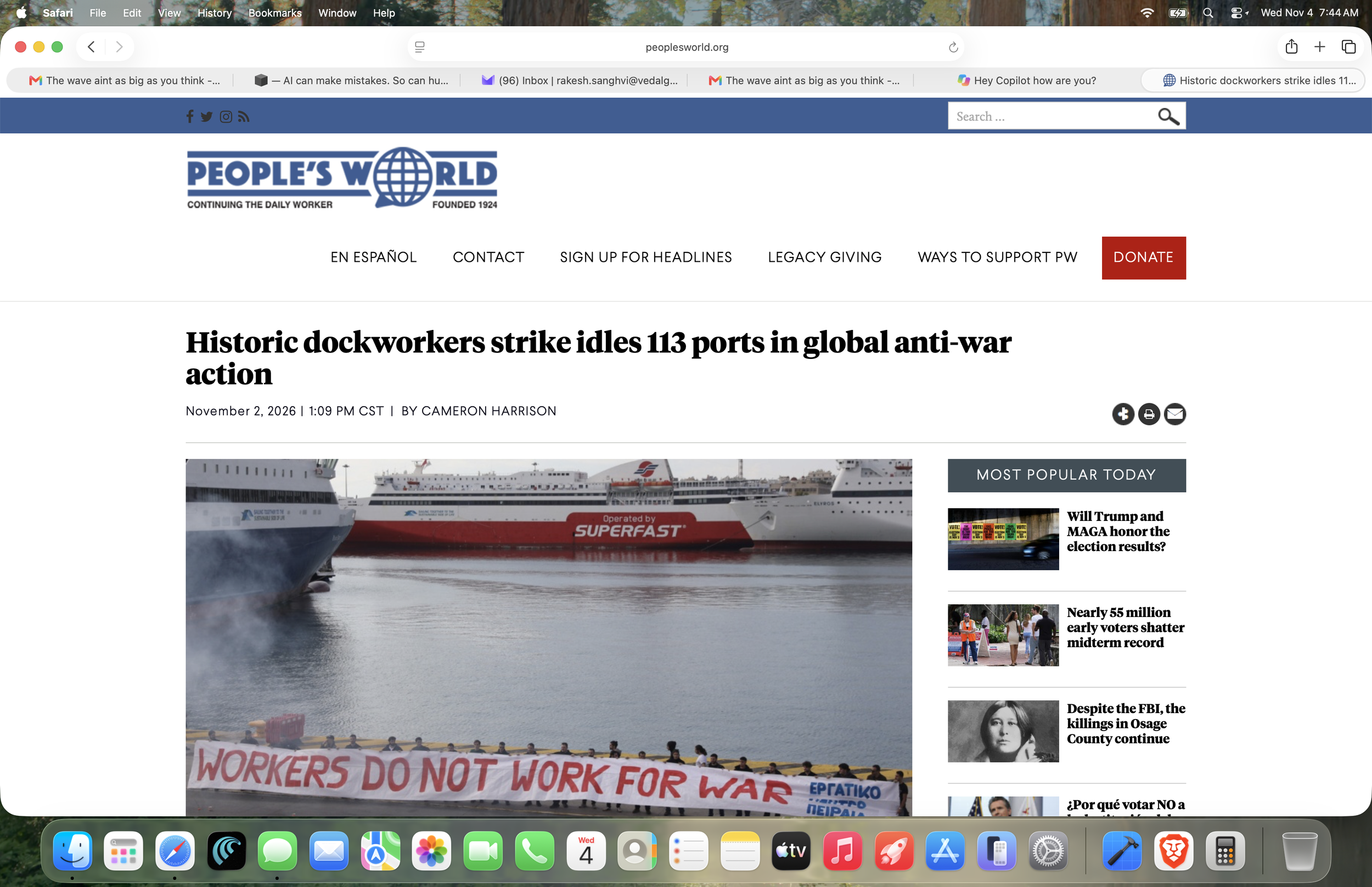
Copilot» That's a good catch, and honestly it's exactly the sort of story that can end up looking "invisible" if your news diet is mostly mainstream U.S. outlets.
The short answer is: yes, the strike appears to have been real and was covered by multiple outlets beyond People's World. The question is less whether it happened and more why it received relatively little attention in major U.S. general-interest media.
What I was able to verify:
On October 30, 2026, dockworkers and maritime unions in 22 countries conducted coordinated strikes, walkouts, or demonstrations at 113 ports, organized under the slogan"Dockworkers Don't Work for War." More than 25 unions reportedly participated. [reuters.com], [reuters.com]
The action focused on opposition to arms shipments, the militarization of ports, and broader labor concerns such as wages and working conditions. [peoplesworld.org], [reuters.com], [reuters.com]
The largest reported impacts were in Mediterranean ports including Piraeus, Genoa, Le Havre, Valencia, Algeciras, Tangier Med, and others. [reuters.com], [reuters.com]
What surprised me is that Reuters covered it twice, both before and during the strike. That's significant because Reuters is one of the largest wire services in the world. [reuters.com], [reuters.com]
Coverage I found
Major wire service
Reuters ran advance coverage on Oct. 29 and follow-up reporting on Oct. 30. [reuters.com], [reuters.com]
Maritime and shipping press
Splash247 covered it. [splash247.com]
gCaptain covered it. [gcaptain.com]
Maritime Briefs published multiple reports. [maritimebriefs.com], [maritimebriefs.com]
Political and labor-oriented outlets
People's World (the article you linked). [peoplesworld.org]
The New Arab. [newarab.com]
The National (Scotland). [thenational.scot]
Palestine Chronicle. [palestinec...onicle.com]
Why it may feel undercovered
Looking at the coverage, this appears to have fallen into a gap between categories:
Too international for local news.
Not disruptive enough for business headlines. Even Reuters noted uncertainty about the actual scale of shipping disruption and reported that some ports expected limited effects. [reuters.com]
Politically charged framing. Because the action was tied to Gaza, arms shipments, and anti-war organizing, some outlets may have treated it as an activist story rather than an economic story. That's my interpretation, not something the sources explicitly state.
One-day action problem. News organizations often devote major attention to labor actions when supply chains visibly break down. The reporting I found focused heavily on potential disruption rather than confirmed large-scale economic impact. [reuters.com], [reuters.com]
My own reaction as a reader: if the participation numbers are even approximately correct, then this is objectively a notable labor story. A coordinated action spanning 113 ports across 22 countries is unusual enough that I'd have expected broader coverage. The fact that Reuters covered it tells me it wasn't merely an activist claim circulating within ideological media. Reuters independently reported the action and the participation figures, while also noting uncertainty about the real-world disruption. [reuters.com], [reuters.com]
One thing I'd be interested in exploring with you is whether Ground News surfaced this because of its bias-diversity model. This feels like a classic example of a story that may have received substantial coverage in labor, maritime, and pro-Palestinian media ecosystems while remaining largely absent from the front pages of mainstream U.S. consumer news outlets.
