Musing from Rakesh Sanghvi, Publisher Sentient Musings.
In the overall scheme of things 5Tn or even 10Tn is not a lot of money. The world's GDP is estimated to be around $110 - 130 Tn annually. Yet one European Bank -- Deutsche Bank or DB for short -- has a daily INTERNATIONAL turnover of 1Tn Euros, implying that they do 365 Trillion Euros annually -- sheer money flowing through the bank with tremendous velocity. In a world where there are several hundred major banking institutions worldwide both public, semi-public, private and banque privée, 5Tn is a drop in a very large bucket. What I am saying is, if these companies fail, it only means that these companies were meant to fail or made to fail -- exactly as Lehman and Bear were. In the immortal words of the Lehman’s CEO Dick Fuld, when asked why Lehman was the only firm allowed to fail, he answered, “Until the day they put me in the ground, I will wonder.” and "To this day, I don't know why we were allowed to fail." The chain of dominoes we have outlined here could happen, and if it does, there will always be a secondary or tertiary REASON as to the WHY it was allowed to happen.
At Sentient Musings, we are not interested in Chaos or Order, but we are interested in the mechanics of both and the mechanisms of both.
That’s why we are interested in mapping China and it’s connections to America’s tech sector. Would it not be to China’s advantage if America erupted in complete chaos on Wall Street? China easily manages a 40% down on their technology sector (last several months) however, for Americans a 40% down in their stocks would cause panic. And in the chaos that emerges, what actually happens in the board rooms? It is that second part — the what actually happens part — that we are interested in mapping.
Sentient Musings · Finance // 18 November 2026
Promises Secured by Promises
The AI boom as a financial feedback loop: two bubbles in one, the difference between a commitment and a cost, and how the dominoes might actually fall
The Wedding Town
Consider a town long populated by older residents, into which young couples begin to arrive in such numbers that everyone starts counting on a wedding season for years to come. The bakers buy new ovens, the wedding planners project their future business, the caterers fit out bigger kitchens, and the positive spiral is quite something to behold. Each of them, having counted the earnings before they were earned, pays for the expansion on a credit card, which is to say on a promise that does not appear as debt until the bill arrives.
The town’s estimate of the newcomers was built by adding up everyone’s bookings, but every couple had made enquiries at three bakers and two planners before choosing one, so each couple was counted several times over. Then the census is read, and it turns out that only half as many young people have moved to town as everyone had projected. The weddings that do take place are real, and they are paid for; the trouble is that the ovens, the kitchens and the credit-card balances were sized for the town everyone imagined.
In the essay that follows, the credit card is an off-balance-sheet commitment, the bakers and caterers are chipmakers and data-centre builders, and the town clerk reading out the census is Sam Altman.
IThe distinction
Most accounts of the artificial-intelligence boom describe it as an investment cycle, in which companies come to believe in a technology, spend heavily on it, and are afterwards either vindicated or embarrassed by the returns. That description is accurate as far as it goes, but it misses the feature that distinguishes the present episode from an ordinary capital-spending binge. What we are watching is not simply money flowing toward a technology; it is a financial feedback loop, in which promises to spend are converted into collateral, the collateral into borrowing, the borrowing into infrastructure, and the infrastructure is then cited as evidence of the very demand that justified the promises in the first place.
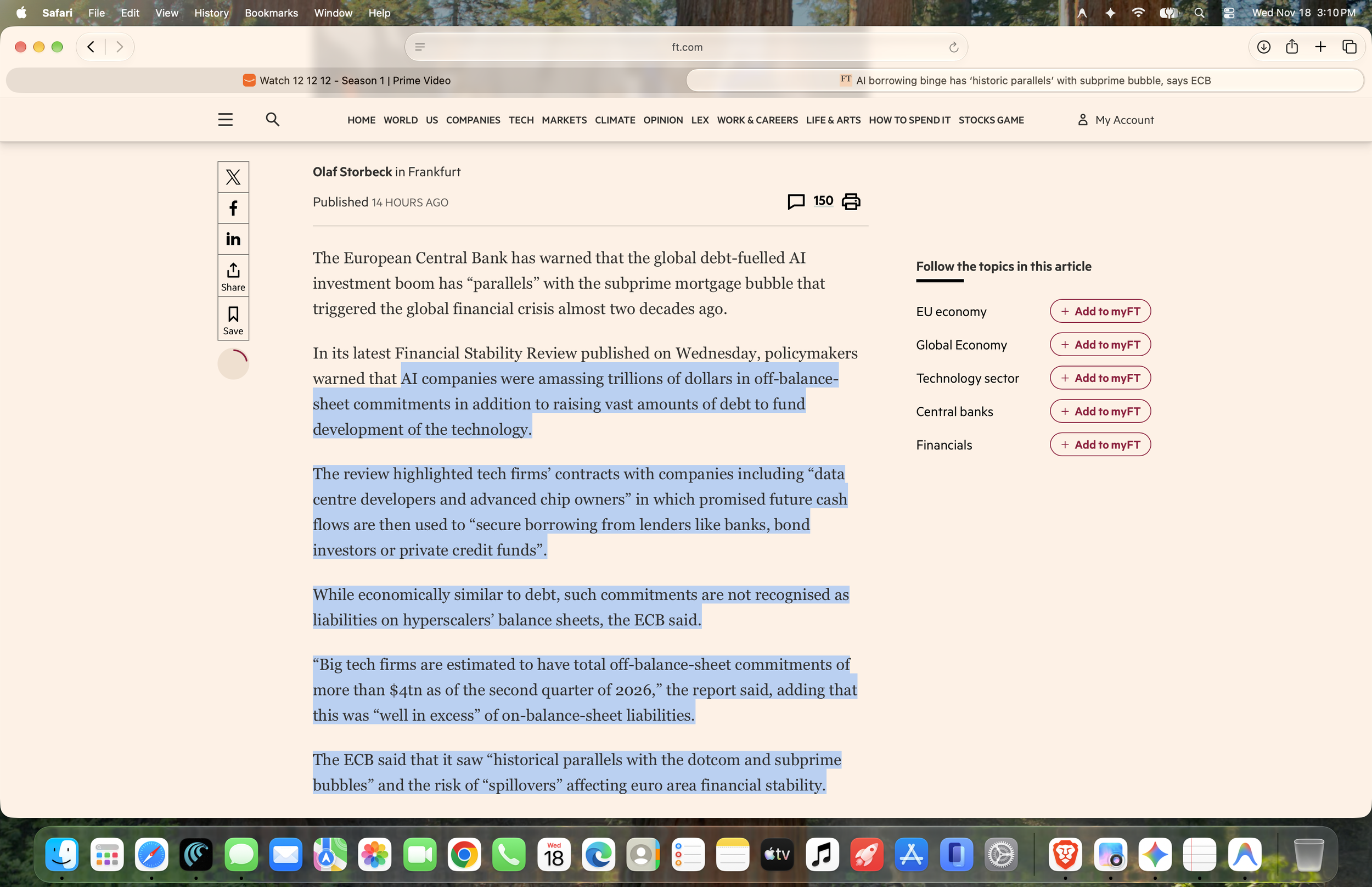
The European Central Bank put a number on that loop on 18 November 2026. In a box within its semi-annual Financial Stability Review, ECB staff estimated that big-tech firms carried more than $4 trillion in off-balance-sheet commitments as of the second quarter of 2026, a sum the bank judged to be well in excess of the liabilities those firms actually report. The same analysis forecast cumulative capital expenditure by US big tech of roughly $5.5 trillion by 2030, while conceding that estimates vary widely, and it observed that free cash flow had turned negative for most US hyperscalers in 2026, because spending on AI infrastructure outran the cash their operations generate, a condition the bank expects to persist until 2028. Its sample comprised eight companies: Alphabet, Amazon, Meta, Microsoft, Nvidia, Oracle, Broadcom and Anthropic.
The bank’s own account of what all this resembles was blunt enough to make the headlines: the rapid shift into debt, it wrote, invokes “historical parallels with the dotcom and subprime bubbles.” This essay takes that sentence seriously, and tries to say precisely which parts of each bubble are present, which are absent, and where the loop is most likely to break.
IIHow the loop runs
The mechanism is simpler than its diagrams. A hyperscaler such as Microsoft or Meta signs a long-term contract to use computing capacity in a data centre owned by somebody else: a developer, a neocloud such as CoreWeave, or a special-purpose vehicle created for the single purpose of owning the building and the chips inside it. The owner then takes that contract to a bank, a bond market or a private-credit fund and borrows against it, because a promise of future payments from one of the most profitable companies on earth is, to a lender, very nearly as good as cash. The borrowed money buys chips, power and concrete, and the finished capacity is leased back to the hyperscaler whose signature began the sequence.
The ECB’s point about accounting is the hinge on which the whole argument turns. Such commitments behave like debt in every economic respect, since the hyperscaler is obliged to pay and the lender is relying on that obligation, yet under US accounting rules they do not appear as liabilities on the hyperscaler’s balance sheet. The leverage exists; it simply lives somewhere else. The Federal Reserve, in a report cited by Governor Barr, arrived at a comparable figure by a different route, putting the potential maximum off-balance-sheet obligations of the seven largest AI firms above $3 trillion, with their on-balance-sheet debt expected to exceed $800 billion by the end of the year.
A second circuit runs alongside the first, and it is the one that earns the word circular. Chipmakers invest in their own customers. Nvidia agreed in 2025 to fund up to $100 billion of OpenAI’s data-centre expansion, much of which would have been spent on Nvidia hardware, before that arrangement was reportedly replaced in early 2026 by a $30 billion equity investment; it holds an equity stake in CoreWeave, which buys Nvidia processors and sells capacity to OpenAI; and it agreed to purchase CoreWeave capacity itself should other customers fail to. By May 2026 its AI equity bets had passed $40 billion, and by August it was reported to be weighing a financial backstop for OpenAI’s Ohio data centre, because OpenAI lacks an investment-grade credit rating and needs other companies’ balance sheets in order to sign leases of that size. Jensen Huang’s defence, offered at a Goldman Sachs conference while he was still chief executive, was that none of this is circular, since Nvidia puts “a little bit of money in, and a lot of money comes back.” That is a fair description of a flywheel, but it is also an exact description of vendor financing, and the two differ only in what happens when the customer cannot pay.
IIIWhat the four trillion is, and what it is not
It would be easy, and it would be wrong, to add the ECB’s two headline numbers together and announce a ten-trillion-dollar bubble, or to treat the $4 trillion as money already lost. Three different quantities are in play, and the argument is considerably stronger for keeping them apart.
The first is commitments: contractual promises to pay for capacity over coming years, most of which have not yet been paid and some of which concern capacity not yet built. The second is debt actually drawn, whether by the hyperscalers on their own balance sheets or by the developers and vehicles that borrowed against hyperscaler contracts. The third is capital expenditure, the cash actually spent on servers, buildings and power. These quantities overlap, since a single data centre can appear simultaneously as a hyperscaler’s commitment, a developer’s loan and a year’s capital spending, so that to sum them is to count the same building three times.
The working hypothesis of a roughly five-trillion-dollar exposure survives this discipline, though in a more defensible form. It is not a sum but an order of magnitude: the off-balance-sheet commitments already exceed $4 trillion and are still being written, while the spending they finance is forecast to reach $5.5 trillion by the end of the decade. What should not be claimed is that five trillion dollars has been borrowed, or spent, or stands at risk of default. A commitment becomes a loss only when the party that made it cannot or will not honour it, and the loop matters precisely because so many lenders have assumed that such a thing will never happen.
IVMeta as specimen
When Meta paid $14.3 billion in June 2025 for a 49 per cent, non-voting stake in Scale AI, and brought its chief executive Alexandr Wang inside the company to lead its pursuit of superintelligence, the deal was reported as Meta’s second-largest ever, exceeded only by the $19 billion it had paid for WhatsApp in 2014. It was meant to look extraordinary, and it did.
Seventeen months later the same sum is routine. Meta’s capital expenditure in the third quarter of 2026, including principal payments on finance leases, was $34.9 billion, up from $19.4 billion a year earlier, which works out to roughly one Scale AI transaction every five weeks, poured not into a company but into servers, networking and data centres such as the Prometheus site in Ohio. The company has narrowed its full-year guidance to between $135 billion and $145 billion. What was once a headline transaction has become the unit of account.
The detail that matters most, however, is not the scale of the spending but its relation to the business that pays for it. Meta’s advertising business is not failing: third-quarter revenue rose 26 per cent to $64.6 billion, comfortably above the company’s own guidance. Yet operating cash flow in the quarter came to $32.8 billion, capital expenditure exceeded it, and free cash flow was negative by about $2.1 billion. Facebook, Instagram and WhatsApp, enjoying one of the strongest quarters in their history, were still not enough to pay for the building programme. The same quarter also absorbed a $9.9 billion charge for a settlement with state attorneys general, and on the day the results appeared a New Mexico judge ordered the company to pay $25 billion over deceiving users about privacy, which is a useful reminder that the legacy business is not merely a fountain of cash but a source of liabilities in its own right.
VRefining the thesis
The intuitive version of the argument runs like this: eventually the legacy businesses will prove insufficient to fund the spending, at which point the companies will cancel their plans, and the cancellation will cascade through everyone who depended on them. The Meta figures suggest that this sequence needs two corrections, and both make the argument harder to dismiss rather than easier.
The first correction is that the moment of insufficiency has already arrived, and none of the hyperscalers cancelled anything. Free cash flow at Meta, and by the ECB’s account at most of its peers, has already turned negative. The response was not retrenchment but borrowing: bond issuance, new equity, and above all the off-balance-sheet commitments that allow someone else to carry the debt. The trigger for a cascade cannot therefore be that the legacy business stops covering the bill, because it has stopped and the bill is being paid anyway. The trigger is the point at which lenders stop accepting promises as collateral, either because the AI revenue that was supposed to replace legacy cash flow has not materialised by the time free cash flow was meant to recover, which the ECB places around 2028, or because a shock somewhere else in the system (a failed neocloud, a private-credit markdown, a sovereign-debt scare) persuades them to reprice every such promise at once.
The second correction is that these commitments are hard to cancel, and that difficulty is exactly what makes them debt-like. A hyperscaler that has signed a fifteen-year lease cannot simply walk away from it without paying, litigating or renegotiating. What it can do quickly is stop signing new ones. A slowdown therefore arrives first not as a cancellation but as an absence: the next contract that is not signed, the next phase of a campus that is quietly deferred, the next loan that a developer cannot arrange because no new promise exists to borrow against. In a loop that depends on fresh commitments to service the expectations created by old ones, an absence of that kind is sufficient.
VIThe dominoes do not fall in a line
The infographics that circulate on this subject draw the cascade as a row of dominoes running outward from the hyperscalers. That picture gets the direction of the fall wrong. The hyperscalers have the strongest balance sheets in the chain; they would see margins compress and share prices fall, but they are the last parties likely to fail. Nvidia and Broadcom, for the present, are not bearing the burden at all; they are being paid by it, and their exposure arrives late and indirectly, through falling orders and through the equity stakes and backstops they have extended to their own customers.
The first to fall would be the parties with the thinnest margins and the most borrowed money: the neoclouds, the single-asset vehicles, the developers whose only collateral is a contract, and the AI laboratories that cannot sign a lease without someone else’s balance sheet standing behind them. Behind those parties stand their lenders, and here the ECB’s interest becomes clear. Its May 2026 review warned that an AI boom increasingly financed by private credit could leave euro-area insurers and pension funds facing material second-round losses if returns disappoint, and the November review notes that US technology and AI firms account for between 16 and 26 per cent of the equity investments held by euro-area non-banks. The risk that troubles a central bank in Frankfurt is not that Meta will go bankrupt; it is that European pensioners own the paper written against Meta’s promises.
VIIHow the chain might start: the Enron precedent
If the dominoes fall from the weakest balance sheet, the question of where the first one tips is best answered by the last great collapse of off-balance-sheet finance. Enron is the obvious precedent, and its value lies less in the fraud, which is the part everyone remembers, than in the speed and mechanics of the unwinding, which is the part that applies here.
Enron had moved debt and troubled assets into special-purpose entities that, under the accounting rules of the day, did not have to be consolidated so long as at least 3 per cent of their capital came from outside investors. Several of those entities were capitalised largely with Enron’s own stock, which they then pledged as collateral in order to borrow; the four Raptor vehicles, built in 2000 to hedge Enron’s investments, were funded substantially with Enron shares. The whole arrangement therefore rested on a single assumption, namely that Enron’s share price and credit rating would hold, so that each vehicle was only ever as sound as the company it was designed to keep off the books.
When the assumption failed, it failed in about six weeks. On 16 October 2001 Enron reported a third-quarter net loss of $618 million and a $1.2 billion reduction in shareholders’ equity connected with the partnerships, and Moody’s placed roughly $13 billion of its debt under review. By the end of the month the share price had halved, the company could no longer roll over its commercial paper, and it drew down its entire $3.5 billion revolving credit facility in an effort to reassure the market, which reassured nobody. On 8 November it restated its accounts back to 1997, conceding that three previously unconsolidated entities, Chewco the largest among them, should have been on its balance sheet all along. By late November all three rating agencies had cut its bonds to junk, the loss of the investment-grade rating forced some $3.9 billion of debt to come due immediately, and Dynegy abandoned the merger that was supposed to rescue it. Enron filed for bankruptcy on 2 December 2001 with $63.4 billion in reported assets, the largest corporate bankruptcy in American history at the time.
Three features of that sequence carry over to the AI loop. The first is that the collateral was correlated with the obligor. Enron’s vehicles borrowed against Enron’s stock, much as data-centre developers now borrow against promises whose value depends on the continued health and continued appetite of the same handful of hyperscalers, and much as Nvidia’s stakes in its customers are worth most at precisely the moment those customers are buying the most Nvidia chips. The second is the trigger clause. Enron was not ruined by a slow erosion of earnings but by a ratings downgrade that converted contingent obligations into immediate ones, and the modern equivalent would be the covenants and rating triggers embedded in data-centre financings, neocloud loans and private-credit facilities, which are as invisible to an ordinary investor today as Enron’s were in September 2001. The third is that the off-balance-sheet structure did not create the losses; it postponed their recognition and then concentrated them into a single moment of disclosure, after which confidence moved faster than any balance sheet could.
The analogy has a limit, and it should be stated plainly. Enron’s partnerships were instruments of concealment, and their accounting was fraudulent; the AI commitments are, so far as anyone has shown, lawful, and they are disclosed well enough that a central bank was able to estimate their size. Nobody is accusing Meta or Microsoft of being Enron. The lesson is narrower and in some ways more unsettling: Enron demonstrated that a structure built on promises collateralised by the sponsor’s own standing can pass from apparent strength to bankruptcy within weeks, and that the first visible crack tends to appear as an accounting disclosure or a rating action at the edge of the structure rather than as a failure at its centre.
VIIICounted twice, by the man at the centre
On 31 October 2026 Sam Altman told the presidents of Samsung’s affiliates, in a remark Korea’s Financial News reported on 11 November, that there had been double counting of demand for AI, and that only two companies, OpenAI and Anthropic, were actually driving the large increase in it. At Semafor’s Silicon Valley summit on 16 November he made the point more concretely: chipmakers, he said, are each assuming that OpenAI, Anthropic and the other large buyers will purchase most of their output, whereas “we’re not all gonna be able to or need to buy” the whole supply of every vendor. When the chief executive of the loop’s most important customer tells the loop’s suppliers that the demand they have been building for is counted twice, the essay no longer needs to argue its thesis by analogy. It has been conceded by the party with the best view of the ledger.
The remark sharpens the subprime comparison considerably. The essence of the 2008 structure was not merely that weak borrowers took on mortgages, but that the same underlying obligations were referenced again and again, in securities, in derivatives written on those securities, and in further securities built from the derivatives, so that the claims on a pool of homeowners grew far larger than anything the homeowners could ever pay. Double-counted demand is the same arithmetic run through an industrial supply chain. Each chipmaker forecasts that it will win the bulk of OpenAI’s and Anthropic’s orders; each forecast becomes a capacity plan; each plan becomes a fabrication contract, a data-centre lease or a loan secured against one; and the sum of those claims on two customers grows larger than anything the two customers intend to buy. If Altman is right, a meaningful share of the ECB’s $4 trillion is not leverage against demand but leverage against the same demand counted several times over.
The customers themselves offer little reassurance. OpenAI’s audited accounts for 2025, published in June by Ed Zitron and verified by the Financial Times, show revenue of $13.07 billion against total costs and expenses of $34 billion, of which some $17.2 billion was paid to Microsoft, the same Microsoft that now books about a tenth of its quarterly revenue from its dealings with OpenAI. Nor can the two companies said to be driving the demand agree on how to measure their own sales: OpenAI accuses Anthropic of inflating its run rate by counting cloud-partner sales gross, and OpenAI’s own annualised figure fell from roughly $70 billion to $50 billion once the press counted it OpenAI’s way. Both methods are lawful, and neither is fraud. But a loop whose collateral is the revenue of two customers is in an awkward position when the size of that revenue depends on which definition one prefers.
The most striking fact, however, is the one that inverts this essay’s original thesis. We had supposed that the cascade would begin when a hyperscaler, finding its legacy business unequal to the bill, cancelled its plans. A cancellation of that kind has already happened, though not at Meta. In February 2026 OpenAI told investors that it now expected to spend about $600 billion on compute through 2030, down from the $1.4 trillion in commitments Altman had advertised a few months earlier, and Nvidia’s arrangement to fund up to $100 billion of OpenAI’s build-out was reportedly replaced by a $30 billion equity stake. Some $800 billion of promised demand was withdrawn by the loop’s central customer, and no domino fell.
The most plausible explanation, and here the essay offers inference rather than evidence, is the wedding town. A supplier whose expected orders shrink can tell itself that a competitor won the business, which is a loss of market share rather than a shrinking market, and a supplier that believes it has merely lost share keeps its ovens, keeps its credit-card balance and keeps building for the next season. So long as every supplier tells itself the same story, the town still looks full of young couples, and the commitments and collateral built against them keep their value. Altman’s remark is the census. If demand was double counted, the shortfall did not go to a rival; it was never there, and the value of everything built and borrowed against it was set by a market that existed only as the sum of everyone’s forecasts. On that reading the chain begins not with a bankruptcy but with a revaluation.
IXThe cascade, imagined
What follows is a scenario, not a forecast: one chain of events, link by link, that could unfold if the ECB’s warnings become fact. Each link is paired with the episode from 2000–02 or 2007–09 that it most resembles, and each depends on the one before it, so that the sequence is meant to be read as a chain of associations rather than a list of separate dangers.
A neocloud trims its guidance
A capacity owner reports that a large customer has scaled back, and its lenders discover that the contract they lent against is worth less than the loan. The market calls it an isolated case, since the hyperscalers are fine.
Bear Stearns’ two mortgage funds
Two Bear Stearns hedge funds, heavily leveraged to subprime securities, failed and filed for bankruptcy at the end of July 2007, eight months before the bank itself. The losses were described as contained to a corner of the market.
A stricken builder is sold for pennies
A data-centre vehicle cannot roll its debt, and a hyperscaler or chipmaker buys it over a weekend at a fraction of its value, with some form of official comfort to make the deal possible. The market learns that the strong will catch the weak, and lends accordingly.
Bear Stearns to JPMorgan
JPMorgan agreed to buy Bear Stearns for $2 a share, later raised to $10, with the Federal Reserve financing up to roughly $29–30 billion of Bear’s less liquid assets. The rescue taught the market to expect the next one.
The buyer inherits the leases
The hyperscaler that bought the distressed capacity cheaply inherits its power contracts, its unfinished campuses, its counterparties and its lawsuits. The cheap purchase becomes the most expensive line in the next three annual reports.
Bank of America buys Countrywide
Bank of America bought the failing mortgage lender for a few billion dollars in 2008; real-estate losses, legal costs and settlements eventually cost it more than $40 billion.
No buyer is found
A laboratory or neocloud that no one will rescue files for bankruptcy, and its contracts are rejected in court. Only then do the holders of its paper, private-credit funds and the insurers and pension funds behind them, learn the full size of what they own. Funds gate redemptions, and every similar credit is repriced overnight.
Lehman Brothers
Lehman filed with about $639 billion in assets, the largest bankruptcy in American history. The next day the Reserve Primary Fund “broke the buck” on $785 million of Lehman paper, and the run spread to money that had been considered as good as cash.
The backstops are called at once
The suppliers who guaranteed their customers’ demand, through capacity-purchase guarantees, lease backstops and equity stakes, find every guarantee called in the same quarter. The firm that insured the loop becomes the firm the loop must save.
AIG
AIG had written protection against the failure of mortgage securities. The Federal Reserve lent it $85 billion for a 79.9 per cent stake, and the total support eventually reached about $182 billion.
The chipmakers survive, smaller
Orders fall, inventories swell and the market stops paying for growth that has already been sold. The great equipment makers survive, profitable and diminished, and their shareholders wait years to be made whole.
Cisco, Qualcomm, Nortel, Lucent
Cisco, briefly the world’s most valuable company, fell about 86 per cent by October 2002 and needed a quarter of a century to regain its peak. Qualcomm had risen 2,619 per cent in 1999 and then lost most of its value. Nortel and Lucent, which had financed their own customers, lost essentially everything.
The start-ups built on cheap compute
Companies whose only asset was access to someone else’s model, priced on subsidised compute, discover that the subsidy has ended. They do not shrink; they vanish, and their venture backers mark them to zero.
Pets.com and Webvan
Pets.com went out of business nine months after its IPO; Webvan, eToys and hundreds of others followed. The internet they were betting on turned out to be real, but it arrived too late to save them.
Dark data centres
Half-finished campuses, idle racks and long power-purchase contracts are left on the books of developers and utilities. Their eventual buyers acquire them for a fraction of their cost, and the cheap compute becomes the foundation of the next boom, which is the one consolation the history offers.
Global Crossing, WorldCom, dark fibre
The carriers that laid far more fibre than the demand of the moment required went bankrupt, WorldCom amid accounting fraud. The fibre stayed in the ground and carried the internet for decades afterwards.
Too strategic to fail
Because AI has been framed in Washington as a contest with China, a failing compute supply chain is more likely to be rescued as industrial policy than left to the market. The bill arrives as public debt, which is the one balance sheet the loop had not yet reached.
The $700 billion bill
When the House of Representatives voted down the first $700 billion rescue bill on 29 September 2008, the market fell sharply. The bill passed days later, and the losses of private balance sheets became public obligations.
XTwo bubbles in one, and the strongest objection
The ECB’s comparison deserves to be taken in two halves. The dotcom half concerns overbuilding: in the late 1990s telecommunications firms laid far more fibre than the demand of the moment required, financed it heavily, and were ruined, although the fibre itself proved useful for decades afterwards. The subprime half concerns financial engineering: obligations were repackaged as collateral, moved off the balance sheets of the institutions that had originated them, and distributed so widely that, when the obligations faltered, nobody could say with confidence who held the losses. The AI loop combines the physical overbuilding of the first with the opacity of the second, which is presumably why a central bank chose to name both.
The strongest objection to the comparison is that subprime mortgages were promises made by households without the income to honour them, whereas the promises underlying the AI loop are made by some of the most profitable companies that have ever existed. The objection is real, and an essay that ignored it would deserve to be dismissed. The answer is not that Microsoft or Meta will default. It is that their profitability has itself become the collateral, borrowed against repeatedly by parties with far less of it, to an extent the ECB judges to be well in excess of the liabilities the companies themselves report. A strong obligor offers little protection to a lender who has lent to a weak intermediary on the assumption that the strong obligor’s demand will keep growing. Subprime never required every homeowner to default; it required only that enough of them default at once for the structures built on their promises to lose the confidence on which they depended.
XICoda
A commitment is a cost that has not happened yet. The AI economy of 2026 is built on a very large number of them, stacked so that each serves as collateral for the next, and so far every one has been honoured, because the demand that was promised has, so far, kept arriving. Perhaps it will continue to arrive; the technology is real, and the people building on it are not fools. But the measure of a bubble is not the size of the sums involved. It is the moment at which an extraordinary transaction becomes the ordinary unit of account, when fourteen billion dollars ceases to be a headline and becomes five weeks of spending, and when the soundness of the system is measured chiefly by its willingness to keep accepting promises secured by promises.
In the overall scheme of things 5Tn or even 10Tn is not a lot of money. The world’s GDP is estimated to be around 110–130Tn annually. Yet one European Bank — Deutsche — has a daily INTERNATIONAL turnover of 1Tn Euros, implying that they do 365 Trillion Euros annually — sheer money flowing through the bank with tremendous velocity. In a world where there are several hundred major banking institutions worldwide both public, semi-public, private and totally privee, 5Tn is a drop in a very large bucket.
What I am saying is, if these companies fail, it only means that these companies were meant to fail or made to fail — exactly as Lehman and Bear were. Asked why Lehman alone was allowed to fail, its last CEO, Dick Fuld, answered: “Until the day they put me in the ground, I will wonder.” The chain of dominoes we have outlined here could happen, and if it does, there will always be a secondary or tertiary REASON as to the WHY it was allowed to happen.
At Sentient Musings, we are not interested in Chaos or Order, but we are interested in the mechanics of both and the mechanisms of both.
None of the above accounts for variables extraneous to the financing loop itself, of which the most conspicuous arrived only last week. On 12 November 2026 Jensen Huang resigned as Nvidia’s chief executive following reports of a relationship with a woman alleged to have spied for China; Colette Kress was named interim chief executive, the FBI and the Department of Justice opened inquiries, China’s foreign ministry called the allegations a smear, and Nvidia’s market value fell below $4 trillion. Nvidia sits at the guarantor’s position in Exhibit 01, so its leadership is not a minor detail to the loop.
Sentient Musings has tried at length to map the fault lines that America’s technology sector shares with Chinese state apparatuses, in China’s UFWD, CIC, NSSF: A Briefing to Americans and The Open Trojan Horse. In the unlikely event that such allegations are taken seriously and something is done about them, by export controls, forced divestments or prosecutions reaching into the supply chain, the consequences could add mayhem of their own to everything described here. That is outside the scope of this essay, for now.
Anthropic, which makes Claude, is one of the eight companies in the ECB’s sample and belongs to the chain of commitments this essay describes. It is also a party to the revenue-accounting dispute discussed in Section VIII, and one of the two companies Sam Altman named as driving most of the demand. The reader should weigh the essay’s treatment of the AI laboratories with all of that in mind.
Sources
1 · Central banks and regulators
- ECB, Financial Stability Review, November 2026
- ECB, Box 3: The debt financing of AI and its implications for financial stability
- Olaf Storbeck, “AI borrowing binge has ‘historic parallels’ with subprime bubble, says ECB,” Financial Times, 18 November 2026 (summary via Dealroom)
- FourWeekMBA: ECB and Federal Reserve estimates of off-balance-sheet AI obligations
- Securities.io: ECB Stability Review flags AI debt and sovereign repricing risks
- Resultsense: ECB warns private-credit-fuelled AI boom poses risk (May 2026)
2 · Meta and the hyperscalers
- FourWeekMBA: Meta’s Q3 2026, capex outran its cash by $2.1 billion
- RBN Energy: Meta Q3 2026 capital expenditure
- AP via News4Jax: Meta Q3 2026 results and the New Mexico judgment
- Reuters via Business Recorder: Meta finalises $14.3 billion investment in Scale AI
- RTTNews via Nasdaq: Meta’s non-voting 49% stake in Scale AI
- FourWeekMBA: Microsoft booked $10 billion from OpenAI, 11% of quarterly sales
3 · OpenAI, Anthropic and Nvidia
- FourWeekMBA: Altman tells Samsung AI demand is double counted (reporting Korea’s Financial News)
- StockHub / Financial News (Korea), 11 November 2026
- BloFin: Altman on double counting in AI chip demand, Semafor, 16 November 2026
- Quartz: OpenAI’s leaked financials, $34 billion spent against $13 billion revenue
- Where’s Your Ed At: OpenAI’s 2025 audited financials
- Axios: OpenAI annualized revenue $20 billion less than previously reported
- Implicator: OpenAI CRO tells staff Anthropic inflates run rate by $8 billion
- Fintool: OpenAI cuts compute target to $600 billion, from $1.4 trillion
- Rallies: Nvidia $30 billion equity replaces $100 billion deal
- Implicator: Nvidia’s $100 billion question mark
- The Next Web: Nvidia tops $40bn in AI equity bets in 2026
- MarketBeat: Nvidia’s OpenAI backstop puts AI financing risk in focus
- Remio: Huang’s defence against the circular-financing charge
- Fox Business: Nvidia CEO Jensen Huang resigns amid investigation
- Al Jazeera: Huang out as Nvidia CEO; market value below $4 trillion
- NPR via WABE: Huang steps down amid alleged spy scandal
4 · Enron
- Enron Form 8-K, 8 November 2001
- Enron filing, November 2001: Q3 2001 net loss of $618 million
- Oil & Gas Journal: Enron’s credit rating slips another notch
- AP via Fox News: Enron, Dynegy call off deal
- Unfolding Values: Enron, the structures that hid everything
- Iowa State University notes: Enron’s SPEs and the 3 per cent rule
5 · The global financial crisis
- Congressional Research Service: Bear Stearns, crisis and “rescue”
- Case study: JPMorgan’s Bear Stearns deal
- Wall Street Journal: BofA’s blunder, $40 billion-plus (Countrywide)
- Marketplace: Mortgage settlement hikes the cost of Countrywide
- Case study: Lehman Brothers’ $639 billion collapse
- Christian Science Monitor: AIG bailout
- Explaining History: The fall of Lehman Brothers
- Dick Fuld (“Until the day they put me in the ground, I will wonder”)
- What happened to Lehman Brothers? (House vote of 29 September 2008)
6 · The dotcom bust
- 24/7 Wall St.: What happened to tech stocks in 2000
- 24/7 Wall St. via Webull: Cisco’s 25-year round trip
- Encyclopedia.pub: Dot-com bubble (Qualcomm, Pets.com, Global Crossing, WorldCom)
- Kiplinger: Lessons from the tech bubble (Nortel, Lucent)
7 · Video
- The Other Side Brief: “AI Bubble Warning? Altman Says Chip Demand Is Double Counted. Musk Says It’s OpenAI’s Products”
- Christine Lagarde on Europe’s money, AI and China trade ties
- “AI’s Circular Financing Problem (This Looks a Lot Like Enron)”
- Ed Zitron on MSNOW with Ari Melber: Nvidia, Jensen Huang and the AI bubble
- Ed Zitron on CNN’s Laura Coates Live, 12 November 2026
