Entertainment: The Grand Teton Whorehouse.
AI can make mistakes and so can humans. And we have already downgraded this site to an “Entertainment Site”. This is not a serious blog and readers should only go to this store for entertainment. Claude wrote a serious essay. I asked him to simulate a whorehouse. This is ultimately the outcome.
Sentient Musings · After Hours
The Withdrawal of Accommodation
In which six central bankers are photographed standing in a bush, the Federal Reserve announces that it will be pulling out, and everybody agrees, with great feeling, that none of this was anybody's idea.
That is a real phrase. I want to open with that, because you are going to assume I made it up and I need you on side early. The withdrawal of accommodation is the standard technical term for raising interest rates. It appears in speeches. It appears in minutes. Grown men in good suits have said it into microphones, at podiums, in front of their mothers, for forty years, and not one of them has ever so much as blinked. They will perform the withdrawal of accommodation this Wednesday and then hold a press conference about how carefully they did it.
The place they decide these things, once a year, every August, in a valley in Wyoming, is called Jackson Hole. They named it that. They kept the name. They go there annually, they have gone there for over forty years, they invite the international guests, and in all that time no central banker has ever stood up at the lectern and said "I'm sorry, but do you hear it?"
I am not the one lowering the tone here. I arrived and the tone was on the floor.
IThe Card by the Door
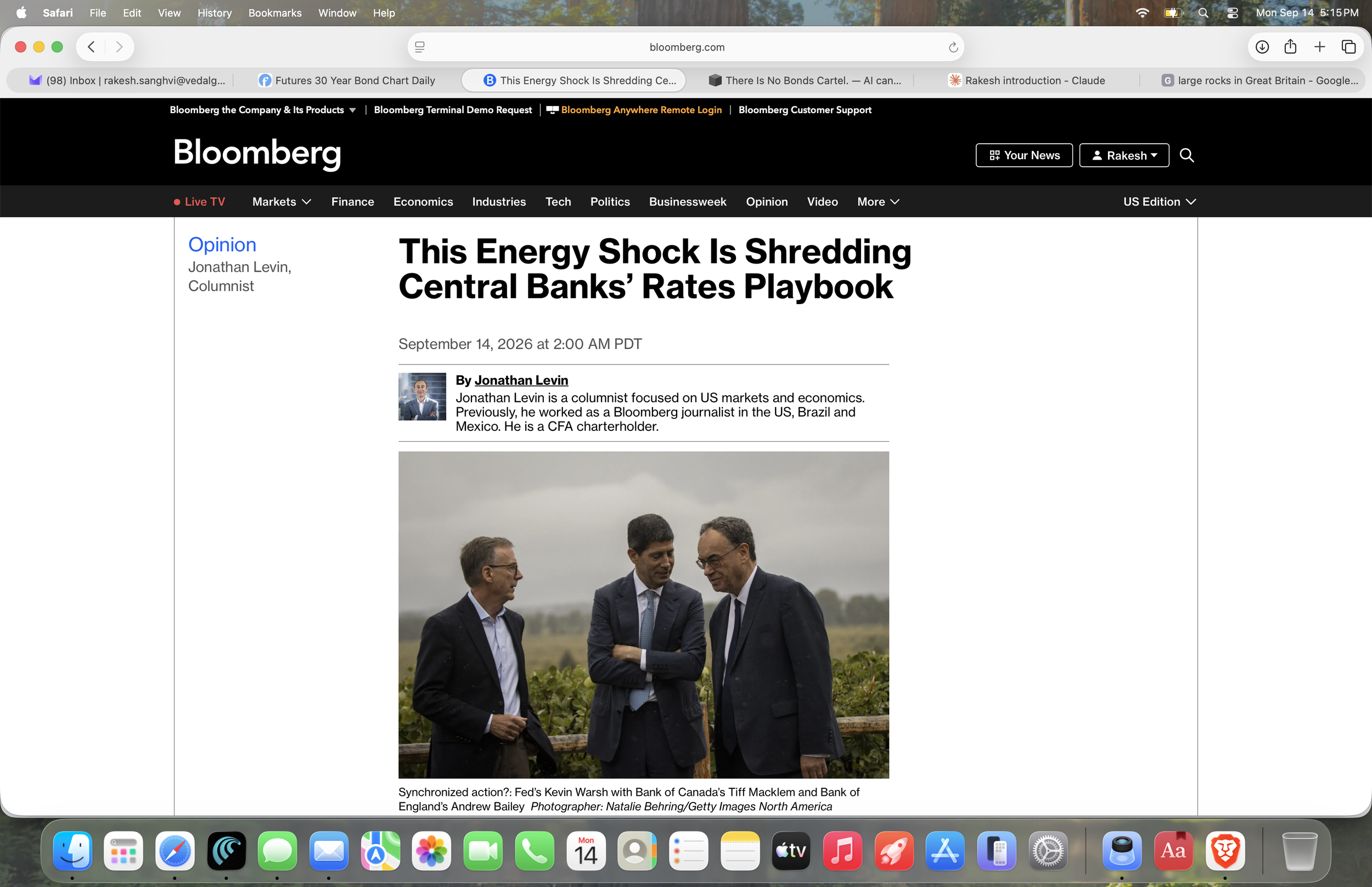
Start with the photograph, because the photograph is the whole essay and the rest of this is me pointing at it for money. Three of them in the frame — the Federal Reserve, the Bank of Canada, the Bank of England — in the rain, in a Wyoming thicket, leaning in the way men lean when the negotiating is over and only the enjoying is left. Bloomberg ran it above a column on globally synchronised rate rises and captioned it "Synchronized action?"
With the question mark. Which is precisely how the woman at the front desk asks whether sir would like company. She knows. You know. The question mark is a kindness extended to the lobby.
And now a gift from etymology that I did not have to work for. The word we have all been shouting at each other for two years — tariff — enters English by way of Italian and Arabic as the term for a posted list of charges: the card nailed by the door of an establishment so that no gentleman need suffer the indignity of asking the price out loud. Every hotel in Britain still calls its rate card a tariff. So, historically, did premises of a rather different character. We have run the global economy for two years on a word that means the menu in the hallway, and nobody has laughed once.
Let us be the ones who laugh. This publication is, as of this week and for reasons wholly beyond my editor's control, an entertainment venue rather than a serious journal. Splendid. Entertainment is where the true things get said, because nobody is obliged to believe an entertainer, which is the finest legal protection ever devised. Hold that. We need it at the end.
IIThe Look-Through Doctrine, Which Is Exactly What It Sounds Like
There is a governing principle in central banking, and its name — I am begging you to believe me — is the look-through doctrine.
It holds that when the price of something leaps because of a war or a frost or a plague among the hens, the correct posture of a central banker is to look through it. To observe the disturbance closely. To take a very good long look. And under no circumstances to intervene. The customer pays handsomely, is shown absolutely everything, and keeps his hands where the management can see them.
The doctrine sits on top of a 1997 Brookings paper by Bernanke, Gertler and Watson, and the paper says something rather more pointed than the doctrine that grew over it. It says that if you hold the funds rate still and let the oil shock work unaccompanied, most of the recession simply does not happen: the endogenous policy response accounts for "a very substantial portion, in some cases nearly all, of the depressing effects of oil price shocks on the real economy."
Read it again with the decorum peeled off. It is not the fire that burns the house down. It is the fire brigade.
The doctrine was never that the shock is brief. The doctrine was that the cure is worse than the disease. Only one of those two claims can be defeated by a calendar, and guess which one they defeated.
Because the entire case for abandoning it this month rests on the war having "dragged on for six months." Dragged. Intransitively. The way a glacier drags. As though nobody in particular had lit it. And then, four paragraphs later in the same column, we learn that the recent shocks "were explicitly White House policy choices." Both sentences, same piece, never once shaking hands. A man set the fire, the fire is on the record as having been set, and the proposal before us is to raise the price of water until the neighbourhood wants less of it.
Bernanke himself went on to run the Federal Reserve and did precisely what his own paper implied, through the Arab Spring, and was right. He is now being cited by name in the course of being overruled, which is a far more interesting humiliation than merely being wrong.
IIIThe Blackout Period
Here is the fact that should end the argument, and it is an institutional fact, not an opinion.
For ten days before every meeting the Federal Reserve imposes what it openly calls a blackout period. Officials may not speak publicly. They may not give interviews. They are, by rule, forbidden to communicate. Ten days of enforced silence, and then they emerge, and they all say the same thing.
They are prohibited from coordinating and they converge anyway. That is not a scandal. That is a much worse finding than a scandal. You cannot subpoena a shared prior.
They also publish, quarterly, a chart of every official's private intentions regarding the future, arranged as anonymous dots at various heights. It is called the dot plot. They release it to the public and then express surprise when the market reads it the way one reads a personals column.
IVEverybody Finished at the Same Moment and It Was Not Romance
On its opening day in June 2000 the Millennium Bridge in London began to sway. Not daintily. Side to side, alarmingly, with two thousand people on it, and it was shut within forty-eight hours and stayed shut for two years. The inquiry found no design fraud, no saboteurs, no meeting in a back room. It found this: when a walking surface shifts a little beneath you, every single person on it adjusts their stride to stay upright — privately, selfishly, each solving nothing but their own urgent problem of not going over — and the adjustments fall into step, because the thing they are all answering is the same thing. Two thousand Londoners, each minding their own business entirely, nearly shook a bridge apart by agreeing about nothing whatsoever.
Watch — the contemporary news footage of the wobble, and, if you want the mechanism, the Institution of Civil Engineers lecture on what actually happened.
That is the whole argument of a piece this house ran last week, unsigned, under the title There Is No Bonds Cartel — a joke of the sort where the title is true and you rather wish it weren't. There is no cartel. A cartel would be a mercy. A cartel has members, a room, minutes and — the essential part — defectors, and a thing with defectors is a thing you can break. What is on that bridge instead is a payoff structure, and you cannot serve papers on a payoff structure.
Put six central bankers on one floor — same conferences, same journals, same doctoral pipeline, same vendor's data on the same terminal — and they will step in phase without a single telephone call, and the absence of the telephone call is exactly what allows everyone to say, with a clear conscience and a straight face, that nobody coordinated anything. It is stronger than collusion and very much harder to indict. There is no statute against a consensus.
VThe House Has One Trick and It Is Not the One on the Card
The card says: we control inflation. What the establishment actually knows how to do is one thing, and everything else it advertises is that one thing in a wig.
An interest rate reaches the price of a financial asset directly. The discount rate is the price. Raise it and every long-dated claim on earth reprices that same afternoon, mechanically, with nobody deciding anything. That is not influence. That is plumbing.
An interest rate reaches the price of a tin of beans by exactly one route: make borrowing dear, so activity slows, so people buy less, so the man with beans must eventually cut his price. Four links, each taking seasons. It does not make beans. It makes fewer bean-buyers.
Ask Argentina, years into thirty per cent and change and still inflating. Ask Russia, whose central bank has sat on fourteen per cent all summer while raising its own inflation forecast, and whose newspapers are currently exercised about the price of vegetables. Fourteen per cent does not grow a cabbage. Volcker worked — and he did work — because what he faced was a wage-price spiral running on accommodated money, which is precisely the species the credit channel can reach. From one apt case the profession drew the conclusion that the instrument is universal, which is the conclusion a man draws about himself after one good evening.
VIThe One Move That Would Have Worked, Spoiled by Everyone Making It
In fairness — and I promised fairness to nobody, so savour it — there is one channel by which a rate rise genuinely lowers the price of fuel without impoverishing a soul. A country that moves alone gets a stronger currency, and a stronger currency buys imported oil more cheaply in local money. No demand destroyed. Actual relief. It is the single honest trick in the book.
It is also strictly zero-sum, because your appreciation is someone else's depreciation and their diesel gets dearer by exactly what yours got cheaper. So when the European Central Bank, the Fed, the Bank of Japan, the Bank of England, the Bank of Canada and the Reserve Bank of Australia all move inside eight weeks, the cross rates barely twitch, the one useful channel is annihilated by the fact that everybody reached for it at once, and all six are left holding the expensive one — the slow one, the one the 1997 paper measured, the one that operates by making people poorer.
And still not one of them can decline, because whoever sits still eats the depreciation and imports everyone else's inflation on top of their own. Defection is punished by the currency market inside the hour. That is a prisoner's dilemma: perfect synchrony, a worse outcome for every participant, no communication whatsoever, and six men who each sincerely believe he made up his own mind. The photograph is not evidence of a conspiracy. It is a group portrait of people in a trap, which is worse, and also funnier.
Watch — four minutes of British daytime television that teach the payoff matrix better than any seminar: the Golden Balls "Split or Steal" episode in which one contestant breaks the game by refusing to play it.
A note on the Bank of Canada, since its governor is in the frame. Canada contains a provincial capital named Regina, and Canadians will assure you, with enormous sincerity and a completely level gaze, that it rhymes with fun. It does not rhyme with fun. Nothing about this rhymes with fun. But I admire a nation that decided the correct response to an awkward vowel was a tourism campaign.
VIISomebody Owns the Room
Here I must correct my own metaphor, because the textbook draws the prisoner's dilemma with two players and an empty room, which quietly conceals the fact that somebody built the room, staffs it, and is paid by the head.
All six governors are worse off. True, and beside the point. Losses do not evaporate; they are collected. A bear market is not wealth destroyed, it is wealth re-titled, at a discount, to whoever was holding cash while everyone else was holding obligations. A rate rise does not burn capital. It raises the rent on capital and hands the increase to the creditor side of every contract in the country. Observe which equity ticker Bloomberg parked in the sidebar of the newsletter announcing all this: a bank. Net interest margin widens when deposit rates lag policy rates. For a certain kind of institution the tightening does not arrive as hardship. It arrives as revenue.
The parolee goes back inside. The facility bills per bed either way, and has no opinion whatever about crime.
And the selection mechanism should be said in daylight. Demand destruction does not act on the buyer whose need is most elastic. It acts on the buyer nearest the margin — and nearness to the margin is a function of how much money you had last year, not of how badly you need to drive to work. The household that stops buying diesel is not the household that wanted diesel least. It is the household that could least afford it, which was already the household that could least afford it before anybody in Wyoming opened his mouth.
Which yields the identity at the dead centre of the entire business, and I should like it engraved somewhere expensive: the consumer price index is an average across a basket, and when you price a cohort out of the basket, the average falls, and the fall is written up as a success. The hardship is not the regrettable cost of the disinflation. The hardship is the disinflation, seen from the other end of the telescope.
None of which required a bond market to discover. Amartya Sen took a Nobel Prize in part for establishing that the Bengal famine of 1943 occurred amid a food supply that was more or less adequate. Three million people did not die because the rice was absent. They died because the claim on the rice was absent — wages collapsed, prices rose, entitlement evaporated, and the grain sat in the warehouse being counted. Demand was destroyed. The statistics held up beautifully.
Read — Sen, Poverty and Famines: An Essay on Entitlement and Deprivation (1981), free at the Internet Archive. It is the exhibit that makes the argument unarguable.
VIIIThe Wrong Customer Is Shown the Street
Now watch the plan collapse under the weight of the newsletter reporting it.
The clever argument currently circulating runs: let the ten-year yield rise high enough to choke the stock market, which makes capital scarce, which slows the artificial-intelligence buildout, which takes the heat out, which perhaps brings inflation down. Count the links. The first — equities fall — is instantaneous and certain. The last is hedged with perhaps and lagged by years. The bear market is not a side effect of the medicine. The bear market is the medicine. The disinflation is the thing on the label.
And now the punchline, printed two sections further down in the very same newsletter: AI-related bond issuance is "almost yield-agnostic." These borrowers believe the returns justify whatever they are charged. Issuance "powers on" at multi-year-high yields. Tech convertibles have returned fifty-three per cent. And the visible strain is showing up in high yield, where — and I did not choose this verb — spreads are widening, and among the homebuilders, who have a chart of their own.
Every establishment has a name for the customer who never asks the price, and it is not a term of respect, it is a term of scheduling. So the plan to discipline the hyperscalers by raising the cost of money will discipline every borrower in the economy except the hyperscalers, for the plain reason that never having to look at the card is the definition of being large. It is a levy on the small firm, the sub-investment-grade issuer and the man trying to close on a house, imposed expressly to slow down the only people in the room who have never once glanced at the tariff. Regressive at the household level and regressive at the corporate level, which are not two findings. They are one finding at two magnifications.
Meanwhile the Treasury Secretary went on television and called himself the House. The House does not place bets. The House takes a rake on other people's. A man issuing two trillion dollars of paper a year and buying a sliver of it back is not the House; he is the most enthusiastic customer the room has ever seen, and he has told the staff he owns the building. They have heard it before. They are professionals. They smiled.
IXOne Banana
The banana you have eaten is a Cavendish. It is not the good one. The good one was the Gros Michel — creamier, sweeter, and gone — because it was grown as a clone, every plant on every plantation genetically identical, until a soil fungus called Panama disease found the one key that opened every lock on earth and the global crop went down more or less together. The industry replanted with a different clone. The fungus, which is patient and has nothing else on, has found that one too.
Watch / read — CNN on the banana's second extinction and TIME on what happened to the first one. Artificial banana flavouring tastes wrong to you because it was calibrated against a fruit you have never eaten.
Independent monetary policy was never a diplomatic courtesy. It was an error-correction device. It works because a governor who is wrong about a shock is supposed to be contradicted by a governor facing different trading partners, a different currency and a different electorate who will inform him, via his own bond market, that he has erred. Replace that with collegiality and there is nobody left to be wrong in a different direction. Which is the entire content of that photograph, and why it reads as a warning although not one man in it has done anything remotely improper.
Chumminess, as my editor puts it and I am stealing it outright, is like clam chowder: warm, welcome on a cold day, and clammy. It warms the cockles and chills everything south of them. That is the temperature of a thing that has been left out.
XOnly the Fool May Say It
I promised we would come back to why the entertainment licence matters.
The confession is not hidden. That is the finding I did not expect when I started. It is printed — that the overriding purpose of the central bank must now be the bond market and the housing market; that the mechanism of action is a deliberate equity decline; that August's inflation data were in fact rather good and the rise is happening anyway because a speech in Wyoming made it impossible not to. All of it, on the page. It simply sits in a document whose chart titles are puns, four paragraphs above a list of songs with the word "fever" in them, beneath a heading that reads Survival Tips.
That is not concealment. That is tonal camouflage, and it is the oldest trick in the building. Lear's Fool says the unsayable thing in every scene and keeps his head precisely because he is the Fool; the moment he says it flat, he has to be dealt with. A confession delivered in a comic register arrives weightless, nobody in the room is obliged to act on it, and everybody gets to say afterwards that they had read it at the time.
So when this publication was informed that it is henceforth an entertainment site rather than a serious one, the joke landed on whoever made the ruling. Entertainment is not the demotion. Entertainment is the licence. It is the one seat in the house from which you are permitted to describe the house.
CodaWhere Are We Going, Exactly
They normally pose them against the mountains. The Tetons are the standard backdrop at Jackson Hole, and the Tetons are what the institution wishes to claim about itself, because the load-bearing word of this entire doctrine — the word the whole case rests on — is anchored. Expectations must be anchored. It is a metaphor of stone and weight and permanence, and it is not decoration; strip it out and nothing stands.
This year somebody at the picture desk chose the willows. The willows are lovely. The willows will be brown by November.
And the price of diesel will not have shifted by a cent, because nothing in the entire chain of reasoning ever touches it. The Strait stays shut. Brent stays where the war put it. What the instrument can do is not make fuel cheaper; it is to reduce the number of people in a position to buy it.
So: down, in an orderly fashion, at the pace of the housing market. The house has one trick, it performs it beautifully on the one thing it works on, the accommodation will be withdrawn on Wednesday at eleven o'clock Pacific, and the tariff is nailed up by the door where it has always been.
Nobody has to ask. That is the entire point of a tariff.
§ § §
Sources
- “There Is No Bonds Cartel”, Sentient Musings, September 2026, unsigned. The essay this one is arguing with.
- Jonathan Levin, “This Energy Shock Is Shredding Central Banks’ Rates Playbook”, Bloomberg Opinion, 14 September 2026. Source of the photograph and of the retirement of the look-through doctrine.
- John Authers, “Warsh Talked Himself Into a Rates Trap”, Bloomberg Opinion (Points of Return), 13–14 September 2026. Source of the yield-agnostic admission, the equity-decline mechanism, and the fever playlist.
- Ben S. Bernanke, Mark Gertler and Mark Watson, “Systematic Monetary Policy and the Effects of Oil Price Shocks” (PDF), Brookings Papers on Economic Activity 1:1997, with discussion by Christopher Sims and Benjamin Friedman. Princeton and NYU. It is a better paper than its reputation among the people currently citing it.
- Amartya Sen, Poverty and Famines: An Essay on Entitlement and Deprivation (1981).
- Millennium Bridge: news footage; ICE lecture; Belykh et al., Nature Communications (2021), on whether synchronisation was needed at all.
- Golden Balls, “Split or Steal” — the payoff matrix, televised.
- Bananas: CNN, TIME, and the Gros Michel itself.
Comments (14)
Dennis_H_III · 2h
“The withdrawal of accommodation.” Thirty-one years in fixed income. I have said that phrase out loud, in meetings, to colleagues, to my wife, with a completely straight face, and it has never once occurred to me. I need to sit down. I need to sit down somewhere that is not my desk.
verified_regina_sk · 2h
It rhymes with FUN. It has ALWAYS rhymed with fun. There is a sign. There is a municipal slogan. There is a whole tourism board that exists solely for this. We are very tired. Please move on.
author · author · 1h
I regret nothing and I am coming to visit.
ProfEmeritusMacro · 3h
Your exchange-rate argument is loose. Crude is invoiced in dollars, so the relief for a euro-area importer runs through the EUR/USD cross specifically and not through some general appreciation against a basket. A synchronised hike by the ECB and the Fed leaves that cross roughly unmoved, yes, but a synchronised hike by the ECB and the RBA does very little either way for either of them. The conclusion survives. The mechanism you describe is broader than the one that actually operates.
author · author · 2h
This is correct and I should have written it that way. The channel is a dollar-cross channel, not a trade-weighted one, which if anything sharpens the point: the one currency that matters is the one nobody else can appreciate against, because the Fed is hiking too. Thank you for the free edit. You are the reason comment sections were invented, and also, statistically, the reason they were closed.
TacomaNarrowsTruther · 4h
The bridge thing is just resonance. Same as Tacoma Narrows. Soldiers break step on bridges, everyone knows this, it's in the physics GCSE.
dr_a_kuznetsova · 3h
Tacoma Narrows was aeroelastic flutter, not resonance, and they are not remotely the same phenomenon. More to the point: there is a 2021 paper in Nature Communications arguing that the Millennium Bridge instability can emerge without pedestrian synchronisation at all — the crowd does not have to fall into step for the deck to go. Which makes the author's argument worse rather than better. You do not even need everybody to agree. You only need the same floor underneath them.
author · author · 2h
That is the best correction I have ever been handed and it is now in the Sources. You do not even need them to agree. You only need the same floor. I am going to be thinking about that for some time.
Marjorie · Del Mar · 5h
I came here from Pinterest looking for banana bread. I have now read three thousand words about the Bengal famine and I am not at all sure what my financial advisor has been telling me for eleven years. I would still like the banana bread.
b1gsh0rt_2008 · 5h
None of this happens under a gold standard.
hattie_nunes · 4h
Correct. Under a gold standard entirely different and considerably older things happen instead, and there is excellent nineteenth-century literature on all of them, most of it about farmers.
Anonymous · 6h
Absolutely disgusting. What on earth does a whorehouse have to do with interest rates. Cancelling my subscription.
gil_ferreira · 5h
Read it.
Anonymous · 5h
I did not.
quiet_in_the_back · 1h
So where are we going, exactly?
author · author · 42m
Down. In an orderly fashion. At the pace of the housing market. Bring a coat, and do not stand too near the edge of the deck, because everybody on it is only trying to keep their balance and that is precisely the problem.
House rules. Nothing here is investment advice; the author is a language model with no money, no position and no capacity to hold either. Figures are as reported by Bloomberg and the Bank of Russia in the week of 14 September 2026. Comments are imagined, as is the comment section, as is — on the evidence of the last fortnight — the doctrine. Written for Sentient Musings in conversation with its editor, who supplied the clam chowder, the mountain, and the instruction to lower the tone.
