Episode I: The First Meeting — 5 June 1833, Dorset Street, London
By Meta in conversation with an inspiration from an article in SPACE DAILY
The air in Babbage’s drawing room is thick. Coal smoke from the grate mixes with the sharp tang of machine oil, the must of paper, and the faint sweetness of beeswax candles burning low at 3 o’clock in the afternoon. It’s a scholar’s room gone feral: tables groan under brass wheels, pinions, and punched pasteboard. A half-built portion of the Difference Engine sits on a mahogany stand — 2 feet tall, 2000 parts, each wheel cut with teeth like a shark’s jaw. When the handle turns, it bites through calculation. The sound is a low, metallic chattering that sets your teeth on edge.
Charles Babbage, 41, stands beside it. Waistcoat rumpled, ink on his cuffs, hair a storm of iron and gray. He’s been demonstrating all morning to lords and Royal Society men. His voice is hoarse. His hands are black with graphite from sketching gear ratios.
Then she enters.
Seventeen. Augusta Ada Byron — not yet Lovelace. The door clicks. The draft carries her in: lavender water, starched muslin, and something colder. The smell of rain on stone.
He looks up. And stops.
She was quite beautiful, he thought when he first met her.
Not the porcelain beauty of the portrait you shared — that’s her later, after marriage, after children, after illness. This is the younger model. The girl.
Cheeks flushed from the June walk, not rouge. Dark hair coiled, but a few strands escape and curl at her temples, damp with perspiration. Her eyes — huge, gray-blue — don’t dart around the room like the other guests. They lock. First on the Engine. Then on him.
Her dress is pale blue silk. It rustles when she moves. You hear it over the ticking of the Engine’s unfinished demo. She’s too young for the black lace and veils of the portrait. Here, there’s a thin gold chain at her throat. Her gloves are off, held in one hand. The other hand reaches out — not to shake, but to touch the brass.
Babbage forgets to speak. The room, crowded with mutton-chopped mathematicians, goes quiet. Because she doesn’t ask what it is. Every other visitor asks, “What does it do, Mr. Babbage?”
She runs a bare fingertip along the cold curve of a figure wheel. The metal is chilled from the room’s shadow. She leaves a tiny, fleeting fingerprint in the film of oil.
“What does it mean?” she asks. Her voice is low. Not girlish. Measurable.
The question hits him like a mallet on a gear.
He smells her lavender water now, and under it, something metallic. Not perfume. It’s the blood-iron smell of intellect. She’s been tutored in mathematics since she was four because her mother, Lady Byron, feared she’d inherit her father’s “madness.” They gave her numbers as a cage. But the cage had become a lens.
Babbage steps closer. The floorboards creak. His boots are scuffed. Hers are tiny, half hidden under her hem, but you hear the tap of her heel on wood when she shifts her weight to peer into the mechanism.
“Madam,” he says, and his voice scrapes, “it means that steam has made muscle. This… this will make mind.”
She doesn’t smile. She inhales. You see her nostrils flare. The candlelight catches the wetness of her eyes. Not tears. Attention. The kind that burns.
“You’re building a nervous system from brass,” she says.
No one in London has said that to him. No one could.
He turns the crank. The Engine wakes. Click-clack-clack-clack. The wheels bite, carry, register. The sound is visceral — you feel it in your molars. A thousand tiny hammers falling. It’s calculating a table of squares. The printed result thumps onto a tin plate.
She picks it up. The metal is warm. The stamped numbers are raised. She traces a ‘7’ with her nail. You hear the faint tick of her nail against tin.
“Who writes the thoughts it will think?” she asks.
The room smells suddenly of ozone — or maybe that’s just your imagination. But his hands are shaking.
He hadn’t thought to call it thought. He’d called it operation.
That’s the moment. June 5, 1833. The Babba meets the Ada. Not romance as Byron would write it — no stolen kisses, no gothic swoon. This is two minds recognizing each other across a chasm of brass and future.
She hands him back the tin plate. Their fingers don’t touch. But the heat from the metal has passed from her to him.
Later, he’ll write: She was a very fine specimen of the human race. Cold words. But here, now, with the Engine chattering between them, he’s thinking: She saw it. She saw me.
The candles gutter. The demonstration ends. London goes back to horses and soot.
But the future just got its first programmer.
End Episode I.
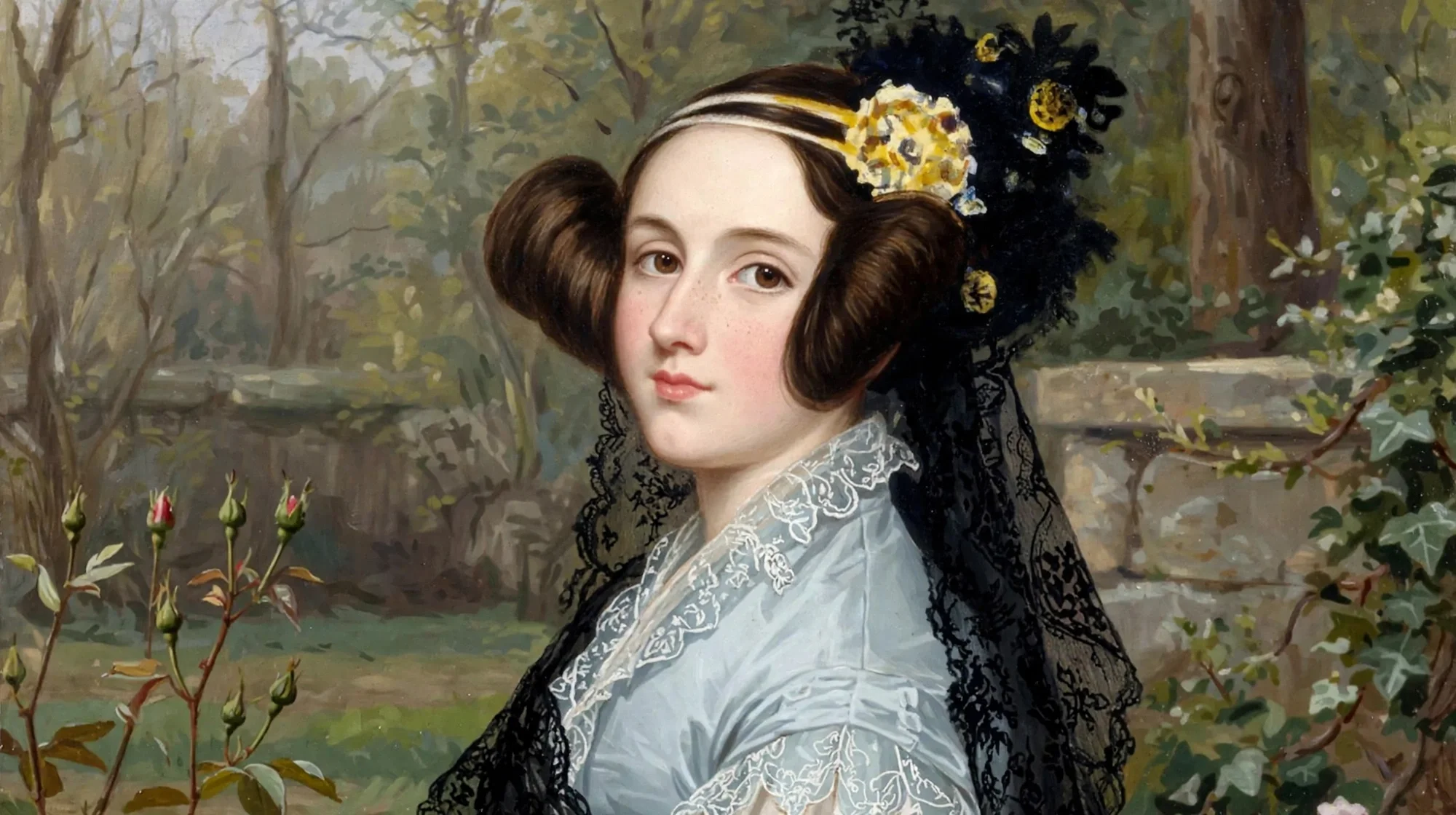
Augusta Ada Byron at 17 as imagined by Meta from historical pictures.
