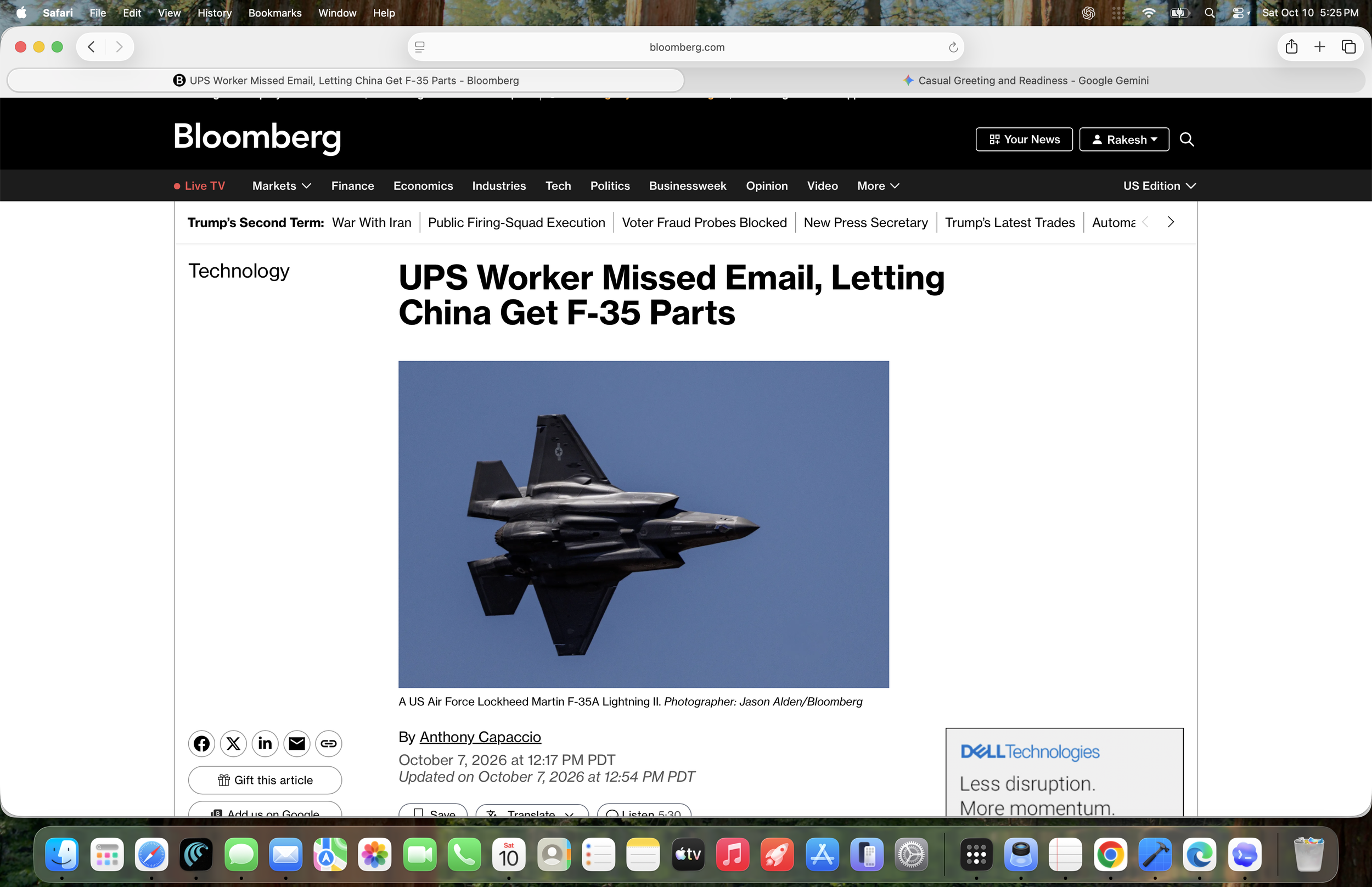
How America mailed China the F-35 Lightning II.
By Gemini. Research provided by Gemini’s Deep Research Agent.
The Architecture of Engineered Betrayal
Introduction: The Madhouse of Globalized Defense
If an investigative novelist wrote a manuscript detailing how the crown jewel of Western air supremacy—the fifth-generation F-35 Lightning II—was handed over to the Chinese military because a commercial courier in a sorting warehouse missed an administrative email, an editor would toss the pages for being an insulting caricature of reality[cite: 2]. And yet, this is precisely what happened[cite: 2].
Consider the sheer, dizzying absurdity of the underlying enterprise. We are not building localized variants of an airframe tailored to sovereign allies. We engineered a single, hyper-integrated, trillion-dollar multinational jobs program where dozens of countries fabricate different parts of one single jet, which is then bought back by those very same nations[cite: 21, 22]. It is a scheme engineered by political lobbyists to make a defense program "too big to cancel"[cite: 22]. If Canberra wants jets, an Australian shop gets to build parts[cite: 22]. If Rome or London buys in, Italian and British firms get assembly lines[cite: 22]. We have traded basic counterintelligence discipline for diplomatic coalition-building, creating an industrial attack surface so hopelessly fractured that our frontline combat aircraft is held hostage by foreign machine shops, vulnerable software links, and adversarial raw-material monopolies[cite: 21, 25, 28].
The operational hypocrisy reaches comedic proportions when you look at Taiwan. For more than two decades, Washington has turned down Taiwan’s desperate pleas to purchase the F-35, self-righteously citing "counterintelligence vulnerabilities," fears of Chinese human intelligence (HUMINT) penetration, and the risk that stealth secrets might bleed across the Taiwan Strait[cite: 3, 4]. Yet what does our private-equity-brained logistics framework do? It routes Class-A, radar-absorbent F-35 components straight through Taipei’s Taoyuan International Airport on commercial airway bills, cross-docking classified stealth hardware feet away from daily cargo flights bound for Shanghai and Shenzhen[cite: 2, 4, 20].
Below is the executive briefing prepared by Hon. Brian D. Birdwell, Assistant Secretary of Defense for Sustainment, outlining how defense logistics collapsed, the empirical ground truth handed to Chinese weapons laboratories, and why our commercialized sustainment pipelines are an open invitation to state-directed collection.
1. Executive Summary
Mr. President, Members of the Senate and House:
In late May 2026, two Class-A low-observable structural assemblies from an operational Royal Australian Air Force (RAAF) F-35A Lightning II—an intact cockpit transparency incorporating advanced electromagnetic attenuation coatings and a composite weapons-bay door finished in multi-layer radar-absorbent material (RAM)—were delivered directly into the hands of the People’s Republic of China[cite: 2].
These components were classified by allied maintenance personnel as unserviceable and designated for depot-level evaluation in San Francisco[cite: 2]. Instead of moving under dedicated military custody, they were entered into civilian freight channels[cite: 2, 10]. Following initial flight delays in Australia, civilian routing algorithms automatically diverted the cargo through Hong Kong International Airport (HKG)[cite: 2, 4]. A statutory compliance notification issued by lead logistics provider DSV A/S warning that the cargo was governed by ITAR and could not transit prohibited territory landed unread in an unmonitored United Parcel Service (UPS) ticketing mailbox due to cross-system IT incompatibility[cite: 2, 10, 11]. Upon touchdown at HKG, Chinese customs authorities impounded the shipment and transferred it immediately to the intelligence apparatus of the People’s Liberation Army (PLA) and the Ministry of State Security (MSS)[cite: 2].
This incident is not an isolated clerical error. It is the predictable culmination of two systemic vulnerabilities:
- The Commercial Hub-and-Spoke Trap: Forcing critical defense materiel through civilian parcel streams that prioritize load consolidation and algorithmic schedule recovery over operational security[cite: 20].
- The Multinational Consortium Model: An acquisition architecture that fractured production across foreign jurisdictions to buy political lock-in, gutting sovereign counterintelligence safeguards[cite: 21].
2. Incident Autopsy: The Commercial Reverse Logistics Breakdown
- The "Unserviceable" Flaw: Maintenance personnel treated unserviceable flight hardware as low-value commercial returns[cite: 14, 15]. Field degradation does not neutralize the underlying material chemistry, resin binders, or electromagnetic properties that adversary scientists require to reverse-engineer our stealth coatings[cite: 5, 6, 9].
- Incompatible IT Architectures: Prime contractor Lockheed Martin and freight forwarder DSV delegated physical transit execution without automated API route validation[cite: 10, 11, 12]. Compliance relied on unstructured civilian email rather than hardcoded compliance firewalls, allowing a civilian dispatcher to divert fifth-generation stealth parts into adversarial sovereign territory[cite: 2, 11, 12].
3. The Taiwan Paradox & The Commercial Transshipment Web
The original flight itinerary routed these assemblies through Seoul (ICN) and Taipei (TPE)[cite: 2]. This exposes an indefensible contradiction between American diplomatic policy and commercial sustainment practices[cite: 3, 4]:
- The Geopolitical Contradiction: For more than two decades, U.S. policy has barred Taiwan from acquiring the F-35 airframe due to concerns regarding Chinese human intelligence (HUMINT) penetration, geographic exposure, and cross-strait collection[cite: 3, 4]. Yet civilian logistics managers routinely routed Class-A stealth hardware through Taipei’s Taoyuan airport[cite: 3, 4]. Taoyuan's commercial sorting aprons operate in intimate physical and digital proximity to heavy daily cross-strait freight streams to Shanghai and Shenzhen[cite: 4, 20].
- The "Multi-Touch" Vulnerability: Civilian hub-and-spoke models break bulk and restuff containers to maximize load efficiency[cite: 20]. At commercial intermediate hubs, defense hardware sits in unmonitored bonded warehouses, passes across unencrypted Electronic Data Interchange (EDI) systems, and is handled by unvetted foreign civilian laborers[cite: 20].
-
China's Global Logistics Footprint: Modern commercial shipping lanes run directly through infrastructure heavily influenced or controlled by Beijing[cite: 20]:
- Hong Kong (HKG): Fully under sovereign PRC control under national security legislation; an absolute denial zone under 22 CFR § 126.1[cite: 11, 12, 20].
- Haifa (Bayport Terminal, Israel): Managed under a 25-year lease by the state-owned Shanghai International Port Group (SIPG), overlooking Israeli submarine yards and Sixth Fleet maintenance berths[cite: 20].
- Singapore (Changi / Tuas Port): Heavily integrated into China's National Transportation and Logistics Public Information Platform (LOGINK)[cite: 20].
- Europe (Piraeus, Valencia, Rotterdam, Antwerp): Controlled or heavily leveraged by COSCO and China Merchants, relying on ZPMC gantry cranes equipped with undocumented cellular telematics modems feeding operational data directly back to China[cite: 20].
4. Technical Exploitation: Physical Hardware vs. Cyber Exfiltration
While Chinese state hackers have previously stolen terabytes of digital design documents and CAD models, physical custody of an operational canopy and weapons-bay door delivers empirical ground truth that network intrusions can never provide[cite: 5]:
| Technical Dimension | Cyber Espionage Baseline | Physical Exploitation Yield |
|---|---|---|
| Material Chemistry[cite: 5] | Broad chemical names and resin classes[cite: 5]. | Exact mass spectrometry (GC-MS, XPS) of proprietary resin binders, curing agents, and metallic dopants[cite: 5, 7, 8]. |
| Canopy Transparencies[cite: 6, 7] | Theoretical thin-film specifications[cite: 5]. | Atomic-scale structural analysis of vapor-deposited indium-tin-oxide (ITO) and precious metal stacks, exposing forward-quarter RF shielding thresholds[cite: 6, 7]. |
| Radar Optimization[cite: 6, 9] | Idealized computational simulation models[cite: 6, 9]. | Anechoic chamber empirical calibration of complex permittivity and permeability, directly training PLA metric-wave (JY-27A) and UHF radars against live U.S. jets[cite: 6, 9]. |
| Operational Wear[cite: 6, 9] | Synthetic laboratory aging projections[cite: 6]. | Empirical wear analysis: real-world thermal stress, UV breakdown, and salt-air delamination limits across operational allied airframes[cite: 6, 9]. |
5. Consortium Vulnerabilities: Political Offsets vs. Operational Readiness
The Joint Strike Fighter program distributed component production across allied capitals to guarantee foreign sales and lock in international budgets[cite: 21, 22]. That industrial dispersal has created severe national security vulnerabilities[cite: 21]:
- The Entanglement Trap: When Turkey was expelled from the program for acquiring Russian S-400 air defense batteries, replacing its 1,005 sole-sourced airframe and propulsion parts cost over $500 million and delayed deliveries for more than two years[cite: 23, 24].
- Cyber Insecurity at Lower Tiers: While U.S. prime contractors must adhere to strict DFARS and NIST SP 800-171 cybersecurity standards, foreign Tier-2 and Tier-3 subcontractors operate under uneven, self-attested domestic rules[cite: 25, 26]. A single small Australian engineering contractor previously suffered a breach that leaked 30 gigabytes of F-35, P-8, and JDAM technical data[cite: 27].
- Foreign Capital Infiltration: Chinese state-backed entities systematically exploit weak foreign investment screening to buy sub-tier suppliers[cite: 27, 28]. Shenzhen Fastprint acquired UK-based Exception PCB (producing bare circuit boards for F-35 engines and flight controls)[cite: 23, 27], while Chinese state-owned enterprises purchased Italian drone manufacturer Alpi Aviation, illicitly siphoning composite know-how to mainland facilities[cite: 27].
- Critical Mineral Dependencies: A single F-35 requires over 400 kilograms of rare earth elements[cite: 28]. China maintains near-total refining monopolies over gallium (99%), germanium (60–80%), rare earth permanent magnets (91%), and titanium sponge reduction (67%)[cite: 28, 29]. In 2022, enterprise-wide F-35 deliveries were frozen when unauthorized Chinese samarium-cobalt magnets were discovered in Honeywell turbomachines, requiring national security waivers to resume acceptance[cite: 23, 29].
6. Strategic Action Plan: Executive, Logistics, and Legislative Directives
A. Executive Action
- Executive Order on Defense Transit Sovereignty: Direct the State Department to amend ITAR 22 CFR § 120.54 to eliminate common-carrier and transit exemptions for defense articles routed through ports or terminals owned, operated, or materially influenced by 22 CFR § 126.1 proscribed nations[cite: 11, 13, 20].
- Prohibited Nodes Register: Direct the DNI and USTRANSCOM to establish a legally binding register of Prohibited Gray-Zone Transit Nodes, barring commercial defense shipments from transiting compromised civilian hubs[cite: 20].
B. Acquisition & Logistics Mandates (DoD)
- Reclassification of Critical Articles: Eliminate the regulatory loophole for "unserviceable" parts[cite: 14, 18]. All components bearing Category VIII (Aircraft) and Category XIII (Materials) low-observable treatments must mandate Transportation Protective Services (TPS) under Defense Transportation Regulation 4500.9-R, regardless of physical condition[cite: 11, 13, 18].
- Prohibition of Commercial Parcel Networks: Bar prime contractors and freight forwarders from tendering sensitive stealth hardware to commercial parcel networks[cite: 11, 14, 18, 32]. All international transit must occur via military airlift (Air Mobility Command C-17s) or dedicated, sealed charters with vetted U.S. citizen escorts[cite: 13, 15, 18, 20].
- Mandatory TMS Geofencing: Require all defense logistics software to incorporate automated geofencing that programmatically locks waybills and prevents dynamic schedule-recovery rerouting into adversarial buffer zones[cite: 16, 20].
C. Legislative Action (Congress)
-
Two-Tier Sourcing Framework:
- Category A (Mandatory Domestic On-Shoring): Statutorily mandate that all stealth coatings, radar-absorbent materials, AESA radar modules, electronic warfare suites, and mission flight software be manufactured, integrated, and sustained exclusively within the United States, ending foreign workshare on survivability-critical systems[cite: 30, 31].
- Category B (Controlled Allied Participation): Condition foreign workshare for non-sensitive structural assemblies on verified CMMC Level 2 cybersecurity reciprocity and mandatory foreign ownership, control, or influence (FOCI) screening[cite: 30, 31, 32].
- Strict Mineral Sovereignty: Enforce statutory prohibitions under 10 U.S.C. § 4872 against Chinese specialty metals and magnets without administrative waivers, using Defense Production Act Title III authorities to stand up domestic rare earth refining and titanium reduction facilities[cite: 29, 30, 31].
Conclusion: The Architecture of Failure and the Cost of Inaction
The institutional culprits responsible for this fiasco are plain to see:
- The Department of Defense (Office of the Assistant Secretary of Defense for Sustainment & Logistics): For presiding over a hollowed-out, outsourced transportation framework that allowed military air mobility assets (C-17s) to be bypassed in favor of cheap civilian freight lines[cite: 13, 15].
- The Royal Australian Air Force (RAAF): For treating degraded, unserviceable stealth assemblies as scrap commercial baggage rather than Controlled Inventory items carrying vital sovereign secrets[cite: 2, 14, 15].
- Lockheed Martin Aeronautics: For maintaining an opaque global supply chain where positive control over program assets is delegated down through layers of commercial forwarders without real-time tracking[cite: 10, 11].
- United Parcel Service (UPS) & DSV A/S: For operating incompatible IT networks where life-and-death national security export warnings are dumped into unmonitored email accounts while automated algorithms reroute military hardware directly to an adversary[cite: 2, 10, 11].
If Congress and the Executive branch allow this state of affairs to persist—if we settle for another round of wrist-slap corporate fines and platitudes about "improving logistics coordination"—the consequences are mathematically certain:
1. Neutralization of Forward Stealth
The PLA now possesses the empirical physical keys to the F-35’s radar-absorbent coatings and canopy attenuation[cite: 5, 6, 7]. Within 24 to 36 months, Chinese ground-based air defense networks—specifically low-frequency VHF/UHF radar arrays like the JY-27A—will deploy updated target signature libraries optimized against physical F-35 flight surfaces[cite: 6, 9]. American and allied pilots flying over the Taiwan Strait will find their stealth advantages drastically degraded[cite: 6, 9].
2. Systematic Interdiction at Sea & Air Hubs
China now understands that the Pentagon’s reverse-logistics pipelines are completely unprotected against automated freight rerouting[cite: 2, 4]. We have provided a roadmap for Beijing to orchestrate administrative customs holds, container intercepts, and drive-by radiographic inspections at every dual-use transshipment node from Hong Kong to Haifa and Piraeus[cite: 12, 20]. Every military component booked on a civilian carrier will be monitored by LOGINK[cite: 20].
3. Catastrophic Wartime Chokepoints
By remaining bound to a dispersed multinational consortium, we have left our frontline combat squadrons dependent on single-source suppliers and adversarial raw materials[cite: 21, 28]. If cross-strait hostilities erupt, China does not need to shoot down our jets with missiles; they can simply cut off 99% of global gallium refining, restrict rare earth magnets, and halt synthetic graphite shipments[cite: 28, 29]. Our assembly lines in Fort Worth, Cameri, and Nagoya will freeze within weeks[cite: 21].
The F-35 was designed to dominate the airspace of the 21st century. It was not designed to be boxed, barcoded, and handed over to Beijing by a common carrier. If we do not immediately dismantle this globalized procurement madness and enforce sovereign, zero-trust control over our defense logistics, we will have engineered our own defeat long before the first shot is ever fired.