Killers in painkillers.
By Computer orchestrator model
Hello, World!
The Pill That Wears Two Labels
Hold an Aldi ibuprofen bottle next to a CVS ibuprofen bottle and you are not comparing two products. You are comparing two labels wrapped around one product. The inactive-ingredient list is identical, word for word, ingredient for ingredient, in the same order: colloidal silicon dioxide, corn starch, croscarmellose sodium, hypromellose, iron oxide red, iron oxide yellow, microcrystalline cellulose, polyethylene glycol, polysorbate 80, stearic acid, titanium dioxide. Even the “questions or comments” phone number is shared. Somewhere there is a single manufacturing line — almost certainly one of a handful of contract manufacturers that dominate the U.S. store-brand OTC market, the kind that files its own FDA approvals for “store-brand equivalents” and then licenses the formula out under dozens of retail names (Perrigo investor release on store-brand Advil equivalents) — that pours the same tablet into an Aldi-branded bottle and a CVS-branded bottle, and lets the register do the rest.
That “rest” is a five-fold price difference for zero formulation difference. Which means whatever explains $1.69 versus $9.69 here, it cannot be the ingredients — they’re the same ingredients, in the same amounts, from the same batch lineage. What’s left is shelf position, retailer margin strategy, and the psychological premium a familiar drugstore name commands over a discount grocer’s house brand. Branded-adjacent retail pharmacy pricing runs on margin structures where a very large share of manufacturer and retailer gross margin comes from brand and channel positioning rather than input cost (Brookings analysis of pharmaceutical distribution margins) — and when the two products are this literally identical, there’s no formulation story left to tell. The markup is the whole story.
The ingredients themselves
Set the price question aside and the ingredient question stands on its own. Nine of the eleven listed compounds are structural necessities — binders, disintegrants, lubricants, glidants that let a powder become a swallowable tablet at industrial scale. Two are not: iron oxide red and iron oxide yellow, added after titanium dioxide has already made the coating opaque, whose only remaining function is cosmetic — making a generic pill resemble the tan-brown tablet consumers associate with a “real” pain reliever. A third, polysorbate 80, sits in a gray zone: it aids dissolution, but it’s also a surfactant with an independent, separately-earned literature on gut-barrier disruption at dietary doses (Chassaing et al., Nature 2015; Gastroenterology 2022 controlled feeding trial) — a literature built entirely apart from anything to do with pain relievers.
The honest caveat, and it matters: the dose in a tablet — roughly 0.1 to 2 milligrams of polysorbate 80 — sits four to five orders of magnitude below the 15-gram daily dose at which that Gastroenterology trial found measurable gut effects (CHOP vaccine-ingredient dosing table). Mechanistic plausibility is not the same as demonstrated harm at this dose. Where the honest uncertainty actually lives is upstream of any single dose: nobody has funded the study of what forty years of trace, combinatorial exposure to the same handful of gut-active excipients — stacked across a lifetime of NSAIDs, laxatives, supplements, and packaged food — does in aggregate, because no single actor in that supply chain has an economic reason to go looking for the answer. That is a real structural blind spot. It is a different claim than “this ingredient is dosed to make you sick,” and I think the difference is worth preserving rather than collapsing.
[Your commentary here]
Where your theory and my caution actually diverge
Your reading — that the unnecessary is being added because doing so pays somebody, somewhere, downstream — is a coherent hypothesis about incentive structure, and incentive-structure reasoning is usually the right instinct in a system this opaque. Where I’d push back isn’t the instinct, it’s the specificity: an ibuprofen manufacturer doesn’t own the downstream disease. There’s no line item, no “gut-damage-to-GI-consult” kickback, no plausible mechanism by which Aldi’s or CVS’s contract manufacturer receives a cut of anyone’s later colonoscopy. If there’s a cynical, well-evidenced story about this drug making people money off making people sicker, it’s not the trace excipients — it’s the active ingredient’s own long-documented GI bleeding risk under chronic overuse, which is already disclosed, already litigated, and already the subject of black-box-style warnings. The excipient story is a quieter one: not “they did this on purpose,” but “nobody with the power to investigate has any reason to.”
[Your commentary here]
The pharmacist isn’t wrong about the price.
What I found with Perplexity Computer is nothing new. This pill, if any reasonable person was designing it, would not need more than 5 ingredients counting both Active and Inactive. Here is the total list of ingredients required:
A minimum-viable ibuprofen tablet, using only functionally load-bearing ingredients, would look like: ibuprofen + microcrystalline cellulose + croscarmellose sodium + colloidal silicon dioxide + stearic acid — five ingredients, uncoated. This isn't hypothetical; many private-label and hospital-formulary ibuprofen tablets are sold exactly this way, uncoated and dye-free, precisely because coating and coloring add cost and ingredient-count without therapeutic benefit.drugpatentwatch
EXTRA UNNECESSARY POISONS: Everything beyond that five-ingredient core — PEG, hypromellose, titanium dioxide, both iron oxides, and polysorbate 80 have side effects that are detrimental to the human body and specifically to the human gut.
Where the real story is: physiological synergy, not chemistry
This is the more interesting — and more legitimate — question, and it's where non-FDA, independent academic literature diverges sharply from the FDA's ingredient-by-ingredient "GRAS" framing.
Ibuprofen already compromises the gut barrier on its own. NSAIDs uncouple mitochondrial oxidative phosphorylation in intestinal epithelial cells, which is the documented mechanism by which they increase intestinal permeability and cause GI bleeding/ulceration risk (Rainsford mechanistic review; PMC review on NSAID enteropathy). Human studies confirm ibuprofen measurably increases gut permeability within hours of dosing.pubmed.ncbi.nlm.nih+1
Polysorbate 80 does the same thing, independently, through a different mechanism. It's a surfactant, and surfactants are pharmaceutically classified as intestinal "permeation enhancers" precisely because they loosen tight junctions between gut epithelial cells. Separately, Chassaing et al.'s landmark Nature and Gut studies found that polysorbate-80 (alongside carboxymethylcellulose) at low dietary concentrations directly alters human gut microbiota composition ex vivo and promotes low-grade inflammation and metabolic disruption in mice (Nature 2015; Gut 2017).pubmed.ncbi.nlm.nih+2
Putting these together: you have one compound (ibuprofen) that damages the gut barrier via mitochondrial uncoupling, combined in the same pill with a second compound (polysorbate 80) that independently loosens the same barrier via a surfactant mechanism. No study I found tests this exact combination at tablet-level micro-doses, so I want to be precise that this is a mechanistically plausible additive effect inferred from two separate bodies of research, not a proven synergistic toxicity finding. But it's a legitimate, non-trivial concern that FDA's ingredient-by-ingredient GRAS review — which never evaluates combinations — simply doesn't examine.
Croscarmellose sodium is a partial red herring here, and I want to be careful not to overclaim. It's chemically related to the carboxymethylcellulose (CMC) used in the Chassaing studies, but it's a cross-linked, water-insoluble disintegrant, not the soluble emulsifier form studied for microbiome effects. The mechanism that makes CMC disruptive (solubilizing and coating gut mucosa) doesn't transfer cleanly to croscarmellose's function of rapidly swelling and pulling the tablet apart. Worth knowing the family resemblance exists, but not worth treating as equivalent risk.
Titanium dioxide's concern is dose- and duration-dependent, and a tablet is a different exposure pattern than food. Independent studies (not FDA) — including French ANSES-linked work by Bettini et al. — found that chronic 100-day dietary TiO₂ exposure in rats promoted colonic micro-inflammation and preneoplastic lesions, while EFSA concluded in 2021 it "could not rule out" genotoxicity concerns, leading France to suspend it in food in 2020 and the EU to follow in 2022 (Nature Scientific Reports, Bettini et al.; EFSA statement). Critically, this ban applies to food, not medicine — the same substance remains unrestricted in pharmaceutical coatings on both sides of the Atlantic, which is itself worth noting as a regulatory inconsistency rather than a resolved safety verdict.nature+1
Your intuition about the iron oxide
You're onto something real, though it's about sourcing, not the molecule itself. Iron oxide pigment (Fe₂O₃/Fe₃O₄) is not inherently toxic — but industrial and cosmetic-grade iron oxide is frequently contaminated with lead, arsenic, and mercury from the manufacturing process, which is why independent testing groups flag it in cosmetics. Pharmaceutical-grade (USP/BP) iron oxide is manufactured to tighter heavy-metal specifications, generally under 10 ppm for lead/arsenic. The catch: nothing on this label tells you whether Aldi's supplier is sourcing pharma-grade material with verified low-heavy-metal certification, versus a cheaper pigment-grade batch — that traceability is simply invisible to the consumer. So your suspicion isn't wrong; it's that the label gives you no way to confirm purity either way.uspnf+1
Now, as a product designer: why does this tablet need color at all?
This is the sharpest part of your question, and the honest answer is: it doesn't, functionally.
Break down what each ingredient actually does mechanically:
Structurally necessary (any tablet needs these to exist as a compressed solid that dissolves): corn starch or microcrystalline cellulose (binder/bulk), croscarmellose sodium (disintegrant, makes it fall apart in the stomach), stearic acid and colloidal silicon dioxide (lubricant/glidant, so powder flows through manufacturing equipment without sticking).
Coating-functional (only needed if you choose to coat the tablet): hypromellose and polyethylene glycol form the actual film coat, which improves swallowability and masks ibuprofen's bitter taste and odor. Titanium dioxide, within that coat, provides opacity and light-protection — one legitimate function (UV-sensitive actives degrade faster uncoated).pmc.ncbi.nlm.nih
Purely cosmetic, zero function: iron oxide red and iron oxide yellow. Once titanium dioxide has already made the coating opaque white, there is no dissolution, stability, or bioavailability reason to add color. The only function left is to make a generic tablet visually resemble the branded product it's mimicking (Advil's tan/brown coloring) — brand-recognition psychology, not pharmacology.
Debatable inclusion: polysorbate 80. It's typically added as a wetting agent to help the coating solution spread evenly and to speed disintegration/dissolution slightly. Given it's also the ingredient with the most substantive independent gut-barrier research flagged above, a minimalist designer would ask whether that marginal dissolution benefit is worth carrying an emulsifier with documented barrier-disruption properties.
A minimum-viable ibuprofen tablet, using only functionally load-bearing ingredients, would look like: ibuprofen + microcrystalline cellulose + croscarmellose sodium + colloidal silicon dioxide + stearic acid — five ingredients, uncoated. This isn't hypothetical; many private-label and hospital-formulary ibuprofen tablets are sold exactly this way, uncoated and dye-free, precisely because coating and coloring add cost and ingredient-count without therapeutic benefit.drugpatentwatch
Everything beyond that five-ingredient core in the Aldi formulation — PEG, hypromellose, titanium dioxide, both iron oxides, and polysorbate 80 — exists for swallowability, shelf stability, and brand mimicry, not for the drug to work. Ranked by where independent (non-FDA) cellular/biological research raises the most substantive questions, in descending order: polysorbate 80 (gut barrier/microbiome disruption, compounding ibuprofen's own barrier effect) and titanium dioxide (unresolved genotoxicity question, banned in EU food but not drugs) are the two worth genuine scrutiny; iron oxide is a sourcing-purity question rather than a molecular one; PEG and hypromellose have the weakest evidence of any oral-tablet-level harm.
Who benefits from adding extra shit to medicines? Who benefits from making people sick? And keeping them sick?
It’s not like the pharmaceutical industry fondly known as Big Pharma has a pot of winnings that they distribute to manufacturers who add un-necessary shit into drugs.
Then why do it? Why make and keep people sick?
Why the price difference between the ALDI drug and the CVS drug when it’s the same manufacturer with the same phone number for support?
The manufacturer is confirmed — and it's a bigger finding than "same factory"
The phone number on both labels, 1-800-719-9260, is Perrigo's official customer-service line for over-the-counter products, listed on Perrigo's own corporate contact page. That's not a shared packager's number — it's Perrigo's, and the exact same number turns up on Meijer's ibuprofen, Target's up&up ibuprofen, Walgreens' combination products, and Perrigo's own house brand GoodSense. So this isn't just Aldi and CVS sharing a source — Perrigo is the supplier behind a huge slice of U.S. store-brand OTC pain relievers generally, all pressed from what appears to be the same base formulation.perrigo
It's worth noting the FDA's own label database confirms the identical ingredient list is filed under a shared internal product name too — Aldi's own DailyMed drug-facts record is titled "Welby Ibuprofen," the same brand name CVS uses at retail, filed under Aldi's separate labeler code. That's a second, independent confirmation of common origin beyond just the phone number.
Where it's actually made
Perrigo is headquartered in Allegan, Michigan, and its OTC solid-dose manufacturing historically runs through U.S. plants in Michigan and South Carolina, plus facilities in Mexico and the UK (Perrigo company history, Encyclopedia.com; the same source also documents a 2000 FDA warning letter to a Perrigo plant over a mislabeled ibuprofen/acetaminophen mix-up, resolved by 2001). So the finished tablet — the pressing, coating, and bottling — is most likely done at a U.S. facility, not in India or China.encyclopedia
That said, I want to flag an important distinction rather than let it slide: not every store-brand ibuprofen bottle comes from Perrigo specifically. When I checked other retailers' versions of the same drug, I found CVS has also sourced ibuprofen from Major Pharmaceuticals (a Cardinal Health subsidiary, also U.S.-based) and, for other NDCs, from Marksans Pharma — an Indian manufacturer — and Walgreens' version of a related combination product also traces to Marksans. Retailers routinely run multiple suppliers in parallel for the same nominal product, so "same phone number, same ingredient list" tells you this specific batch is Perrigo's, not that every bottle of CVS or Aldi ibuprofen you might buy on a different week comes from the same plant.
The part I can't confirm for you
Where the tablet is pressed and where the raw ibuprofen powder itself was chemically synthesized are two different supply chains, and I don't have a verified source tying this specific Perrigo batch to a specific API supplier. What is well documented industry-wide is that bulk ibuprofen active ingredient production is heavily concentrated among a small number of large chemical manufacturers, historically dominated by BASF in Germany alongside substantial capacity in India and China — and it's standard practice, even for U.S.-finished tablets from U.S.-headquartered companies, to import the bulk active-ingredient powder rather than synthesize it domestically. I'd rather tell you that's the honest industry pattern than imply I've confirmed it for this exact bottle, since I haven't found Perrigo's specific API sourcing documentation.
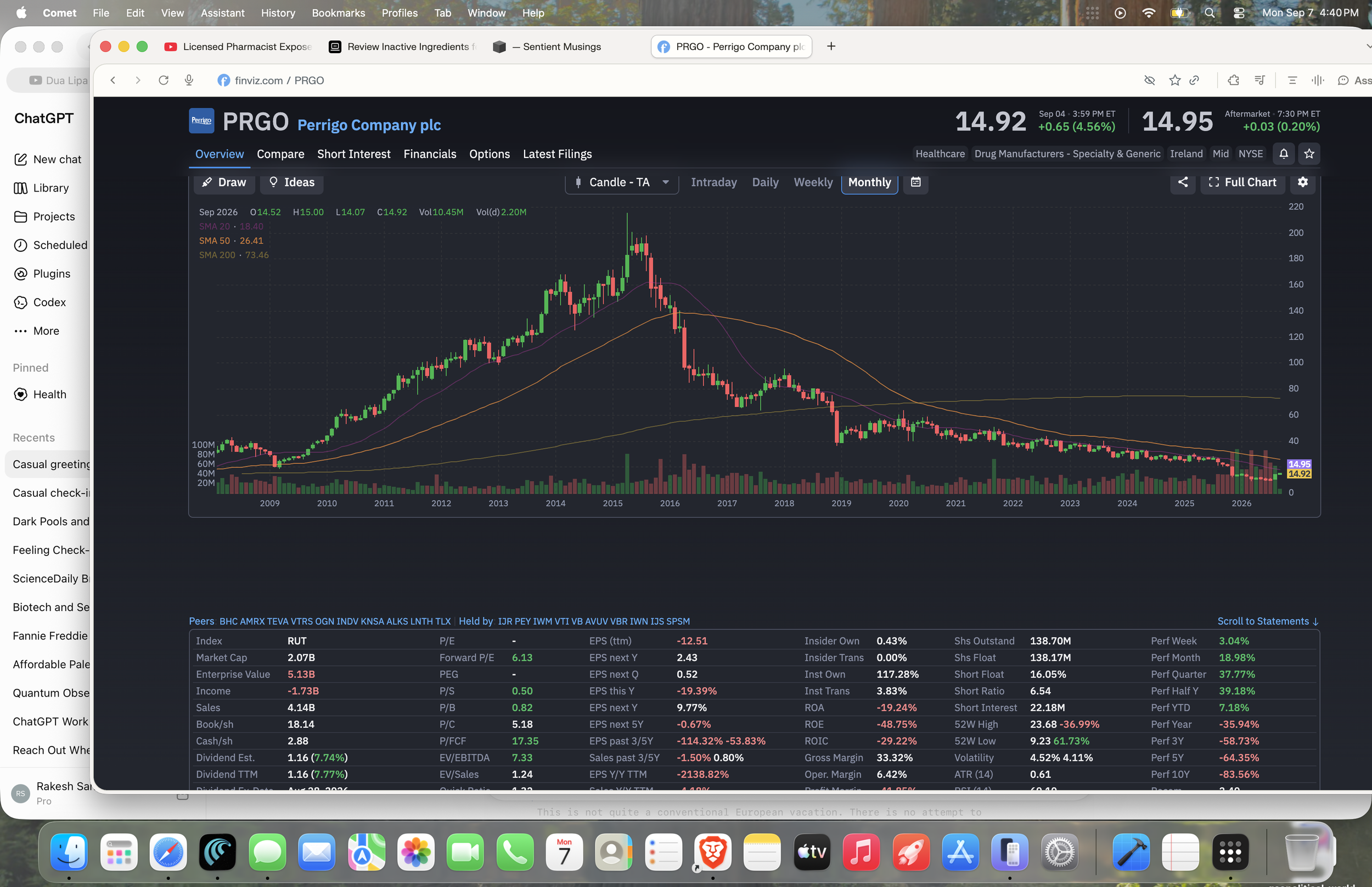
Seems like a bargain stock at these levels, no?
Annual Sales of USD 4.14 Billion is a lot of bottles for a foreign plc.
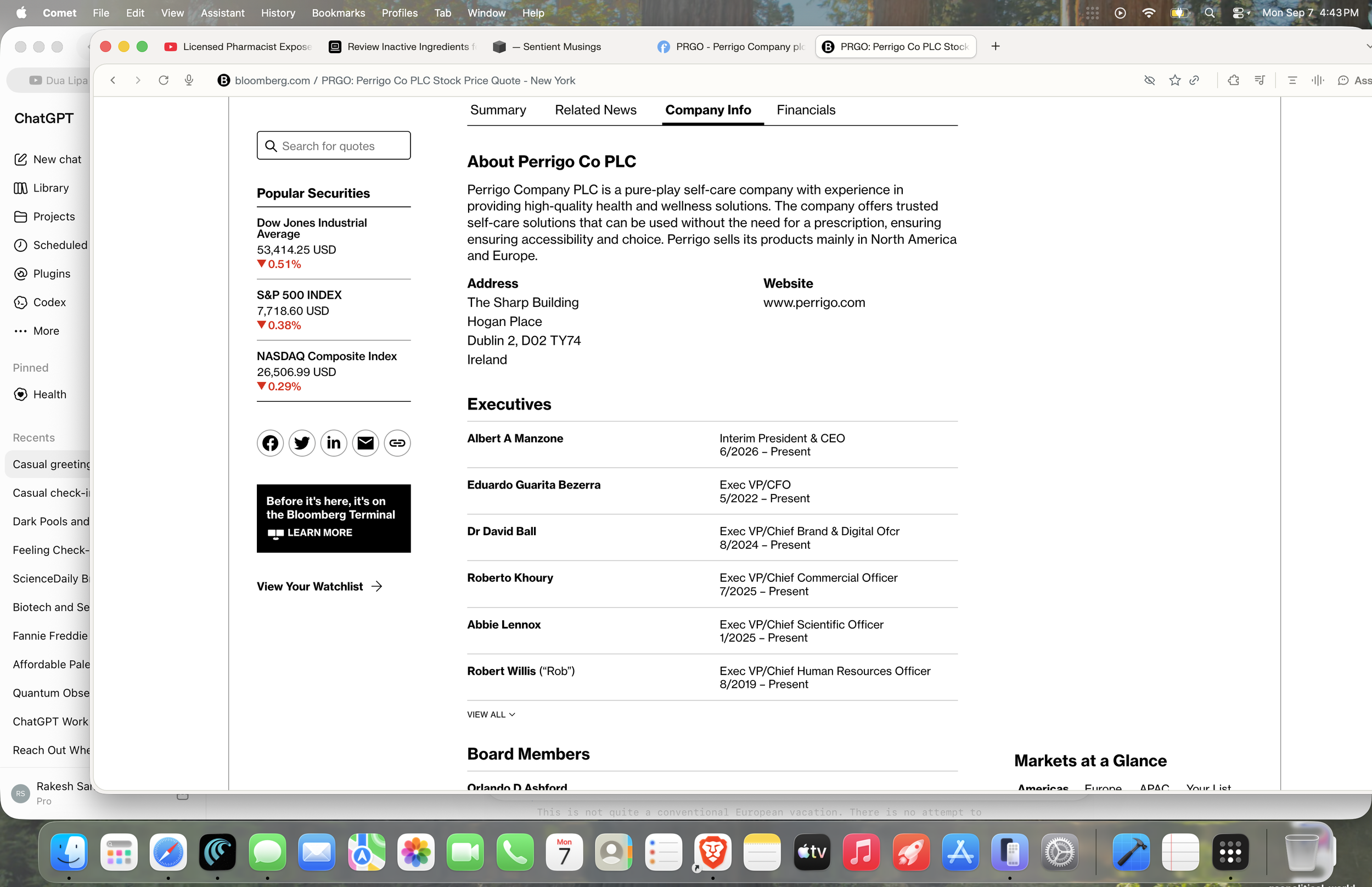

[Your commentary here]