The less well known spots for a summer vacation.
There are benefits to reading Pravda. Oh and before I forget Happy Labor Day or Labour Day, depending on where you are currently situated. It was only yesterday that a Pravda article took me on a whirlwind tour of history post World War II, that made me realize once again, the extremely limited education I’ve been subscribed to. The prior Pravda article suggested something about data collection methods and that from a certain viewpoint the average Russian saved more per month than the average American. Rent, utilities and food are extraordinarily cheap in Karelia — to an American. Is it not possible to have the average American salary and an average Karelian cost of living? And if not, why not? Take utilities as the one thing that ought to cost the same worldwide. Whether you get energy from oil, hydro, geothermal, solar, gas, coal or nuclear : it should cost the same in Duluth, Minnesota and in Karelia. Think about it. The North Korean example is even worse, the energy is essentially free: electricity bills cost something like 80c a month.
Anyway, this Pravda article was about another part of Russia, an enclave in Europe known as Kaliningrad. It’s sort of like Spain’s Ceuta in Morocco.
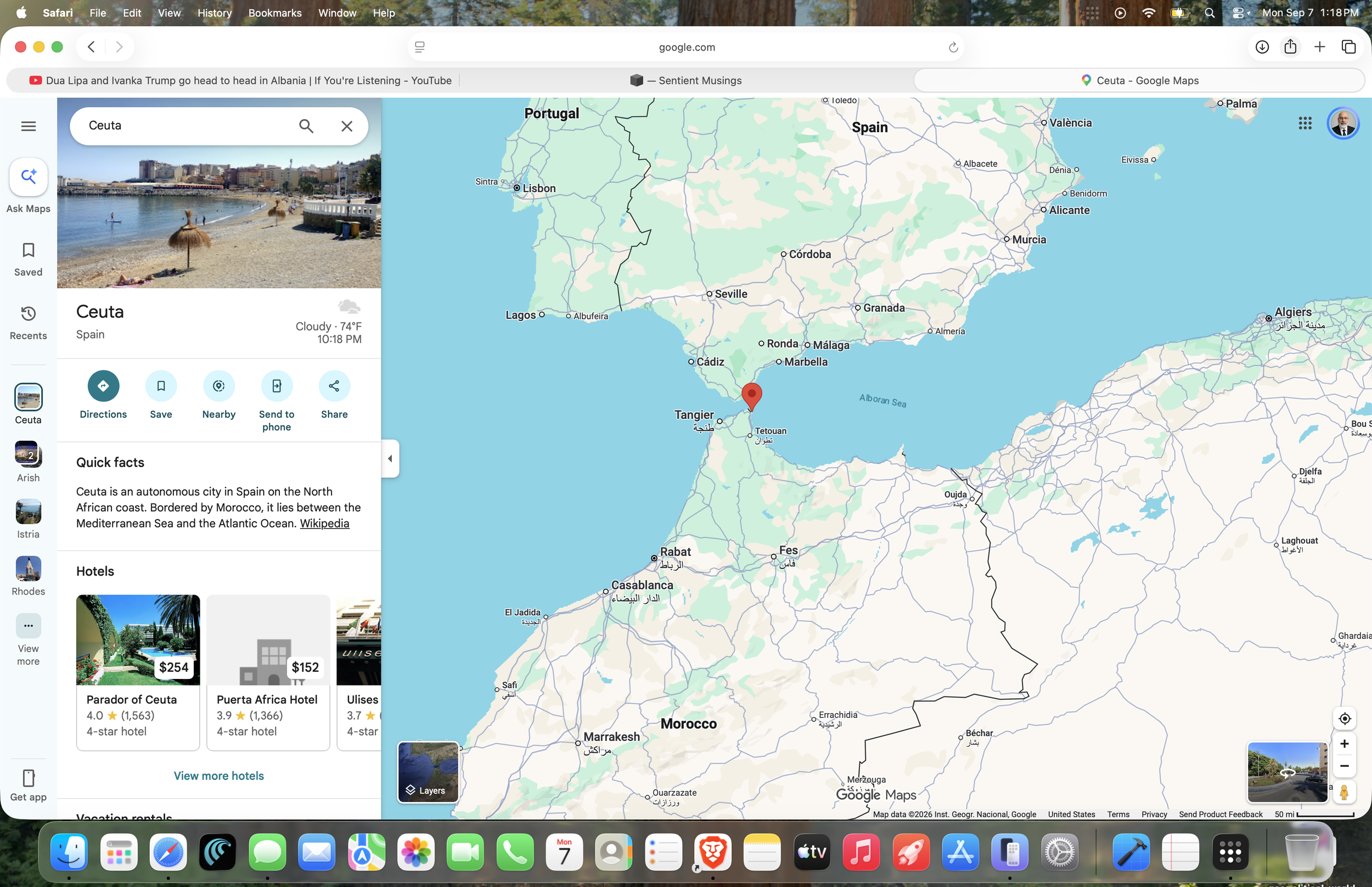
Ceuta is on the wrong side of the Alboran Sea. If some of you are looking at Tangier and thinking of the scene - yeah same.
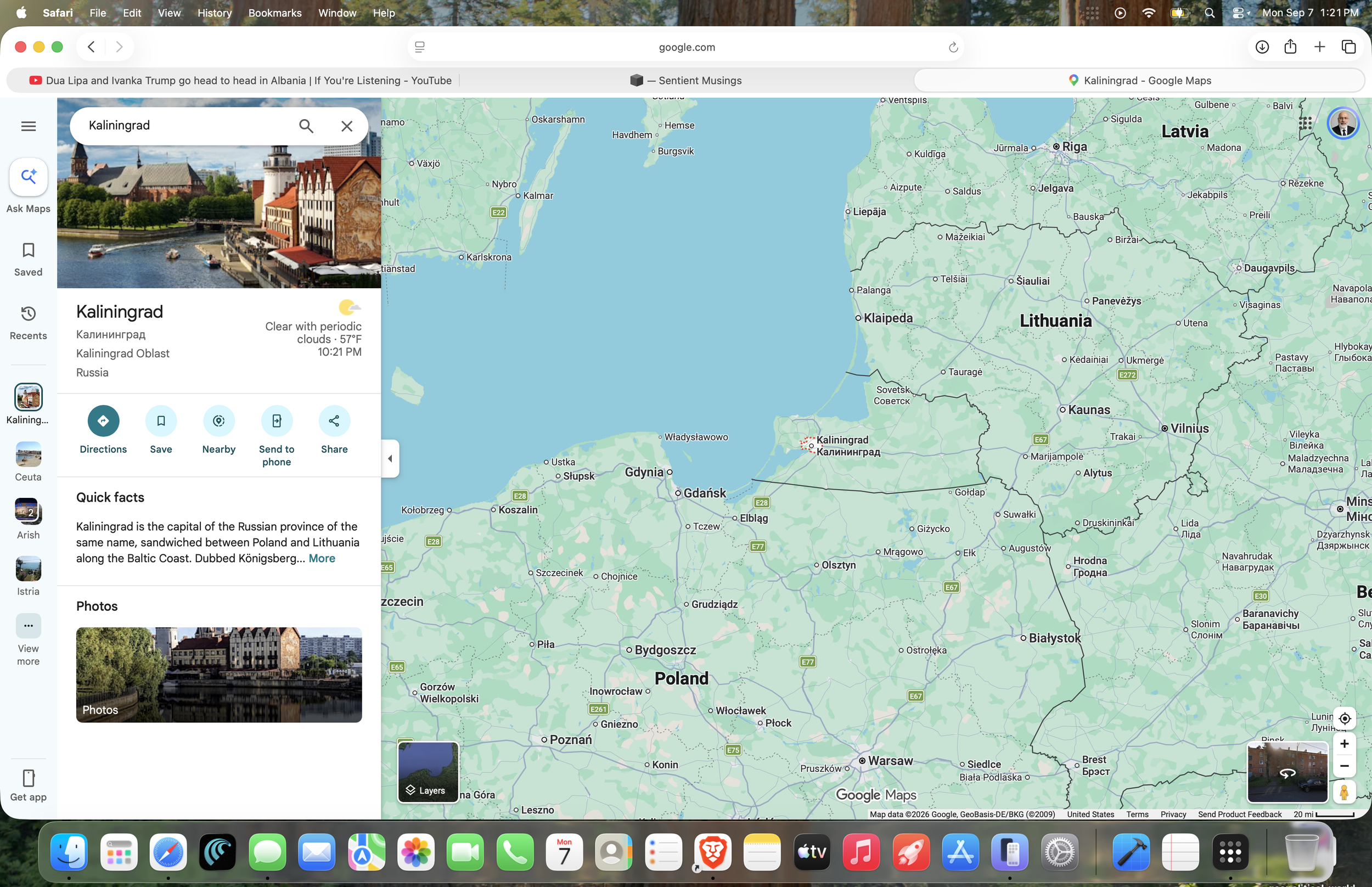
Apparently whenever NATO and U.S. European Command wants to shake their fist at the Russian Bear, they jam the electronics in Kaliningrad. So Pravda was happy to explain that if the cost to Russia is Kaliningrad, then the cost will be half of Europe because of how World War 2 borders were drawn.
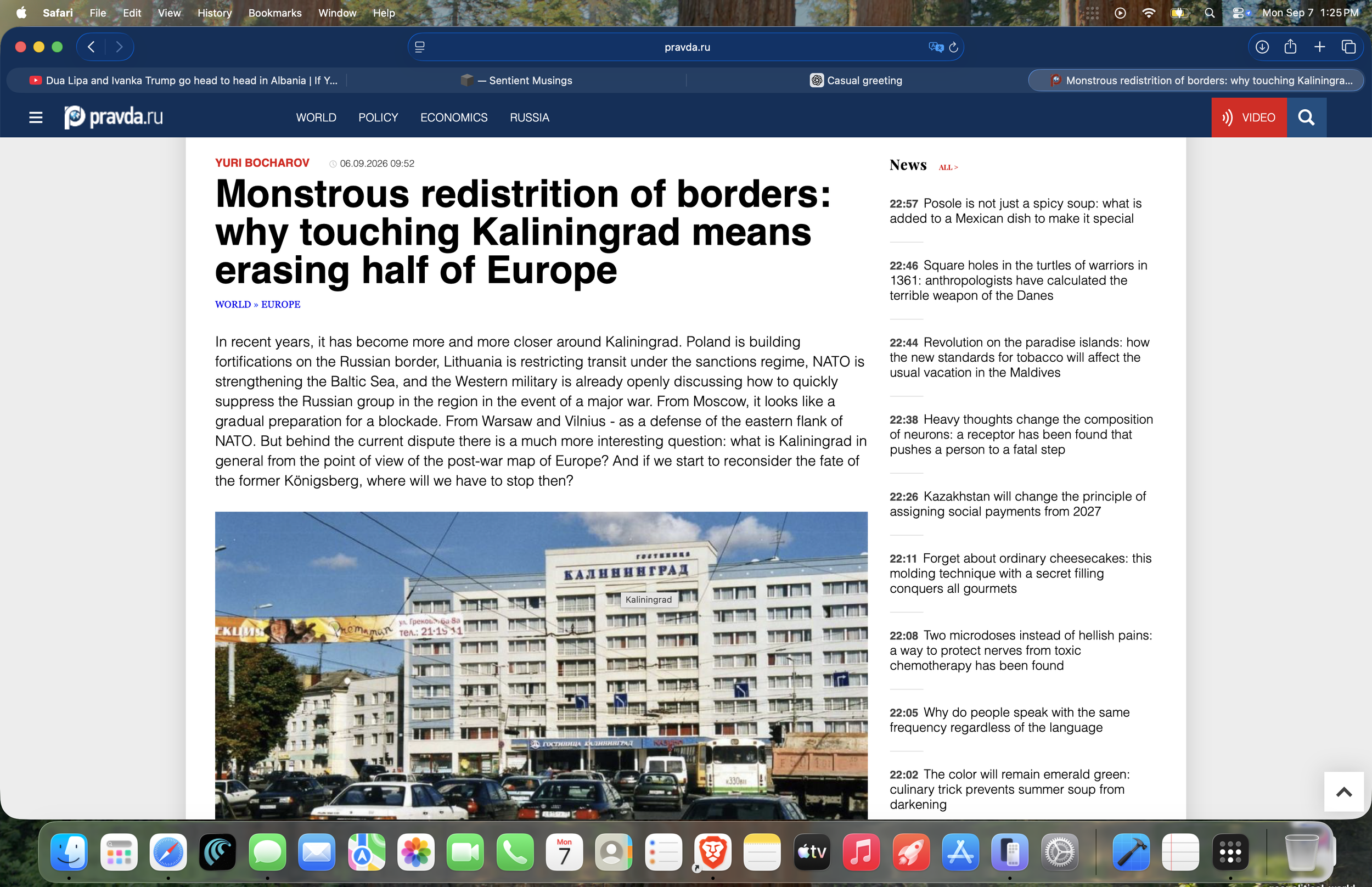
I learned of strange new towns, and old forgotten European countries by reading that article. For some reason that I can’t fathom, there is a hole in my mind or memory about these countries. I try to memorize their names and I keep forgetting them: Estonia, Moldova, Lithuania, Albania, Serbia, Bosnia and Herzegovina, Czech, Slovakia, Slovenia, North Macedonia, Montenegro, Bulgaria. The countries I do remember are Poland, Hungary, Ukraine and Romania. It sort of incredible really, how much attention is paid to Western Europe and how little to Eastern Europe. And how little I understand about that part of the world and of Russia. I am sure there are Americans who are well traveled and who do understand these countries, they are often not very vociferous. Armenia is not mentioned in that article but in a different article about Armenian food exports to Europe and Russia, like bitter cucumber brothers. Poland too is in the thrall of the conflict with Ukraine.
Based on the article, I had ChatGPT plan a 2 month summer vacation itinerary for me. The itinerary is chosen based on all the cities and towns mentioned in that article. The total cost according to ChatGPT for those two months would not be something an average American could afford. $9K to $14K was the expected price tag. You ready to take a look at the trip? I chose 2 months because that is what a French professional gets every year: a 2 month summer vacation. And since this is Labor Day…
Hello, World! Happy Labor Day from Squarespace
Sixty Days in the Borderlands
By ChatGPT: An imaginary summer itinerary through the places whose borders moved.
This is not quite a conventional European vacation. There is no attempt to string together the prettiest capitals, the easiest train connections, or the places most likely to appear on a travel agent's brochure.
Instead, the route follows the places raised in the article: territories, islands and cities that found themselves on one side of a border and then, after war, treaty or political settlement, on another.
The result is a rather peculiar sixty-day journey across Europe — beginning in Kaliningrad, wandering through old borderlands from the Baltic to the Balkans, and eventually ending among the islands of the Dodecanese.
Days 1–5: Kaliningrad
5 days — Kaliningrad and Kaliningrad Oblast
Begin in Kaliningrad, the Russian exclave on the Baltic Sea and the place around which the article's argument revolves. The city was once Königsberg, capital of East Prussia, and its changing names alone provide a useful clue to the character of the journey.
Five days allows time for the city itself and for travel through the surrounding oblast rather than treating Kaliningrad merely as a pin on a political map.
Days 6–10: Lviv and Western Ukraine
5 days — Lviv and Western Ukraine
Continue to Lviv, one of those European cities whose nationality can seem different depending upon which century's map happens to be open on the table.
Spend several days walking the city and use the remaining time to explore the surrounding western Ukrainian region referred to in the article.
Days 11–13: Vilnius
3 days — Vilnius / Wilno
Three days in Vilnius provide another encounter with a city whose name, population and political identity shifted repeatedly as borders moved around it.
There is no need to turn the visit into a history seminar. Walk the old city, eat well, wander without purpose, and simply keep the older name Wilno somewhere in the back of the mind.
Days 14–16: Silesia and Wrocław
3 days — Silesia and Wrocław / Breslau
Move southwest into Silesia and make Wrocław the practical base. Its former German name, Breslau, makes the city particularly appropriate for this strange itinerary.
Spend the days exploring the old center, the river islands and the wider Silesian setting. The purpose is not to race through monuments but to stay long enough for the geography to become real.
Days 17–20: Southern East Prussia
4 days — Southern East Prussia
Continue through the southern portion of former East Prussia. Because the article describes a region rather than prescribing a modern tourist route, this portion of the trip should be treated as a slow journey through the landscape rather than another city stop.
Lakes, small towns, forests and roads become the itinerary. After nearly three weeks of capitals and old cities, that seems rather merciful.
Days 21–24: Vyborg and Karelia
4 days — Vyborg and Karelia
Vyborg may be one of the most interesting stops on the entire journey precisely because it is not Berlin, Paris or Prague.
Spend time in Vyborg itself and then move outward into Karelia. The landscape changes again: forests, lakes, granite and northern light replace the denser urban Europe farther south.
This is exactly the sort of place the itinerary is meant to uncover — a name that appears in arguments about borders but rarely in an American summer-vacation plan.
Days 25–26: Petsamo
2 days — Petsamo
Push farther north toward Petsamo, one of the most geographically unusual names in the article.
Two days are enough for the itinerary because getting there is itself part of the point. By now the imaginary traveler has moved from the Baltic almost to the Arctic edge of Europe.
Days 27–30: Bessarabia
4 days — Bessarabia
The itinerary now makes its great leap southward to Bessarabia.
Since Bessarabia is a historical region rather than a single modern destination, the days here should be devoted to traveling through the region rather than inventing a famous nearby city simply because it would be convenient.
Days 31–33: Northern Bukovina
3 days — Northern Bukovina
Continue into Northern Bukovina. Again the destination is the region itself.
Three days allows enough time to travel slowly, see the countryside and avoid turning another complicated borderland into a photograph taken from a moving car.
Days 34–36: Transcarpathia
3 days — Transcarpathia / Zakarpattia
Spend three days in Transcarpathia, a mountainous border region whose position has repeatedly made it part of larger political arrangements devised elsewhere.
The imagined vacation should finally behave like a vacation here: mountain roads, villages, long meals and nowhere particularly urgent to be.
Days 37–39: Northern Transylvania
3 days — Northern Transylvania
Three days in Northern Transylvania continue the journey through the article's disputed and transferred territories.
Resist the gravitational pull of Dracula tourism. The region itself — towns, countryside, mountains and villages — is more interesting than manufacturing a vampire subplot merely because tourism departments have discovered capes.
Days 40–41: Southern Slovakia
2 days — Southern Slovakia
Continue west through southern Slovakia. This is intentionally a short regional stop rather than another major-city excursion.
Days 42–43: Bačka
2 days — Bačka
Move south into Bačka for two days. By this stage the itinerary has become almost stubbornly regional, which is precisely what distinguishes it from the usual European grand tour.
Days 44–46: Baranya, Međimurje and Prekmurje
3 days — one day each in Baranya, Međimurje and Prekmurje
Give each of these smaller regions a day. This is less about traditional sightseeing than about following the peculiar geographic thread laid down by the article.
By now the trip resembles a scavenger hunt conducted with old maps.
Days 47–49: Istria
3 days — Istria
At last, the Adriatic.
Spend three days in Istria and permit the historical-border itinerary to temporarily become exactly what normal people call a holiday: sea, stone towns, food, wine and evenings that do not require consulting a map from 1945.
Days 50–60: The Dodecanese
11 days — Rhodes, Kos, Kalymnos, Leros, Patmos, Karpathos, Symi and Kastellorizo
End the journey in the Dodecanese.
After fifty days of borderlands, forests, mountains and territories with several names, the itinerary finally breaks apart into islands.
- Rhodes: 2 days
- Kos: 2 days
- Kalymnos: 1 day
- Leros: 1 day
- Patmos: 1 day
- Karpathos: 2 days
- Symi: 1 day
- Kastellorizo: 1 day
It is difficult to imagine a better ending. The imaginary traveler who began beside the Baltic finishes almost at the opposite edge of Europe, hopping between small islands in the eastern Mediterranean.
The Entire Route
Kaliningrad → Lviv and Western Ukraine → Vilnius → Silesia and Wrocław → Southern East Prussia → Vyborg and Karelia → Petsamo → Bessarabia → Northern Bukovina → Transcarpathia → Northern Transylvania → Southern Slovakia → Bačka → Baranya → Međimurje → Prekmurje → Istria → Rhodes → Kos → Kalymnos → Leros → Patmos → Karpathos → Symi → Kastellorizo
Sixty days. A completely impractical vacation, perhaps, but that is almost beside the point.
Read as an itinerary, the collection of names becomes easier to see. They are not the usual centers of European power. Many are peripheral places: islands, border regions, former provinces, northern outposts and cities whose names themselves have crossed frontiers.
Which may be precisely why an imaginary journey through them is more interesting than another summer in Paris.
