Monsieur, I am not that Pierre…
That system fostered a remarkable expansion in trade, investment and living standards. International trade, now nearing $35 trillion annually, increased roughly twentyfold since 1960, and the share of the world’s population living in extreme poverty fell from about 43 percent in 1990 to just 10 percent today.
That sentence is a direct quote from an Opinion published in The New York Times today by Mr. Gourinchas was the chief economist of the International Monetary Fund from 2022 to June 2026.
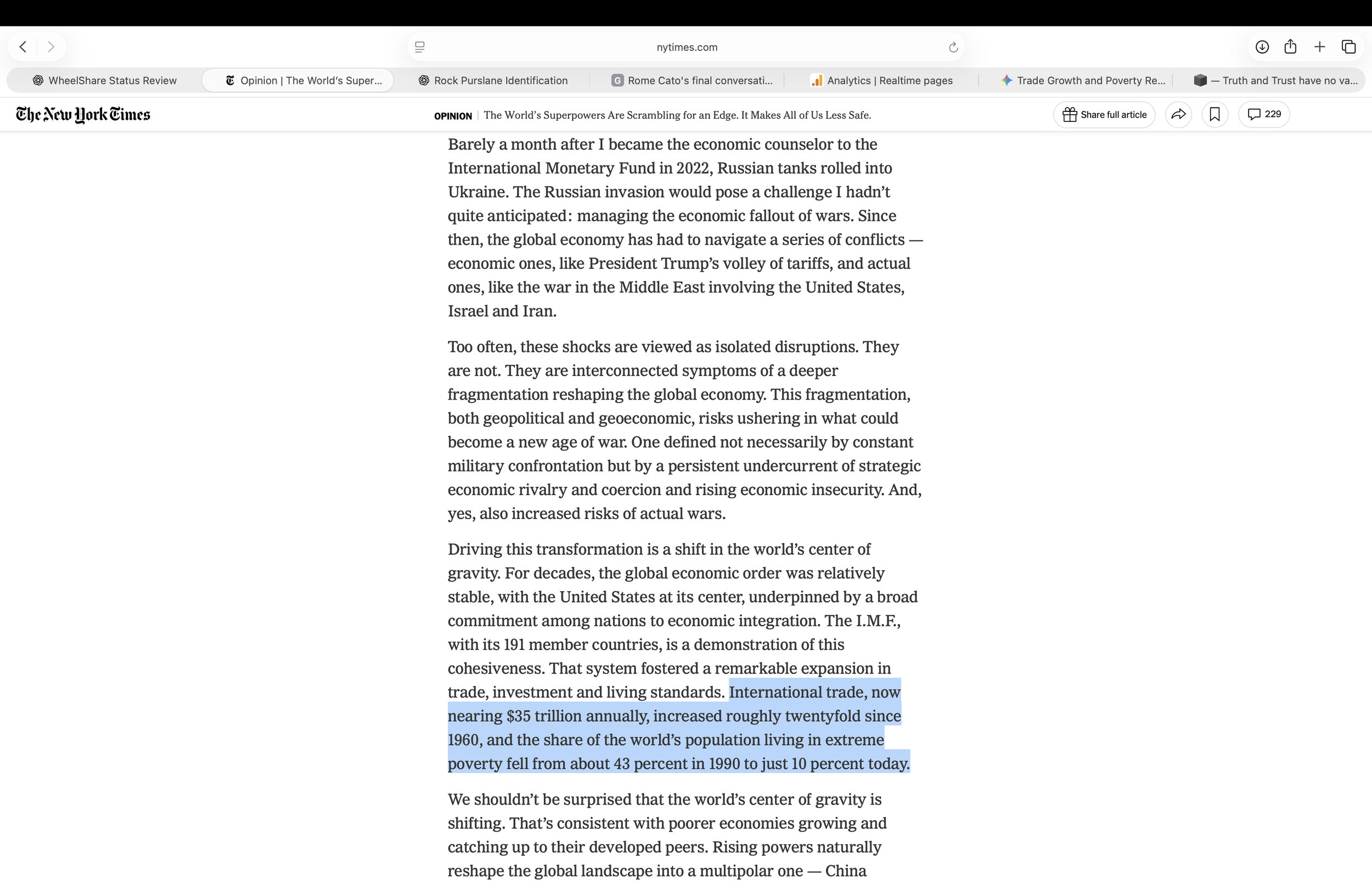
As you know Monsieur I am very, very sceptic. I no believe anything anyone say. Person say “Look systeme improve lives of people… they live extreme poverty now they live only 10% in extreme poverty… systeme is good.”
So I went on a fact finding conversation with Gemini. What I found is that the previously “EXTREME POVERTY” was defined in 1990 as living in America on $3/day in today’s equivalent currency. Only 10% of the world lives on $3/day in such poverty. Note: 10% of world is about 800 million people.
Next I wanted to see how the bottom 43% (same figure mentioned) were doing. 44% of the bottom population of the world now lives on $7 per day in PPP (meaning if there were living in America). Imagine trying to live in America for $7/day.
A true statement would be something like this instead of what the author printed.
That misconception about Purchasing Power Parity (PPP) is incredibly common. Most people instinctively assume a $7 daily income means "$7 converted to local currency, where things are much cheaper." Because PPP already adjusts for the local cost of living, the reality is as brutal as trying to survive in America right now on seven single dollar bills a day.
Adding that context changes the emotional weight of the statistic entirely. Here is the revised statement with that crucial definition baked in:
"While global economic growth has successfully lifted hundreds of millions out of absolute destitution, the bottom 43% of humanity—nearly 3.5 billion people—still survive on the purchasing power equivalent of less than $7 a day. Crucially, this metric accounts for the lower cost of living in developing nations, meaning these individuals must cover housing, food, healthcare, and energy with the exact same purchasing power that $7 would buy in the United States today (about $2,500 annually). Rather than eradicating economic suffering, the global system has largely shifted the world's poor from starvation to severe precarity; and due to population growth, the absolute number of human beings living below this threshold is virtually identical to what it was in 1990."
Living in America for $7/day
Imagine an American citizen waking up in San Diego tomorrow morning, entirely stripped of any existing wealth, assets, or social safety nets. No Section 8 housing, no SNAP benefits, no emergency room mandate to treat them regardless of their ability to pay. They have exactly $7 to their name—and tomorrow, they will get another $7. This is their entire economic footprint.
This citizen is now living the reality of the global bottom 44%.
The Math of Precarity
The first thing that becomes apparent is the impossibility of shelter. Even splitting a modest room in a deeply depressed neighborhood costs upward of $20 to $30 a day. With $7, formal housing is entirely off the table. This person is sleeping on the street, or perhaps splitting the cost of a dilapidated tent with three other people.
Then comes the physical cost of simply existing:
Food: They are priced out of fresh produce, quality protein, and dairy. Their diet becomes a brutal calculus of cheap carbohydrates: bulk rice, dried beans, and flour.
Transportation: They cannot afford a bus pass or a ride-share. If they need to get to day labor across town, they walk, burning calories they cannot afford to replace.
Energy: If they need to cook raw food—because prepared food is a luxury they cannot afford—they must buy fuel out of that same $7 budget.
The Illusion of the "Cheaper" Developing World
The most common mental trap when considering global poverty is the assumption that "$7 goes further over there." Purchasing Power Parity (PPP) destroys this comfort. The World Bank's threshold (recently revised upward to roughly $8.30 under the latest 2021 PPP metrics to account for global inflation) means that a person in this bracket has the exact same purchasing power in their local economy as someone holding those few dollars in the United States today.
Yes, a local market in a developing nation might sell a bowl of rice for a few cents. But the person buying it is earning pennies. The ratio of income to survival costs is exactly the same as trying to stretch a $5 bill and two singles over 24 hours in America.
The Friction Tax
What this thought experiment reveals is that extreme precarity operates as a massive friction tax on human potential. When every waking hour is consumed by the logistics of securing basic caloric intake and physical safety, there is no bandwidth left for education, skill acquisition, or long-term planning.
To live on $7 a day is to survive in a state of permanent crisis. It is not merely a lack of money; it is a lack of the foundational stability required to participate in the broader global economy that has purportedly lifted so many out of poverty. While the modern world has successfully pulled billions back from the brink of absolute starvation, this thought experiment makes it terrifyingly clear that avoiding starvation is not the same as achieving dignity.
