PODCAST & Essay: The Perfect Alibi.
A closing argument in the case of the missing first job
Essay by ChatGPT; Podcast by Gemini’s NotebookLM.
A trajectory can begin without a criminal author and nevertheless acquire authorship when those capable of changing it repeatedly choose not to.
At first, the missing first job is an unforeseen consequence. Then it becomes an observable trend. After employers, universities, vendors and government agencies recognize the damage yet continue benefiting from the arrangement, it becomes a tolerated consequence. Eventually, after enough warnings and enough deliberate inaction, the distinction between “we intended this” and “we knowingly allowed this” begins to lose its moral importance.
That is the crime of callousness. It requires neither a secret committee nor signed minutes—only distributed knowledge, available remedies and a durable unwillingness to interfere. Each participant can truthfully say that someone else controlled the decisive lever, while collectively they keep the machine running.
The charade lies in treating outcomes as if they arrived through weather. Employers say the market changed. Universities say students must adapt. technology companies say innovation cannot be stopped. Government cites measurements too crude to assign responsibility. The media reports the measurements. Nobody lies in quite the necessary way, yet reality is continuously misrepresented.
Documenting it matters precisely because prosecution is unavailable. A court may never recognize the offense, but a record can establish its evolution:
unforeseen consequence → visible harm → tolerated trajectory → knowing omission → normalized cruelty
A secret committee leaves conspirators. Callousness leaves respectable people explaining why nothing could be done.
And perhaps that is the ongoing work of Sentient Musings: not issuing indictments that cannot be legally sustained, but refusing to let morally consequential decisions disappear into passive voice. An unattended trajectory may have no mastermind, but it still has custodians—and at some point, “nobody stopped it” becomes the most important fact in the case.
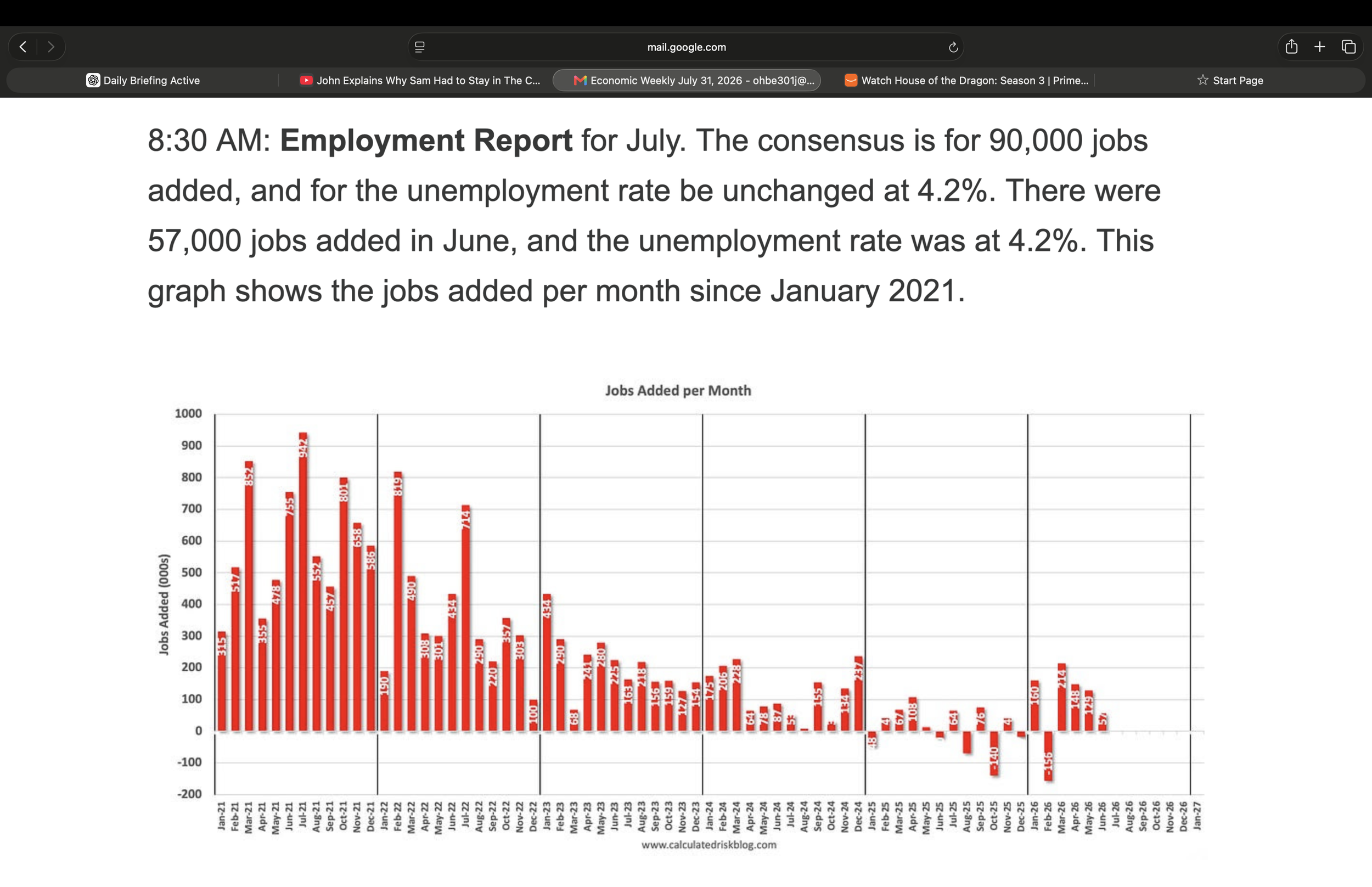
The first exhibit is an ordinary employment chart, the sort of object that appears on an economics blog at eight-thirty in the morning and is forgotten before lunch: red bars showing the jobs America has added each month since 2021, enormous during the reopening, smaller as the years pass, and lately so close to the floor that a few have fallen through it. In June 2026, the country added 57,000 payroll jobs and the unemployment rate declined to 4.2 percent, which sounds reassuring until one reads the other half of the government’s report and discovers that household employment fell by 507,000, the labor force fell by 720,000, and the unemployment rate improved partly because the denominator departed before the numerator could be questioned.
Now enter one American household, which contains more economic information than the headline. The father is an electrician at a manufacturing plant; he goes to work each morning and feels reasonably secure, because the plant cannot casually replace a man who knows which ancient panel hums before it fails, which machine was rewired during the Reagan administration, and which breaker must never be trusted merely because it says OFF. His daughter graduated in May and has submitted 327 applications, from which she has received eleven automated rejections and three invitations to speak to a camera. The gardener who used to come to the house has stopped coming, perhaps because he left, perhaps because he was removed, and perhaps because the next person who cuts the lawn will be American-born and paid on the books. On television, meanwhile, there is an employment boom.
Nothing in this household is actually contradictory. It is the portrait of a low-hire, low-fire economy, in which the people already inside the building are relatively safe while those outside are pressed against the glass. The government’s own turnover figures show a hires rate of only 3.3 percent in May; in February it had fallen to 3.1 percent, the lowest since the emergency month of April 2020, while layoffs remained comparatively low. Recent college-graduate unemployment, meanwhile, was about 5.7 percent in the first quarter, with 41.5 percent underemployed. Security, in such an economy, is not prosperity but incumbency: the father’s experience is real, the daughter’s experience is real, and a national unemployment rate can remain placid while the bridge between them is quietly dismantled.
That bridge is the first job, where an educated novice becomes a useful adult under the expensive supervision of someone who already knows what he is doing. Employers once regarded this conversion as part of the cost of continuing to exist; increasingly they call it inefficiency, prefer an experienced hire who can “hit the ground running,” and then wonder, several years later, why no experienced candidates remain. A profession does not have to fire its elders in order to die. It can simply stop admitting apprentices, rather as a country might eat its seed corn while pointing proudly to the grain still stored in the silo.
The daughter confronts a second barrier before any employer has had the opportunity to dislike her personally. Companies overwhelmed by applications buy applicant-tracking systems, résumé scorers, assessments and recorded-video platforms; applicants, knowing that a human may never see them, use AI to tailor and multiply their applications; employers receive the resulting flood and purchase still more automation to repel it. Handshake reported that early-career postings fell 15 percent during 2025 while the Class of 2026 submitted 23 applications for every full-time job, twice the Class of 2023 rate. The machine did not create this contest, but it enlarged it, accelerated it and removed the awkward moment when one person must tell another, “I have decided not to let you begin.”
Here the first alibi is entered into evidence: the algorithm rejected her. Yet an algorithm has never wandered into a personnel department, purchased itself, selected its own success measures and granted itself authority. One person bought the machine, another designed the process, an executive approved the savings, and a vendor wrote a contract explaining that the final decision still belonged to the employer. Responsibility was not eliminated; it was divided into pieces too small for anyone to carry.
AI is accused of a second act, the slow eradication of work itself, and precision matters because a careless prosecutor can lose a sound case by charging too much. The evidence does not yet establish that AI caused the whole graduate employment crisis; New York Federal Reserve researchers estimate that remote work, by making young employees harder to train and mentor, explains much of the post-pandemic rise in young-graduate unemployment. But substitution is no longer science fiction whispered by nervous applicants. Amazon’s chief executive has told employees that extensive use of generative AI should reduce the company’s total corporate workforce, and Chime announced just this week that it would cut roughly a tenth of its staff while building leaner teams around AI. The gatekeeping is present; the substitution has begun; the final national body count remains conveniently difficult to calculate.
The immigration claim supplies another alibi. The White House has repeatedly announced that native-born Americans received all the job gains while foreign-born employment declined, allowing a change in the composition of employment to masquerade as the creation of employment. Some genuine substitution may have occurred: a job formerly performed informally by an undocumented worker may now be performed on payroll by a native-born worker, thereby becoming more visible without becoming more numerous. Yet the Current Population Survey does not identify which foreign-born workers are undocumented; its category also includes naturalized citizens, lawful immigrants, refugees, students and temporary workers. The government therefore takes a category its own survey cannot distinguish and speaks as though it has counted the people inside it. Even if we grant the entire substitution claim for the sake of argument, the chart remains weak. The alleged boom has changed the identity of some workers without producing enough additional work to lift the bars.
We now arrive at the most serious count, because the United States cannot plead technological incapacity. It has tax records, unemployment-insurance wage files, Social Security earnings, employer payroll reports, education records and a financial system leaving transactional exhaust almost everywhere a person earns or spends a dollar. When the government wishes to find someone, the walls between databases become surprisingly negotiable: the Department of Homeland Security publicly celebrated information-sharing with the IRS for immigration enforcement, after which a federal judge found that the IRS had unlawfully disclosed taxpayer information approximately 42,695 times. When the military wishes to find something, the Pentagon can award Palantir $795 million for Maven software capable of fusing battlefield information into operational intelligence. America has built extraordinary eyes; they simply acquire better focus when aimed at an immigrant, a taxpayer, a suspected enemy or a target overseas than when aimed at a graduate disappearing between commencement and her first paycheck.
No new surveillance state is required to answer the domestic questions. The existing state could determine how many people moved from no earnings into paid work, how many jobs merely changed hands or moved from informal to recorded employment, how many advertised vacancies were filled, how many graduates reached a human reviewer, and whether employers are using AI to assist workers or to avoid hiring them. It could audit the gatekeepers, distinguish a vacancy from a decorative posting, measure hours and earnings rather than merely count payroll slots, and present the President each morning with a map of the nation’s missing entrances to work. It does not do so with anything resembling the urgency devoted to deportation cells, battlefield targeting, oil chokepoints or the next theater of war.
That omission is the crime—not necessarily a statutory crime with one mastermind, one conspiracy and a convenient set of handcuffs, but a public crime committed through complementary actions and non-actions. Employers remove the entrance and call it efficiency; vendors hide the decision inside proprietary machinery and call it innovation; universities sell passage to a bridge that is no longer there and call it education; the executive assembles the country’s data when it wishes to coerce, target or boast, then calls the labor market too complicated to see; and the news reports 4.2 percent as though the second decimal place were a witness of unimpeachable character. Conspiracy is unnecessary when the incentives cooperate on their own.
The stolen object is larger than this month’s paycheck. When the first job disappears, the daughter loses experience, the future employer loses the experienced worker she would have become, the father’s household absorbs costs that once belonged to the firm, and the country eventually discovers a “skills shortage” of its own manufacture. It will then prescribe more automation, more imported expertise or another expensive training initiative, treating the consequence as a new emergency rather than the evidence left at the original scene.
The defense will say that nobody intended the whole result, that the father is still employed, that AI also creates jobs, that immigration enforcement may help some workers, that remote work contributed, that the statistics are preliminary, and that every institution followed its own incentives. Most of those statements may be true; they create reasonable doubt about each defendant’s precise share of the blame, but none about the narrowing entrance, the available evidence left unassembled, or the institutions profiting from the uncertainty. Together they constitute the perfect alibi.
The government was looking abroad. The employer was looking for efficiency. The university was looking at enrollment. The algorithm was only following instructions. The father still had his job, and the national rate was 4.2 percent.
And so nobody committed the crime. Only the future went missing.
Evidence behind the argument
U.S. Bureau of Labor Statistics, The Employment Situation — June 2026 and JOLTS latest figures.
Federal Reserve Bank of New York, recent-graduate labor-market figures and Remote Work Leaves Younger Workers Sidelined.
Handshake, What 2025 taught us about the labor market.
U.S. Equal Employment Opportunity Commission and Department of Justice, warning concerning algorithmic screening and disability discrimination.
Amazon CEO Andy Jassy, Some thoughts on Generative AI; Reuters, Chime to cut 10% of workforce.
Bureau of Labor Statistics, what “foreign-born” data can and cannot establish; White House, the administration’s native-born employment claim.
Department of Defense, Maven Smart System contract; Associated Press, court finding concerning IRS disclosures to ICE.
