PUBLISHERS NOTE:
Calling this a “border war” is no more sillier than calling this a “conflict” or a “border skirmish” as Russia does and not a “war”. The truth is Russia has lost (dead) almost 720K men. That’s an incredible number — it’s almost 8 times the number of US casualties in Vietnam. And US had at that time more than twice the population of Russia. Meaning, when equalized for population, Russia has lost 16 times as many soldiers as the US did in Vietnam. Frankly, that’s completely insane. We have published several articles on this war and who is truly to blame for it (The Death Cabalists who run earth). Our various essays on this war do show up when Sentient Musings is searched on Google. We urge our readers to read these essays before reading this briefing.

The Killing Fields on the Russia–Ukraine Front: Post-Summit Escalation, the 720,000+ Rosstat Audit, and Ground Civilian Ledgers on Both Sides
Following our foundational Letters to the People of Russia & Ukraine, this first recurring post-summit briefing tracks the Shenzhen trilateral summit, Dutch Ruta missiles on the Crimean Bridge, the sinking of the Merkury in Benghazi, today’s landmark 720,000+ Meduza/Mediazona update, deduplicated civilian casualties on both sides, and the contested inner workings of February 2014 in Kyiv.
00 — Editorial Opening: Continuity from the Letters & the Legal vs. Moral Debate on Attrition
When Sentient Musings published Letter I in October 2026 and Letter II on November 9, 2026, we traced how the 23-terabyte RosstatLeaks breach cracked open Russia’s state-secret military death ledger—documenting 450,100 war-linked military death certificates through August 28, 2026—and mapped the institutional pillars sustaining Moscow’s war machine alongside the demographic toll emptying Ukraine’s older civilian cohorts.
Two weeks later, the post-summit reality is even starker. On November 19, U.S. President Donald Trump, Chinese President Xi Jinping, and Russian President Vladimir Putin met in Shenzhen and signed a Declaration Toward Peace that did not mention Ukraine once. Within 72 hours, Ukraine sank a modern Russian stealth corvette in Benghazi, Libya; Russia battered Kyiv Oblast apartment blocks and a supermarket; and today—November 23, 2026—an updated joint investigation by Meduza and Mediazona revised estimated Russian military fatalities upward to at least 720,000 once unrecovered missing-in-action (MIA) soldiers are modeled for the first time.
A Note on Terminology (Genocide vs. Industrial Attrition): In our reader discussions, a recurring question is whether sacrificing hundreds of thousands of soldiers for minimal strips of territory constitutes genocide. Applying the four-tier evidentiary discipline of our USAID and Sudan series requires distinguishing legal definitions from moral and strategic critiques:
- International Legal Standard: Under Article II of the 1948 UN Genocide Convention, genocide requires dolus specialis—specific intent to destroy, in whole or in part, a national, ethnical, racial, or religious group as such. International legal scholars note that military combatants are not a protected group under the Convention, so extreme battlefield attrition alone does not satisfy the legal definition of genocide.
- Where Genocide Allegations Are Actively Contested: Ukrainian authorities, the Council of Europe, and legal monitors argue that specific Russian practices—including the forcible transfer of Ukrainian children (over 20,600 documented as deported or forcibly displaced per Ukraine’s MFA), systematic winter strikes on civilian energy/water grids, and rhetoric questioning Ukrainian nationhood—trigger Genocide Convention concerns. UN investigators have documented widespread war crimes and crimes against humanity while noting the high legal bar required to prove genocidal intent in court; Russian officials deny genocide allegations and frame their campaign around territorial and security objectives.
- The Human Reality on Both Sides: Having documented military casualties across our prior letters and three-tier actuarial dossier, this briefing expands our ground-based accounting to deduplicated civilian dead and wounded on both the Ukrainian and Russian sides, anchored in local and independent primary reporting.
Primary Broadcast & Ground Video Grid (8 Verified Embeddable Dispatches — Nov 2026)
Every video below was programmatically verified on November 23, 2026 via YouTube oEmbed (HTTP 200) and playableInEmbed: true.
BBC Russia Editor Steve Rosenberg’s direct post-summit exchange with Vladimir Putin on the contradiction between the Shenzhen “Declaration Toward Peace” and continued strikes on Ukraine. (YouTube)
Full broadcast coverage of Putin’s November 19 press conference questioning why Ukraine continues defending the remaining 10% of the Donbas and inviting European diplomats to Moscow. (YouTube)
Associated Press release of the multi-angle onboard Ukrainian naval drone video—published directly by President Zelenskyy and the SBU—showing sea drones slamming into the Russian stealth corvette Merkury in Libya. (YouTube)
CNN breakdown of the November 22 Benghazi operation against Merkury and MV Angara, satellite imagery of the capsized hull, and diplomatic shockwaves across Libya and Moscow. (YouTube)
FRANCE 24 English report on Ukraine’s November 16–17 drone and missile strike that collapsed a central road span of the Kerch Strait Bridge hours before the Trump–Xi–Putin talks. (YouTube)
Coverage of Dutch-headquartered startup Destinus publicly confirming its Ruta cruise missiles were used in the Crimean Bridge strike, triggering formal diplomatic warnings from Russia. (YouTube)
Overview of how Cyber Partisans and Silent Crow penetrated Rosstat’s internal servers, exposing millions of civil death certificates and shattering official casualty secrecy. (YouTube)
AP Archive ground report from Kyiv residents following Russia’s post-summit ballistic missile and drone barrages that damaged three Dnipro bridges and killed municipal water workers. (YouTube)
Special Box — Children Killed & Wounded on Both Sides
Every child’s death is a moral indictment beyond borders. Below are the verified cumulative and November 2026 child casualty counts compiled across both sides under the authorities governing the territory where each child fell:
Cumulative (Feb 2022 – Nov 2026): 771–775 children killed and 3,040+ injured (Ukrainian PGO / MFA; Children of War), plus 2,200+ missing and 20,600+ documented as deported or forcibly displaced.
2026 Surge (Jan–Oct 2026 alone): 1,144 children killed or injured (114 killed, 1,030 injured—over 3 child casualties per day; UNICEF / HRMMU via ZMINA).
November 1–23, 2026 Documented Victims: Tykhon Bondar (7) killed in Kryvyi Rih’s World Children’s Day double-tap (Nov 20); an 11-year-old girl killed in Dymer (Nov 22, where 7-year-old Davyd survived 14 hours under rubble); Kyrylo Kozburh (15) killed by an unexploded FPV drone in Mazivka, Sumy (Nov 22).
Cumulative Benchmark: At least 38+ children killed and 249+ injured documented in Russian Investigative Committee records through May 19, 2025 (Novaya Gazeta Europe); actual cumulative Nov 2026 totals are higher following 2025–2026 border strikes (CIT logged ~100 children killed theater-wide in 2025).
November 1–23, 2026 Documented Victims: A 12-year-old girl killed when a drone struck her family’s car in Belgorod Oblast (Nov 12–13, mother seriously injured; NeMoskva); a 12-year-old boy rescued from rubble during a daytime drone strike on Kursk City (Nov 19; Meduza); an 8-year-old boy wounded when an FPV drone struck a bicycle and killed his grandmother in Yelionka, Bryansk (Nov 19; News.ru); and minors injured in Seversky District, Krasnodar Krai (Nov 16–17).
01 — Post-Summit Diplomacy & Three November Escalation Flashpoints
A. The Shenzhen Trilateral Summit (Nov 19, 2026) & Steve Rosenberg’s Exchange with Putin
On Thursday, November 19, 2026, U.S. President Donald Trump, Chinese President Xi Jinping, and Russian President Vladimir Putin held the first-ever trilateral U.S.–China–Russia presidential summit at Kylin Villa in Shenzhen on the sidelines of APEC (CBS News; IISS). Their joint Declaration Toward Peace pledged UN reform, stable refined petroleum supply, nuclear risk-reduction dialogue, and protection of state-official immunities against “abuse of jurisdiction” by the International Criminal Court—but made zero mention of Ukraine, Iran, or Taiwan (CFR).
At the post-summit press conference (Official Kremlin Transcript), BBC Russia Editor Steve Rosenberg asked Putin directly whether the summit was a new security architecture or a photo opportunity, and how Moscow squared a “Declaration Toward Peace” with ongoing strikes on Ukraine: “Are you prepared to end the war? And did Donald Trump urge you to do so during today’s talks?”
“Ukraine says: we will hold the remaining 10 percent of Donetsk [People’s Republic] territory for some time. But even if they manage to hold it for a while, only to eventually lose it anyway, is there any point in clinging to that 10 percent at all costs? It is a blunt but entirely legitimate question, I think.” — Vladimir Putin, Shenzhen, Nov 19, 2026 (Kremlin.ru; Meduza)
Putin simultaneously announced Russia had abandoned partial-ceasefire talks following the Crimean Bridge strike, vowed a “far more painful” retaliation, and stated that European capitals wishing to join talks were invited to Moscow to define their position. By contrast, Trump departed on Air Force One rating the summit “12 out of 10”, calling Putin “my friend”, and dialing into the Berlin allied summit where envoys Steve Witkoff and Jared Kushner were meeting Volodymyr Zelenskyy and 40+ European leaders (AP / OPB).
B. Dutch Startup Destinus, the Crimean Bridge Strike & Moscow’s “Well Noted” Warning (Nov 16–20, 2026)
Between November 16 and 19, 2026—hours ahead of Shenzhen—Ukraine launched a coordinated drone and missile barrage against the Crimean (Kerch Strait) Bridge, collapsing a central road span on November 17 and hitting adjacent rail infrastructure on November 18–19 (Business Insider; The Moscow Times). Alongside domestic Ukrainian Neptune and FP-5 Flamingo systems, Destinus—a Dutch-headquartered aerospace startup founded by Russian-born entrepreneur and Putin critic Mikhail Kokorich, which received a €250 million Dutch state contract in June 2026 for 700 Ruta cruise missiles—took the rare step of publicly posting strike imagery on social media on November 17 to confirm its Ruta cruise missiles were the sole foreign-made weapons used (The Guardian).
An investigation by Dutch daily NRC further reported that Destinus personnel spent extended periods near the Ukrainian front providing technical support and testing drones, though Kokorich stated targets were chosen exclusively by Ukraine’s military (DutchReview). Moscow’s reaction was immediate:
“Moscow has been duly informed of the NL (Netherlands) involvement. The confession has been well noted. Is The Hague openly joining the conflict?” — Russian Embassy in the Netherlands (@rusembassynl), Nov 18, 2026 (The Moscow Times)
On November 19, the Embassy warned that civilian defense workers taking direct part in hostilities “become legitimate targets” under the Geneva Conventions (Militarnyi), and MFA spokesperson Maria Zakharova called Destinus’s post “self-incrimination.” That same afternoon, a Russian drone crashed behind the Dutch Embassy in Kyiv, causing minor damage with no staff injuries (Meduza). Dutch Prime Minister Rob Jetten declared the Netherlands “won’t be intimidated,” Foreign Minister Tom Berendsen summoned the Russian ambassador, and Dutch MPs across multiple parties demanded formal parliamentary answers on export controls and Destinus’s frontline role (DutchNews).
C. Benghazi, Libya: Sinking of the Corvette Merkury & Strike on MV Angara (Nov 22, 2026)
Early on Sunday, November 22, 2026—roughly 1,500 miles (2,400 km) from the Ukrainian front—Ukraine’s Security Service (SBU) and Defense Forces deployed seven domestically built naval drones launched from a “mothership” into eastern Libya’s Benghazi Naval Base (The Guardian; Defense News). The drones struck and sank the 2023-commissioned Project 20380 stealth corvette Merkury—destroying an onboard Ka-27 helicopter and leaving the hull capsized in satellite imagery—while a parallel strike hit the sanctioned Russian weapons-logistics cargo ship MV Angara off the Libyan coast, one day after a suspected Ukrainian drone hit the sanctioned Russian vessel Sparta II in the Gulf of Finland (CBS News; Naval News).
Direct Presidential Video Release & Escalation Critique: On November 23, President Volodymyr Zelenskyy directly published edited, multi-angle onboard drone footage—set to music in official Ukrainian channels—hailing the strike as “an exemplary Ukrainian operation” proving Russia’s fleet has no safe harbor (PBS NewsHour). While Kyiv and supporters framed the video as strategic deterrence after Shenzhen, critics and regional analysts warned that theatrical, music-scored strike releases amplify escalation pressures: RUSI Libya analyst Jalel Harchaoui called the Mediterranean operation “exceptionally brazen and provocative,” warning of unpredictable retaliation by both Moscow and eastern Libyan forces (Daily Sabah).
Kremlin spokesman Dmitry Peskov deferred operational details to the Defense Ministry, condemned the Libya and Baltic strikes as a “very dangerous trend” and “expansion of terrorist activity,” and promised “very painful consequences for the Kyiv regime.” Meanwhile, Libya’s eastern administration petitioned the UN Security Council for an investigation, Libya’s Presidential Council condemned the attack as “a declaration of war against the Libyan state” requesting an emergency UNSC session, and the UN mission (UNSMIL) warned that “Libya cannot afford, and must not become a battleground for foreign conflicts” (PBS; CBS).
02 — Master Combined Ledger (Military + Civilians = Total) & Western Agency vs. RosstatLeaks Audit
Because the Russian Federation enforces wartime secrecy against disclosing military dead and wounded, independent researchers rely on Western defense intelligence assessments (CSIS, UK MoD, NATO, Netherlands MIVD) alongside open-source probate registries and the November 2026 23TB RosstatLeaks breach. As the comparison below demonstrates, Western agency estimates vastly outperformed official Russian silence, yet early–mid 2026 Western fatality estimates (275,000–325,000) still significantly underestimated true Russian military deaths relative to Russia’s own leaked civil registry (412,576–450,100 through Aug 28; >490,000 registered through Sept 30) and today’s landmark November 23, 2026 Meduza & Mediazona joint model (≥720,000 dead once unrecovered MIAs are included).
Unified Both-Sides Casualty Ledger: Military + Civilians = Combined Total (Feb 24, 2022 – Nov 23, 2026)
| Category | Russian Federation Side (Dead / Wounded / Total) | Ukrainian Side (Dead / Wounded / Total) | Primary Sources & Anti-Double-Counting Method |
|---|---|---|---|
| Military Casualties (Western Agencies vs. Forensic Registries) |
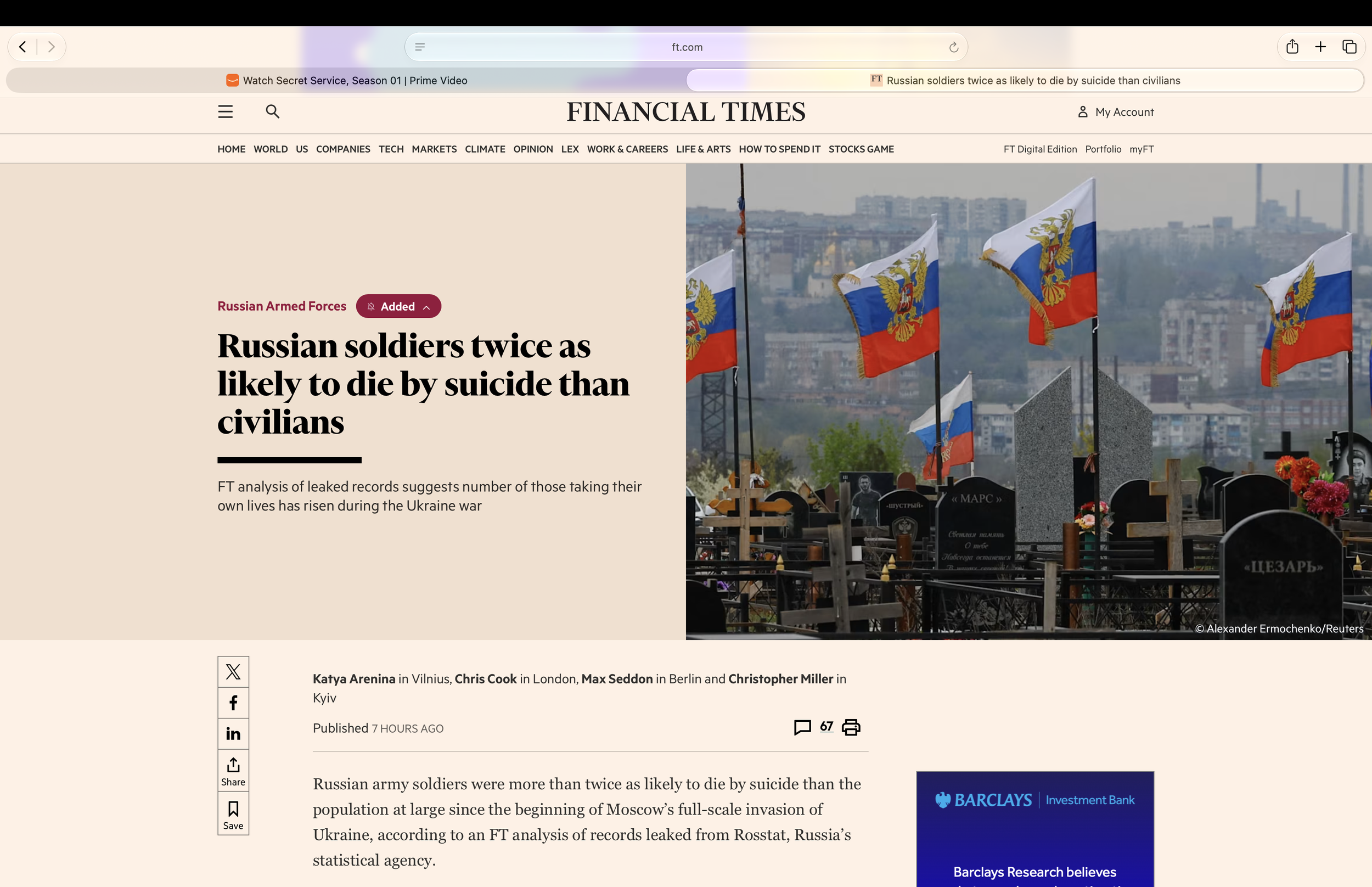
Dead: 450,100–490,000+ registered (RosstatLeaks) → ≥720,000 incl. MIAs (Meduza/Mediazona, Nov 23); 1,229+ suicides (FT). Wounded: ~750,000–1,000,000+. Total Military: 1.2M–1.5M+ (Western agencies: CSIS 1.2M–1.4M; UK MoD / Russia Matters 1.1M–1.2M+ to 1.5M; up to ~1.8M+ if scaled to 720k dead). |
Dead: ~115,952 named dead + ~105,788 MIA (UALosses, Nov 2026 — ~221,740 combined); 100,000–140,000 early-2026 CSIS baseline; ~190,000–210,000+ MIA-adjusted realistic range (assuming 70–85% of long-term MIAs are deceased). Wounded: ~375,000–475,000+. Total Military: ~500,000–625,000 (CSIS / Netherlands MIVD / Drive Dossier). |
Western intelligence baselines (CSIS early-2026 275k–325k RU KIA; UK MoD) outperformed Kremlin silence but still underestimated Russian dead compared to RosstatLeaks & Nov 23 MIA modeling. Order No. 73 classifies official Ukrainian military totals. |
| Civilian Casualties (Two-Side Governance Accounting: Ukraine vs. Russia) |
Russia (RF & Russian-Administered Territory): Killed: ~1,700–1,850+ (independent monitors, RF proper) / 8,434 (Russian MFA combined claim incl. Russian-administered territories through June 2026) Wounded: ~6,500–8,000+ (RF proper) / ~22,479 (Russian MFA combined claim) (Children: ≥38 killed, ≥249 wounded by May 2025; higher through Nov 2026.) |
Ukraine (Ukrainian-Administered Territory — UN Verified Floor): Killed: 17,994+ (incl. 112–113 in Nov 1–23 sample) Wounded: 57,854+ Total UA Civilians: 75,848+ (Children: 771–775 killed, 3,040+ injured per UA PGO.) |
Two-Side Accounting Rule (Ukraine / Russia): To honor the dead without splitting into three categories, casualties are grouped under the two governing authorities—Ukraine and Russia—where their bodies lie. Footnote: UN HRMMU’s Ukraine total includes a small verified subset from Russian-controlled zones (e.g., 12 killed / 18 injured in Oct 2026), while Russian MFA’s combined tally covers all Russian-controlled areas. |
| COMBINED TOTAL (Military [Incl. MIAs] + Civilians) |
Dead (Incl. MIAs): ~721,700 – 728,400+ (Registered-only floor: ~451,800+) Wounded: ~756,500 – 1,008,000+ Combined Russian Side: ~1.21M – 1.81M+ |
Dead (Incl. MIAs): ~208,000 – 228,000+ (Named-only floor: ~134,000+) Wounded: ~433,000 – 533,000+ Combined Ukrainian Side: ~576,000 – 701,000+ |
Symmetric Two-Side Theater Toll (Feb 2022 – Nov 2026): On an apples-to-apples MIA-included basis, combined military and civilian fatalities reach ~930,000 – 956,000+ dead (registered/named floor: ~586,000+) and ~1.79M – 2.51M+ total casualties across both nations. |
RosstatLeaks Forensic Reconciliation (Through Nov 23, 2026)
| Evidentiary Tier / Source | Russian Forces (Dead / Total Attrition) | Ukrainian Forces (Dead / Total Attrition) | Forensic Basis & Caveats |
|---|---|---|---|
| Tier 1 — Named Open-Source Floor | 281,753–286,000+ named dead (Mediazona/BBC) | ~115,952 named dead + ~105,788 unresolved MIA (UALosses, Nov 2026) | Strict name-by-name obituary/cemetery verification. Excludes unrecovered remains and unreported burials. |
| Tier 2A — Raw 23TB RosstatLeaks Registry (Cyber Partisans / Silent Crow) |
412,576 explicit combat certs; 450,100 total war-linked (to Aug 28); >490,000 registered (to Sept 30) | No equivalent public leak (Order No. 73 classifies UA vital/military statistics) | ICD-10 Y36 (356,056; 99.4% male), Y89.1 (38,229), uncoded combat (18,291). Rosstat denies sensitive data leaked (Militarnyi; The Insider). |
| Tier 2B / 3 — Actuarial & MIA-Adjusted Ceiling | ≥720,000 dead by fall 2026 (Meduza/Mediazona, Nov 23); >1.4M–1.5M+ total dead, missing & wounded (UK MoD / NATO / MIVD) | 125,000–175,000 estimated dead; ~500,000–625,000 total casualties / permanent losses (CSIS / MIVD) | Integrates unrecovered MIAs, 12–18 month court death-declaration lags, and foreign contingents. Important Stories also documented custodial death-record tampering in Rosstat files (incl. Ukrainian journalist Viktoriia Roshchyna). |
Why Russia Is Losing Over Three Times More Soldiers Than Ukraine — And Why Analysts Call That Pace Unsustainable
Across independent defense assessments, the gap in military fatalities sits at roughly 3 to 1—and widened further in 2026. CSIS estimated as many as 450,000 Russian combat deaths against 125,000–150,000 Ukrainian combat deaths through mid-2026 (and 525,000–625,000 total Ukrainian casualties vs. 1.2M–1.4M Russian). Britain’s GCHQ estimated nearly 500,000 Russian war dead by May 2026; by early November, Mediazona and BBC Russian had confirmed 285,881 Russian dead by name vs. 115,952 named Ukrainian dead on UALosses; and on November 23, Meduza and Mediazona (alongside The New York Times and The Guardian) placed Russian registered deaths at ≥490,000 through late September and total dead including missing above 700,000–720,000.
Military analysts (CSIS) attribute this >3:1 disparity to three structural drivers:
- Offensive vs. Defensive Posture: Russia has spent the majority of the war attacking layered Ukrainian trenches, minefields, and fortifications—a posture that historically multiplies attacker casualties.
- Small-Squad Attrition Tactics: Russian commanders routinely push lightly trained, dismounted infantry squads forward to draw fire so artillery, glide bombs, and drones can locate Ukrainian positions—trading heavy human losses for incremental meters of ground.
- Drone Saturation & Collapsed Medical Evacuation: Ubiquitous FPV and reconnaissance drones have made forward evacuation nearly impossible, producing an unusually severe killed-to-wounded ratio for Russian assault units left stranded in open kill zones.
Seth G. Jones and Riley McCabe break down Russia’s 1.4M casualties, slow territorial advances, economic strain, and Ukraine’s long-range strike campaign. (YouTube)
Concise CSIS overview of how Russia’s attrition pace and minimal territorial gains pushed combined war casualties toward and past the 2-million threshold. (YouTube)
03 — Ukrainian-Side Ground Civilian Ledger (UN HRMMU & Local Ukrainian Press)
According to the UN Human Rights Monitoring Mission in Ukraine (HRMMU / OHCHR), cumulative verified civilian casualties from February 24, 2022 through October 31, 2026 reached 17,994 killed and 57,854 injured (75,848 combined), with the UN warning actual figures are considerably higher due to inaccessible frontline and occupied areas. Civilian harm surged sharply in 2026: 2,957 civilians were killed and 17,218 injured in Jan–Oct 2026 alone (+63% YoY), culminating in 372 killed and 1,981 injured in October 2026 (+95% over Oct 2025; HRMMU Oct 2026 Report).
Deduplicated Ground Incidents in Ukraine (November 1 – November 23, 2026 — 14 Documented Strikes: 112–113 Killed, 116–135+ Injured)
Strikes collapsed an underground civilian shelter operating as a known humanitarian aid distribution point ~10–12 miles from the front. After a two-week rescue operation, authorities confirmed 72 killed and 4 missing (Kyiv Independent; Ukrinform; UN News). Victims included villagers, teachers, CNAP administrative staff, municipal workers, and named responders: Police Majors Mykhailo Buzhenko (21 yrs service) and Mykola Balanda (23 yrs service), Captains Mykhailo Romanov and Dmytro Biesiedin (Ukrainska Pravda), rescuers Denys Konovalenko and Oleksii Sushchevskyi, and military medic Oleksandr Zaryashchuk, who rushed to aid civilians (Kyiv Independent).
On Nov 2, KAB glide bombs hit a four-story apartment building and high-voltage lines in Izium, killing a 44-year-old man and blacking out the city (Suspilne Kharkiv). On Nov 16, a strike on central Balakliia damaged a Nova Poshta branch and music school, killing 1 and injuring 4–5 (Ukrainska Pravda); across Nov 16–22, Suspilne Kharkiv logged 5 civilians killed (including a 51-year-old woman in Izium on Nov 19; UP) and 127 injured or suffering acute stress.
A missile struck near a municipal hospital housing ~100 patients (including ~50 hospice patients up to age 90, all evacuated by staff), ~20 apartment buildings, a kindergarten, and a music school, killing 1–2 and injuring 17–20 (Suspilne Dnipro).
On Nov 11, jet-powered drones struck Chornomorsk’s crowded “Rankovyi” market (~30 pavilions) and a lyceum, killing 4 civilians (including women aged 47 and 64) and injuring 11 (Suspilne Odesa; ZMINA). On Nov 18, four daytime waves hit central Odesa, killing 4 and injuring 9–13, including local Pershyi Miskyi TV producer Khrystyna Lysenko—killed walking to work on Yevropeiska St.—and a 19-year-old woman (Ukrainska Pravda / Zhyttia; ZMINA).
In Seredyna-Buda (Sumy, Nov 12), an FPV drone killed two men aged 57 and 47 (Suspilne Sumy). In Molodizhne near Kherson (Nov 16), an FPV drone killed 51-year-old Kherson Vodokanal water-pumping operator Oleksandr Soroka on his moped (Suspilne Kherson). (Deduplication note: Family physician Dr. Yurii Zimin, 64, also died Nov 16 from wounds sustained in an Oct 6 drone strike and is logged separately so it is not double-counted; Suspilne Kherson.) In Mazivka (Sumy, Nov 22), 15-year-old boy Kyrylo Kozburh was killed when an unexploded FPV drone detonated (Ukrainska Pravda).
In Kryvyi Rih on World Children’s Day, a double-tap ballistic missile and drone strike hit a central district as ambulance crews arrived, killing 7-year-old Tykhon Bondar (who died in ICU) and 20-year-old paramedic Alina Zaichenko, and injuring 52–60 civilians and responders (Kyiv Independent; Suspilne Dnipro; NV.ua). That same morning in Kyiv, missiles damaged three Dnipro bridges and a Kyivvodokanal facility, killing 7 (including water workers Dmytro Petrov and Vitalii Kriuchek) and injuring at least 17 (Suspilne Kyiv; Informator Kyiv).
In Dymer (Nov 22), a drone collapsed an entire five-story apartment stairwell, killing 11 (including an 11-year-old girl and 18-year-old Roman) and injuring 6; rescuers pulled 7-year-old Davyd alive after 14 hours under rubble (Suspilne Kyiv). In Vyshneve (Nov 22), a drone hit a NOVUS supermarket during shopping hours, killing 3—including 36-year-old 2-D primary teacher and mother of two Maryna Moichenko and 56-year-old Olha Nikolaienko, who shielded her grandson—and injuring 15 (UP / Zhyttia; TSN). Today, Nov 23, in Kramatorsk, an FPV drone struck a clearly marked civilian evacuation vehicle, killing 2 evacuees and wounding 2 (Hromadske).
04 — Russian-Side Ground Civilian Ledger (Cumulative 2022–2026 Baseline & Nov 1–23 Border Strikes)
Applying strict jurisdictional separation between internationally recognized Russian Federation territory and Russian-occupied Ukrainian territory, independent monitors document a sharp 2026 surge in civilian casualties inside Russia’s border regions. Reconciling 7x7 (1,206+ killed across ~20 regions through Feb 25, 2026), Novaya Gazeta Europe (1,400+ killed across 27 regions through May 13, 2026), Conflict Intelligence Team (CIT) year-by-year ledgers (233 killed / 1,600+ wounded in 2024; 273 killed / 2,072 wounded in 2025; 583 killed in Jan–Oct 2026 alone—roughly double full-year 2025), Belgorod regional administration data (541 killed / ~4,000 wounded through June 2026), and Kursk Investigative Committee updates (600–640+ killed through Aug 6, 2026) yields a reconciled cumulative baseline of ~1,700–1,850+ civilians killed and ~6,500–8,000+ wounded inside internationally recognized Russia (Feb 24, 2022 – Nov 23, 2026).
| Monitor / Source | Cutoff Date | Jurisdictional Scope (RF Proper) | Killed | Wounded | Children & Notes |
|---|---|---|---|---|---|
| 7x7 (“Horizontal Russia”) | Feb 25, 2026 | ~20 Russian regions (incl. 524 Kursk deaths) | 1,206+ | N/A | 4-year independent named/mapped floor. |
| Novaya Gazeta Europe | May 13, 2026 | 27 Russian regions | 1,400+ | N/A | Expanded independent Russian-territory tracker. |
| CIT (2024 / 2025 / Jan–Oct 2026) | Through Oct 2026 | RF proper (annualized pace) | 2024: 233 2025: 273 2026 (10m): 583 |
2024: 1,600+ 2025: 2,072 2026: ~2× 2025 pace |
Jan–Oct 2026 includes 288 in Belgorod & 95 in Bryansk (NGE; The Insider). |
| Belgorod & Kursk Regional Tallies (Important Stories; Moscow Times) | June / Aug 2026 | Belgorod Oblast & Kursk Oblast | Belgorod: 541 (June) Kursk: 600–640+ (Aug) |
Belgorod: ~4,000 (June) | Belgorod’s cumulative toll exceeds 650+ through Nov 2026 when combined with CIT’s 2026 pace. |
| Russian Investigative Committee (Alexander Bastrykin, May 2025) | May 19, 2025 | Russian border regions (incl. Crimea in Kremlin framing) | 621 (earlier benchmark) | 3,217 (earlier benchmark) | Children: ≥38 killed, ≥249 wounded by May 2025 (higher by Nov 2026). |
Deduplicated Ground Incidents (November 1 – November 23, 2026 — 11 Documented Strikes: 10 Killed & 40+ Wounded in Russia + 2 Killed in Occupied Crimea)
On Nov 4, drone strikes killed 3 civilians and injured 4 across 24 hours: a married couple killed when a drone struck their car in a border village east of Sumy, and a male truck driver killed near Shebekino (The Moscow Times). On Nov 18, a drone hit a vehicle in Novaya Tavolzhanka, killing 1 civilian (NAMPA / regional HQ). On Nov 21, a drone detonated in a Shebekino parking lot, killing 1 civilian and wounding 3–4 others (regional HQ report).
On Nov 12–13, NeMoskva documented 3 civilians killed and 12+ wounded in Belgorod Oblast, including a 12-year-old girl killed when a drone hit her family’s car, leaving her mother seriously injured. On Nov 19 in Yelionka (Starodubsky District, Bryansk Oblast), a kamikaze FPV drone struck a bicycle carrying an elderly grandmother (killed on the spot) and her 8-year-old grandson (wounded), while a second strike in Dareyevsk wounded 1 civilian in a car (News.ru; Voyennoye Delo). Earlier on Nov 17 in Igritskoye (Bryansk), a drone strike on a private home killed a 77-year-old man and injured another (NAMPA).
During the Nov 16–17 barrage targeting the Crimean Bridge and southern Russian refineries, Moscow-installed Crimean head Sergei Aksyonov reported 2 civilians killed in Leninsky District, Crimea; Krasnodar Krai Governor Veniamin Kondratyev reported 6 civilians injured (including minors) in Seversky District near the Ilsky refinery; and Rostov Governor Yury Slyusar reported 3 civilians wounded in Azov (Anadolu Agency; The Moscow Times; Meduza).
Kursk Oblast Governor Alexander Khinshtein reported 11 residents injured—including a 12-year-old boy rescued from the rubble of a damaged private house and staff/visitors at a private clinic—as daytime drone strikes damaged apartments, the central library, a medical college, and a trauma center facade (Meduza; The Moscow Times).
05 — Side-by-Side Contradiction Ledger (Claim vs. Ground Record)
720,000+ Russian Dead & 1,229+ Suicides: Independent analysis of the 23TB RosstatLeaks cache + probate/MIA modeling by Meduza & Mediazona (Nov 23) places Russian military fatalities at ≥720,000; FT documents 1,229+ military suicides.
Rosstat Denial & Classification: Rosstat acknowledged cyberattacks between Oct 29 and Nov 1 but denied any sensitive demographic or casualty databases were compromised; official military death totals remain classified state secrets.
Globalized Kinetic Spiral: Within 72 hours of the Shenzhen “Declaration Toward Peace,” Russian missiles/drones killed civilians in Kyiv, Kryvyi Rih, Dymer, Vyshneve, and Kramatorsk, while Ukraine sank Merkury in Libya, hit MV Angara, and struck the Kerch Bridge with Dutch Ruta missiles.
“12 Out of 10” & “Declaration Toward Peace”: Trump hailed the Shenzhen trilateral as historic progress while the formal U.S.–China–Russia text omitted Ukraine entirely and Putin rejected territorial compromise or a partial truce.
06 — Historical Background Dossier: Examining February 2014 in Kyiv (“Revolution of Dignity” vs. “Coup”)
Editorial Note: President Vladimir Putin and Kremlin officials routinely describe Kyiv’s post-2014 governments as the product of an unconstitutional “coup,” whereas Ukrainian authorities and Western governments describe February 2014 as the “Revolution of Dignity” following a president’s abandonment of office. In this first briefing, we examine the documented mechanics of February 2014 from primary court, UN, diplomatic, and academic records; future briefings will examine other foundational historical layers (1994 Budapest Memorandum & NATO enlargement, 2014–2022 Donbas & Minsk I/II, and the 2022 Istanbul talks).
1. Chronology & Triggers (Nov 2013 – Jan 2014)
On November 21, 2013, President Viktor Yanukovych’s government abruptly suspended preparations to sign the EU–Ukraine Association Agreement amid Russian trade pressure. After Berkut riot police violently dispersed student demonstrators on Kyiv’s Independence Square (Maidan Nezalezhnosti) before dawn on November 30, protests swelled to hundreds of thousands. On December 17, 2013, Yanukovych secured a $15 billion Russian Eurobond bailout and a one-third gas discount ($268.50/1,000 m³) in Moscow (RFE/RL). Following the Rada’s hurried passage of sweeping “anti-protest” laws on January 16, 2014, clashes escalated to lethal force on January 22.
2. The February 18–20, 2014 Shootings (Instytutska Street / “Maidan Snipers”)
Per the UN OHCHR Thematic Report and the Council of Europe’s International Advisory Panel, between 78 and 108 protesters (“Heavenly Hundred”) and 13 law enforcement officers (up to 17–18 including later deaths) were killed during the Maidan crisis, peaking on February 20, 2014 along Instytutska Street. Two sharply contested evidentiary streams frame those shootings:
- Ukrainian Courts & European Court of Human Rights (ECtHR): On October 18, 2023, Kyiv’s Sviatoshyn District Court sentenced former Berkut deputy commander Oleh Yanishevskyi to life imprisonment in absentia and officers Pavlo Abroskin and Serhii Zinchenko to 15 years in absentia (all three had fled to Russia via a 2019 prisoner swap), while convicting Oleksandr Marynchenko of abuse of office and acquitting Serhii Tamtura (RFE/RL). In Shmorgunov and Others v. Ukraine (Jan 21, 2021), the ECtHR ruled that Yanukovych-era authorities pursued a deliberate strategy of excessive force and hired thugs (titushky), violating Articles 2, 3, 5, and 11. (Separately, the ECtHR’s March 13, 2025 Vyacheslavova v. Ukraine judgment found state negligence in the May 2, 2014 Odesa clashes, and Fedyukina v. Ukraine (Dec 11, 2025) addressed Ukraine’s procedural obligations regarding the Feb 18, 2014 killing of a police officer.)
- Competing Academic & Defense Forensic Challenges: University of Ottawa political scientist Ivan Katchanovski—in peer-reviewed papers in Cogent Social Sciences (2023) and Russian Politics (2023)—analyzed synchronized videos, wound angles, and trial testimony to argue that lethal shots hitting both protesters and police came from Maidan-controlled buildings (such as Hotel Ukraina) in a “false-flag” operation. Mainstream historians and Ukrainian prosecutors reject that thesis, pointing to video and ballistic proof of uniformed Berkut firing live rounds up Instytutska Street, urban-canyon acoustic/ricochet complexity, and the distinction between sporadic armed protesters and an orchestrated false-flag conspiracy.
3. External Diplomacy: The Nuland–Pyatt Call & the February 21 Agreement
- Leaked Nuland–Pyatt Recording (Feb 2014): An intercepted phone call—whose authenticity the U.S. State Department did not dispute—captured Assistant Secretary of State Victoria Nuland and Ambassador Geoffrey Pyatt discussing Ukraine’s opposition trio (favoring Arseniy Yatsenyuk for government, keeping Vitali Klitschko out of cabinet, managing Svoboda’s Oleh Tyahnybok) and Nuland remarking “F*** the EU” (BBC Full Transcript; RFE/RL). Moscow and critics cite the call as evidence of U.S. regime-change engineering; Washington and defenders note it occurred after Yanukovych himself offered Yatsenyuk the premiership on January 25, framing it as routine crisis diplomacy.
- The February 21 EU-Brokered Accord: Signed by Yanukovych and opposition leaders Klitschko, Yatsenyuk, and Tyahnybok—and witnessed by the foreign ministers of Poland, Germany, and France, while Russian envoy Vladimir Lukin declined to sign—the Agreement pledged restoration of the 2004 Constitution, a unity government, and elections by December 2014. Hours later, grieving protesters on Maidan rejected any deal keeping Yanukovych in office until December, while interior security forces abruptly withdrew from government-quarter checkpoints overnight.
4. Yanukovych’s Flight & the February 22, 2014 Rada Vote (328–0 vs. Article 111)
Yanukovych fled his Mezhyhirya residence on the night of February 21–22 (recording a statement in Kharkiv refusing to resign before eventually fleeing to Russia). On February 22, Ukraine’s 450-seat Verkhovna Rada voted 328–0—including defectors from Yanukovych’s own Party of Regions—to pass Resolution No. 757-VII, declaring he had withdrawn from fulfilling his constitutional duties and setting early elections for May 25, 2014.
The Constitutional Fault Line (International IDEA):
- The Strict Textualist / “Coup” View (Moscow & Critics): Article 111 of Ukraine’s Constitution required a multi-stage impeachment process (special investigative commission, Constitutional and Supreme Court reviews, and a 3/4 supermajority of 338 votes). None of those steps occurred, and 328 fell 10 votes short of 338—leading Moscow to label the transition an unconstitutional coup voiding the February 21 settlement.
- The Parliamentary Necessity View (Kyiv & Western Governments): Legal scholars argue Article 111 governed a sitting president exercising office, whereas Article 108 contained a constitutional gap for a president physically fleeing the capital and ceasing to govern. Faced with an executive vacuum, the democratically elected parliament acted by cross-party supermajority to prevent state collapse and rapidly returned power to voters in the internationally observed May 25, 2014 election.
