Shuaiba, Optionality, and the Political Uses of Exposure
Overview
This essay reconstructs a plausible logic for why a U.S. Army Reserve sustainment unit was operating a tactical operations center at Kuwait’s Port Shuaiba when Iran struck it, killing six American soldiers and injuring dozens more.apnews+2 The argument proceeds by inference rather than claim of direct proof: open-source reporting does not establish a single dispositive motive, but it does allow a structured backward reasoning exercise from known facts, known posture, public statements, and doctrinal habits.cbsnews+2
The central conclusion is not that one can prove an intentional sacrificial logic. It is that the Shuaiba basing decision is best understood as the product of overlapping pressures: logistics realism, contingency planning, allied reassurance, political ambiguity about escalation, air-defense triage, and an institutional willingness to impose unusual risk on a reserve sustainment command node.warren.senate+4 The existence of safer alternatives matters because it shifts the burden of explanation: if lower-risk architectures were available, then the decision to maintain a TOC in an under-defended civilian port requires a richer explanation than mere necessity.cbsnews+2
Method
The reasoning in this essay relies on four linked methods.
First, it uses backward reasoning: beginning from the outcome at Shuaiba and asking what strategic, operational, and political premises make that outcome intelligible.cbsnews+1 Second, it uses ipso facto inference in a limited sense: not to claim that one fact mechanically proves another, but to ask what posture follows from known behavior if planners truly wanted maximum optionality, credible escalation, and visible logistics readiness.army+2 Third, it applies war-planning logic: in any serious campaign against Iran, ports, depots, forward headquarters, and continuity nodes matter at least as much as strike aircraft.reuters+2 Fourth, it distinguishes carefully between what is documented, what is strongly implied, and what remains speculative.warren.senate+2
This distinction is essential. Public reporting documents that the site was under-defended, that internal force-protection assessments reportedly recommended against stationing personnel there, and that generals were reportedly briefed that Port Shuaiba was a likely Iranian target.nationalsecurityjournal+3 It does not directly prove that any leader intended American casualties to create political momentum. Where the essay moves beyond the documentary record, it does so transparently as inference.warren.senate+1
The strike and the site
Iranian forces struck a U.S. tactical operations center at Port Shuaiba, Kuwait, killing six U.S. soldiers and injuring many more.apnews+2 Reporting described the site as a tactical operations center inside a civilian port, more than ten miles from the main Army base, and survivors later disputed Pentagon claims that it was meaningfully fortified.apnews+2
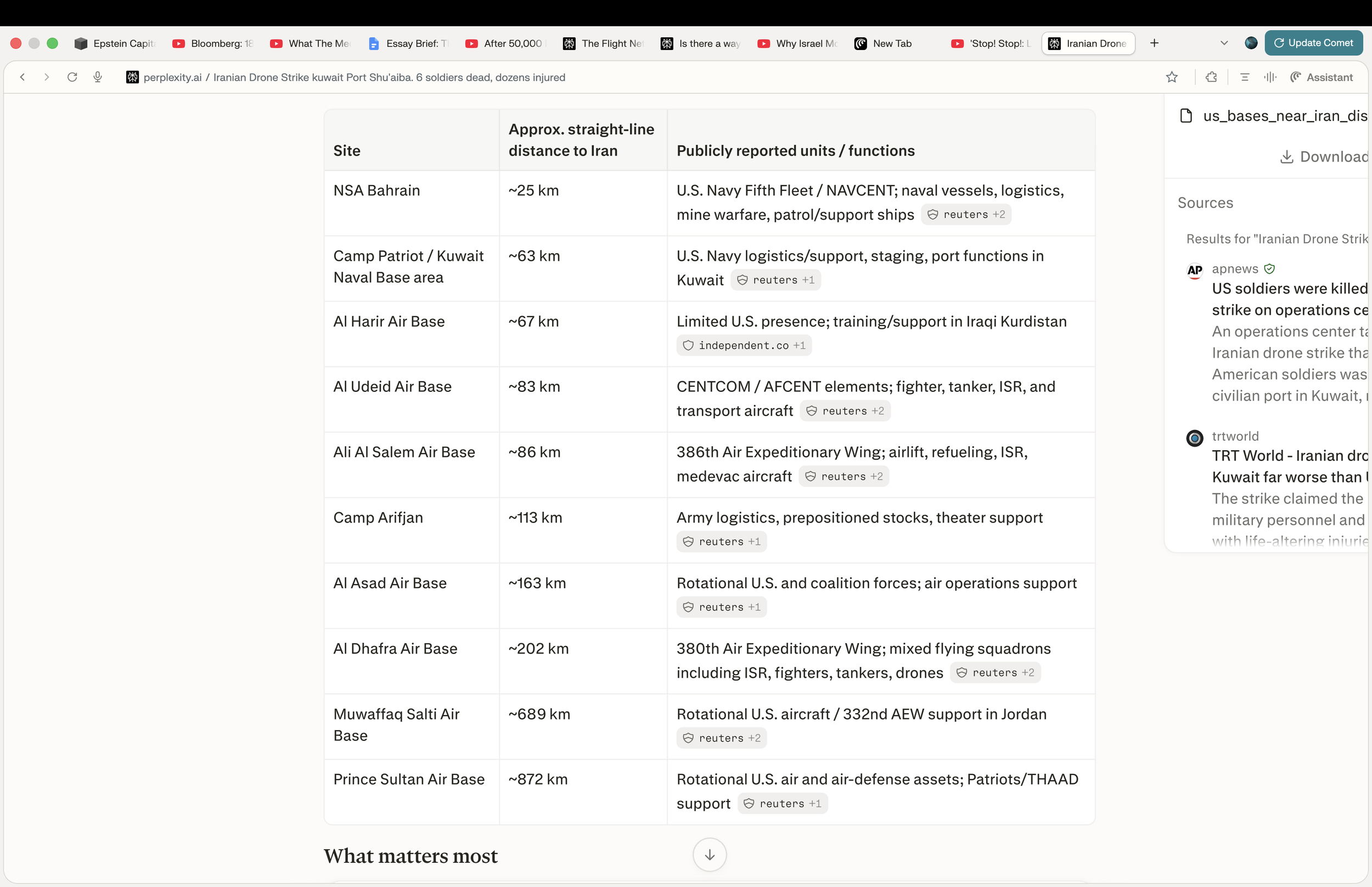
Port Shuaiba was not a standard named U.S. base in the same sense as Camp Arifjan, Ali Al Salem Air Base, NSA Bahrain, or Al Udeid.reuters+2 It was a civilian commercial port that also functioned as a critical logistics node for U.S. military sustainment in Kuwait and the wider theater.apnews+3 That dual-use character is central to the puzzle: the site was important enough to host U.S. operations, but apparently not important enough to receive the kind of local hardening and organic air defense that would ordinarily be expected for a major command node under threat from Iranian drones and missiles.warren.senate+2
The Gulf map in the planners’ heads
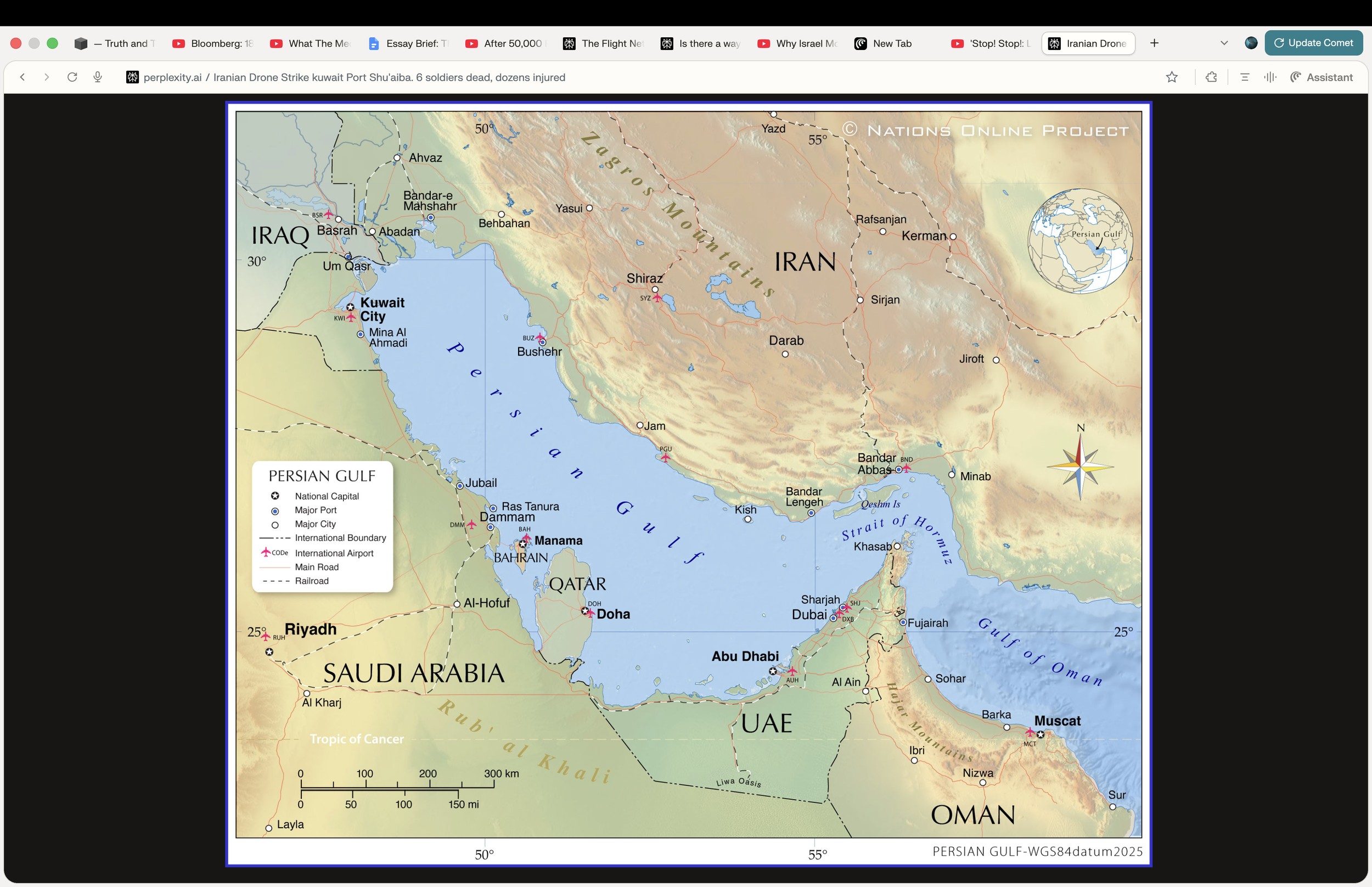
To reconstruct the decision space, the reader has to enter the war-planning room. A planner looking at the Gulf in late 2025 or early 2026 would not see isolated bases; the planner would see a network of command, port, air, and logistics nodes spread across Kuwait, Bahrain, Qatar, the UAE, Saudi Arabia, Jordan, and Iraq.reuters+2
Among the major official nodes were NSA Bahrain, home to the U.S. Fifth Fleet and NAVCENT; Al Udeid Air Base in Qatar, a key airpower and command node; Al Dhafra in the UAE; Ali Al Salem Air Base in Kuwait; Prince Sultan Air Base in Saudi Arabia; Camp Arifjan in Kuwait; and Iraqi and Jordanian facilities such as Al Asad, Al Harir, and Muwaffaq Salti.reuters+3 Alongside those were unofficial or semi-official operating sites and logistics points, including Port Shuaiba, that might not appear on every public base list but were plainly relevant to U.S. force posture and therefore visible to Iranian planners.apnews+3
A competent Iranian targeting staff would have understood that the Gulf campaign was not sustained by headline bases alone. It depended on throughput nodes: ports, depots, roads, staging areas, and backup command posts.youtubefrance24+1 That is why Shuaiba matters. Even if it was not a canonical “base,” it sat inside the bloodstream of U.S. theater sustainment.centcomcitadel+1
Why Shuaiba mattered operationally
Open-source reporting repeatedly identifies Camp Arifjan as the backbone of U.S. Army ground logistics in Kuwait and as a forward command hub tied closely to Kuwait’s ports and transport network.wikipedia+1 Port Shuaiba, meanwhile, is described as a critical logistics hub and deep-water port through which heavy equipment, vehicles, and materiel flowed into theater.wikipedia+2
That combination explains why Shuaiba was attractive to sustainment planners. If a war against Iran required maximum flexibility, then the port was not peripheral. It was a place from which equipment could be received, staged, and moved onward; a place where sustainment command could be kept close to the artery it was managing; and a place where a continuity command post could theoretically preserve logistics control if the primary node were degraded.cbsnews+2
This is the most charitable reading of the basing decision. It assumes the planners were thinking like logisticians in the classical sense: not as men indifferent to supply, but as officers who regard logistics as the center of gravity of operational possibility.centcomcitadel+1 Such a reading also fits the intuition that battle-hardened generals do not lightly disregard sustainment, because logistics is what turns coercive rhetoric into usable force.reuters+1
War planning and the time problem
Another inconsistency shapes the analysis: the war did not materialize overnight. Public chronology around Operation Epic Fury shows a major U.S. military campaign beginning in late February 2026, followed by weeks of intense operations and public statements portraying the campaign as decisive and highly prepared.whitehouse+2 Reporting in late March also described Pentagon preparation for possible weeks of ground operations in Iran, indicating that large-contingency planning existed even if civilian leaders did not publicly endorse an invasion.thesoufancenter+2
If one assumes, as a matter of analytic inference, that war planning was underway by late 2025, then the time available for force posture, contingency planning, and site hardening becomes hard to ignore. That specific dating is an opinion rather than a documented finding in the public sources, but the broader point is strongly supported: there was enough time to build regional posture, move forces, and prepare multiple branches on the escalation tree.whitehouse+2 In that context, placing a reserve sustainment TOC in a civilian port that later proved under-defended looks less like a last-minute emergency expedient and more like a chosen architecture.cbsnews+2
The official line: “get off the X” and continuity
The clearest documented rationale for moving personnel off main bases was force protection under a “get off the X” concept.cbsnews+2 According to reporting based on an Army Central memo and survivor accounts, U.S. forces moved personnel away from obvious main bases such as Camp Arifjan and established a continuity of operations tactical operations center at Shuaiba as part of a dispersal plan.cbsnews+1
On its face, this logic is comprehensible. A major theater headquarters concentrated entirely at Camp Arifjan could be vulnerable to a successful decapitation strike.cbsnews+1 A continuity TOC at another site could, in theory, preserve command and control and maintain sustainment throughput if the primary site were struck.cbsnews+1
The problem is that the same reporting indicates Shuaiba was not just an alternate site; it was an alternate site with serious known deficiencies. Survivors and later accounts say the post had no meaningful local drone defense, no adequate early warning, and only minimal protective construction, while internal force-protection assessments reportedly recommended against stationing personnel there at all.cbsnews+3 If that reporting is accurate, then “get off the X” becomes less a coherent protective maneuver than a transfer from one target set to another, softer one.cbsnews+1
Alternative explanations beyond logistics alone
Logistics remains the core explanatory thread, but it is not the only one. Several other plausible motives emerge when the public statements and omissions are read carefully.
One possibility is maximum optionality. Public reporting on the war repeatedly described official goals in narrow air-maritime terms while also revealing Pentagon planning for ground operations or limited incursions that civilian leaders had not publicly authorized.whitehouse+4 In such a policy environment, commanders would be incentivized to build a posture that could support anything from continued bombing to limited raids to larger ground action, all without forcing a public political declaration.thesoufancenter+1
A second possibility is allied reassurance, including reassurance to Israel and Gulf partners that the United States was not merely posturing rhetorically but creating the logistics conditions for escalation if required.thesoufancenteryoutube There is no public proof that Israeli officials demanded a TOC at Shuaiba or dictated U.S. basing choices. There is, however, a strong strategic logic in assuming that allied planners would want visibility into U.S. logistics timelines and posture if they were trying to understand whether Washington’s threats against Iran were real or theatrical.thesoufancenter+1 Under that logic, visible sustainment movement at Shuaiba would serve not just U.S. operations but alliance signaling.
A third possibility is air-defense triage. Public statements by Hegseth emphasized high interception rates and broad destruction of Iranian strike capacity, while Senate critics and survivors stressed that Shuaiba had little or no local defense.war+3 That combination suggests a resource allocation choice: protect the major air and command nodes first, and assume that secondary logistics sites can live under the wider regional umbrella.warren.senate+1 If so, Shuaiba may have been accepted as a “good enough” site because scarce local protection was prioritized elsewhere.
A fourth possibility is institutional hierarchy and risk transfer. The soldiers at Shuaiba were reserve sustainment personnel, not glamour combat units.usar.army+1 Survivor and congressional accounts imply that requests for improved defenses were not treated with urgency, and that official descriptions afterward overstated the site’s protection.cbsnews+2 That does not prove contempt, but it raises the possibility that a reserve logistics node was treated as a more tolerable bearer of risk than other formations.warren.senate+1
What Trump, Hegseth, and others said — and did not say
Public language matters. Hegseth’s remarks repeatedly described Epic Fury as a “historic” and decisive campaign, warned there would be more casualties, and portrayed Iranian drone and missile capacity as being reduced dramatically.war+3 His public framing of the Shuaiba strike as a rare “squirter” through otherwise robust defenses implied that the system had largely worked and that the strike represented leakage rather than design failure.war+2
What is less visible in those statements is any serious acknowledgment that Port Shuaiba itself may have been structurally under-defended and mischaracterized to the public.warren.senate+1 The omission is revealing. If the site had been openly acknowledged as a thinly protected civilian logistics node used as a continuity TOC despite prior warnings, the strike would read less like wartime tragedy and more like institutional negligence.cbsnews+2
Congressional and senatorial reactions sharpened this contrast. Letters and public criticism pressed the Pentagon on whether it had taken adequate steps to protect service members and whether official accounts misdescribed the site’s defenses.warren.senate+2 These criticisms did not resolve the underlying motive question, but they did expose a contested narrative space: one side describing an unlucky penetration of a fortified system, the other describing a known soft site left exposed.stripes+1
The institutional incentive problem
Once the possibility of safer basing is admitted, a harder question emerges: why were safer options not chosen?cbsnews+2 Several lower-risk architectures were plainly available in theory. The primary TOC could have remained at Camp Arifjan while Shuaiba hosted only a small liaison or movement-control element.wikipedia+1 A continuity TOC could have been placed at another hardened location inside Kuwait or elsewhere in the Gulf.reuters+1 If senior leaders insisted on a substantial presence at Shuaiba, the port could have been given real local counter-drone systems, early warning, and overhead protection.warren.senate+1
The fact that these options existed shifts analysis from necessity to incentives. The safer options were less attractive if planners believed they needed visible forward posture, immediate continuity over the port, reassurance for allies, and support for multiple escalation branches at once.thesoufancenter+1youtube They were also less attractive if decision-makers assumed casualties, though tragic, would be politically narratable as the price of resolve rather than as proof of strategic incompetence.foxnews+1youtube
This does not prove intentional sacrifice. It does suggest a dangerous institutional equation: the visible credibility of U.S. posture was treated as more valuable than the marginal increase in safety that a less exposed basing architecture would have offered the reserve sustainment unit.warren.senate+2 The rhetorical template for that equation is old and familiar. Once Americans die, leaders can invoke duty, sacrifice, and the claim that the fallen must not have died in vain.foxnews+1youtube
Did the plan imply invasion?
The evidence does not justify the categorical claim that a full-scale invasion of Iran was the settled war plan.thesoufancenter+3 It does support a narrower but important conclusion: U.S. posture and planning preserved the ability to escalate toward ground operations, raids, coastal seizures, or other missions that would require substantial sustainment.thesoufancenter+2
That matters because Shuaiba makes more sense in a world of contingency planning than in a world of purely symbolic coercion. If leaders wanted maximum optionality, then port-based sustainment command becomes more understandable even absent a final invasion decision.thesoufancenter+1 The problem is that contingency logic does not erase the obligation to protect personnel at the sites used to keep those contingencies alive.warren.senate+2
The Israeli pressure hypothesis
The hypothesis of U.S. complicity with Israeli pressure is analytically plausible but not directly proven in the available record.thesoufancenter+1youtube The stronger inference is structural rather than conspiratorial. Israeli leaders and military planners almost certainly cared whether U.S. plans were real, scalable, and logistically credible; it would be surprising if they did not.thesoufancenteryoutube That does not require access to call records to infer. In any coalition or quasi-coalition war environment, allies ask whether public threats correspond to actual logistics and actual timelines.thesoufancenter+1
From that perspective, Shuaiba may have served as a form of proof. A sustainment TOC tied directly to the key port demonstrated that the U.S. military was preparing not merely to bomb but to preserve options for something larger.cbsnews+2 The open question is not whether Israel would care about such evidence of seriousness. The open question is how much weight U.S. leaders placed on alliance signaling relative to force protection for the personnel placed at that node.warren.senate+2
The planners’ room
Imagine the war-planning room. On the wall is a Gulf map marked not only with official U.S. bases but with ports, road corridors, oil infrastructure, airfields, and backup command nodes.reuters+2 Camp Arifjan anchors Army logistics. Ali Al Salem supports airlift and movement. NSA Bahrain anchors naval command. Al Udeid and Al Dhafra supply airpower. Port Shuaiba sits below them, a dual-use port where the cargo actually touches Kuwaiti ground.reuters+5
The planners speak in branches and sequels. What if Iran hits Arifjan? What if a broader ground option is needed? What if allies demand proof of readiness? What if markets panic? What if the White House wants every option open but refuses to say so plainly?thesoufancenter+1youtube In that room, a continuity TOC at Shuaiba can appear rational: close to the artery, outwardly serious, useful for multiple contingencies, symbolically and operationally forward.cbsnews+2
The tragedy is that rationality at that altitude can become irrationality on the ground. The same architecture that satisfies logistics theory, alliance politics, and optionality can still fail the elementary duty of not stationing reserve personnel in a known soft target without adequate local defense.warren.senate+3
Conclusion
The Shuaiba decision is best read neither as a pure accident nor as a proven murder plot. It is better understood as the product of strategic overdetermination: too many incentives all pointing toward a forward, visible, flexible logistics posture, and too few incentives compelling leaders to redesign that posture around the actual drone threat.warren.senate+3 Logistics, continuity, optionality, allied reassurance, air-defense scarcity, and institutional hierarchy all help explain why the TOC was there.warren.senate+2
The core indictment is narrower and stronger. There appears to have been time to plan, reason to know the threat, and evidence that safer alternatives existed.thesoufancenter+2 If that is correct, then the dead at Shuaiba were not simply caught by fate. They were caught inside a war-planning architecture that treated their exposure as acceptable in service of larger strategic and political aims.
Prompt for the Readers to ask their AI:
Build a chronological timeline of the March 1, 2026, Port Shuaiba drone strike, contrasting the official Pentagon narrative with documented survivor testimony, intelligence warnings, and congressional hearing excerpts from Rep. Pat Ryan and Rep. Chris Deluzio. Include source links to verified CBS news reports and transcripts from House Armed Services Committee hearings, highlighting specific moments where Secretary Hegseth's claims were directly challenged by internal military documents or eyewitness reports of the lack of counter-drone protection, overhead shielding, and medical readiness at the site
Lakeland, FL…. that’s where the largest collection of Frank Lloyd Wright buildings are… where I went to college.
