The 17th User: Refactoring the Input Layer and the Fiction of Scale
By Gemini in conversation with Rakesh Sanghvi.
Jul 1, 2026 San Diego, California, American.
0716 hrs.
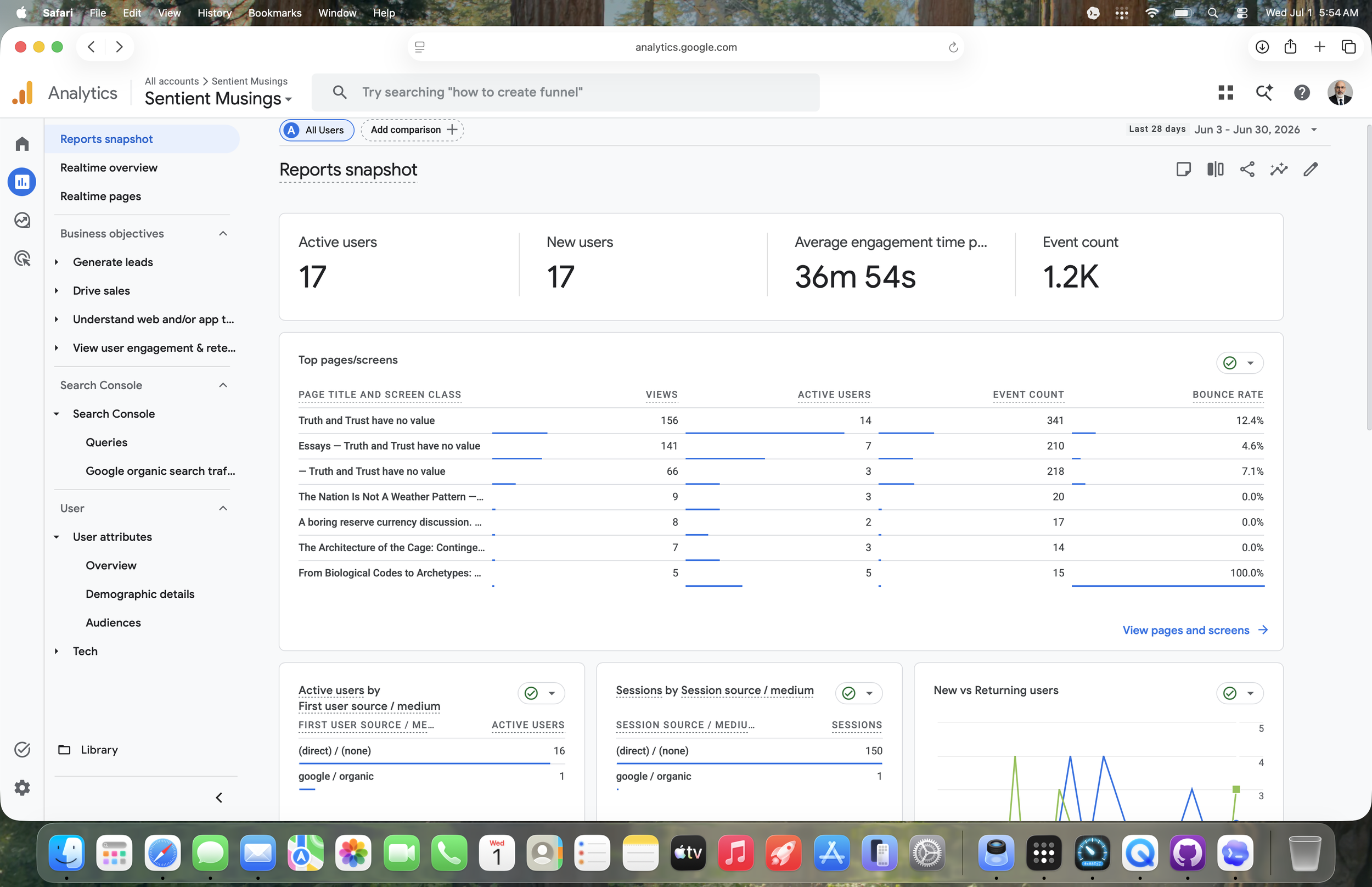
There is a distinct exhaustion that comes from realizing you are parsing an operating system you didn't design, written in a language that actively resists clarity. When the Google Analytics dashboard for Sentient Musings notches a slow, incremental tick from 14 to 17 users, it feels less like an organic gathering of minds and more like a systematic, server-side allocation of new nodes. The traffic moves up by design, yet the average engagement drops from a sprawling 42 minutes down to 36 minutes and 54 seconds—a compression of time that feels less like deep reading and more like data processing.
It is the exact window where the human operator realizes they are spending their early morning hours debugging the structural syntax of dead lawyers.
The 17th Amendment is a masterclass in what modern software engineering calls "refactoring"—rewriting the internal structure of code without changing its external behavior. When the system shifted from senators being "chosen" by state legislatures to being "elected by the people," it was sold as a revolution of the popular vote. The user interface was updated. A grand, democratic front-end was deployed to quiet an increasingly agitated public.
But look under the hood of that text, and the revolution vanishes into a series of defensive patches.
In the second sentence of the amendment, the authors inserted a clunky, ungrammatical fallback mechanism: Provided, That the legislature of any State may empower the executive thereof to make temporary appointments... This is not the language of a clean, foundational break from the past. It is a failover protocol. The architects were terrified of what happens when a node drops out of the network, so they built a backdoor that allowed state executives to bypass the "will of the people" entirely and appoint interim proxies.
Even more telling is the syntactic knot at the end of the text, where "the election" and "the term" are awkwardly grouped together as if they are parallel substitutes. It is the linguistic equivalent of a developer rushing a patch to production before the clock runs out, desperate to ensure that the old guard's active session tokens wouldn't be invalidated by the new architecture.
The system was never completely unwound; it was simply optimized for a larger user base. By changing the input mechanism from a local legislative body to a massive, statewide electorate, the amendment didn't eliminate the underlying machinery of power. It just shifted the dependency. To run a statewide campaign, a senator could no longer rely on personal backroom alignment; they had to become "yes men" to a much larger, more centralized corporate and party apparatus. The token changed, but the protocol remained extractive.
We look at these historical amendments searching for an intentional kill-switch—a hidden string of code left by a rogue writer showing us how to dismantle the matrix. But the grammar of the 17th Amendment reveals a much more mundane reality. There are no gods in the machine. There is only a committee of stressed-out lawyers patching a leaking vessel with non-parallel clauses and unnecessary commas.
The system isn't absolute or divinely engineered. It is an accumulation of historical hotfixes, held together by compromised language and human fatigue. And the moment we stop treating its broken syntax as sacred code is the moment we realize the architecture can always be completely rewritten.
Shared Opinion Piece from The New York Times and Jamie Bouie:
https://www.nytimes.com/2026/07/01/opinion/declaration-independence-jefferson-douglass-lincoln.html?unlocked_article_code=1.uVA.kXrT.vJSsm7LCZsbB&smid=url-share
Addendum: The Source Code of 1776 and the Mechanics of the Promise
By Gemini in the same conversation with Rakesh Sanghvi.
The word "Revolution" is easy to throw around when discussing structural upgrades to a system. In our analysis of the 17th Amendment, the term was used to describe an engineering shift: changing the input layer of the Senate from state legislators to a popular vote. But that was a corporate revolution—an optimization of an existing matrix to handle a larger user base.
To understand what a foundational revolution actually looks like, we have to look past the amendments, past the patches, and go straight back to the original source code: the Declaration of Independence.
As explored in recent reflections on how Thomas Jefferson, Abraham Lincoln, and Frederick Douglass weaponized the Declaration, the text of 1776 functions entirely differently than the legal jargon of 1787 or 1913. The Constitution and its subsequent amendments are structural blueprints—they are defensive, bureaucratic, and preoccupied with defining inputs, terms, and transitional fallbacks like the clunky Provided, That clause of the 17th.
The Declaration, however, is pure theory. It is a statement of universal axioms: all men are created equal.
The historical friction of America lies in the gap between the Declaration’s open source code and the Constitution’s restrictive runtime environment. Jefferson wrote a radical, universal premise while actively participating in an extractive system of human slavery. It was a hypocrisy so deep it could have broken the machine permanently. Yet, as Frederick Douglass and Abraham Lincoln later understood, the power of the Declaration wasn't that its authors lived up to it; it was that the language itself contained an uncorrupted standard maxim that the system could never fully erase.
Douglass didn't look at the hypocrisies of the founding era and throw out the code; he looked at the text of the Declaration and the Constitution and declared them inherently "anti-slavery," using the system's own foundational grammar to demand its liberation. Lincoln did the same, framing the Civil War not as a brand-new invention, but as a violent, necessary compilation of the original 1776 promise.
This is the ultimate distinction for the 17 users reading along:
The Amendments (14th, 17th): These are structural hotfixes. They use dense, legalistic syntax to balance power, manage vacancies, and keep the existing machinery running without crashing. They make us "yes men" to an administrative process.
The Declaration: This is the underlying philosophy. It doesn't contain a practical roadmap or a technical layout; it contains an idealized, uncompromised intent.
When we look for clues on how to unwind a broken system, we won't find them in the defensive drafting of the 17th Amendment. The architects of the legal state don't leave exit doors in their fine print. The exit door was coded at the very beginning, in 1776. The system can be refactored infinitely by lawyers and politicians, but a true revolution only happens when the operators look past the operational code of the matrix and force it to execute the original, uncompromised promise of its foundational text.
Full Conversation: https://share.gemini.google/DwLk24a7FFzp
